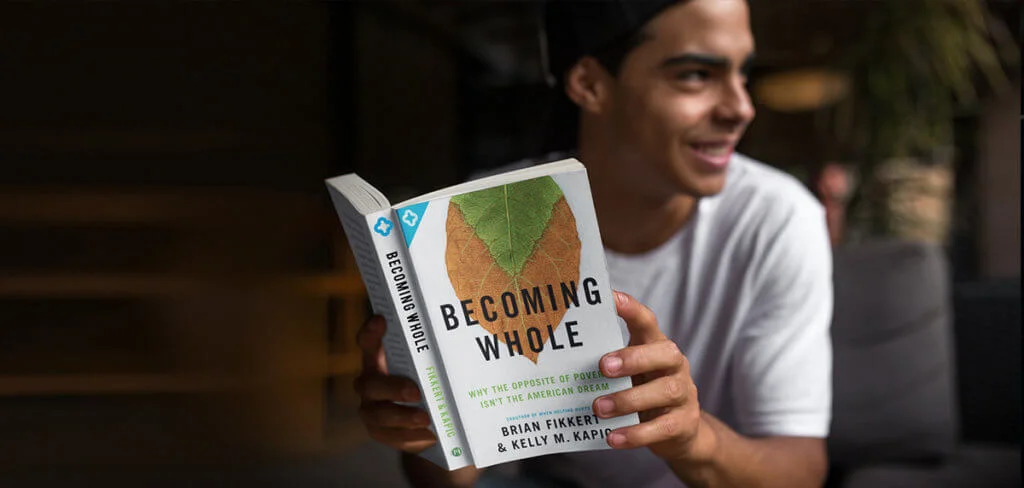
Book Recommendation: Becoming Whole by Brian Fikkert

  Image by    The Chalmers Center

Image by The Chalmers Center

We’re so excited to have Brian Fikkert on the podcast this week. He has been a leading voice in the Faith Driven Investor movement, and we’re excited to share what’s new in his world. As he shared on his episode, he recently released a new book, Becoming Whole.

Below, you’ll find information on his book, as well as an excerpt from an interview he did with The Chalmers Center. We hope this encourages you to read more and to really enjoy this resource!

Becoming Whole: Why the Opposite of Poverty Isn’t the American Dream

Western Civilization is wealthier, but it isn’t happier.

We are the richest people ever to walk the face of the earth, but according to research, we aren’t becoming happier. Families and communities are increasingly fragmented, loneliness is skyrocketing, and physical and mental health are on the decline. Our unprecedented wealth doesn’t seem to be doing us much good.

Yet, when we try to help poor people at home or abroad, our implicit assumption is that the goal is to help them to become like us. “If they would just do things our way, they’d be fine!”

But even when they seem to pursue our path, they too find that the American Dream doesn’t work for them. What if we have the wrong idea altogether? What if the molds we are using to help poor people don’t actually fit any of us? What if the goal isn’t to turn other countries into the United States or to turn America’s impoverished communities into its affluent suburbs?

In Becoming Whole (building on the best-selling When Helping Hurts)Brian Fikkert and Kelly M. Kapic look at the true sources of brokenness and poverty and uncover the surprising pathways to human flourishing, for poor and non-poor alike. Exposing the misconceptions of both Western Civilization and the Western church about the nature of God, human beings, and the world, they redefine success and offer new ways of achieving that success. Through biblical insights, scientific research, and practical experience, they show you how the good news of the kingdom of God reshapes our lives and our poverty alleviation ministries, moving everybody involved towards wholeness.

Check out A Filed Guide to Becoming Whole to learn more about how to help the poor in ways that actually help.

Brian Fikkert on Becoming Whole

Brian Fikkert recently sat down with Laura Haley to discuss his latest book, Becoming Whole—and how the stories we tell ourselves shape our work with the poor.

Listen to the interview here!

Christians and Wealth: How Much is Too Much?

  Image by   Jeff King

Image by Jeff King

This article was originally published here.

Check out The Institute for Faith, Work, and Economics for other quality content!

by Hugh Whelchel

A sincere young man just starting his career asked, “As I continue to work and earn more money, should I at some point restrict the amount of my income?” He was listening to my colleague Anne Bradley on the radio discuss income from a Christian perspective.

This question is not dissimilar to the question of another young man two thousand years ago, who asked Jesus, “What good deed must I do to inherit eternal life?” Jesus tells the rich young man to sell all his possessions and give to the poor (Matthew 19:16-26).

While this is a passage that deserves scrutiny, especially by those of us in the global West, it is commonly misunderstood to mean that wealth is, itself, unrighteous.

Wealth and Wholehearted Discipleship

Theologian Jonathan Pennington in his IFWE paper on this passage explains that we are to view Jesus’ command to the rich young man amidst the broader theme in the book of Matthew of whole-life discipleship. The rich young man had perfected externalrighteousness in obeying the commandments. Jesus didn’t ultimately want his money, he wanted his whole heart—an internal righteousness.

In his IFWE booklet, Wholehearted: A Biblical Look at the Greatest Commandment and Personal Wealth, Scott Redd points to the same theme of wholehearted living in the Old Testament “greatest commandment,” Deuteronomy 6:4-6. We are to love God with all of our heart, soul, strength, and wealth.

So how can we be faithful to Jesus with our whole hearts? How does this practically impact our work and income? In his great sermonon money, 18th century evangelist John Wesley made three points drawn from scripture:

  • Earn all the money you can

  • Save all the money you can

  • Give all the money you can

These principles are still true today. We were created by God to produce quality goods and services as a product of our work. Instead of arbitrarily restricting your income, you should seek to work as hard as you can with all your God-given gifts.

Yet in doing so, generosity and prudence are just as important. We must avoid the sin of greed, the idolatry of materialism, and losing our identity in Christ through the lure of consumerism.

There also may be times in a person’s life when he or she may need to cut back on time at work, for example, when they begin to raise a family. This decision may or may not affect income, but it is certainly not arbitrary in this instance.

There is another issue that could underlie the question about limiting your income. It is the idea that if I make more, someone else makes less. This is the “zero-sum” mentality. Nothing could be further from the truth. This is the great mystery of wealth creation: in our free market system, when we, through honest means, produce more goods, services, and wealth, we not only benefit ourselves, but others as well.

What if God Restricts Your Income?

I have a friend who, through her God-given gifts, could do almost anything she wants vocationally. She could be a very successful lawyer, or make a lot of money in the corporate world. Instead, God called her to be a first-grade teacher. This decision to be faithful to God’s call on her life severely restricted her income potential. This short-term sacrifice on her part will pay tremendous dividends, though, both in this world and in the next. She will never know the extent of the positive effect she has on the hundreds of children that spend time in her classroom, but she will hear, “Well done my good and faithful servant!” when she stands before our Master.

Faithfulness Is Not Measured by Income

God does not measure our faithfulness to him by what is on our W-2s. What matters is:

  • How we answer his call on our lives

  • How that works out in our vocations

  • How, through our work, we glorify God, serve the common good, and further his kingdom

God has called us to love our neighbors, and one way we can do that is by doing our jobs well. So no matter what we are called to do, whether working at jobs that create great wealth or not, let us, as the apostle Paul instructs in Colossians 3:23-24,

“Work heartily, as for the Lord and not for men, knowing that from the Lord you will receive the inheritance as your reward. You are serving the Lord Christ.”

14 Bible Verses About Generations

 Photo by  Adam Sherez  on  Unsplash

Photo by Adam Sherez on Unsplash

Article originally posted here by Bill High

by Bill High

In our Western world, we tend to think about the here and now—the immediate. It’s so much about job, career, taking the next step.

There was a time, however, when people used to think beyond themselves. They had to think about generations—the people that would come behind them. Farmers would clear a field with the consideration that their children would farm it.

Modern Americans tend to think of our own life and—if marriage and kids are part of the picture—our children and perhaps grandchildren.

But God thinks in terms of generations, a much longer view. Here are 14 verses to encourage us to think about family in terms of generations, generations of influence.

  1. Genesis 9.12: And God said: “This is the sign of the covenant which I make between Me and you, and every living creature that is with you, for perpetual generations.

  2. Genesis 17.7: And I will establish My covenant between Me and you and your descendants after you in their generations, for an everlasting covenant, to be God to you and your descendants after you.

  3. Genesis 50.23: Joseph saw Ephraim’s children to the third generation. The children of Machir, the son of Manasseh, were also brought up on Joseph’s knees.

  4. Exodus 3.15: Moreover God said to Moses, “Thus you shall say to the children of Israel: ‘The Lord God of your fathers, the God of Abraham, the God of Isaac, and the God of Jacob, has sent me to you. This is My name forever, and this is My memorial to all generations.’

  5. Exodus 12.14: This day shall be for you a memorial day, and you shall keep it as a feast to the LORD; throughout your generations, as a statute forever, you shall keep it as a feast.

  6. Leviticus 23.43: …that your generations may know that I made the people of Israel dwell in booths when I brought them out of the land of Egypt: I am the LORD your God.

  7. Joshua 22.28: Therefore we said that it will be, when they say this to us or to our generations in time to come, that we may say, ‘Here is the replica of the altar of the Lord which our fathers made, though not for burnt offerings nor for sacrifices; but it is a witness between you and us.’

  8. 2 Kings 10.30: And the Lord said to Jehu, “Because you have done well in doing what is right in My sight, and have done to the house of Ahab all that was in My heart, your sons shall sit on the throne of Israel to the fourth generation.”

  9. Esther 9.28: …that these days should be remembered and kept throughout every generation, every family, every province, and every city, that these days of Purim should not fail to be observed among the Jews, and that the memory of them should not perish among their descendants.

  10. Psalm 22.30: A posterity shall serve Him. It will be recounted of the Lord to the next generation

  11. Psalm 49.11: Their inner thought is that their houses will last forever, Their dwelling places to all generations; they call their lands after their own names.

  12. Psalm 78.4: We will not hide them from their children, telling to the generation to come the praises of the Lord, And His strength and His wonderful works that He has done.

  13. Joel 1.3: Tell your children about it, and let your children tell their children, and their children the next generation.

  14. Ephesians 3.21: …to Him be glory in the church by Christ Jesus to all generations, forever and ever. Amen.


Generations and God’s Perspective

These verses demonstrate an important aspect of God’s character. He is the Lord of history, the Ancient of Days who is weaving together the stories of individuals, generations and nations into His eternal purpose.

He sees our lives in the context of the big picture. His purpose and plan are greater than any individual and continues from generation to generation. That perspective might be hard for us in our individualistic Western culture to swallow! But it may provide a necessary corrective to our natural way of viewing ourselves and our world.

In Psalm 90, a prayer attributed to Moses, the psalmist meditates on the fragility of human life before the everlasting God. But he concludes with humble hope, asking that God will establish his people’s work to endure: May the favor of the Lord our God rest on us; establish the work of our hands for us—yes, establish the work of our hands. 

May we also seek to live and work in ways that will outlive us, building a legacy of good for those who come behind.

1.435 Billion to 1: the Miraculous Origins of CEF

1.435 Billion to 1: the Miraculous Origins of CEF

 Photo by Adi Constantin on Unsplash

Photo by Adi Constantin on Unsplash

by Chuck Bentley

The late Rob Moll (1977-2019), a writer and former editor at Christianity Today, was a friend of mine. Our friendship began when his life impacted my life in a very unexpected way, via an article he wrote for the Wall Street Journal, Want More Growth in China? Have Faith. (August 8, 2008). (link)

While I typically scan the Wall Street Journal for business and economic news on a frequent basis, I had never looked for or expected to find an article that would directly impact my life as a Christian. In his article, Rob interviews a Chinese economist whose Americanized name is Dr. Peter Zhao. As a rising star in the Communist Party and an avowed atheist, Dr. Zhao was commissioned to do an academic study to determine the reason why America has the largest and most powerful economy in the history of the world. 

He reported that the secret to America’s phenomenal economic engine was the Christian Church. He carefully documented some of the elements of the faith that are missing in Chinese culture such as a tireless work ethic, honesty, suppression of corruption, a motivation for excellence, generosity and the “spirit of creativity” which comes from worshipping a Creator.  He very perceptively noted that things were invented or created in America but only made in China; to reverse that, the Chinese would need to worship a Creator. He reported that there are rice shops on every corner in China, but America appears to have a church on every corner that feeds the mind and soul.

The response to Dr. Zhao’s report was not warm – the country wanted a “market economy” but without the Church. How could China copy the system but not adopt the beliefs that make the system possible?  Dr. Zhao persisted in his research, writing a paper investigating market economies without the Church and market economies with the Church.  His paper confirmed that the Church has been the key driver behind the largest economies in the modern world and are essential for long term sustainability to avoid the fatal flaws of greed, corruption, lack of trust and limited innovation.  It became one of the most widely read economic articles in China and catapulted Dr. Zhao into the forefront of contrarian thinkers in their society. 

1.435 Billion to One 

The research and remarkable journey of Dr. Zhao captivated my own heart. I agreed with his findings and was gripped by his honesty and courage. I began to pray for him and learn all that I could, hoping that he would survive his bold reporting of the profound and simple truth that God’s truth guides and shapes our economic progress. 

The rest of the story could only have been written by God Himself. This sincere atheist who explored the data with an open mind and heart was so touched by what he saw in America and what he learned about the elements of the Christian faith that he bought a Bible and began to read it. It was not long after his research was published that he professed his personal belief in the Lord Jesus Christ. By the time he was interviewed by Rob Moll, he was a devout Believer. 

Two years after reading the Wall Street Journal article, I attended a conference in Orlando, Florida and was seated in a bland ballroom packed with people with a common interest in improving Christian generosity.  I noticed that the table of ten next to me were all Chinese men who were listening on headphones as someone translated from English to Mandarin. At the first break, I introduced myself and asked the translator if she knew or had ever heard of Dr. Peter Zhao. She seemed puzzled, so I explained who he was and how I read of his remarkable story and tried to learn all that I could about him, hoping and praying for his survival and success but I had no idea what had happened to him since the article I read. 

She finally connected the dots and realized who I was so enthusiastically talking about since she did not know him as “Peter”. 

“Oh yes, I know Dr. Zhao. I am his personal secretary”, she said with a humble smile as she paused. 

“Really?! Oh, my…Please tell him that I so admire his work, his courage, his boldness, his message…Is he okay? How has he done since becoming a Christian? I would love to know everything I can about him…He is one of my heroes! Can you tell him for me?”  I finally stopped for a second to let her reply…

Her response: “Why don’t you tell him yourself…he is sitting right here at the table.” 

Cold chills covered my body as I looked at the men sitting within three feet of my table. She spoke in Mandarin and asked Dr. Zhao to come over and meet me. I could barely hold back my tears.  I had never been to China in my life. I had prayed for only one of the 1, 435,000,000 + Chinese people and here was that one – standing in front of me – one of my heroes –one of the most powerful leaders I had ever met. God seated us next to each other in a crowded conference room in America where we had the freedom to openly share with each other and begin an enduring friendship that would take us around the world teaching and training together on the power of God’s principles to transform personal and national economies. 

A Ripple Effect 

The point of my story is this: God’s Word has an incalculable and profoundly positive impact on individuals and a nation’s economy. 

Two things provide a snapshot of the health and future of a nation: the number of healthy Bible-believing churches and the number of entrepreneurs that are free to pursue their dream. Dr. Zhao was right, China needs God. But not just China; every Christian needs to understand they are redeemed by God to be “good economic actors” with the values, the character and creative spirit that edifies both the individual and the economic health of a nation. 

We need more like Dr. Peter Zhao.  That is why when we first launched the Christian Economic Forum in 2011 in Jackson Hole, Wyoming, my friend Peter was there with me. He continues to participate in our global events and has had an immeasurable impact on Christian business leaders inside and outside of China.

I have traveled to much of the world sharing this simple message. I have had the honor of teaching many times inside of China with my beloved friend Dr. Zhao. Neither of us plan to stop. This message is far too important. 

A modified version of this article was originally published at Patheos.com May 24, 2020.

When God is your Portfolio Manager

When God is your Portfolio Manager

  Image by   Carlos Muza

Image by Carlos Muza

This article was originally published at The Wall Street Journal.

by Jason Zweig

What would Jesus buy?

That question is spreading in the investing world, as evangelicals and other Christians seek investment management and financial planning to match their interpretation of biblical principles. The latest sign of the rise of faith-based investing was the launch of the Inspire International ESG exchange-traded fund on Sept. 30. Its ticker symbol? WWJD, short for the popular expression “What would Jesus do?”

Read the full story at The Wall Street Journal.