Investing for Impact

With the help of faith friends from our gathering of Faith Driven Investors, we’ve begun drafting a set of Unifying Principles. Our hope is that we can begin to come together under these thoughts and ideas to work toward a more full vision of what it means to let our faith drive our investments.

If you have thoughts, questions, concerns, things you’d change or add, please let us know! We’re relying on you, our community, to make this resource the best it can be.

Marc Andreesen once said (something that Warren Buffett has since popularized) that he would invest in a house or a boat but not a houseboat. What he meant was that he wanted to put his money toward an investment (i.e. a house) or give it away to charity (i.e. a boat). His point was that he avoided making impact investments with less than market returns. We disagree with this approach.

Many investments that come out of this movement are going to be focused on providing at, or better than, market rates of returns as compared to other, more secular products in their fields. Others are going to have outsized impact in other areas of impact from job creation to discipleship, but might fall short of market financial returns. Ours is a movement that celebrates both of these groups of investments. Faith Driven investors aren’t afraid of investing in excellent houseboats.

Instead of an either/or mentality, we approach investments with a both/and thought process, or a multiple-bottom line mentality as some may call it. This means we search for companies that are a good investment because of the financial, social, and spiritual impact they are making.

We don’t believe you have to give up one in order to have the other. In fact, the best investments usually offer you multiple sources of return.

Using Scripture as Our Guide

  • Proverbs 3:27 Do not withhold good from those to whom it is due, when it is in your power to do it.

  • Psalm 112:5 It is well with the man who deals generously and lends, who conducts his affairs with justice.

  • Proverbs 11:25 A generous person will prosper; whoever refreshes others will be refreshed.

  • Proverbs 19:17 Whoever is kind to the poor lends to the Lord, and he will reward them for what they have done.

Creating Wealth is Godly Work Too

  Image by   Riku Lu

Image by Riku Lu

This article was originally published here.

Check out The Institute for Faith, Work, and Economics for other quality content!

by Hugh Whelchel

“Capitalism is an organized system to guarantee that greed becomes the primary force of our economic system and allows the few at the top to get very wealthy and has the rest of us riding around thinking we can be that way, too—if we just work hard enough, sell enough Tupperware and Amway products, we can get a pink Cadillac.”

So says film-maker and author Michael Moore of Roger & Meand Fahrenheit 9/11 fame. Ironically, Moore has become a multimillionaire condemning the system that has made his wealth possible.

Certainly, in today’s culture, there is a certain disdain for wealth. And while there are many examples of the misuse of power to create wealth and how wealth itself has caused much corruption and evil, the Bible has plenty to say about the positive aspects of wealth creation.

The Bible claims that the creation of wealth is both a godly gift and a command. It also tells us that wealth should be shared, but it cannot be shared if it is not created. Unfortunately, the biblical role of wealth creation is misunderstood in many churches today.

The Source of Both Wealth and the Ability to Create Wealth

But remember the Lord your God, for it is he who gives you the ability to produce wealth, and so confirms his covenant, which he swore to your ancestors, as it is today (Deut. 8:18).

In Deuteronomy 8:18, Moses tell us four important things about wealth creation:

First, he reminds us that it is the Lord God who gives us the ability to produce wealth. The very idea of wealth creation is ultimately rooted in God the creator and is underscored in Leviticus 25:23, and 1 Chronicles 29:11-12.

We read in the opening chapter of Genesis that God created us in his image, according to his likeness (Gen. 1:26) and gave humanity the role of sub-creators directing us to fill the earth with God’s images and to subdue the earth, making it an incredible place for these images to flourish (Gen.1:28). There is an expectation that we are to make something with the raw materials God has so abundantly given us.

God has given us an abundance of raw materials, but God retains ownership, establishing us as stewards of his creation (Ps. 50: 10-12). This is important because it reminds us that even the wealth that we produce through the ability he has given us belongs to him and must be used according to his desires.

Second, wealth production is a good thing designed to be a vehicle for biblical flourishing in God’s creation. In a paper on wealth creation written by the Lausaunne Movement and Business as Mission (BAM) Global, it states:

We believe that creating real wealth is what God desires from us: wealth that blesses families, communities, and countries. That blessing includes sharing faith and love, providing jobs that are meaningful and reflect the creativeness of our God. Building business for the long haul: sustainable and scalable.

Third, wealth production confirms the covenant given to Abraham and is repeated at least 28 times in the Old Testament where God states, “I will be their God, and they shall be My people.”

J.I. Packer writes that faithfulness within this covenant brings blessing:

Covenant faithfulness is the condition and means of receiving covenant benefits, and there is nothing arbitrary in that; for the blessings flow from the relationship, and human rebelliousness and unfaithfulness stop the flow by disrupting the relationship. Israel’s infidelity was constantly doing this throughout the Old Testament story, and the New Testament makes it plain that churches and Christians will lose blessings that would otherwise be theirs, should covenant fidelity be lacking in their lives.

Finally, in the larger context of this verse, we see that our work in the covenant, blessed by God, produces wealth. Throughout the book of Proverbs, we see a strong causal relationship between work and blessing (food, profit, leadership, other rewards) and how our work is to glorify God and serve the common good (Prov. 12:11, 14b, 24; 14:23).

Although wealth is a covenantal blessing, wealth accumulation is not the end God seeks and should not be viewed as directly linked to our level of faithfulness (the prosperity gospel). Wealth creation is about bringing greater flourishing in God’s creation—creating jobs, innovation, services that benefit those created in God’s image, or all mankind. Believers should see wealth-generating work as being redemptive, kingdom-focused, embodying the principle of shalom.

Some Wealth-Creation Guidelines Based on God’s Design and Desire for Creation

Last year, 30 Christians representing the business world, the church, and academia from 20 nations gathered and wrote what they called the “Wealth Creation Manifesto.” This is the best thing I have discovered that truly captures the biblical idea of wealth creation. In it, they affirm the following:

Wealth creation is rooted in God the Creator, who created a world that flourishes with abundance and diversity.

We are created in God’s image, to co-create with him and for him, to create products and services for the common good.

Wealth creation is a holy calling, and a God-given gift, which is commended in the Bible.

Wealth creators should be affirmed by the Church, and equipped and deployed to serve in the marketplace among all peoples and nations.

Wealth hoarding is wrong, and wealth sharing should be encouraged, but there is no wealth to be shared unless it has been created.

There is a universal call to generosity, and contentment is a virtue, but material simplicity is a personal choice, and involuntary poverty should be alleviated.

The purpose of wealth creation through business goes beyond giving generously, although that is to be commended; good business has intrinsic value as a means of material provision and can be an agent of positive transformation in society.

Business has a special capacity to create financial wealth, but also has the potential to create different kinds of wealth for many stakeholders, including social, intellectual, physical and spiritual wealth.

Wealth creation through business has proven power to lift people and nations out of poverty.

Wealth creation must always be pursued with justice and a concern for the poor, and should be sensitive to each unique cultural context.

Creation care is not optional. Stewardship of creation and business solutions to environmental challenges should be an integral part of wealth creation through business.

You can find more about the “Wealth Creation Manifesto” here.

A biblical view of wealth creation has to be something we correctly understand if are going to work at bringing about holistic transformation in how believers and others view wealth. Seeing wealth creation in light of scripture will also unleash our own creativity in the workplace and help us avoid the two damaging extreme views—Michael Moore’s view that wealth is evil and the prosperity gospel that views wealth as a sign of faith.

Editor’s note: A proper view on wealth creation starts with an understanding of God’s purpose in our work. Read more in How Then Should We Work? Rediscovering the Biblical Doctrine of Work.


Podcast Episode 6 – Truth Telling and Impact Investing with Aimee Minnich

subscribe to the podcast here

Impact Investing is a buzzword in the faith driven investing world. But there are dozens of definitions out there for what it actually means. On today’s episode, we’re moving toward setting the record straight. Aimee Minnich has been around since the beginning of the Faith Driven Investor movement and through her work with the National Christian Foundation and the Impact Foundation she’s proven herself an expert on what it means to invest with impact in mind.

When you listen to her episode, you’ll hear the history of impact investing. While the term has been around since 2006, Aimee makes it clear that this idea has been around for much longer. And in addition to looking back, she also gives us an idea of where impact investing is trending next. She also discusses the value of truth-telling and how that relates not only to the way we interact with others, but to how we approach investing.

We’re so glad to have people like Aimee Minnich involved in this movement, and after you hear this episode, we think you’ll be excited to hear more from her in the future. 

Useful Links:

About Us – Impact Foundation

Impact Foundation – Annual Report

How Much Impact/Financial Return Will I Get from Impact Investing?

10,000 Voices: The Restoration and Flourishing of Cities

Article originally hosted and shared with permission by The Christian Economic Forum, a global network of leaders who join together to collaborate and introduce strategic ideas for the spread of God’s economic principles and the goodness of Jesus Christ. This article was from a collection of White Papers compiled for attendees of the CEF’s Global Event.

by Eli Mercer

Joshua 1:9: Valuable Leadership Lessons

The timeless leadership lessons in Joshua 1 are as helpful today as throughout the ages. The story of Joshua encourages us to step up, take action, and lead wherever the Lord sends us (Joshua 1:9-11) but to do so in a diligent and committed manner that stewards well the resources and relationships we are provided (Joshua 1:12-18). Many people are suffering in the modern era, and cities face entrenched challenges and barriers to progress (Dreier, 1996). To follow Joshua’s example, we who feel called to restore cities must take immediate and decisive action. Are we committed to the restoration and flourishing of cities for God’s Kingdom and for His glory (Isaiah 61)? Will we make sacrifices? Are we prepared to obey the Lord’s call? 

New Seasons Require New Leadership

Moses had prepared them and led them out of Egypt, through the desert, and to the border of the Good Land. People overcame great hardship and endured the journey. The law of Moses had been their primary guide. Joshua’s leadership of the nation of Israel signified a shift in focus to the occupation, possession, and cultivation of the Good Land. Previously, it had been about getting to the River Jordan. This new season required a new type of courage and a new type of commitment to fulfill God’s call for the people of Israel. God commissioned them to “rise up and walk out His call to settle and defend the Good Land,” (Philippians 3:7-16). It is time to humble ourselves as disciples, roll up our sleeves, and invest time, talent, and treasure for measurable impact. We must work together to bring about transformative change (Acts 4:32-35). 

We Are Invited into God’s Economy by His Love and Grace

The story of Joshua reminds us that God, not their own strength, gave Israel the Good Land (Joshua 1:2-6). Victory belongs to the Lord (John 16:33). It is by His love and His grace that each of us is blessed with a role to play in His economy (1 Corinthians 15:10). We trust in Him and are at peace knowing He has a plan for us (Psalms 71:16). We acknowledge and embrace God’s sovereignty in our lives (Revelation 4:11) and declare that all good things flow out of intimacy with God (John 15:4-6). He can do more in an instant than we can do in a lifetime (Psalms 115:3). We pray for His divine guidance, wisdom, and favor on our mission and the communities we serve. “Unless the Lord builds the house, the builders labor in vain. Unless the Lord protects the city, the watchmen stand guard in vain,” (Psalms 127:1). Without Him, our efforts amount to little or nothing over time. With Him, we walk in joy knowing anything is possible (Matthew 19:26). We seek intimacy with God as our primary objective.

Away from Individual Giving and Toward Unified Investment Strategies

The story of Nehemiah teaches us the importance of organizing and dividing time, labor, costs, and responsibilities toward a common goal. They used prayer by fasting and calling upon the name of the Lord to rebuild the walls of Jerusalem section by section and piece by piece. However, it was their unity in sprit and in action that allowed each person or household to take a section of the wall and work together as one to build and repair it (Nehemiah 1:4-11). We need a similar concerted effort to restore cities. Trends show record highs in charitable giving (Association of Fundraising Professionals, 2022), volunteering (AmeriCorps, 2018), and the emergence of impact investing as a major capital source (International Finance Corporation, 2020). These stats show how more and more people are prepared to take action. Are we prepared to come together as one Body to team up for impact? Like Nehemiah, we rely on the Holy Spirit for the softening of hearts (2 Corinthians 5:17). Hearing the Spirit and taking action has the power to bring victory in Christ Jesus (Ephesians 2:18-22). We must steward all the Lord provides by investing in people and communities for their restoration and for His glory (1 Peter 4:10). 

God Calls Joshua to Lead the People to Take Possession of the Good Land

Joshua leads the people to reap a bountiful harvest for God’s Kingdom and for His glory. God calls Joshua to steward well the fruits of His provision. Joshua heard, saw, and obeyed. He stepped up, took command, and embraced his unique role, all the while relying upon the Lord and His Word for wisdom and discernment. The people followed Joshua’s lead. They went forth and multiplied in spite of many extraordinary challenges. The Lord saw them through and provided in great abundance. He will see us through too. We must remain in a posture of humility and submission to the Lord and service to others. We must shed sinful behaviors and turn toward the Lord in order to clearly hear, obey, and take up the mantle when called to serve. It is in obedience and hard work that we gain His double portion of the Good Land (Isaiah 61).

As One Body, Unified, We Are Unstoppable

The most pressing issue facing the world today is the lack of unified, cohesive, decisive, and obedient action on the part of the Body of Christ. If we were to come together and take action on the challenges we face, we would be unstoppable. We could overcome the vast majority of the suffering taking place in our families and our cities. Politically, socially, economically, and spiritually, the effects of a unified global Church would be staggeringly positive. As an example, Tarrant County, Texas, has roughly 2.25M inhabitants. Just over half of them self-identify as a Christian. That is roughly 1.25M people in one county, in one state, in one country—out of 2.38 Billion people who self-identify as Christians globally (Worldpopulationreview.com, 2022). Even at the small scale of one unified county, we could accomplish great things. Just imagine 2.3B people standing together as one for God’s glory. We are stronger when we are unified and working together. It is time to come together.  

Be Encouraged in the Lord

“Be strong and courageous. Do not be frightened, and do not be dismayed, for the Lord your God is with you wherever you go,” (Joshua 1:9). This powerful Scripture provides clarity for us as leaders to seek God’s voice and direction in our lives and to remain obedient in times of harvest and in times of drought.  

Be Agents of Change

Take courage in deliberate and decisive action. Take concrete steps toward the mission God has called us to fulfill. Too often, we act as individuals, as small groups, as local churches, and as families—but not as one Body. We must unite as communities, as cities, as states, as countries, and as one global Body of believers. We must embody and walk out the change. It falls upon us, as believers, to be decisive and courageous. We must follow the work through to fruition. We plant many mustard seeds of change along the way and rely upon the Lord to spring them forth with life in His good timing.    

Eagle Venture Foundation

Similar to Joshua and his people, our team at Eagle Venture Foundation feels called to lead and take decisive action to build strong Kingdom ecosystems and collaborative communities for the restoration and flourishing of cities for God’s glory. The Foundation exists to fund, measure, and accelerate the restoration and flourishing of cities. Restoration refers to solving problems, overcoming barriers, and developing relationships to help citizens, organizations, and communities reach their full potential. Flourishing includes, but is not limited to, improved quality of life measures in 5 areas: Prosperity, Education, Workforce, Health, and Well-Being.

10,000 Voices Project

In collaboration with anchor partners in DFW, Boston, and Annapolis, we are conducting 10,000 interviews with regional leaders and influencers from all walks of life to gain their knowledge, wisdom, networks, and influence in support of our mission. The 10,000 voices project is a global first step in the development of a robust catalogue of needs, goals, barriers, and solutions faced by leaders seeking to restore and rejuvenate cities.  Our goals are to steward dialogue, build relationships, and foster a culture of shared wisdom among leaders from around the world. In addition, we seek to leverage our global network, partner organizations, and resources to help connect the dots, fill gaps, and break down barriers. We are conducting structured interviews in 100 cities around the world with 100 regional leaders and influencers from each city. We seek to answer three basic questions: How can we come together to break down barriers and overcome challenges to unleash the full potential of our cities? Once high-potential opportunities are identified, how can we laser strike capital, talent, know-how, leadership, and networks to unleash that potential and build momentum? How can communities flourish long-term? 

DFW Metro: Needs, Goals, Barriers, and Solutions – Interviews with 100 Leaders

Our first study is underway in DFW and globally during summer 2022. We plan to interview 100 regional leaders and influencers from all sectors of society to learn their Needs, Goals, Barriers, and Solutions to the restoration and flourishing of their cities. We grow stronger when we share information, take steps to measure impact, and improve together. Quarterly reports will identify clear and measurable targets and help build pathways to get there along with reports on the state of the region and the landscape globally. We measure impact and communicate wins along the way.  

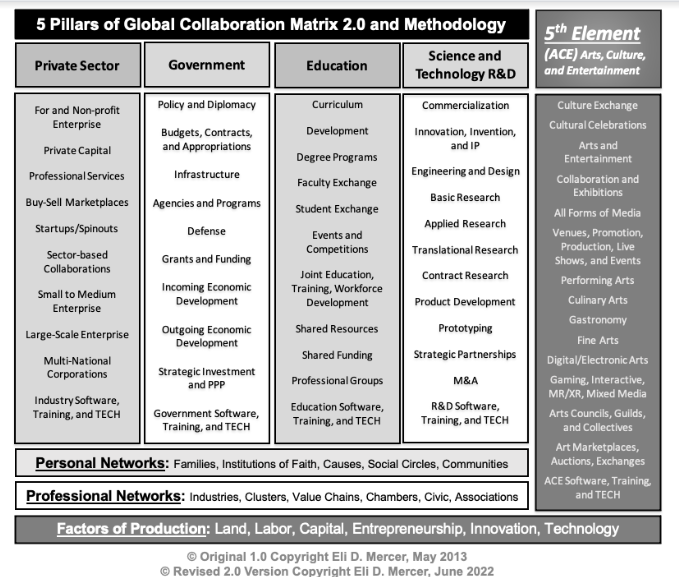
5 Pillars of Global Collaboration: Matrix 2.0 and Methodology

The 5 Pillars of Global Collaboration is a methodology for developing and optimizing robust human ecosystems. Ecosystems struggle when it comes to finding, choosing, and implementing a methodology for the formation, segmentation, engagement, relationship building, and deal flow that takes place in robust collaborative ecosystems. Scholars such as Smilor, Kozmetsky, & Gibson (1989), Butler & Gibson (2013), and Etzkowitz (2008) paved the way with global research, publications, tools, and methods they developed and tested in various ecosystems. I was fortunate to learn while leading regional ecosystem development projects in several countries. The research, practical application, and years of experience resulted in the 5 Pillars of Global Collaboration model depicted above (Mercer, 2013 and 2022).

We Were Created for Just a Time and Place as This

While the vision can feel daunting in scale and scope, we find solace in Jeremiah 1. “‘Before you came forth from the womb, I knew you; And before you came forth from the womb, I sanctified you. I have appointed you as a prophet to the nations.’ Then I said, ‘Alas, Lord Jehovah! Indeed, I do not know how to speak, for I am but a youth.’ But Jehovah said to me, ‘Do not say, I am a youth; for everywhere I send you, you will go; and everything I command, you will speak. Do not be afraid of their faces, for I am with you to deliver you, declares Jehovah,’” (Jeremiah 1).  

The Year of the Lord’s Favor

This is the year of the Lord’s favor (Isaiah 61). The Spirit of the Lord our God is upon me (us). We are called to bind up the broken-hearted, feed the poor, heal the sick, care for the widows and orphans, and love and serve one another as we would want to be loved and served. We are called to build one another up in love, that we may reach our full potential. We are called to blend and harmonize as Saints and Ambassadors in the world, bearing witness to the good news of the Gospel. We are called to tend His vineyards, shepherd His flocks, and plant mustard seeds in faith. We are called as One Body and as One Church to this good work. 

Sources

Biblical References

Joshua 1

Isaiah 61

2 Corinthians 5:17

Ephesians 2:18-22

1 Peter 4:10

Acts 4:32-35

John 16:33

1 Corinthians 15:10

Psalms 71:16

Revelation 4:11

John 15:4-6

Psalms 115:3 

Psalms 127:1

Matthew 19:26

John 21:1-25

Isaiah, 1:19

Matthew 13:9-16

Deuteronomy 5:33

Jeremiah 17:7-8

Acts 4:23-31

1 Peter 3:18

Philippians 3:7-16

Ephesians 3:8

Jeremiah 1

Nehemiah 1:4-11

16,000 Hours to Change the World(view)

Article originally hosted and shared with permission by The Christian Economic Forum, a global network of leaders who join together to collaborate and introduce strategic ideas for the spread of God’s economic principles and the goodness of Jesus Christ. This article was from a collection of White Papers compiled for attendees of the CEF’s Global Event.

by Ryan Horn

world·view | ˈwərl(d)-ˌvyü   : a comprehensive conception or apprehension of the world especially from a specific standpoint[1] 

As a Christian, I would suggest that there are only two types of worldviews available to humanity. The first is a Christian worldview grounded in Biblical principles and concepts of the proper relationship between the Creator and the creation. The second would be a humanist worldview falling into two broad categories of false religion and secular humanism. False religions developed by man will lack an accurate understanding of man’s relationship to his Creator. Secular humanism promotes ideas that describe humanity as “undesigned, unintended beings who arose through evolution, possessing unique attributes of self awareness and moral agency” and as something that “celebrates emancipating the individual from traditional controls by family, church, and state, increasingly empowering each of us to set the terms of his or her own life.”[2] 

As Christian parents, the Bible instructs us to “Train up a child in the way he should go…”[3] and reminds us to “Take these words to heart. Repeat them to your children. Talk about them when you’re at home or away, when you lie down or get up.”[4] Jesus’ words continue to emphasize the importance of children when stating, “But if you cause one of these little ones who trusts in me to fall into sin, it would be better for you to have a large millstone tied around your neck and be drowned in the depth of the sea.”[5] The Bible leaves little doubt as to the importance God places on the rearing of children, and we have a responsibility to help shape our children in the development of their identities, moralities, and general worldview. 

While parents have a great deal of influence on the development of children, we also partner with other people and organizations to participate with us, including family, friends, coaches, churches, and schools. Each of these mentors we allow into our children’s lives contributes to

their development in varying degrees, often positively correlated to the quantity of time spent with them. If more time with children wields greater influence in their development, it is important to understand where children spend their time and what ideas are being 

incorporated in their personal and worldview development. And there are few places that children spend more time than in school. 

16,000. That is the average number of hours a child spends in school in the United States between kindergarten and graduating the twelfth grade. That number goes even higher when you include extracurricular activities such as sports, clubs, etc. Those hours are actively spent by educators training and instilling ideas and concepts of the world. We teach our children that they can trust their teachers as caring adults when they are in their early elementary years. As they mature into middle school and high school, children naturally tend to pull away from parents to begin testing the concepts and boundaries of independence. It is at these times when some other adult person, often a teacher, holds great sway with children. 

To draw a comparison, a child attending church two hours a week during the same time period will spend 1,352 hours under the teaching of someone with a Christian worldview. What a child hears in school either supports a Christian worldview or opposes it and does so by a factor of twelve over the church. 

In the United States, every child has access to the public education system funded by tax revenues. The question must be asked, “Is what the American public school system teaching our children congruent with our Christian beliefs?” Generally speaking, I would say it is not and would contend that public education is not neutral in its position toward a Christian worldview, but rather, it finds itself in direct opposition to it. While there are many public-school 

educators who are followers of Jesus, they are prohibited from incorporating faith and must teach from an entirely secular curriculum. 

Public education has become steeped in secular humanist ideas. In 1930, humanist Charles F. Potter wrote, “Education is thus a most powerful ally of humanism, and every American school is a school of humanism. What can a theistic Sunday school’s meeting for an hour once a week and teaching only a fraction of the children do to stem the tide of the five-day program of humanistic teaching?”[6] 

And a little over fifty years later, John J. Dunphy wraps up his essay “A Religion for a New Age” in the following manner: 

“I am convinced that the battle for humankind’s future must be waged and won in the public school classroom by teachers who correctly perceive their role as the proselytizers of a new faith: a religion of humanity that recognizes and respects the spark of what theologians call divinity in every human being. These teachers must embody the same selfless dedication as the most rabid fundamentalist preachers, for they will be ministers of another sort, utilizing a classroom instead of a pulpit to convey humanists values in whatever subject they teach, regardless of the educational level — preschool day care or large state university. The classroom must and will become an arena of conflict between the old and the new — the rotting corpse of Christianity, together with all its adjacent evils and misery, and the new faith of humanism, resplendent in its promise of a world in which the never-realized Christian ideal of “love thy neighbor” will finally be achieved.[7]” 

Children spend 16,000 hours in a place where truth has become a relative concept, where there are no moral absolutes, where identity is fluid, and where without a Creator, humans are nothing but “accidents” of the universe. When no truth or purpose exists, is it any wonder why children are confused and teen depression continues to increase? Secular schools are focused on the development of the body and the mind, but humans consist of more than that. The spirit must be nurtured as well. 

A Christian school is the only institution that is equipped to address the development of the whole child consisting of body, mind, and spirit. If we want our children to develop a Christian worldview, surrender themselves to Jesus as King, and be Kingdom minded (which is a 180 degree turn from the world mindset), then being taught those ideals throughout their schooling would help to instill them. Maybe even more important than being taught Christian concepts is having teachers who can live out the Christian life in community with them every day. The only place this can happen in a consistent and open setting is within the walls of a Christian school. 

The challenges that the local Christian school face are many, but I can distill them down to apathy and funding. The first one I find most disturbing—the lack of support from the local church. I’m not referring to monetary support but rather to an attitude of ambivalence from pastors. I can’t think of two institutions that should work more closely together than the Christian church and the Christian school in preparing young people for service in God’s kingdom. It has been my experience that some pastors do not want to risk offending a congregation, who overwhelmingly choose a public education for their children, by endorsing it. At times there is even sense of competition between the two. 

Lack of funding is another significant challenge for the average Christian school. In the United States, there is no public money used to support faith-based schools. That means each school must raise its own operating funds by charging tuition, but tuition rarely covers the full costs of running the school. It’s not uncommon to see tuition cover only 80% of expenses with the rest coming from fundraising and gifts. 

Because of the limited funding, faculty and staff who have chosen to serve in Christian schools often work for significantly less pay than their counterparts in the public-school systems. These are people who forego greater compensation to pour their lives into teaching a subject that incorporates the wholeness of a Christian worldview. They do it out of their love for God and their love for teaching kids, and they make all the difference. 

Tuition can often be a deterrent for families who would like to send their children to a Christian school but are concerned of the financial impact. This can be a very legitimate reason, but many schools I’m familiar with will bend over backward to try and find a way to help those families who desire that for their children. There are often financial aid and scholarships made available; however, that ultimately reduces the operating funds available to the school. 

Many of the financial issues facing Christian schools would be addressed merely by increasing the numbers of students on their rolls, as fixed costs do not rise in proportion with additional students. Similar costs covered by more students could even lead to a decrease in tuition rates or an increase in available financial aid and scholarships. This would also lead to better compensation for the faculty and staff working within the school. While the financial solution is easy to see, it is dependent on addressing the general sense of apathy in the Christian church and community. 

My ask to the members of the CEF community is twofold: 

  1. Use your leadership skills to encourage local churches to partner with their local Christian schools and to work together to train our children “in the way they should go.” 

  2. Consider offering financial support to your local Christian school. 

I have watched Christian teachers pour their lives into children and show them the love of Jesus while teaching them about the world He created. I have witnessed the change in perception of self-worth when students come to understand that they are not “accidents” but are loved and designed with purpose and a destiny. I have seen a community of believers come together to support children and each other as we train the next generation of Kingdom minded believers. 

As parents, we have 16,000 hours for which we must make a choice on behalf of our children. Those hours can be used to reinforce the values and views of the world, or those 16,000 hours can be used to instill a greater view that will change the world. 


[1] https://www.merriam-webster.com/dictionary/worldview 

[2] https://secularhumanism.org/what-is-secular-humanism/ 

[3] Proverbs 22:6 

[4] Deuteronomy 6:5-9 

[5] Matthew 18:5-6 

[6] Charles F. Potter, “Humanism: A New Religion,” 1930 pg. 128 

[7] https://johnjdunphy.medium.com/a-religion-for-a-new-age-f812839c4cb8

When Will We See More Gender Equality in Investing?

  Image by   Tim Gouw

Image by Tim Gouw

This article was originally published here.

Check out Harvard Business Review for other quality content!

by Karen Firestone

In many spheres, such as politics, media and entertainment, women have made considerable progress in reaching executive leadership positions, achieving higher pay, and building new enterprises. But this ascent hasn’t been achieved everywhere. In my own industry, investing, progress has been painfully slow.

Aside from professional sports, the investment business — encompassing investment management, mutual, hedge, private equity, and venture capital funds — might have the lowest percentage of women at the top of the pyramid (at 4%). And women only control between 1% and 3.5% of assets under management, depending on specific class.

The lack of women leaders in investing is an issue that more firms should be worried about. Research shows that gender diversity at the top is connected to positive returns. And aside from financial performance, retaining and promoting more women in a field is the only way to ensure that promising talent isn’t being lost or shuffled out of the industry.

There is little good data on how many women are entering investment firms at junior levels, as research analysts and associates. But in researching the subject, I’ve learned from colleagues at several large firms in the U.S. that women have accounted for about one-quarter to one-third of their first-year associates over the past fifteen 15 years.

However, as several senior executives in the industry explained to me, and as I have witnessed in my decades in the business, the ranks of women investors dwindle as you go up the career ladder…

Continue reading this article at Harvard Business Review