What’s Your Why? The Ronald Blue Story

This article was originally published here.
Check out
Ronald Blue Trust for other quality content!

by Ronald Blue Trust

Every organization has a What, a How, and a Why. Our What is wealth management and trust services. Our How is through experienced financial advisors building relationships and applying tools such as proprietary financial planning software, investment vehicles, and estate planning strategies. But it’s our Why that sets us apart from other wealth management and trust companies. Why is what motivates us to get out of bed in the morning – it’s our reason, cause, and purpose for what we do.

Ronald Blue Trust is not simply a financial planning, investment management, trust services, or estate planning company. We believe we do all of those things with excellence, but essentially seek to help our clients gain clarity and confidence around their finances. And we firmly believe that when our clients live with clarity and confidence about money – without conflict, anxiety, or fear – their lives are richer and more fulfilling. They can envision and act on their Why.

The vision of helping people seek and live their Why was one of the cornerstones on which Ron Blue established Ronald Blue & Co. in 1979. Ron felt challenged and called to help people become better stewards of their wealth and have a better relationship with money by using not just technical expertise, but biblical principles as well. Ronald Blue Trust clients have come to us, and stay with us, because they are attracted to our uncommon approach to wealth management. Read more about how we integrate biblical principles into financial planning and watch our video story by clicking the image below.

Yes, Even the Poor Can be Greedy by Jerry Bowyer

  Photo by Johnny Chen

Photo by Johnny Chen

Our friend Jerry Bowyer recently interviewed Ron Blue and Karen Guess to discuss the relationship between greed and material wealth. While Western culture tends to view materialism as something that only wealthy people experience, Ron Blue’s trip to Africa pointed to the fact that it is more of a human problem than a social one. See what else they had to say in the full interview below.

read original article at Forbes

Ron Blue and the late Larry Burkett double-handedly created the faith and finance movement among evangelicals in the 1970s. This was a time of rapid acceleration in the number of people (including Jimmy Carter) who publicly declared themselves to be ‘born again’. Chuck Colson wrote a book with that title. The social movement grew rapidly and institutions developed to serve it. Ron and Larry became that movement’s financial counselors.  Without them, there is no Dave Ramsey.

I interviewed Ron recently and he told me that the major turning point in his understanding about faith and finance came when he was visiting a friend in Africa. His friend lived in a mud hut perched atop a small patch of dirt. Pastor Daniel was, by American standards, quite poor materially. Ron asked him what the most important spiritual challenge which his African Christian parishioners faced. When the pastor answered, “Materialism”, Ron was shocked. Ron had somehow imbibed the notion that materialism was a malady of the wealthy Northwest quadrant of humanity, not the poor Southeast. It’s then that he realized that greed was a universal human problem. It afflicts both rich and poor and there is no income level so high that greed cannot sour it with discontent. Any economic class can feel financial fear. Any economic class can feel satisfied. Any class can be generous. Any class can be needy. Any class can worship money imbuing it with attributes that move it from useful tool to pitiless master.

In my experience people tend to think of people who work in finance as particularly susceptible to the vice called greed. Pastors and professors can rail against Wall Street, but are the preaching classes more generous than the financial classes? Do faculty show more generosity in foregoing pay increases in order to lessen the burden on their ‘customers’ than money managers? Ron tells the story of a CPA who had 85 pastors for whom he prepared tax returns and not one of them were tithers. I’ve seen rich people stab one another in the back for monetary advantage, but I also had a homeless friend whom I saw withhold funds that he owed to another man (a homeless vet suffering from PTSD) so he could buy tobacco. Pastor Tim Keller once said that in all his years of serving congregations no one had ever confessed to being guilty of the sin of greed—which is probably an indicator that maybe we all are.

I sat down across a Skype line with Ron and Karen recently and you can listen to the audio of that interview here and read a partial transcript below. Both are edited for clarity.

Note: While I do not have direct business dealings with Ron, I have spoken at events held by institutions with which he has been associated, such as Ronald Blue & Co. (which he founded but is no longer associated with), as well as Kingdom Advisors, and the Ronald Blue Institute at Indiana Wesleyan University. I have not received speaker’s fees from these events, though I did accept travel and lodging reimbursements.

Jerry Bowyer: There are stories of very poor people in “Never Enough?”. And there are stories of very rich people in “Never Enough?”.  And that tells me that these principles apply to the very rich and the very poor and everyone in between; is that right?

Karen Guess: Yes, it is. And I think that was what was partly exciting about writing it; they’re real stories, but getting to kind of express the principles in various ways through people that we knew.

And my second story that I was going to tell you was my favorite, because my dad picked mine, was Pam’s story, because Pam is somebody I know personally.  Hers is in the last chapter.  And I admire her from the bottom of my toes in terms of her professionalism ‑‑ she is just a woman of great class in her industry.

And her story is one of being humble through a season of being a single parent and choosing, even though she was a financial professional who knew all the stuff, she heard a sermon one Sunday at church just about the very basic principles of ordering your priorities and went home and had a conversation with her little girls — they were school-aged at the time – and said girls, this is what we’re going to do, let’s talk about how owe spend our money and they reoriented the way they spent.  And they had monthly meetings going forward.  And so I just appreciated the humility that she had to accept the fact that the principles are true no matter what your life experience is, and she just took a step back in her own life when it was time and reapplied them.

Bowyer: I think my favorite story in the book is a story that I’ve heard you tell before, Ron, which is when you were visiting Pastor Daniel in Kenya. And he’s living there with his wife and several children, and they’re in the mud hut on the edge of the village.  Chickens are pecking around and doing all the stuff that chickens do there in the front yard that isn’t really a yard.  And kids are playing with batteries in the dirt.  And you ask him, what’s the biggest challenge in the African church, and he answers, materialism.  How did that answer shift your view of the world?

Ron Blue: That had dramatic and ‑‑ that happened in 1980 or ’81, so almost forty years ago. But what it revealed in an instant that money was always related to the heart and that the true spiritual challenge was never money issues; it was always heart issues.  So it changed the way I thought about money, and it changed the way that I’ve counseled over the years.  And a line that I used all the time and a belief that I have, is that money issues are always symptomatic of what’s going on spiritually; even if you’re a non-Christian, there still are values and priorities and goals that you have, and you reflect them through your checkbook.  And I think the most objective measurement of spirituality is how you spend your money.  You reveal it through your checkbook and through your credit card statements, and tax returns, and so forth.  A very objective look at our finances, or at our spirituality through our checkbook.

And that instance with that pastor really got me started down that track.  And it also made me realize that the amount of money was not the issue.  I thought — before he said that — that materialism and consumerism was only an American problem.  But when that happened, I said oh, my goodness; it’s universal and it’s a disease of the heart.

So it changed the way I gave advice, it changed the way I wrote, the way I thought.  It really set me on a course.  And I look at it and say God was so involved in that that ‑‑ it was his doing to make sure that I had the right attitude about money.

Bowyer: I think the naïve discussion about money and the heart and greed is that greed is a rich-person problem.

Blue: Yep.

Bowyer: But it’s a person problem.

Blue: Yep.

Bowyer: Rich can be greedy or generous, middle class can be greedy or generous, poor people can be greedy or generous.

Guess: Yeah.

Blue: Yeah.
Part 2: What is Kingdom Impact? by Impact Foundation

  Photo by Ben White

Photo by Ben White

In part 2 of their defining and measuring series, Impact Foundation sets out to define some of the terms we often use in the conversation around Faith Driven Investing. We believe this article will be particularly helpful in clarifying what a Kingdom-focused company looks like. Keep your eye out for part 3 coming soon!

by Impact Foundation

PART 2 IN OUR “DEFINING AND MEASURING SERIES”

“I own a company and I’m a Christian. Does that mean you can invest in my company?” – We get a version of this question at least once a week at Impact Foundation. Consequently, we’ve spent a lot of time thinking about what it means to say deploy capital for social and spiritual impact alongside financial gain. 

It is easy to understand Kingdom impact in a company that provides specifically religious or spiritual products for consumers, like the Abide Prayer App. Or one of the dozens of film and TV producers who create content with redemptive and biblical themes (some of whom make movies people actually watch and who truly create a return for investors–really!).

But is that it? 

Increasingly, Christians have come to hope, and perhaps even expect, there is more to the idea of Kingdom impact through business. The faith at work conversation has made much progress in the past decade to remind us of the theological importance of our day-to-day work. Through the efforts of countless authors, parachurch ministries, and pastors, we understand that our work provides an opportunity for living the gospel and witnessing to our neighbors. In addition, a few great authors have exhorted us to see that our work–whether as accountants, pilots, artists, homemakers, gardeners, or lawyers–has unique and intrinsic value as a means of worshipping our Creator and of partnering with Him in His work of renewing all things.

To extend this idea, the leaders of a company can create positive social impact through leadership that intentionally incorporates their Christian faith into meaningful relationships with employees, vendors, and customers. For example, a new company called Exothermix sells innovative portable heating to consumer product companies. Exothermix has adopted a company covenant to align senior leadership and investors around a few core tenets. While there is nothing particularly spiritual about a self-contained heating unit that can warm prepackaged soup in a few minutes, the covenant is part of a sincere attempt to incorporate biblical values into the company culture. No one is required to profess faith in Jesus to work for the company, but senior leadership works to create a winsome witness to the gospel for employees and customers.

This is not to say that Christian leadership, on its own, is all that is needed for a company to be placed in the Kingdom Impact Investing category. Scripture is clear that personal faith will result in changed behavior, which Paul calls “the fruit of the Spirit.” Certainly a corporate entity cannot have faith or be baptized as a “Christian.” Still, a CEO or group of senior leaders shaping that company with their personal faith can be expected to display evidence from the company that is indicative of spiritual health. As a corollary to the idea that “faith without works is dead,” we can look to the fruit of the company to determine whether this second type of spiritual impact is at work. This saves us the difficult, and strangely invasive, task of trying to assess the spiritual health of a leader to see if their company can be considered worthy of a Kingdom Impact Investment.

What have we missed? What makes a company worthy of investment if we’re seeking social and spiritual transformation along with financial return?

Why We Don’t Complete Estate Plans by Bill High

 Photo by  Nik MacMillan

Photo by Nik MacMillan

A 2016 WealthCounsel survey on estate planning offers some interesting insights on why Americans don’t complete their estate planning. Forty-three percent of Americans don’t have a will. Some of the reasons include the following:

  • 25% of respondents didn’t want to talk about an estate plan because they didn’t want to talk or think about their own death;

  • 29% say they aren’t wealthy enough to think about it;

  • 53% say that it is difficult to find an advisor they trust to create the plan.

ESTATE PLANNING CONFUSION ABOUNDS

The same WealthCounsel survey found that “confusion” best described how people felt about estate planning. Some of this finding can be attributed to the fact that 49% believed that estate planning is only for the wealthy.

Sixty-one percent believed that a will was sufficient to meet their needs and only 3% of respondents even mentioned “trusts.”

On the encouraging side, 74% of the respondents value professional guidance in understanding estate planning. A similar percentage believe that estate planning attorneys are the source for such guidance.

On that last point, while it is true that attorneys may offer the best legal advice, they may not be the best source to deal with the other issues related to an estate. So much in estate planning deals with the soft issues: What does family communication look like? Is there harmony? Are the children ready to receive?

Part of where we need to go with the estate planning conversation is to go beyond the legal issues to the larger family communication issues. Perhaps then we might see the level of confusion go down.

It’s these issues that tell us that we have much to do when it comes to this area of family finances.

Particularly for people of faith who have the hope of eternal life, our estate plans ought to be living documents that spell out a legacy beyond our lives.

When we see our estate plans as messages to the next generation and even to a generation we won’t meet, perhaps we won’t have such reluctance in entering into the discussion and the planning.

Part 3: What Do We Measure? by Impact Foundation

  Photo by Fleur

Photo by Fleur

Now that we’ve defined Kingdom Impact, how do we measure it? In the final post of their defining and measuring series, Impact Foundation reveals the five things they look at when evaluating a company’s impact.

by Impact Foundation

PART 3 IN OUR “DEFINING AND MEASURING SERIES”

Tracking performance of investments to determine if we’re meeting our goals for spiritual transformation feels like the holy grail of Kingdom Impact Investing. 

We have been part of at least a dozen Skype sessions, meetings, and phone calls with other leaders in this space to define the concept and figure out which metrics to use. As entrepreneurs, we are not inclined to keep talking and wait for perfection. It’s time to put forth a working version that can be implemented now and improved over time because we have seen the power of Kingdom Impact Investing and want to unleash it for more good.

Rather than create a rigid, one-size-fits-all methodology, we offer several suggestions that each company or investor can tailor to fit their own culture and goals. After selecting the appropriate measurement areas, a user could add a weighting filter to make is easier to compare companies across industries. Here’s the list we’re starting to use at Impact Foundation. We welcome your feedback. 

1.    The Basics (yes/no)

At a minimum, all Kingdom Impact companies should exhibit the following:

  • Pays a fair compensation

  • Provides value (quality service/goods at fair prices)

  • Stands against corruption

  • Has satisfied, repeat customers

  • Pays bills on time

  • Practices basic environmental stewardship

  • Has a CEO or other senior leader(s) who regularly participate in spiritual disciplines–some investors and companies choose to implement very detailed metrics for personal spiritual integration

2.    Financial Performance

The markers of financial success are well established and do not need to be repeated here. We mention them to reiterate that without financial viability, a company cannot sustain its impact.

3.    Proliferation of the Good News

  • Number of faith conversations with employee/vendors/contractors

  • Consumers/customers interacting with faith-influenced products or services

  • Corporate chaplain visits

  • Owners and/or employees volunteer their services in the community

  • Intentional relationships built with ministry/church/community leaders

  • Contribution of finances, goods, and services to NGOs and local churches

4.    Environmental Stewardship

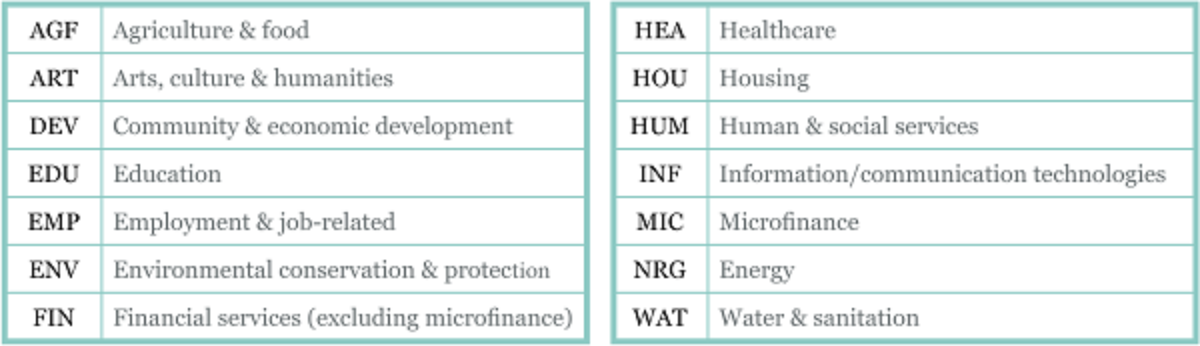
Great tools already exist for measuring social and environmental impact thanks to IRIS, GIIN, TONIIC, and others. The following chart from Mission Investors Exchange helps categorize the hundreds of social/environmental impact types into manageable pieces. 

There are so many potential categories of metrics and it can be overwhelming. So we’ve chosen to track the following with our investments: 

  • Clean water provided

  • Waste reduced

  • Natural resource management improved

5.    Social Impact

Any of the numerous IRIS, GIIN, or TONIIC metrics would work. Impact Foundation is beginning to track simple categories, including:

  • Jobs created

  • Job/skills training for marginalized or underserved populations

  •  Jobs held by marginalized or underserved populations

Each of the above measurements is worthy of its own essay to dissect its meaning and discuss how to implement it in various contexts, but this is a start. Some may argue that our list is too short or too simple to be accurate. We welcome help to add important concepts we have overlooked, but we caution against making it overly complicated. Busy business owners and investors must be about the important work of running their companies. If we make metrics too difficult or cumbersome, they will not be implemented in the field.