A New Marketplace for the Common Good

 Photo by  Pete Owen  on  Unsplash

Photo by Pete Owen on Unsplash

by Greg W. Spencer and J. Greg Spencer 

Unrecognized Value 

Most social impacts, even when quantified, remain significantly undervalued by investors and, at times, are completely unrecognized by the market. While impact investments and the emphasis on Socially Responsible Investing have increased significantly since 2000, the value of such investments are often either evaluated using traditional financial metrics or insufficiently considered in non-financial performance. Therefore, non-financial performance, or “positive externalities” remain external to the transaction. 

We have evidence that this market failure exists from our own experience. After launching and operating several for-profit social ventures in East Africa over the last decade, we routinely sold the environmental benefits produced by our clean burning cookstoves into reasonably sophisticated carbon offset markets. However, we consistently received only a modest – if any – premium from also enabling families to save (and implicitly reinvest) more than twenty-two million dollars of income, thirty-one million hours of time, two and a half million trees, and arguably even more significant (but unquantified) improvements in health. We have also observed the inefficacy of development work and outdated models of donors and corporates paying for inputs hoping to achieve unverified impacts.

These unrecognized externalities mimic the conditions surrounding the emergence of the carbon markets in North America in the late 1990s. Working with large emitters who anticipated upcoming climate change regulations, we developed diverse sources and types of emission reduction projects to deliver newly created environmental assets. Ultimately, many of these project methodologies evolved into standards adopted by both commercial and regulatory bodies and became part of what is now a thriving industry. 

A New Marketplace for Good

We believe the solution to capturing unrecognized social value is the development of a “Common Good Marketplace” – a place to value and exchange independently verified social impacts categorized within the UN’s 17 Sustainable Development Goals (SDGs). This Common Good Marketplace might well emerge following a development process similar to that in the carbon markets. 

There are strong, but early indicators that this marketplace is already evolving. A handful of carbon registries, nonprofits, foundations, social enterprises and project developers are already creating new SDG-specific impact standards and methodologies with the goal of measuring social impacts. What we have not yet seen are any attempts to independently certify and then exchange these assets for value once created.

A marketplace will likely only grow when there is reasonably consistent supply and demand for the products and services provided. Therefore, the first step toward creation of such a market must be a much broader awareness that SDG impacts can be quantified for the purpose of being converted into assets. Once this awareness is combined with verifiable quantification methodologies, it seems only a modest step to then economically value and transfer them for the benefit of corporate buyers, foundations and donors, who could then better assess the “social ROI” of their investments. 

The Relevance of Resiliency 

The recent energy, airline and hospitality industry shocks, stock market volatility and higher long-term unemployment resulting from the COVID-19 pandemic demonstrates that corporate resiliency is more important than ever. “Resilience” can be difficult to monitor, quantify and develop, but through the lens of Environmental, Social and Governance (ESG) performance, it can more easily be identified and improved. According to Oxford University’s Robert Eccles, “Firms with a better ESG record than their peers produced higher three-year returns, were more likely to become high-quality stocks, were less likely to have large price declines, and were less likely to go bankrupt”. He was specifically citing the Bank of America Merrill Lynch ESG study completed in 2018. 

We know that investing in environmental performance and the purchase of environmental assets increases performance of the environmental component of ESG. We believe a similar thesis exists for using social assets: companies will increasingly invest in internal, supply-chain, and external (third-party verified) social impacts to improve their ESG performance and long-term resiliency.

Limitless Opportunity?

In any market, suppliers, buyers, technical experts, capital, and infrastructure are needed. This Common Good Marketplace would serve non-profits, social enterprises, development organizations, foundations, and corporates. Impact measurement experts, auditors, economists and registries (certifiers of and repositories for impact) would make up the technical expertise required to quantify and qualify impact standards and methodologies; developers would create new business models that investors would finance; and, finally, foundations and corporates would create demand by purchasing quantified, verified outcomes, thereby demonstrably improving their ESG performance. The opportunities seem limitless. Could this new marketplace match the $215 billion in transaction value last year for the carbon markets, and attract  investments as significant as Jeff Bezo’s recent $10 billion commitment to climate change (SDG 13)?

We know this market will require diverse expertise, actors and capital to work. We also know that faith like a mustard seed can move a mountain. Many of the faith-driven investors we have spoken to believe it is time for the faith community to demonstrate greater leadership in identifying and developing mechanisms and opportunities to enhance human flourishing.While we wait to see what roles are adopted by the faith community in this emerging impact marketplace, you may wish to consider how the organization’s you manage or support might benefit from developing quantitative, verified “pay-for-performance” funding mechanisms for their social and environmental impacts.

A Manifesto for Financial Advisors

This article was originally published here

by Jeff Haanen

Financial advisors play a critical role in the future of America.

They are stewards of a sacred trust, helping clients to save money for when they can no longer work, live a life of generosity, invest in businesses that align with God’s purposes for the world, spend wisely, and re-discover their calling to work and serve their neighbors over a lifetime.

If you’re a financial advisor, or you know one, what might it look like integrate Christian truth into this entire field, a $27 trillion-dollar industry that is shaping the destinies of millions?[i] (Click here to access a free downloadable pdf of this “Manifesto for Financial Advisors.”)


Here’s a place to begin.

1. Christian financial advisors help clients save money for when they can no longer work.

Saving is wise (Proverbs 21:20). Financial advisors have the privilege of encouraging people to prepare for the day when they cannot work due to old age or health. They also have the honor of helping clients still have enough to share with others (Proverbs 13:22; 1 Timothy 6:17-19).

But Christian financial advisors resolutely resist the narrative about saving for retirement built on utopian dreams of travel, never-ending vacation, and a care-free lifestyle. They recognize that sin and the Fall have affected all people, both wealthy and poor, and that there is no such dream of heaven on earth until Christ comes again. They also boldly call into question fear-based motives for saving in retirement, pointing people to trust God alone for their daily bread.

Also, since retirement (the cessation of work for a lifetime) is essentially a foreign concept to the Bible, Christian financial advisors work diligently to help people save for the day when they can no longer work due to health concerns, not for the day when they don’t want to work.

To work is to be human.

Financials advisors help their clients save money for retirement in order to provide for themselves in old age or illness, their family, and their community.

2. Christian financial advisors encourage clients to live a life of generosity.

God’s call to generous giving could not be clearer (Matthew 6:19-21; 10:42; Luke 21:1-4; 2 Corinthians 8:12-15; 1 John 3:16-18; Proverbs 11:24-25). Generous living most closely reflects God’s grace toward his people (2 Corinthians 8:9).

Christian financial advisors counsel clients toward sacrificial giving toward the mission of the church, the well-being of the poor, and the critical social, economic, and cultural needs of our day. They explore creative ways to facilitate their clients giving their cash, assets, time, skills, relationships, and influence. They lead by example.

Even though Christian financial advisors often don’t have a financial incentive to encourage generosity amongst their clients, they do so anyway because God first gave generously to them (John 3:16). 


3. Christian financial advisors counsel their clients to invest in businesses that align with God’s purposes for the world.

Christian financial advisors believe that God owns everything (Psalm 24:1), including both their client’s money and also the money that is invested in companies through stocks, bonds, and mutual funds.

They are leaders in the space of socially responsible investing (some Christians also call this values-based investing, or biblically responsible investing). They believe God’s purpose for business is to provide for the needs of world by serving customers and creating meaningful work, while giving glory to God.[ii] Profit, therefore, is a means to an end, not the end of business. They believe investments are intended to help businesses grow and bless their communities. Christian financial advisors also believe business has been tainted by the Fall, and today corporations, like individuals, are bent toward greed and injustice (Micah 6:8-10). There are no “neutral” investments.

Inasmuch as they are able, Christian financial advisors seek out investments for their clients that align with their client’s values and God’s good purposes for business. They take leadership in providing ample returns for their clients and multiplied societal blessing through their client’s investments.[iii]


4. Christian financial advisors counsel their clients to spend wisely.

God has given us money to be enjoyed and spent wisely. But Christian financial advisors also recognize that “godliness with contentment is great gain,” and Christian history is filled with vows of poverty and commitment to simple living for the sake of more deeply enjoying the riches of Christ (1 Timothy 6:6, 17-19).  Frugality is not a curse but a means to experiencing the abundance of God’s love, care, and heavenly riches.

Christian financial advisors are uniquely able to speak to our cultural moment and the current “retirement crisis” because they believe God himself, not the pleasures of this world, is our greatest joy. They believe in a deeper wealth than what money can offer.[iv]

Christian financial advisors counsel their clients to avoid debt, live within their means, defer gratification, and discover non-consumeristic ways to enjoy life and God’s good world.


5. Christian financial advisors counsel their clients to consider the different seasons of work over a lifetime.

Christian financial advisors see God’s pattern of six days of work and one day of rest as a blessing that lasts for a lifetime.

Rather than preparing clients to completely cease from work at retirement, they encourage sabbaticals and seasons of rest to renew a sense of calling for the next phase of life.

Therefore, they are instigators of a deeply counter-cultural movement. They begin to help clients save money for both sabbaticals and for when their clients can no longer work. They ask pointed questions to help their clients see a deeper purpose to life than entertainment or pleasure.  Christian financial advisors, then, become sages, mentors, theologians, and philosophers who help their clients prepare for the next season of work, whether they are 60, 70, or 80 years old.[v]

Christian financial advisors are the innovators who call for a new movement of work, sabbatical, and re-engagement based on God’s design for work over a lifetime (Leviticus 25).[vi] They openly challenge the Let’s vacationparadigm of retirement, and honor the men and women who work later in life as the dignified elders of our churches, communities, and society.

They are the first to point out the valuable, brilliant, and creative work of men and women stewarding their skills, knowledge, and abilities into the sunset of their lives.


For a free downloadable version of this manifesto, visit https://www.uncommonretirement.com/financial-advisors.


Endnotes

[i] Nick Thornton, “Here’s What the $27 Trillion US Retirement Industry Looks Like,” Think Advisor, 2 January 2018, Accessed on August 10, 2018: https://www.thinkadvisor.com/2018/01/02/heres-what-the-27-trillion-us-retirement-industry/?slreturn=20180714204623.

[ii] Jeff Haanen, “Theology for Business (Video),” Denver Institute for Faith & Work, Accessed on August 1, 2018: https://denverinstitute.org/video-the-purpose-of-business-today/.

[iii] Organizations like the Christian Investment Forum and faith-friendly mutual funds like Eventide Funds actively explore how to pursue competitive returns for their shareholders while upholding Christian values. For examples of philosophies of Christian faith and investing, watch the video “Investing 360 – The Story of Eventide Funds”: https://vimeo.com/223488058 or read “Integrating Faith Into the Way We Invest,” by Tim Macready, CIO of Christian Super, an Australian Pension Fund: https://denverinstitute.org/integrating-faith-way-invest/.

[iv] For an excellent treatment on faith, money, and retirement, see: Chad S. Hamilton, Deep Wealth (Denver: PFI Publishing, 2015).

[v] I recognize this is almost unheard of today. But my thesis in this book is that this rhythm of work and rest is more biblical than the contemporary idea of retirement and it more closely aligns with God’s intent for us to work, in different capacities, over a lifetime.

[vi] Rob West, the CEO of Kingdom Advisors, a Christian ministry to financial professionals, says, “One of the roles of the advisor is to not only help the client to answer the question, ‘How much is enough financially?’ – in terms of our financial finish line so we can maximize giving – but also, ‘What are you going to do in the retirement season?’ Even if we stop our vocation, what are we going to do to be of service to the Lord full-time for God’s glory?” Both Rob West and Ron Blue, the founder of Ron Blue Co. believe both wise financial decisions and a lifetime of work, which changes in different seasons, are biblical.

A Chicken or an Empire: Your Choice

Article originally hosted and shared with permission by The Christian Economic Forum, a global network of leaders who join together to collaborate and introduce strategic ideas for the spread of God’s economic principles and the goodness of Jesus Christ. This article was from a collection of White Papers compiled for attendees of the CEF Global Event.

by David McAlvany

I know a man who loaned out the equivalent of $50,000 to a neighbor. Much to his chagrin, the debt was settled with a single chicken.

I’m familiar with another family that, in similar circumstances, made a choice to diversify their family business geographically. Over the next 30 years, they expanded one company into 4,500 companies and 3,000 manufacturing plants.[i]

How could such similar beginnings yield such different results? They resulted from differing responses to the same monetary occurrence. I’ll explain in a moment.

By the end of this essay, you will have joined not the 1%, but the 10,000th of 1% (.000001). You will be one in a million. How? John Maynard Keynes quipped that inflation is something only one in a million people understands. You will be that one.

Inflation is not a dazzling topic. Most people consider it boring. But it affects your lifestyle, the things you can do, your ability to care for yourself and your family, your ability to do business, your ability to save for retirement, and much, much more. It’s like air: not something you think about very much, but extremely important.

Perhaps being one in a million also sets you apart in another way. Perhaps you are a part of a remnant of individuals who can actually help those closest to them as the ravages of inflation take their toll.

My aim in writing this paper is first to consider the definition and destructive nature of inflation and second to explore a Christian response to inflation in keeping with the principle of subsidiarity—an important principle I’ll review for you shortly.

Inflation is defined here as an increase in the quantity of money that results in the dilution of purchasing power and is evidenced by the increase in cost for goods and services. In layman’s terms, things keep getting more expensive because the number of dollars in use goes up faster than the number of products available to buy them with.

The government is supposed to keep track of inflation, and it has some tools for that. Two such efforts are the Consumer Price Index (CPI) and Personal Consumption Expenditure (PCE). These price indices were originally constructed to show whether a family could continue to enjoy a basic lifestyle through time or if cost increases for goods jeopardized a family’s ability to care for itself.

However, the measures have changed through time. The original “basket of goods” (the specific products whose prices are monitored) in CPI has changed. Certain products have been substituted, with each one assigned a unique weighting in the index.[ii] Through the decades, the measures have become less reliable as a gauge of enduring economic security.[iii]

Now that we’ve defined inflation and have seen that it deals with both the quantity and quality of money, let’s define “money.” We don’t think about this one very much because we have dollars and cents in our pockets or our bank accounts, and we can buy things with them—case closed.

But the question is crucial: What is money? It’s especially important in a time when digital code is described as “coin” and its creation referred to as “mining.” Central banks are now aggressively pursuing their own digital currency versions as a substitute for the physical form.

“Specie” is the term given to money in the form of coins or notes (someday soon, these may be forgotten relics of our past that require an explanation, as eight track or vinyl does today). The value of those coins and notes has for millennia been secured by the materials they are made of (usually gold and silver) or were exchangeable for in the case of a paper proxy. Only since 1971 has the world operated on a system where reputation and faith are the only backing for currencies. Since that time, credit has been easier to create and has largely displaced specie as the more important form of money creation.

Currency evolves along a continuum of trust. If trust is ever questioned, the social reversion is to the most secure form of money available. Historically, that is gold and silver.

A significant revolution in money creation occurred in 2020 when governments took control of the distribution of credit. They began delivering money/credit directly to businesses and individuals.[iv] Before that, credit (a form of money) was normally created two ways: by a central bank or by a commercial bank.[v] Following the global pandemic, governments around the globe have rediscovered a powerful third way to create money. By directing credit and credit guarantees towards politically favored recipients, and bypassing the central bank as the primary creator of money, governments are breaking into the domain of bank-created money.

This kind of politically motivated monetary inflation has created many economic disasters throughout history. Governments today seem to be operating according to the very dangerous words: This time is different. The words are dangerous, of course, because that’s what every disaster-creating government throughout history has said to salve its conscience just before inflation ran away with its economy.

Now, back to inflation. Will inflation be transitory? Yes and no.

Inflation is returning in a way it has not been experienced in decades. This bypass of the central banks by governments is in an early stage, and it changes the nature of how both money and inflation will be experienced in the years ahead.

There are, of course, post-pandemic supply-chain bottlenecks that temporarily boost inflation statistics. These appear to be the focus of the central bank community, leading them to conclude that inflation will be transitory. The neglected element that economists appear to have missed is that governments globally are retaking control of credit distribution (therefore money creation) and, like Bernanke’s and Friedman’s “helicopter drops” of money, are now delivering cash and credit guarantees to preferred constituencies (via the Cares Act, PPP, and Mainstreet Lending program, as three examples) with commercial banks assisting in distribution but in no way taking on credit risk themselves. This shift in roles further politicizes access to resources and invites a new era of inflation.

After decades of disinflation and the accrued benefits of declining capital costs, we should now anticipate a reversal of the past. This will include an increase in consumer inflation and, as a downstream consequence, a decrease in real returns across almost all asset classes. A different approach to asset management is required in the years ahead, including a different approach to liquidity management.

As dry as statistics may seem, the reality of inflation and money supply growth is in some contexts a drama, in others a thriller, and, in a few rare cases, a complete horror show. Inflation should enter your mind not as a statistic, but as a human experience. Stories illustrate the pernicious nature of inflation, with extreme stories shining a light on the final stages of currency repudiation and collapse.

When families run out of money before the end of the month, or when retirees are gradually squeezed between rising costs and a fixed income, we witness the minor stresses and strains of inflation. When the later stages of inflation are reached, occasionally an extinction event occurs—extinction for the currency and for the values held dear by that cultureIn the end, inflation matters because people matter.

Stefan Zweig narrates his personal inflation experience in The World of Yesterday,

“Prices jumped arbitrarily; a thrifty merchant would raise the price of a book of matches twenty times the amount charged by his upright competitor who was innocently holding to yesterday’s quotation; the reward for his honesty was the sale of his stock within an hour, because the news got around quickly…people wanted goods instead of paper. The most grotesque discrepancy developed with respect to rents, the government having forbidden any rise; thus tenants were protected…property owners the losers…before long, a medium-size apartment in Austria cost its tenant less for a whole year than a single dinner. A man who had been saving for forty years…became a beggar. A man who had debts became free of them. Standards and values disappeared during this melting and evaporation of money; there was but one merit: to be clever, shrewd, unscrupulous, and to mount the racing horse instead of being trampled by it.”[vi]

Today, the divide between rich and poor continues to widen. Some attribute this to an unjust capitalist system. However, a closer look reveals that monetary policy choices (central bank liquidity creation) globally have increased the quantities of money and credit on an unprecedented scale. Therefore, asset prices (stocks, bonds, real estate, art, etc.) have taken on overblown bubble characteristics, with central bank liquidity largely trapped and recirculating within financial markets. This is evidenced by the Forbes’ annual world billionaires tally that lists a record 2,755 billionaires. This year’s crop sports a combined worth of $13.1 trillion, up 64% over the past year to all-time highs. Household Net Worth in the U.S. reached an all-time high of $130 trillion. Net Worth ended Q1 at 606% of GDP, dwarfing previous cycle peaks of 492% in 2007 and 446% in early 2000. Owners of assets have benefitted in the process, while much of the poor and middle class has been left behind. This awkward economic reality is a defining factor in the policies of redistribution likely to be implemented in the years ahead and contributes to existing social and political tensions.

Inflationism is implicit in the current monetary regime. The previous system, known as Bretton Woods after the New Hampshire gathering in the 1940s, was dollar-based and gold-backed. It ended in 1971. Micheal Bordo recounts, “For the first time in history, the world after 1971 adopted a peacetime fiat money regime.”

Now, with no tangible asset backing our currency, limitless money and limitless credit creation are allowable. Political exigency and circumstantial justifications, such as recessions, financial market panic, and, most recently, pandemic, have meant that policymakers “print” whenever necessary and spend on whatever they desire.

This is a part of the devolution of money. Guilio Gallarotti observed, “The monetary orientation of politics has changed over the last century, from one of stable money to one of inflation. With the politization of the budget (through the rise of the welfare state) and the electoral impact of unemployment, inflation has become a fundamental means through which elites gain and maintain office.”[vii]

The emergent phenomenon of inflation will indeed be a challenge to control with government debt surpassing 125% of GDP (see chart). Nial Fergusson comments in The Cash Nexus, “Inflation is easier to start than to stop under conditions of high public indebtedness. A central bank aiming to halt inflation by raising the short-term interest rate would be likely to fail if the government continued to run high deficits.”

With a budget of six trillion dollars proposed for 2022 and expected revenues of $4.16 trillion (which assumes an increase of 670 billion for the year), the deficit is anticipated at $1.84 trillion. This follows 2021’s deficit of $2.3 trillion, 2020 at $3.1 trillion, and 2019 at $984 billion—a four-year total of $8.25 trillion.

Fold in all debts, not just governmental, and the motive to inflate away these burdens becomes even more compelling. Over the past six quarters, total debt securities—Treasuries, agencies, corporates, and municipal bonds—have jumped $8.174 trillion, or 18%, to $53.920 trillion.  There’s been nothing comparable. At 251% of GDP, the total debt securities ratio compares to 200% in 2007; 157% to end the ’90s; 126% to end the ’80s; and 74% to conclude the ’70s. As the debt binge increases, so does the probability of policymakers intentionally ramping up inflation to alleviate the burden of those liabilities.

Jeffrey Frieden in his book Currency Politics states, “The level of the exchange rate can express a government’s position on the trade-off between domestic consumers and domestic producers…. A government’s exchange rate policy tells us a great deal about its priorities, both international and domestic.” Strong currencies serve a purpose, as do weak currencies. The policy choice to interfere with an exchange rate implicitly conveys who is intended to accrue economic benefits in the future. It is a choice of designating winners and losers.

Public policy choices indirectly designate economic winners and losers. When politicians prioritize massive spending initiatives and fund them through ever-larger deficits, the context is set for a follow-on policy choice: inflation.

Step one: Spend beyond your tax revenues; provide discriminatory benefits to select constituencies, creating deficits in the process.

Step two: Pay back your debt with cheaper currency.

Large scale budget deficits and debt monetization (after beginning 2008 at $850 billion, Fed balance sheet assets are on course to surpass $8 trillion in a few months), or literal printing, contribute to asset price distortion and the gradual loss of purchasing power.

Stanley Fischer said in his IMF World Bank paper titled Inflation and the Poor: “The claim that ‘inflation is the cruelest tax of all’ is often interpreted as meaning that inflation hurts the poor relatively more than the rich. It could also mean that the inflation tax is particularly unfair because, the taxing mechanism being little understood, the inflation tax can be imposed by stealth.” [viii] He goes on to quantify that, indeed, the deliberate tax via inflation is felt more by the poor in society.

So, considering current policy choices, the social programs being scripted by global leaders seem necessary to aid the poor even while the net effect of inflation, stemming from deficit spending and money printing, is punitive to them at the same time. There is a tragic irony in the chosen public policy winners also being the concurrent losers. It’s like a grand societal experiment with Stockholm syndrome—policymakers creating a system of abuse for which the people are in turn grateful.

I began this paper with a $50,000 chicken. The value of the chicken never really changed, but the currency devalued to the point where it took that many currency units just to buy the barnyard bird. The debt was a real obligation, fixed in currency units (German Marks), with no escalators or indexing of debt applied. The element of surprise came from the changed value of those currency units. With a fixed currency obligation came great relief to the borrower. The foul consolation for the neighborly lender was like adding insult to injury.

Crisis compresses time. There is no clearer example of this than the Stinnes family in Germany. The family grew a small coal company into a vast multinational conglomerate—in large part due to inflationary crisis dynamics—and a diversified revenue base that enabled them to act boldly when others were cautious. The single greatest investment the family made was in a boat, which allowed for delivery of coal outside of Germany and, thus, brought income in a variety of other currencies. The value of foreign currency revenue in a period of domestic inflation was seen in the Stinnes family’s ability to consolidate distressed assets throughout Germany—from a replenishing store of savings not subject to monetary policy abuse to the dramatic inflationary repercussions experienced between 1919 and 1924, destroying the local currency.  Sidestepping the consequences of inflation, the Stinnes family grew their business interests exponentially in a relatively short period of time. They created an economic buffer against the costs of hyperinflation, turning crisis into opportunity.

As we conclude, the Catholic social theory of subsidiarity is instructive for structuring a response to emergent inflationary trends, inspiring outreach to those in need and taking direct responsibility for neighbor care. Subsidiarity as a principle places power and decision making at the lowest level possible.

“Subsidiarity charts a course between individualism and collectivism by locating the responsibilities and privileges of social life in the smallest unit of organization at which they will function. Larger social bodies, be they the state or otherwise, are permitted and required to intervene only when smaller ones cannot carry out the tasks themselves. Even in this case, the intervention must be temporary and for the purpose of empowering the smaller social body to be able to carry out such functions on its own.”[ix]

Subsidiarity offers both a perspective and prescription for the inflationary consequences ahead. Today, a family’s inability to meet basic needs regularly defaults to governmental resources as a solution, consistent with the migration of welfare and other social safety nets from private charity to the public sector over the last one hundred years. The period ahead provides an opportunity for private sector and community-based initiatives to step forward and perhaps even supersede the role of government in meeting the needs of people, reestablishing neighbor care and meaningful grassroots compassion.

The numbers suggest we are a long way from being able or willing to displace that governmental role.[x] What seems to be missing is a missional and neighborly generosity. We must assume that some economic buffer is maintained through a period of inflation that helps maintain the means by which those resources can be utilized.

Surveying the approach taken in Acts 2:42-47, we find a noble voluntarism and generosity defining the early life of the church. Open hearts translated directly into what we think of as hospitality and open homes. The sharing of resources can take on many forms but begins with understanding where all our resources come from, and, with gratitude of heart and willingness of spirit, making available all that we steward to tangibly express love to our community.

The practice of delegating this awareness of need and deferring to the public sphere of governmental solutions elevates the role of larger social bodies. It also allows for a detrimental distancing from needs and narratives that might well soften our hearts and further transform our lives through inspired compassion and generosity.

The age we are entering is an age where Christ followers must be defined by their deeds as well as what they stand for (not just what they are against). The lives of our families and communities can be greatly enhanced by a depth of sensitivity to the needs around us and a commitment to roll up our sleeves and directly assist those that are most affected by pressures and personal crises—including those wrought by inflation.


 ——

[i] A Genius in Chaotic Times, By Edmund Stinnes

[ii] Shelter is given a 42% weighting in the CPI, and on the latest data was up a mere 1.7%, contributing to an understatement of the inflation figure.

[iii] The Ghost of Arthur Burns by Stephen S. Roach https://www.project-syndicate.org/commentary/fed-sanguine-inflation-view-recalls-arthur-burns-by-stephen-s-roach-2021-05 “In the aftermath of the 1973 Yom Kippur War, Burns argued that, since this had nothing to do with monetary policy, the Fed should exclude oil and energy-related products… from the consumer price index…we gulped and followed his order to take food – which had a weight of 25% – out of the CPI… He also raised questions about homeownership costs, which accounted for another 16% of the CPI. Take them all out, he insisted! By the time Burns was done, only about 35% of the CPI was left – and it was rising at a double-digit rate!…”

[iv] Russell Napier. https://mcalvanyweeklycommentary.com/the-power-of-politicized-credit-russell-napier/

[v] This is the Keynesian distinction between “state” money and “bank” money dating to the 1930’s. Others make the same distinction but call them “printing press” and “fountain pen” money. The Economic Journal Vol. 41, No. 162 (Jun., 1931), pp. 241-249 (9 pages)

Published By: Oxford University Press

[vi] The World of Yesterday by Stefan Zweig, pg. 204

[vii] Micheal Bordo and Forest Cappie Monetary Regimes in Transition, pg. 49 quoting Guilio Gallarotti.

[viii] World Bank Policy Research Working Paper 2335 https://documents1.worldbank.org/curated/en/667341468767111866/pdf/multi-page.pdf

[ix] Robert K. Vischer, “Subsidiarity as a Principle of Governance: Beyond Devolution,” Indiana Law Review 35, no. 1 (2001): 119. (Quoting Fred Crosson, “Catholic Social Teaching and American Society,” Principles of Catholic Social Teaching, ed. David A. Boileau (Milwaukee: Marquette University Press, 1998), 170-171).

[x] Joe Carter; https://blog.acton.org/archives/104847-can-private-charity-replace-the-social-safety-net.html

A Christian Vision of Social Justice

Article originally posted here by The New York Times

by The New York Times

Like a lot of people, I’ve tried to envision a way to promote social change that doesn’t involve destroying people’s careers over a bad tweet, that doesn’t reduce people to simplistic labels, that is more about a positive agenda to redistribute power to the marginalized than it is about simply blotting out the unworthy. I’m groping for a social justice movement, in other words, that would be anti-oppression and without the dehumanizing cruelty we’ve seen of late.

I tried to write a column describing what that might look like — and failed. It wasn’t clear in my head.

But this week I interviewed Esau McCaulley, a New Testament professor at Wheaton College and a contributing writer for New York Times Opinion. He described a distinctly Christian vision of social justice I found riveting and a little strange (in a good way) and important for everybody to hear, Christian and non-Christian, believer and nonbeliever.

This vision begins with respect for the equal dignity of each person. It is based on the idea that we are all made in the image of God. It abhors any attempt to dehumanize anybody on any front. We may be unjustly divided in a zillion ways, but a fundamental human solidarity in being part of the same creation.

3 Ways to ACE Stewardship

 Photo by  Andrik Langfield  on  Unsplash

Photo by Andrik Langfield on Unsplash

by Pete Kelly

When I was 12 years old, I got my first job as a delivery boy for the local newspaper. Each morning I woke early before school to walk the two mile route, placing newspapers on customers’ steps. And at the end of each month, I retraced the route in the evenings to collect payments. But the money I received wasn’t necessarily mine to keep. The first portion always went to the company to cover their costs, and I got to keep whatever was left over.

Although I called it “my paper route,” in truth, it wasn’t really mine. Yes, I was responsible for the customers and resources assigned to me, but they ultimately belonged to another. I served at the newspaper’s discretion. If I was irresponsible or lazy, the company could always give my route to another willing candidate.

That experience helped shape my understanding of biblical stewardship: managing the property or affairs of another. In truth, everything I have is ultimately a gift from God, entrusted to my care for however long he sees fit. I am not the owner. He is. I am simply a steward. And my goal is to be the best steward possible.

As CEO of Apartment Life, I begin each day with this prayer: 

God, this is your organization, not mine. If you want to grow it, please grow it. If you want to prune it, it’s yours to prune. Only let me be faithful with everyone and everything you have entrusted to me: every client, every employee, every board member, every dollar. Everything I have is yours.

Each time I pray this, I’m reminded of the parable Jesus told about a ruler who entrusted his servants with various amounts of money. When they were faithful with the little they had been given, the master entrusted them with even more. I believe this is how God would want us to steward the organizations we lead. If we do an excellent job caring for our clients, we will naturally earn more business. If we do an amazing job caring for our employees, we will never lack for talent. Our job is simple… be the best stewards possible. 

But what does excellent stewardship practically look like? At Apartment Life, we define it with the acronym ACE, which stands for: Attitude, Communication, and Experience. 

Attitude: Excellent stewardship begins with our attitudes. In his book Shine, author Kris Den Besten tells the story of the most remarkable busboy he had ever seen. The server worked with such focus, precision and enthusiasm that the entire restaurant applauded each time he finished clearing a table. The author was so impressed by this young man’s attitude he had a hard time sleeping that night, wondering if anyone would ever applaud him for that same kind of work ethic.

Of course, it’s nice when people appreciate our hard work; however, for me an even bigger test of attitude is how I handle negative feedback, especially when it comes from someone inside the organization. It’s one thing to bear patiently with an unhappy client. After all, they are paying me. It’s entirely different when it comes from an employee whom I am paying.

Yet if I want my frontline staff to serve clients with an excellent attitude, that culture starts with me. If I want them to be cheerful, grateful and gracious, even when people are negative, I need to lead by example. And the purest source of motivation comes from God himself, as I experience his cheerful grace despite my ingratitude. As the apostle Paul put it, “Be kind and compassionate to one another, forgiving each other, just as in Christ God forgave you” (Eph 4:32).

Communication: Excellent stewardship also requires strong communication. In my experience, a great attitude tends to naturally come out in face-to-face and phone conversations. It radiates from our countenance and tone of voice. But written communication is much more challenging.

At Apartment Life we emphasize four attributes of excellent communication, especially in email:

  • Warm – (It uses positive, affirming language).

  • Personal – (It shows a genuine interest in the other person).

  • Proactive – (It anticipates questions or concerns of the other person).

  • Timely – (It responds the same day, whenever possible).

For me, the trickiest part is maintaining all four consistently. I tend to be pretty timely, but not always proactive. I could be better at anticipating others’ needs. That’s one of the things I like so much about Amazon. Whenever a shipment is delayed, Amazon anticipates that concern and proactively communicates. Granted, they aren’t warm, personal emails. (They are computer-generated, I assume.) But they certainly are proactive and timely.

Experience: That third ingredient of excellent stewardship is experience. That is, deliver exactly what we promise, and if possible, go the extra mile. This is something for which the Ritz Carlton is famous. In his book, The New Gold Standard, Joseph Michelli shares how Ritz Carlton employees go out of their way to create a legendary customer experience. One of my favorite stories comes from a hand-written letter from a Ritz Carlton guest:

One of your employees and I got on an elevator in your building. I pushed the sixth-floor button and he pushed none. Instead of getting off with me on the sixth floor, your employee simply said, “Have a nice day.” Upon exiting the elevator I asked, “Where are you going? Aren’t you getting off here?” Your employee replied, “No, I’m going back down to the fifth floor.”

The guest went on to ask, “How do you find people who are so invested in placing the needs of their guest above their own?” While the Ritz Carlton employee only went one extra floor to serve the guest, it might as well have been a mile.

Stories like that inspire, and yet it’s helpful to remember that before you can go the second mile, you have to go the first. That means providing quality basic service. Even companies like the Ritz have to deliver the basics, by making sure the rooms are clean and ready on time.

Bringing it all together

Imagine the impact if every Christian led enterprise embraced these three aspects of stewardship: 

  • Attitude – If we were cheerful, grateful, gracious, even when people were negative.

  • Communication – If we were warm, personal, proactive, and timely.

  • Experience – If we delivered on our promises, and whenever possible, went the extra mile.

How would our culture respond? How might the perception of Christians change? What would be the long-term impact for the gospel? Imagine the honor it would bring to the Rightful Owner we serve.

4 Dimensions of Faith and Investing

 Photo by  Traf  on  Unsplash

Photo by  Traf  on  Unsplash

by John Silverling

To understand the purpose and impact of Faith Based Investing, it is important to look at the fundamental relationship between our faith and money.  God and money.  Or perhaps more accurately, God or money?  Which of these has the higher priority in our lives?  We know which one should have the higher priority, but in practice we often center our lives around money and things money provides.

In his book Counterfeit Gods, Tim Keller writes that

“internal idol worship, within the heart, is universal… the human heart takes good things like a successful career, love, material possessions, even family, and turns them into ultimate things.  Our hearts deify them as the center of our lives, because, we think, they can give us significance and security, safety and fulfillment, if we attain them.”

The point here is not to disengage from a successful career, love, money or any of these.  It is simply to understand their relative priority to what we know should be the highest priority – God.   Further, it is then to consider how our Faith in God effects our actions, and specifically in this case how our Faith effects our actions with our wealth – faith and investing.

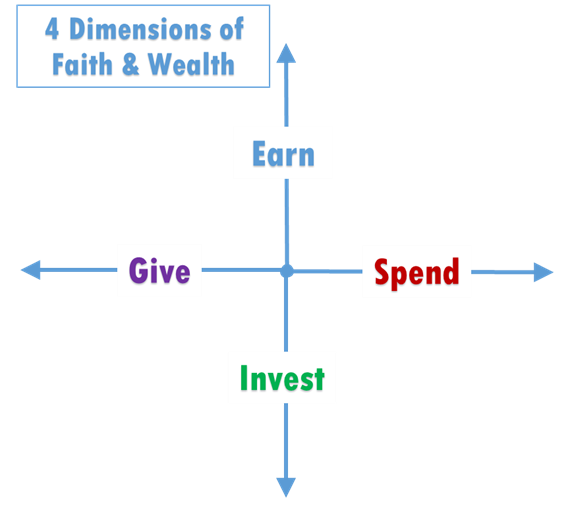
There are 4 main dimensions of money in our lives.  We earn it from our work or vocation.  We spend it on things we want or need.  What is left we can invest to increase our wealth.  From what we earn, save, and invest we can give to others or leave for our families.  Earn, Spend, Invest and Give.  Within each of these dimensions, it is appropriate to consider how our faith and the values that derive from that faith, can or should impact our actions.

On each dimension, there are some simple questions worth considering.  The first question in each is always should Faith influence and affect actions?

EARN – Where do I work?  How do I work? How much should I work?

SPEND – How much do I spend?  Where do I spend?  For what do I spend?

INVEST – How much should I invest?  In what should I invest?  With whom should I invest? What is my risk tolerance on investing?

GIVE – How much do I give?  Where do I give?  How do I give?

The easy part is asking the questions on each dimension.  The much harder part is answering those questions honestly with the right perspective, and acting from that answer.  And doing that over and over and over.

Independent BUT Inter-dependent

It is possible to look at each of these dimensions, and make decisions about integration of faith only within that one dimension.  There is independence in each dimension.  But they are also inter-related and highly inter-dependent when considered holistically.  Where we work and how we work can certainly impact how much money we earn and therefore how much we have and for what do we spend it.  Decisions on spending and saving certainly impact how much is left to save and invest, and thus how we invest.  Finally, how we invest determines how much I will have to be generous in giving to others.

The point here is not to suggest that every decision we make has the same impact.  Nor is it to suggest even that each dimension is as important as the others.  We spend much more of our time in our vocations, so how we bring our faith into that work may have more significant impact than other dimensions.  But integrating faith well in one dimension does not, nor should it, excuse neglecting integration in the other dimensions.