A Call to Work Together with Professors

Article originally hosted and shared with permission by The Christian Economic Forum, a global network of leaders who join together to collaborate and introduce strategic ideas for the spread of God’s economic principles and the goodness of Jesus Christ. This article was from a collection of White Papers compiled for attendees of the CEF’s Global Event.

by Robert Brooks

The Christian community needs a robust response to the naturalist economic viewpoint. C. S. Lewis observes, “(T)o be ignorant and simple now—not to be able to meet the enemies on their own ground—would be to throw down our weapons, and to betray our uneducated brethren who have, under God, no defense but us against the intellectual attacks of the heathen. Good philosophy must exist, if for no other reason, because bad philosophy needs to be answered.”[1] 

Warren Brookes, journalist and author of The Economy of Mind published in 1984, asserts, “We are dealing, no less, with the basic conflict between two entirely different concepts of man and his universe, concepts that affect every aspect of our social and economic lives, one determinedly physical and finite and the other profoundly metaphysical and infinite; the one (collective socialism) rooted in fearful concern about visible resources, the other (market capitalism) springing from faith in spiritual reality.”[2] He goes on to further assert, “Since economic thought first became formalized over two centuries ago, there have been essentially two different views about wealth. One view, first defined by Adam Smith and Jean-Baptiste Say, is that wealth is primarily metaphysical, the result of ideas, imagination, innovation, and individual creativity, and is therefore, relatively speaking, unlimited, susceptible to great growth and development. The other, espoused by Thomas Malthus and Karl Marx, contends that wealth is essentially and primarily physical, and therefore ultimately finite. The modern presentation of this view argues that since usable energy is steadily diminishing into entropy, all wealth is really cost to be shared more equitably.”[3] 

Because universities play a vital role in transforming economic thought as well as culture, we need to engage those who are permanent university residents— faculty. How far is the nearest institution of higher education from your home? 

Do you know personally any Christian faculty or Christian PhD students? Have you ever considered working together with faculty to advance the Kingdom as well as improve your business? As Joseph of Arimathea was able to walk into Pilate’s office seeking the body of Jesus, professors who are Christian are often in influential positions.[4] 

Darin joined our church around 1991 as a graduate student in marketing at the University of Alabama. He and his wife were seeking to faithfully follow Jesus but were new to navigating the terrain of PhD programs. Ignoring my advice to be very discrete within the halls of this institution, he became the target of a particular secular professor who sought to have him removed from the program because he was a Christian. By God’s gracious provisions, Darin is now a world renown marketing professor at Samford University having a kingdom impact through a wide array of activities.[5] 

At Darin’s suggestion, one of his students entered a PhD program at the University of Alabama. Again, not heeding my advice, Alex faced significant hostility because he was a follower of Jesus Christ. Today, he is a professor at a secular university seeking to use his position to God’s glory. 

If universities are one gateway to influencing the world, then faculty are their gatekeepers, and PhD students hold the keys to the future. Further, business innovation often emanates from universities. From product innovation to advanced financial management practices, faculty often have an unbiased and unique perspective. Unfortunately, due in part to the academic culture, we often have challenging personalities. Let’s face it, what kind of person can work for weeks on a particular quantitative solution knowing it will likely end up in the trash? Together, partnering with faculty and PhD students can lead to some interesting opportunities for you, your family, and your business, as well as your local ministries. 

Ann and I have been involved in Tuscaloosa’s International Friends for decades. [6] Although TIF is not a Christian organization, many Christians are involved. It is amazing the opportunities that become available simply from sharing a meal with our global guests. We have had too many experiences to enumerate here. Many PhD students arrive here seeking to become world-renowned academics 

and leave here disciple-making followers of Jesus, having a Kingdom impact in countries often deeply hostile to Jesus’ Kingdom. They are world-renowned but in a different world. 

Future global economic leaders are training in U.S. universities today. The current foundation of academic economic thought is atheist at its core and often Marxist in flavor. In other words, the foundation is sand and in desperate need of a surer foundation. You likely hold the keys to transformation through engagement one-on-one with faculty and potential faculty. Liberty is so clearly one key component of human dignity, and it leads to human flourishing.[7] Core to improving economic thought within universities is addressing the key issue of what it really means to be human. 

In the right context, business consulting relationships with faculty can be mutually beneficial. You receive conflict-free assessments, and faculty’s core presuppositions are often changed. Faculty assist you with innovation, and you assist them with their worldview. 

Further, the opportunities for you and your local ministries to partner with on campus groups are vast. There are ministries focused on undergraduate students,[8] ministries focused on graduate students,[9] and ministries focused on faculty.[10] As students are transient, these ministries are greatly benefittedby permanent residents, from faculty to area Christians. Although the temptation is to start something new, please consider just partnering with existing groups. 

Within each academic area, you will find partnering opportunities. See, for example, Christian Business Faculty Association,[11]Association of Christian Economists,[12] and Christian Finance Faculty Fellowship.[13] 

Let us now turn to finance as an illustration. My academic interest for over 30 years is quantitative finance. Based on extensive research and industry consulting, one key to human flourishing is improved financial decision-making. Returning to the previously quoted Warren Brookes, “The primary and essential character of wealth is metaphysical, not physical, and is the direct result of the creativity of mind, not the availability of raw materials—the sum product of individual efforts, not the manipulated static resources of collective nations or governments or lands.”[14] At its core, financial decision-making is metaphysical and rests on our worldview. Thus, I have been wrestling with the essence of the connection between finance and one’s philosophical worldview. [15] 

Ideas have consequences. The idea that the Bible addresses personal finance has a direct consequence to those of us who are biblically responsive. But, can we really trust the biblical perspective, or should we turn to naturalism and modern sages? 

Remember, not only do ideas have consequences, but ideas also have antecedents. Why should we entrust the weight of our lives to the biblical perspective for the purpose of taking us across life’s harrowing bridge? It has been our experience that if the biblical foundation is firmly established in the heart, then the unique particular financial strategies adopted will withstand the withering pressures of the day. One’s grasp on a particular biblically-based strategy may weaken if it is not firmly gripped with a robust understanding of its deep truthfulness and if one is not journeying together with other Christians. The Christian-based finance perspective is radically different fromalternative approaches, particularly those taught in academic institutions. Thus, we need a robust philosophical foundation for the Christian-based finance approach. 

Again, Warren Brookes notes, “Our economic future is not now and never has been tied to the physical assets we now see, but to the vast untapped potential of creative thinking—the metaphysical process which can show us entirely new reserves and new and easier ways of doing things, extending value and increasing wealth without depleting our planet.”[16] As God’s image-bearers, the Christian community should be at the very forefront of economic innovation. 

The doctrine of original sin should keep us attentive and cautious. From a biblical perspective, we know that there is objective truth. We also know that humans have a deeply-ingrained capacity to misrepresent the truth. Hence, when analyzing investment opportunities, we need to be ever vigilant to disentangle truth claims out of the mass of financial information. 

Many financial industries rely on people not carefully assessing their choices. “Easy payments” just sounds so appealing especially if I can get something now rather than wait and have delayed gratification. Understanding the foundational nature of semantic information as well as what one’s worldview states regarding human nature is one key to successfully navigating the many financial decisions faced every day. 

Economic prediction is not the same as economic preparation. Key to quality financial decision-making is understanding the fundamental difference between historical data and the semantic representations of future expectations. Life’s experiences as well as biblical patterns suggest that those things that have never happened in history may in fact happen. We tend to think we can predict the future better than we actually can. The biblical perspective is clear. In the New Testament, James challenges his readers, “Come now, you who say, ‘Today or tomorrow we will go into such and such a town and spend a year there and trade and make a profit’—yet you do not know what tomorrow will bring.” (ESV, 4:13-14a).

This simple truth may cause a significant pivot in how we manage our investments. With the humble admission that we do not have the capacity to accurately forecast the future, financial planning strategies change. One clear example is retirement planning. Rather than focus solely on how much to save and where to invest, this inability to forecast leads naturally to focusing on the relationship between invested assets and the fair estimate of the present value of retirement needs. 

As interest rates have fallen from the mid-1980s to 2020, the present value of retirement needs has significantly risen. Incorporating the fact that retirement needs rise in present value dollar terms when interest rates fall naturally suggests investing in an alternative way. We may not have known that rates would fall, but the relationship between rates and retirement needs is well known. Some estimate the losses within the pension industry exceed several trillion dollars just on this one issue. The simple reorientation toward managing investment portfolios in light of the stochastic behavior of non-investment assets as well as known liabilities would have saved enormous wealth, including trillions within the pension industry. Thus, well-vetted academic insights could have prevented these losses. 

We know that business is one gateway to influence culture. I propose that higher education is another gateway often neglected within the Christian community. My hope is to have challenged you to consider your local university as a powerful agency to enhance your business processes as well as extend your reach. Please pray and ask God whether your calling may include engaging people within your university. If you find yourself somehow meeting a young person who is a PhD student or an abrasive adult who is a professor, then perhaps your vocational calling is about to expand. Finally, if you know high school students who are really intelligent as well as spirit-filled followers of Jesus, please encourage them to at least consider the life of a college professor as they are training the world’s future leaders. Although it is a vocation deeply hostile to the Christian viewpoint, the Kingdom opportunities are vast.

[1]C. S. Lewis, The Weight of Glory, p. 58. 

[2]Ibid, 24. 

[3]Ibid, 12 (italics in original). 

[4]See the Gospel According to John, chapter 19, verses 38-42. [5]See https://www.samford.edu/business/directory/White-Darin. 

[6]See http://international.ua.edu/programs-activities/tuscaloosas international-friends/. 

[7]See Galatians 5:1 For freedom Christ has set us free; stand firm therefore, and do not submit again to a yoke of slavery. (ESV) 

[8]For example, Cru, Navigators, Intervarsity, Reformed University Fellowship, Fellowship of Christian Athletes, Athletes in Action, and various denominational ministries such as Baptist Campus Ministries to just name a few. 

[9]For example, Ratio Christi, Grad Resources, and Christian Grads Fellowship. [10]For example, Faculty Commons (https://www.facultycommons.com). [11]See https://www.cbfa.org. 

[12]See http://christianeconomists.org. 

[13]See https://sites.baylor.edu/shane_underwood/cffa/. 

[14]Warren T. Brookes, The Economy in Mind (NY: Universe Books, 1982), p. 12. 

[15]Extensive materials are freely available at 

http://www.robertebrooks.org/project/christian-apologetics-and-finance/. Any feedback deeply appreciated, even negative in nature.

[16]Brookes, The Economy in Mind, p. 36. ©
A Chicken or an Empire: Your Choice

Article originally hosted and shared with permission by The Christian Economic Forum, a global network of leaders who join together to collaborate and introduce strategic ideas for the spread of God’s economic principles and the goodness of Jesus Christ. This article was from a collection of White Papers compiled for attendees of the CEF Global Event.

by David McAlvany

I know a man who loaned out the equivalent of $50,000 to a neighbor. Much to his chagrin, the debt was settled with a single chicken.

I’m familiar with another family that, in similar circumstances, made a choice to diversify their family business geographically. Over the next 30 years, they expanded one company into 4,500 companies and 3,000 manufacturing plants.[i]

How could such similar beginnings yield such different results? They resulted from differing responses to the same monetary occurrence. I’ll explain in a moment.

By the end of this essay, you will have joined not the 1%, but the 10,000th of 1% (.000001). You will be one in a million. How? John Maynard Keynes quipped that inflation is something only one in a million people understands. You will be that one.

Inflation is not a dazzling topic. Most people consider it boring. But it affects your lifestyle, the things you can do, your ability to care for yourself and your family, your ability to do business, your ability to save for retirement, and much, much more. It’s like air: not something you think about very much, but extremely important.

Perhaps being one in a million also sets you apart in another way. Perhaps you are a part of a remnant of individuals who can actually help those closest to them as the ravages of inflation take their toll.

My aim in writing this paper is first to consider the definition and destructive nature of inflation and second to explore a Christian response to inflation in keeping with the principle of subsidiarity—an important principle I’ll review for you shortly.

Inflation is defined here as an increase in the quantity of money that results in the dilution of purchasing power and is evidenced by the increase in cost for goods and services. In layman’s terms, things keep getting more expensive because the number of dollars in use goes up faster than the number of products available to buy them with.

The government is supposed to keep track of inflation, and it has some tools for that. Two such efforts are the Consumer Price Index (CPI) and Personal Consumption Expenditure (PCE). These price indices were originally constructed to show whether a family could continue to enjoy a basic lifestyle through time or if cost increases for goods jeopardized a family’s ability to care for itself.

However, the measures have changed through time. The original “basket of goods” (the specific products whose prices are monitored) in CPI has changed. Certain products have been substituted, with each one assigned a unique weighting in the index.[ii] Through the decades, the measures have become less reliable as a gauge of enduring economic security.[iii]

Now that we’ve defined inflation and have seen that it deals with both the quantity and quality of money, let’s define “money.” We don’t think about this one very much because we have dollars and cents in our pockets or our bank accounts, and we can buy things with them—case closed.

But the question is crucial: What is money? It’s especially important in a time when digital code is described as “coin” and its creation referred to as “mining.” Central banks are now aggressively pursuing their own digital currency versions as a substitute for the physical form.

“Specie” is the term given to money in the form of coins or notes (someday soon, these may be forgotten relics of our past that require an explanation, as eight track or vinyl does today). The value of those coins and notes has for millennia been secured by the materials they are made of (usually gold and silver) or were exchangeable for in the case of a paper proxy. Only since 1971 has the world operated on a system where reputation and faith are the only backing for currencies. Since that time, credit has been easier to create and has largely displaced specie as the more important form of money creation.

Currency evolves along a continuum of trust. If trust is ever questioned, the social reversion is to the most secure form of money available. Historically, that is gold and silver.

A significant revolution in money creation occurred in 2020 when governments took control of the distribution of credit. They began delivering money/credit directly to businesses and individuals.[iv] Before that, credit (a form of money) was normally created two ways: by a central bank or by a commercial bank.[v] Following the global pandemic, governments around the globe have rediscovered a powerful third way to create money. By directing credit and credit guarantees towards politically favored recipients, and bypassing the central bank as the primary creator of money, governments are breaking into the domain of bank-created money.

This kind of politically motivated monetary inflation has created many economic disasters throughout history. Governments today seem to be operating according to the very dangerous words: This time is different. The words are dangerous, of course, because that’s what every disaster-creating government throughout history has said to salve its conscience just before inflation ran away with its economy.

Now, back to inflation. Will inflation be transitory? Yes and no.

Inflation is returning in a way it has not been experienced in decades. This bypass of the central banks by governments is in an early stage, and it changes the nature of how both money and inflation will be experienced in the years ahead.

There are, of course, post-pandemic supply-chain bottlenecks that temporarily boost inflation statistics. These appear to be the focus of the central bank community, leading them to conclude that inflation will be transitory. The neglected element that economists appear to have missed is that governments globally are retaking control of credit distribution (therefore money creation) and, like Bernanke’s and Friedman’s “helicopter drops” of money, are now delivering cash and credit guarantees to preferred constituencies (via the Cares Act, PPP, and Mainstreet Lending program, as three examples) with commercial banks assisting in distribution but in no way taking on credit risk themselves. This shift in roles further politicizes access to resources and invites a new era of inflation.

After decades of disinflation and the accrued benefits of declining capital costs, we should now anticipate a reversal of the past. This will include an increase in consumer inflation and, as a downstream consequence, a decrease in real returns across almost all asset classes. A different approach to asset management is required in the years ahead, including a different approach to liquidity management.

As dry as statistics may seem, the reality of inflation and money supply growth is in some contexts a drama, in others a thriller, and, in a few rare cases, a complete horror show. Inflation should enter your mind not as a statistic, but as a human experience. Stories illustrate the pernicious nature of inflation, with extreme stories shining a light on the final stages of currency repudiation and collapse.

When families run out of money before the end of the month, or when retirees are gradually squeezed between rising costs and a fixed income, we witness the minor stresses and strains of inflation. When the later stages of inflation are reached, occasionally an extinction event occurs—extinction for the currency and for the values held dear by that cultureIn the end, inflation matters because people matter.

Stefan Zweig narrates his personal inflation experience in The World of Yesterday,

“Prices jumped arbitrarily; a thrifty merchant would raise the price of a book of matches twenty times the amount charged by his upright competitor who was innocently holding to yesterday’s quotation; the reward for his honesty was the sale of his stock within an hour, because the news got around quickly…people wanted goods instead of paper. The most grotesque discrepancy developed with respect to rents, the government having forbidden any rise; thus tenants were protected…property owners the losers…before long, a medium-size apartment in Austria cost its tenant less for a whole year than a single dinner. A man who had been saving for forty years…became a beggar. A man who had debts became free of them. Standards and values disappeared during this melting and evaporation of money; there was but one merit: to be clever, shrewd, unscrupulous, and to mount the racing horse instead of being trampled by it.”[vi]

Today, the divide between rich and poor continues to widen. Some attribute this to an unjust capitalist system. However, a closer look reveals that monetary policy choices (central bank liquidity creation) globally have increased the quantities of money and credit on an unprecedented scale. Therefore, asset prices (stocks, bonds, real estate, art, etc.) have taken on overblown bubble characteristics, with central bank liquidity largely trapped and recirculating within financial markets. This is evidenced by the Forbes’ annual world billionaires tally that lists a record 2,755 billionaires. This year’s crop sports a combined worth of $13.1 trillion, up 64% over the past year to all-time highs. Household Net Worth in the U.S. reached an all-time high of $130 trillion. Net Worth ended Q1 at 606% of GDP, dwarfing previous cycle peaks of 492% in 2007 and 446% in early 2000. Owners of assets have benefitted in the process, while much of the poor and middle class has been left behind. This awkward economic reality is a defining factor in the policies of redistribution likely to be implemented in the years ahead and contributes to existing social and political tensions.

Inflationism is implicit in the current monetary regime. The previous system, known as Bretton Woods after the New Hampshire gathering in the 1940s, was dollar-based and gold-backed. It ended in 1971. Micheal Bordo recounts, “For the first time in history, the world after 1971 adopted a peacetime fiat money regime.”

Now, with no tangible asset backing our currency, limitless money and limitless credit creation are allowable. Political exigency and circumstantial justifications, such as recessions, financial market panic, and, most recently, pandemic, have meant that policymakers “print” whenever necessary and spend on whatever they desire.

This is a part of the devolution of money. Guilio Gallarotti observed, “The monetary orientation of politics has changed over the last century, from one of stable money to one of inflation. With the politization of the budget (through the rise of the welfare state) and the electoral impact of unemployment, inflation has become a fundamental means through which elites gain and maintain office.”[vii]

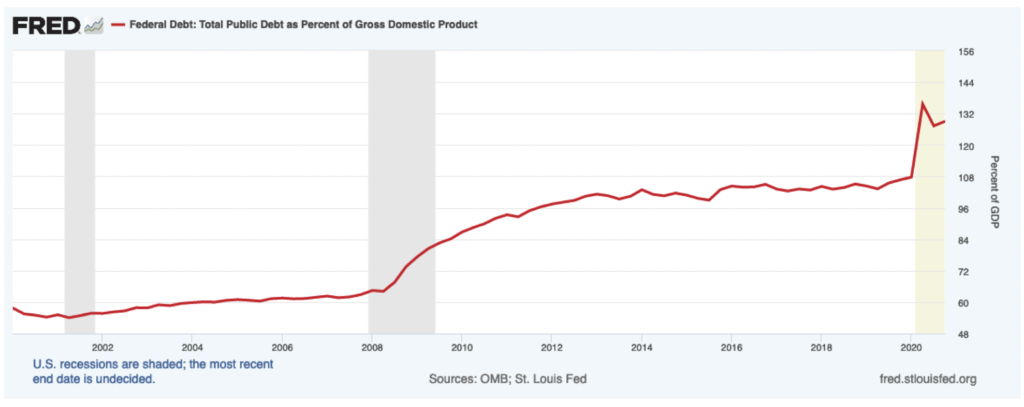
The emergent phenomenon of inflation will indeed be a challenge to control with government debt surpassing 125% of GDP (see chart). Nial Fergusson comments in The Cash Nexus, “Inflation is easier to start than to stop under conditions of high public indebtedness. A central bank aiming to halt inflation by raising the short-term interest rate would be likely to fail if the government continued to run high deficits.”

With a budget of six trillion dollars proposed for 2022 and expected revenues of $4.16 trillion (which assumes an increase of 670 billion for the year), the deficit is anticipated at $1.84 trillion. This follows 2021’s deficit of $2.3 trillion, 2020 at $3.1 trillion, and 2019 at $984 billion—a four-year total of $8.25 trillion.

Fold in all debts, not just governmental, and the motive to inflate away these burdens becomes even more compelling. Over the past six quarters, total debt securities—Treasuries, agencies, corporates, and municipal bonds—have jumped $8.174 trillion, or 18%, to $53.920 trillion.  There’s been nothing comparable. At 251% of GDP, the total debt securities ratio compares to 200% in 2007; 157% to end the ’90s; 126% to end the ’80s; and 74% to conclude the ’70s. As the debt binge increases, so does the probability of policymakers intentionally ramping up inflation to alleviate the burden of those liabilities.

Jeffrey Frieden in his book Currency Politics states, “The level of the exchange rate can express a government’s position on the trade-off between domestic consumers and domestic producers…. A government’s exchange rate policy tells us a great deal about its priorities, both international and domestic.” Strong currencies serve a purpose, as do weak currencies. The policy choice to interfere with an exchange rate implicitly conveys who is intended to accrue economic benefits in the future. It is a choice of designating winners and losers.

Public policy choices indirectly designate economic winners and losers. When politicians prioritize massive spending initiatives and fund them through ever-larger deficits, the context is set for a follow-on policy choice: inflation.

Step one: Spend beyond your tax revenues; provide discriminatory benefits to select constituencies, creating deficits in the process.

Step two: Pay back your debt with cheaper currency.

Large scale budget deficits and debt monetization (after beginning 2008 at $850 billion, Fed balance sheet assets are on course to surpass $8 trillion in a few months), or literal printing, contribute to asset price distortion and the gradual loss of purchasing power.

Stanley Fischer said in his IMF World Bank paper titled Inflation and the Poor: “The claim that ‘inflation is the cruelest tax of all’ is often interpreted as meaning that inflation hurts the poor relatively more than the rich. It could also mean that the inflation tax is particularly unfair because, the taxing mechanism being little understood, the inflation tax can be imposed by stealth.” [viii] He goes on to quantify that, indeed, the deliberate tax via inflation is felt more by the poor in society.

So, considering current policy choices, the social programs being scripted by global leaders seem necessary to aid the poor even while the net effect of inflation, stemming from deficit spending and money printing, is punitive to them at the same time. There is a tragic irony in the chosen public policy winners also being the concurrent losers. It’s like a grand societal experiment with Stockholm syndrome—policymakers creating a system of abuse for which the people are in turn grateful.

I began this paper with a $50,000 chicken. The value of the chicken never really changed, but the currency devalued to the point where it took that many currency units just to buy the barnyard bird. The debt was a real obligation, fixed in currency units (German Marks), with no escalators or indexing of debt applied. The element of surprise came from the changed value of those currency units. With a fixed currency obligation came great relief to the borrower. The foul consolation for the neighborly lender was like adding insult to injury.

Crisis compresses time. There is no clearer example of this than the Stinnes family in Germany. The family grew a small coal company into a vast multinational conglomerate—in large part due to inflationary crisis dynamics—and a diversified revenue base that enabled them to act boldly when others were cautious. The single greatest investment the family made was in a boat, which allowed for delivery of coal outside of Germany and, thus, brought income in a variety of other currencies. The value of foreign currency revenue in a period of domestic inflation was seen in the Stinnes family’s ability to consolidate distressed assets throughout Germany—from a replenishing store of savings not subject to monetary policy abuse to the dramatic inflationary repercussions experienced between 1919 and 1924, destroying the local currency.  Sidestepping the consequences of inflation, the Stinnes family grew their business interests exponentially in a relatively short period of time. They created an economic buffer against the costs of hyperinflation, turning crisis into opportunity.

As we conclude, the Catholic social theory of subsidiarity is instructive for structuring a response to emergent inflationary trends, inspiring outreach to those in need and taking direct responsibility for neighbor care. Subsidiarity as a principle places power and decision making at the lowest level possible.

“Subsidiarity charts a course between individualism and collectivism by locating the responsibilities and privileges of social life in the smallest unit of organization at which they will function. Larger social bodies, be they the state or otherwise, are permitted and required to intervene only when smaller ones cannot carry out the tasks themselves. Even in this case, the intervention must be temporary and for the purpose of empowering the smaller social body to be able to carry out such functions on its own.”[ix]

Subsidiarity offers both a perspective and prescription for the inflationary consequences ahead. Today, a family’s inability to meet basic needs regularly defaults to governmental resources as a solution, consistent with the migration of welfare and other social safety nets from private charity to the public sector over the last one hundred years. The period ahead provides an opportunity for private sector and community-based initiatives to step forward and perhaps even supersede the role of government in meeting the needs of people, reestablishing neighbor care and meaningful grassroots compassion.

The numbers suggest we are a long way from being able or willing to displace that governmental role.[x] What seems to be missing is a missional and neighborly generosity. We must assume that some economic buffer is maintained through a period of inflation that helps maintain the means by which those resources can be utilized.

Surveying the approach taken in Acts 2:42-47, we find a noble voluntarism and generosity defining the early life of the church. Open hearts translated directly into what we think of as hospitality and open homes. The sharing of resources can take on many forms but begins with understanding where all our resources come from, and, with gratitude of heart and willingness of spirit, making available all that we steward to tangibly express love to our community.

The practice of delegating this awareness of need and deferring to the public sphere of governmental solutions elevates the role of larger social bodies. It also allows for a detrimental distancing from needs and narratives that might well soften our hearts and further transform our lives through inspired compassion and generosity.

The age we are entering is an age where Christ followers must be defined by their deeds as well as what they stand for (not just what they are against). The lives of our families and communities can be greatly enhanced by a depth of sensitivity to the needs around us and a commitment to roll up our sleeves and directly assist those that are most affected by pressures and personal crises—including those wrought by inflation.


 ——

[i] A Genius in Chaotic Times, By Edmund Stinnes

[ii] Shelter is given a 42% weighting in the CPI, and on the latest data was up a mere 1.7%, contributing to an understatement of the inflation figure.

[iii] The Ghost of Arthur Burns by Stephen S. Roach https://www.project-syndicate.org/commentary/fed-sanguine-inflation-view-recalls-arthur-burns-by-stephen-s-roach-2021-05 “In the aftermath of the 1973 Yom Kippur War, Burns argued that, since this had nothing to do with monetary policy, the Fed should exclude oil and energy-related products… from the consumer price index…we gulped and followed his order to take food – which had a weight of 25% – out of the CPI… He also raised questions about homeownership costs, which accounted for another 16% of the CPI. Take them all out, he insisted! By the time Burns was done, only about 35% of the CPI was left – and it was rising at a double-digit rate!…”

[iv] Russell Napier. https://mcalvanyweeklycommentary.com/the-power-of-politicized-credit-russell-napier/

[v] This is the Keynesian distinction between “state” money and “bank” money dating to the 1930’s. Others make the same distinction but call them “printing press” and “fountain pen” money. The Economic Journal Vol. 41, No. 162 (Jun., 1931), pp. 241-249 (9 pages)

Published By: Oxford University Press

[vi] The World of Yesterday by Stefan Zweig, pg. 204

[vii] Micheal Bordo and Forest Cappie Monetary Regimes in Transition, pg. 49 quoting Guilio Gallarotti.

[viii] World Bank Policy Research Working Paper 2335 https://documents1.worldbank.org/curated/en/667341468767111866/pdf/multi-page.pdf

[ix] Robert K. Vischer, “Subsidiarity as a Principle of Governance: Beyond Devolution,” Indiana Law Review 35, no. 1 (2001): 119. (Quoting Fred Crosson, “Catholic Social Teaching and American Society,” Principles of Catholic Social Teaching, ed. David A. Boileau (Milwaukee: Marquette University Press, 1998), 170-171).

[x] Joe Carter; https://blog.acton.org/archives/104847-can-private-charity-replace-the-social-safety-net.html

A Christian Vision of Social Justice

Article originally posted here by The New York Times

by The New York Times

Like a lot of people, I’ve tried to envision a way to promote social change that doesn’t involve destroying people’s careers over a bad tweet, that doesn’t reduce people to simplistic labels, that is more about a positive agenda to redistribute power to the marginalized than it is about simply blotting out the unworthy. I’m groping for a social justice movement, in other words, that would be anti-oppression and without the dehumanizing cruelty we’ve seen of late.

I tried to write a column describing what that might look like — and failed. It wasn’t clear in my head.

But this week I interviewed Esau McCaulley, a New Testament professor at Wheaton College and a contributing writer for New York Times Opinion. He described a distinctly Christian vision of social justice I found riveting and a little strange (in a good way) and important for everybody to hear, Christian and non-Christian, believer and nonbeliever.

This vision begins with respect for the equal dignity of each person. It is based on the idea that we are all made in the image of God. It abhors any attempt to dehumanize anybody on any front. We may be unjustly divided in a zillion ways, but a fundamental human solidarity in being part of the same creation.

3 Ways to ACE Stewardship

 Photo by  Andrik Langfield  on  Unsplash

Photo by Andrik Langfield on Unsplash

by Pete Kelly

When I was 12 years old, I got my first job as a delivery boy for the local newspaper. Each morning I woke early before school to walk the two mile route, placing newspapers on customers’ steps. And at the end of each month, I retraced the route in the evenings to collect payments. But the money I received wasn’t necessarily mine to keep. The first portion always went to the company to cover their costs, and I got to keep whatever was left over.

Although I called it “my paper route,” in truth, it wasn’t really mine. Yes, I was responsible for the customers and resources assigned to me, but they ultimately belonged to another. I served at the newspaper’s discretion. If I was irresponsible or lazy, the company could always give my route to another willing candidate.

That experience helped shape my understanding of biblical stewardship: managing the property or affairs of another. In truth, everything I have is ultimately a gift from God, entrusted to my care for however long he sees fit. I am not the owner. He is. I am simply a steward. And my goal is to be the best steward possible.

As CEO of Apartment Life, I begin each day with this prayer: 

God, this is your organization, not mine. If you want to grow it, please grow it. If you want to prune it, it’s yours to prune. Only let me be faithful with everyone and everything you have entrusted to me: every client, every employee, every board member, every dollar. Everything I have is yours.

Each time I pray this, I’m reminded of the parable Jesus told about a ruler who entrusted his servants with various amounts of money. When they were faithful with the little they had been given, the master entrusted them with even more. I believe this is how God would want us to steward the organizations we lead. If we do an excellent job caring for our clients, we will naturally earn more business. If we do an amazing job caring for our employees, we will never lack for talent. Our job is simple… be the best stewards possible. 

But what does excellent stewardship practically look like? At Apartment Life, we define it with the acronym ACE, which stands for: Attitude, Communication, and Experience. 

Attitude: Excellent stewardship begins with our attitudes. In his book Shine, author Kris Den Besten tells the story of the most remarkable busboy he had ever seen. The server worked with such focus, precision and enthusiasm that the entire restaurant applauded each time he finished clearing a table. The author was so impressed by this young man’s attitude he had a hard time sleeping that night, wondering if anyone would ever applaud him for that same kind of work ethic.

Of course, it’s nice when people appreciate our hard work; however, for me an even bigger test of attitude is how I handle negative feedback, especially when it comes from someone inside the organization. It’s one thing to bear patiently with an unhappy client. After all, they are paying me. It’s entirely different when it comes from an employee whom I am paying.

Yet if I want my frontline staff to serve clients with an excellent attitude, that culture starts with me. If I want them to be cheerful, grateful and gracious, even when people are negative, I need to lead by example. And the purest source of motivation comes from God himself, as I experience his cheerful grace despite my ingratitude. As the apostle Paul put it, “Be kind and compassionate to one another, forgiving each other, just as in Christ God forgave you” (Eph 4:32).

Communication: Excellent stewardship also requires strong communication. In my experience, a great attitude tends to naturally come out in face-to-face and phone conversations. It radiates from our countenance and tone of voice. But written communication is much more challenging.

At Apartment Life we emphasize four attributes of excellent communication, especially in email:

  • Warm – (It uses positive, affirming language).

  • Personal – (It shows a genuine interest in the other person).

  • Proactive – (It anticipates questions or concerns of the other person).

  • Timely – (It responds the same day, whenever possible).

For me, the trickiest part is maintaining all four consistently. I tend to be pretty timely, but not always proactive. I could be better at anticipating others’ needs. That’s one of the things I like so much about Amazon. Whenever a shipment is delayed, Amazon anticipates that concern and proactively communicates. Granted, they aren’t warm, personal emails. (They are computer-generated, I assume.) But they certainly are proactive and timely.

Experience: That third ingredient of excellent stewardship is experience. That is, deliver exactly what we promise, and if possible, go the extra mile. This is something for which the Ritz Carlton is famous. In his book, The New Gold Standard, Joseph Michelli shares how Ritz Carlton employees go out of their way to create a legendary customer experience. One of my favorite stories comes from a hand-written letter from a Ritz Carlton guest:

One of your employees and I got on an elevator in your building. I pushed the sixth-floor button and he pushed none. Instead of getting off with me on the sixth floor, your employee simply said, “Have a nice day.” Upon exiting the elevator I asked, “Where are you going? Aren’t you getting off here?” Your employee replied, “No, I’m going back down to the fifth floor.”

The guest went on to ask, “How do you find people who are so invested in placing the needs of their guest above their own?” While the Ritz Carlton employee only went one extra floor to serve the guest, it might as well have been a mile.

Stories like that inspire, and yet it’s helpful to remember that before you can go the second mile, you have to go the first. That means providing quality basic service. Even companies like the Ritz have to deliver the basics, by making sure the rooms are clean and ready on time.

Bringing it all together

Imagine the impact if every Christian led enterprise embraced these three aspects of stewardship: 

  • Attitude – If we were cheerful, grateful, gracious, even when people were negative.

  • Communication – If we were warm, personal, proactive, and timely.

  • Experience – If we delivered on our promises, and whenever possible, went the extra mile.

How would our culture respond? How might the perception of Christians change? What would be the long-term impact for the gospel? Imagine the honor it would bring to the Rightful Owner we serve.

How Do We Black Start the Economy?

 Image by  Claudio Schwarz

Image by Claudio Schwarz

This article was originally published here by Joel Thomas.

by Joel Thomas

“Black start” is a term used in the energy industry. It refers to a situation, for example, when an entire electrical grid goes dark in a state, region or an entire country. In such scenarios, power plants are often unable to turn back on because they need electricity to start and run. As a result, it is necessary for the operators of the electrical grid to maintain resources that are able to start when the rest of the grid goes dark, which can then bring the rest of the grid’s resources back online. This is where black start resources come into play.

COVID19 has introduced an enormous challenge to our economy and the economic security of families in America. In recent weeks, I have watched with great admiration as national health experts, American governments, industry and business leaders have with one voice pressed for aggressive action to protect the lives of Americans and the capacity and strain on the healthcare systems, hospitals, and workers through a widely popular model known as “Flattening the Curve”. 

Private-Public Partnerships Pave the Way

“Flattening the Curve” is a notion that if we collectively respond to this global coronavirus pandemic, we can reduce the strain on health care systems and providers, and as a result, save lives. Through one of the world’s finest examples of a Private-Public Partnership ever, the U.S. government has partnered with private industry to rapidly develop tests with LabCorp and Quest, and deliver them in parking lots of well known stores such as Walmart, CVS, Target, etc. “According to one government official, at this point officials believe that private-public partnerships are a more effective way to get the resources they need quickly.”

Unforeseen Casualties of the COVID19 War

Concurrently, Governors and Mayors around the country have issued government orders to shut down schools, restaurants, stadium events, and issue quarantines around the country with one loud voice and decisive action. This is incredible to watch unfold. Concurrently, we are seeing humanity respond by hoarding, social distancing, the best hygiene ever, and lots of fear. This fear is driving stock markets mad. This fear is also rooted in a reality that the unintended casualties of this war will principally be calculated by the total number of business closures and job losses…

Thousands of hospitality workers are being laid off. The Pour Taproom restaurant that I own in Greenville, South Carolina just got orders from the Mayor to close indoor service yesterday. We are trying to innovate, offering to-go “crowlers” between the hours of 4-7pm daily. But America needs to understand that restaurants and retail industry are already inherently a risky industry that employs millions of Americans, especially the vulnerable, people who depend on tips and can’t work from home. Restaurants operate on a need for cash week to week and month to month…we are going to need a plan to get cash in people’s pockets and then get out of debt.

Even the U.S. Secretary of the Treasury believes that unemployment may rise to as much as 20% due to COVID19. This moment may have ripple effects that will last an entire generation.

But it doesn’t have to…

That is why we need collective action to Flatten the Economic Curve which includes Flattening the Supply Chain Disruption Curve. There are multiple curves that need flattening, and in this time of national emergency. Its time to broaden the aperture.

We. Must. Act. Now.

Therefore, I implore the U.S. Government and all of American Industry to consider how we can lean forward and apply a maximum pressure now to Flatten the Economic Curve. As the White House National Security Strategy states, “Economic Security is National Security”. In just the past week, Congress has passed legislation to address some of the economic challenges, while the Fed has cut interest rates, and the Small Business Administration has introduced COVID19 loan assistance program, and more measures are being considered to help put cash in the pockets of Americans, while business owners are doing everything they can to keep their business alive.

These bold measures have been exemplary, yet we need to do more as a nation, recognizing that liquidity, sales, and jobs are what matter the most right now, and that legislative and policy maneuvers alone will not save our economy. We need private and public sectors and the citizens of this nation to come together as a whole community to take aggressive measures to Flatten the Economic Curve, especially for the most vulnerable such as small businesses and ‘main street”, including women-owned and minority-owned, lest our great country fall into another great depression.  Watch this video.

SPIN Global proposes a strategic national approach:

We need a plan to “Black Start” the economy that we have intentionally shut down. Some day in the coming months, lights will be turned back on, but what will still remain is up to the aggressive actions we take now.

  1. Convene a National Economic Private-Public Partnership – Using the model led by Vice President Pence with private industry partners such as Quest and LabCorp, Walmart, Walgreens, CVS, Target etc…a national economic partnership should be formed immediately, and include representation of key business leaders, industries, economic experts, and the National Security Council working together to address this challenge. 

  2. Understand Current and Forecasted Economic Impacts of COVID19 – The disruption to our economy caused by COVID19 is unprecedented. We need to use the most current and granular data to conduct routine pulse checks on our economic environment, and use various vital signs in our economy to inform courses of action.

  3. Mobilize America to “Flatten the Economic Curve. In the midst of national closures, cancellations and quarantines, we need to provide guidance and messaging about how every American can contribute to sustaining the livelihoods of families in America by patronizing small, medium and large businesses in a safe and responsible way. This can be partially achieved thru a variety of measures including online purchases, pickup, no-contact delivery…and by finding ways to re-open businesses as soon as possible in a safe and responsible way, especially small business and main street, which according to the Small Business Administration represent over 99% of all businesses in America and employ 45% of the country. Second only to the life-saving mission led by the healthcare industry, the life-sustaining mission must be aggressively tackled through coordinated effort to stabilize the economy and help it to recover in the months and years ahead. 

Have we got a plan to black start this economy? It’s time to take a cold hard look at this, and flatten the economic curve for the average American before it gets out of control.

Editorial note: A true black start predicates the economy stops entirely. It would be more precise to say the entire economy is in a “grey start” and we need to avoid a black start, while some local micro-economies, industries and businesses do require “black starts”.

FOR MORE INFORMATION ON COVID-19, PLEASE SEE OUR PAGE HIGHLIGHTING SOME OF THE BEST RESOURCES OUT THERE FOR FAITH DRIVEN INVESTORS & ENTREPRENEURS IN THIS SEASON.

Why We Created Eventide

 Image by  Eventide

Image by Eventide

This article and video were originally published here.

Check out Eventide Investments for other quality content!

by Finny Kuruvilla

How does a Harvard-trained physician find himself as Eventide’s Chief Investment Officer? Hear the story of Eventide’s beginnings from Eventide CIO, Finny Kuruvilla, MD PhD.

We often get the question … it’s probably I would say the number one question that I’ve gotten over the years is how I as a physician got into investing, and helping start a mutual fund company. This is a photograph from when I was much younger, while I was still working in the medical world…

I was doing an MD-PhD program at Harvard Med school. As part of the MD-PhD program, I received a stipend. It was roughly $10,000 a year. Not a lot of money, but I was single at the time, and didn’t have a lot of expenditures, and so I was able to save a portion of that.

I looked at a number of mutual funds, and what I found was that as you look at the top 10 holdings of a mutual fund, which you can see when you get the glossy literature for it, or when you go online, I could see the top 10 holdings, and I could see that these top 10 holdings were not companies that I felt comfortable owning because of my values, because of my own faith. I could not bring myself to invest in these companies.

My roommate at the time, he was doing his PhD in economics at Harvard, and he advised me to learn how to invest myself, and so he gave me a few books, one of which was by Peter Lynch, and I devoured the book. I thought it was absolutely fascinating, and decided to use what I learned from Peter Lynch, who I still consider as a mentor of mine, and implement that in investing.

We created Eventide to open up this space in investment management where real discernment takes place around ownership and the common good, and to make a way to invest in companies that create value. We believe this is a tremendous opportunity for you as a financial advisor to offer to your clients companies that they can be proud to talk about, companies that are harmonious with their values.

This also provides you with the opportunities to make recommendations that you could be proud to talk about. We believe it’s very important for you as a financial advisor to have conviction around what you own, so that you can be proud of what you’re doing, and you can look yourself in the mirror and be glad that you are advancing the global common good, advancing your own values with what you’re doing day in and day out.


This communication is provided for informational purposes only and expresses views of Eventide Asset Management, LLC (“Eventide”), an investment adviser. There is no guarantee that any investment strategy will achieve its objectives, generate profits, or avoid losses. Eventide’s values-based approach to investing may not produce desired results and could result in underperformance compared with other investments. Any reference to Eventide’s Business 360 approach is provided for illustrative purposes only and indicates a general framework of guiding principles that inform Eventide’s overall research process. Investing involves risk including the possible loss of principal. Past performance does not guarantee future results.

Before investing or sending money, an investor should carefully review investment objectives, risks, charges and expenses as provided in prospectuses and other information available at www.eventidefunds.com or by calling 1-877-771-EVEN (3836). Eventide Asset Management, LLC serves as investment adviser to the Eventide mutual funds distributed through Northern Lights Distributors, LLC (“NLD”), member FINRA/SIPC. NLD and Eventide are not affiliated entities.

8041-NLD-8/22/2018