
Building Community is Good for the Soul and the Bottom Line – Pete Kelly of Apartment Life

 Photo by  Aro Ha

Photo by Aro Ha

The two biggest issues multifamily owners face are turnover and resident satisfaction. If a property is not at full occupancy, your bottom line takes a significant hit. How can you address both of these issues and create a community in your apartments that makes residents want to stay, even if the rents go up?

Pete Kelly is the CEO of Apartment Life, a faith-based nonprofit motivated by a commitment to building relationships and community. Apartment Life serves the multifamily industry, redefining the resident experience in order to increase retention, improve tenant satisfaction, and enhance the community’s online reputation.

Pete sits down with me to share his background in the nonprofit world, explaining the basics of Apartment Life as an organization. He discusses the research around loneliness and public health, customer engagement and brand loyalty, and the economic impact of the CARES Program. Pete offers the specifics of what the CARES and Workforce Housing teams do to engage residents and how the faith-based roots of the organization impact their mission. Listen in for Pete’s insight on building a community that is good for the human soul AND the bottom line.

KEY TAKEAWAYS

Pete’s background in the nonprofit world

  • 24 years with organization serving young people

  • Two years as CEO of Apartment Life

The fundamentals of Apartment Life

  • Relationships good for soul AND bottom line

  • Friendships increase chances of staying

  • Team hosts events, creates ‘sticky community’

The research around loneliness and public health

  • 26% more likely to die if feel lonely

  • As bad as smoking, obesity

The business research around connection and engagement

  • Emotionally connected customer 52% more valuable

  • Spend more money more often, loyal to brand

How friendships affect a resident’s willingness to stay

  • Seven friends in complex = twice as likely to renew

  • Neighbors themselves are amenity

The financial benefits of the CARES Program

  • $138K annual value to owner

  • 3 renewals/month

What the Apartment Life teams do

  • Usually husband/wife team that lives on-site

  • Events to connect residents

  • Opportunities to care (e.g.: baby gift, ride to airport)

  • Visit tenants 90 days before lease renewal

  • Build positive online presence for community

The cost of the CARES Program for owners

  • Provide 2BR/2BA unit for CARES Team

  • Management fee of $650 to Apartment Life

  • Budget for events ($2/door)

  • Best for A/B Class properties, at least 250-units

The alternative Workforce Housing Program

  • Class C properties in lower income communities

  • Team lives off-site, paid hourly

  • Manages requirements for LIHTC

The faith-based element of Apartment Life

  • ‘Love thy neighbor’

  • Recruit teams from local churches

  • Follow Fair Housing Act guidelines

The mission of Apartment Life

  • Dramatic impact on residents’ lives

Balancing Transparency and Privacy in This Broken World

 Photo by  LinkedIn Sales Navigator  on  Unsplash

Photo by LinkedIn Sales Navigator on Unsplash

by Christian Schnedler

I have spent the majority of my career innovating in the gap between the ever-more-sophisticated tactics used by criminals and terrorists and the staid methods employed by the government agencies charged with maintaining law and order. This journey has led to stints as an entrepreneur, international technology consultant, government employee, and now senior executive. Throughout I have been guided by a vision — my “Leaf by Niggle” (Tolkien, 1938), as it were — that in the life hereafter we will once again walk unclothed and unashamed, with neither the taint of sin nor the self-awareness that proceeded from it interfering with our revelation to one another and to God. Yet this life demands a balance between transparency and privacy; a balance in need of a solution facilitating a more robust, redemptive dialogue between the government and governed. My hope is that the result will be transparent conversations focused on the fundamental decisions that must be made and enforced by each society, rather than sensationalized examples and concepts taken out of context and without any real bearing on the true issues at hand. It is a solution that I have been advancing in the various vocations God has called me to, but one that remains in dire need of support from others willing and able to answer the call.

As a case in point: Americans are demanding greater transparency regarding the use of emerging technologies by the criminal justice community. This includes the use of facial recognition and artificial intelligence across surveillance cameras and other Internet of Things sensors. Most public debates result in polarizing conclusions and unverifiable accusations that such technology is facilitating the systemic oppression of at-risk communities. In the face of this public outcry, the criminal justice community’s adoption of such technologies has become unnecessarily opaque and erratic across jurisdictions (stagnant in some and growing unrestrained in others). Not only has this effect diminished the tangible benefit realized by law enforcement in its fight against crime and terrorism, but the private industry manufacturing this technology has been motivated to look elsewhere for guidance on how this technology should mature and evolve — including to countries that do not share the same societal norms as the United States.

In reality, the criminal justice community is naturally compelled to provide great care in the selection and operation of technical solutions to address threats posed by criminal and terrorist actors. Law enforcement budgets are limited and procurement is an arduous, Byzantine process. Leaders cannot afford (politically or financially) to make large bets on technology programs with a high risk of failure. This leads to a “late majority” adoption model, with expenditures directed towards technology platforms proven in the commercial sector. Due care is also taken to ensure any new innovations conform to the even more outdated expectations of the courts, including explicit or implicit policies that analogize the methods and work product to prior art in the law enforcement playbook. Yet this definition of appropriate use is often poorly communicated (e.g. lack of publicly-available policies), inconsistent (e.g. lack of standards spanning jurisdictions), and untimely (e.g. relying on common law decisions). This leads external observers, and especially those predisposed to question the earnestness of the government, to conclude that the criminal justice leaders are out of touch at best and hiding something at worst.

Moreover, this opaque and unregulated nature of the criminal justice system’s use of technology leads to needless waste, broken families, and lives lost. As I once explained to a panel reviewing law enforcement’s use of facial recognition: if a bomb goes off in Midtown Manhattan, it’s not like everyone near the incident won’t be investigated simply because there is no tool to aid in the process. Rather than relying on technology to help expedite the identification of suspects wishing to cause harm, dozens if not hundreds of law enforcement officials spanning multiple government agencies will be brought in to manually review everything they can leading up to the incident. Countless man hours will be spent poring over information, and with each passing second the likelihood of apprehending those responsible before they can do further harm is reduced. The families of those serving in the criminal justice system are likewise materially impacted, and the trauma that the officers experience reviewing the darkest parts of humanity can be lifelong.  

The solution I am advancing addresses issues such as this by refocusing and reframing the conversation on the fundamental topics that should be transparently reviewed and agreed to based on societal norms and in light of the brokenness of this world.  

This solution includes the notion of persons deliberately and authoritatively identifying themselves within a population of people. These persons have individual rights and histories, and these persons also form broader communities that exhibit emergent properties all their own. As an avowed believer in democracy and the freedoms engendered by the United States Constitution, I believe that the default state of these persons should be one of privacy as no government or commercial entity has the right to peer through a one-way mirror at its fancy. Yet as a Christian, I understand that the evil of this world perverts such freedoms and leads certain persons to commit unspeakable crimes under this same shroud of privacy.  

The solution I am advancing therefore also enables the government’s indisputable identification of individual persons within a population of people. The government, through its agents (whom are also persons), must follow transparent processes in order to obtain authority to remove the shroud of privacy in order to identify persons of interest. The shroud of privacy resumes for all other persons. To prevent abuse, the means by which the identification process was adhered to must be made transparent as part of the trial process. To prevent bias, an aggregated view of the identification process and determination by the courts must be made transparent once a verdict has been reached and investigation closed.

In other words, the solution I am advancing represents the reconciliation of the subpoena process employed by the criminal justice system in the United States with the reality of today’s technology-driven world. Technology has lowered the barrier to achieving both true anonymity and complete transparency. Yet the solutions that achieve these ends are themselves shrouded in technical jargon and secrecy that creates an impenetrable definition and unregulated existence. The solution must take the form of something easy to understand and manage. However, the solution must also understand the fundamental forces at play dating back to the time of Adam and Eve.

Here’s a glimpse of how the solution I am advancing could work, using the same lightning rod example of facial recognition cited before: 

In the future, we should all go about our ways in complete anonymity to both the governments we are governed by and businesses we patronize. Our governing bodies should have a transparent rubric that defines criminal behavior and that has been translated into technical rules. When a crime occurs that justifies the identification of the otherwise-anonymous actors, law enforcement can request a subpoena from the courts that de-anonymizes only those actors in close proximity to the event. As the investigation narrows, anonymity returns to those whose proximity was mere happenstance. Once the case has been presented to a jury and the verdict rendered, the anonymity of those involved also returns as before — albeit with the guilty receiving an indicator in their anonymized profile. The anonymized records of the population are generally available, encouraging privacy advocates and academia to continuously vet the efficacy of the system and provide feedback for continuous improvement.  

Scenarios such as the above where humans are on the technology loop guiding the criminal justice system in a transparent manner is no longer mere science fiction. The identities of persons within entire populations are routinely exploited by commercial ads, tech companies, and authoritative regimes around the world. What is missing in Western societies is a commitment to have the tough conversations required to establish a regulatory framework that balances the desire for privacy with the reality of the brokenness in this world. These conversations, implicitly or explicitly, must acknowledge our carnal desire to control which portions of our identity we reveal to God and to our fellow man.  They must likewise acknowledge the reality of evil and its propensity for deception. This evil resides in each of us and its temptations increase with our worldly influence. Those placed in positions of authority must therefore be held especially accountable in grace and love.

Personally, I am grateful for the Christian community that has supported me on this journey as I strive to strike this balance and innovate solutions that can bring about a more redemptive criminal justice system. Though I harbor no illusion that I will succeed in crafting a perfect solution to such a foundational problem in this imperfect world, I pray daily for guidance and forgiveness as the world marches closer to striking a new balance between transparency and privacy. Through it all, I cling to hope in the revelation God has given me that in the life hereafter we shall once again walk naked and unafraid in the cool light of grace.

This is one of the 2020 CEF Whitepapers. For more information on the Christian Economic Forum, please visit their website here.

An Investment in Social and Economic Change

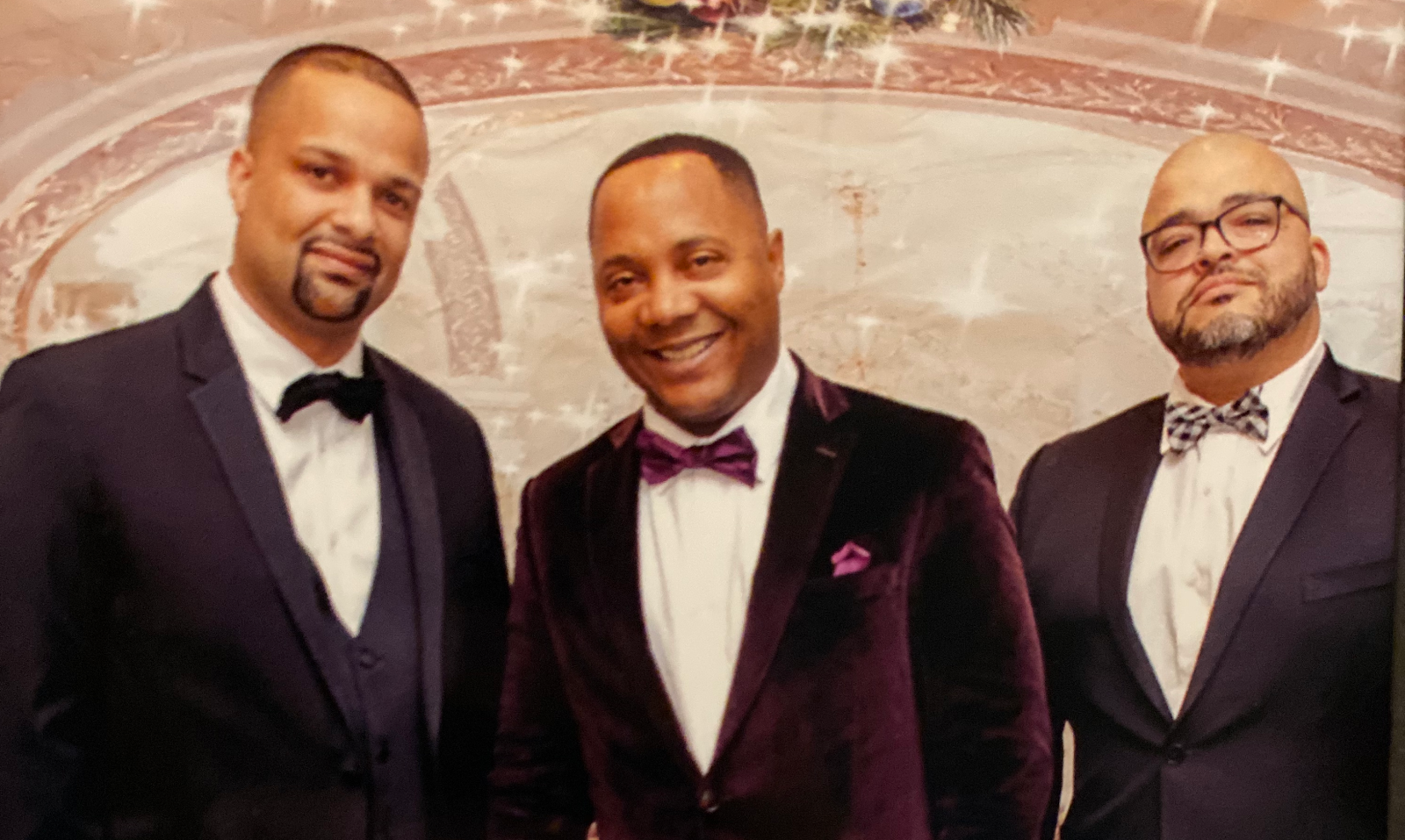
 After years of blending his loves of business and ministry, Dr. Paul Campbell(left) co-founded Brown Venture Group along with Jerome Hamilton (center) and Dr. Chris Brooks (right), a venture capital accelerator focused on technology entrepreneurs of color .

After years of blending his loves of business and ministry, Dr. Paul Campbell(left) co-founded Brown Venture Group along with Jerome Hamilton (center) and Dr. Chris Brooks (right), a venture capital accelerator focused on technology entrepreneurs of color .

This article was originally published here by Bethel University

by Dr. Paul Campbell and Jason Schoonover

Abstract: What if we could take our historical disadvantage, created by systemic racism and artificial poverty, and turn it into our competitive business advantage? What if, by leveraging the platform of technology entrepreneurship, we could bypass many of the cognitive biases which have prevented both economic and human flourishing within our community for centuries? These questions, as well as a biblically informed frame of justice, led my colleagues Dr. Chris Brooks, Jerome Hamilton, and I to co-found Brown Venture Group, a venture capital accelerator focused on technology entrepreneurs of color.

After a successful period working for Sprint, I applied for a job at a large telecommunications company. I felt like I checked every box needed to get the role. I had consistently exceeded expectations. I had buy-in from peers. I’d built a strong network of connections that would be beneficial in the job. I also formed a strong 90-day plan for the new role. Moreover, at the time, I had two master’s—one in pastoral care with an emphasis on leadership from Minnesota Graduate School of Theology in Minneapolis and a Master of Business Administration from Bethel University of St. Paul, Minnesota.

But I didn’t get the job. It went to someone I had worked with, someone I had objectively outperformed. For the first time, I had to admit that it was likely due to racial barriers. Being biracial growing up, I experienced things, but I always said, “I refuse to be a victim”. But as I reflected on my career, I recognized this had been an issue—for myself and for many others. I realized that my problem was not unique to me.The frustrating experience inspired me to form Brown Venture Group; a venture capital accelerator focused on technology entrepreneurs of color. Based on my research, I believe this effort will build organizations that can produce jobs, solve problems, and help overcome racial barriers through technology.

This is a business opportunity that can make a significant return on investment, and it’s a social entrepreneurial opportunity where I can make a tremendous impact by making generational wealth, creating jobs for people who had a hard time getting jobs, and removing barriers to contribution that existed in these organizations.

— Dr. Paul Campbell 

Business and ministry

In many ways, Brown Venture Group blends my callings to business and ministry, of which I have deep family ties to both. My maternal grandfather, Thomas McKee, was born in 1887 and was a pastor for 70 years in the Denver area. My paternal great-grandfather, Columbus Johnson, was also a businessman and minister. Johnson was an “Exoduster” who helped lead former slaves from the south to the Kansas City and Denver areas in the late 1800s looking for opportunities. Years later, my parents did inner-city ministry work in the Twin Cities, and my father, the late Rev. Dr. Bill Campbell, was a highly educated pastor and co-founder of the Minnesota Graduate School of Theology, where I would later earn my first masters and a doctorate in social entrepreneurship. But after experiencing biases that kept him from getting a job, my father joined the Navy as a chaplain in 1989 and moved our family to Virginia. 

After my father died suddenly in 1992, I remained involved at Rock Church of Virginia Beach, where I met and learned from many prominent evangelical leaders and eventually became a youth pastor. Though my time at Rock Church was an entrepreneurial experience, as I helped coordinate concerts and largescale prayer rallies, I felt a tension between my call to ministry and my lifelong love of business. Then in 2006, my mother, Dr. Peggy (Campbell) Rayman, and I traveled to Africa to help train pastors. When we arrived, a local pastor, Abraham Maji, took me around the town of Jos, Nigeria, where I noticed signs of past violence. After Pastor Maji told me of past religious warfare between Christians and Muslims, I asked why it stopped, and the answer changed my life. The warfare was causing economic unrest and was hurting businesses. “When they realized they were killing each other’s customers, it stopped,” he told me. It was kind of this ‘aha’ moment that business could be used to do tremendous good.

I started seeking ways to blend faith and work and was later introduced to the Theology of Work Project, a program that strives to make work more meaningful and productive through a Christian approach. This connected me to Dr. Ron Soderquist of Cru, who became my mentor and directed me to Bethel’s MBA program. At Bethel, I became involved with Work With a Purpose, which helps leaders engage with whole-life discipleship in their workplaces.The experience, connections, and lessons I gained at Bethel helped me to be able to embrace and understand the opportunity to form Brown Venture Group, inspiring me to think critically about solving problems. Chief Advancement Officer Jim Bender met me and asked me to join Bethel’s National Alumni Board. Bender notes Bethel’s programs combine rigorous business training with a Christ-focused core to prepare students to face issues in a unique way. “Paul carries this out as he takes his business acumen, combines it with his MBA education, and then layers in Biblical principles in serving others,” Bender says. 

Taking action

After losing out on the job, I sought a solution instead of staying angry and frustrated. I didn’t want that to be an issue I had to deal with. I wanted it to be the fact that I was out-performed. My work should speak for itself. My research led me to begin to make connections between behavioral economics and racism, that is, racial economics—and to seek solutions that either neutralize or eliminate the harmful impact of systemic racism. My experience at this company kind of forced me to open my eyes to a larger issue. 

I poured over topics around race from issues of today all the way back to reconstruction after the Civil War, slavery, and before. I started seeing patterns that I came to identify as “barriers to contribution” that keep people of color from succeeding and acquiring transferrable wealth. My research revealed a long line of barriers, including states taking measures to keep African-Americans from owning property, voting, and seeking education; redlining policies that kept African-Americans from buying homes in certain neighborhoods—or from buying homes at all; and much more. These barriers were built into education and grew into financial gaps over time. Today, most African-American wealth is in entertainment, sports, music, and similar jobs, but few, I would argue, have transferrable wealth like property.

I wondered why I was able to overcome some barriers earlier in my career, while others couldn’t. Then it occurred to me the reason why was because I was able to use technology as a tool to overcome serval barriers. With this in mind, I researched technology companies and startup programs, finding that only 1% percent of venture capital (Cbinisghts) was given to communities of color, even though they have a similar or better success rate. I started exploring ways to bring startup and funding dollars to the African-American community. That led me to found Brown Venture Group in 2018 with Chris Brooks, a thought leader in Biblical justice and racial equality, and Jerome Hamilton, a pastor and successful businessman. We all came together to start a firm that focuses on accelerating bright ideas that have a hard time getting capital. All three of us bring extensive experience in ministry and smart, sound business acumen. We have this intersection of faith and work.

The Opportunity: Our disadvantage has become our competitive advantage. 

My colleagues and I think that there is a strong case to be made that entrepreneurs of color are one of the most undervalued and mispriced investment opportunities of our time. As a result of hardships endured under artificial poverty created by systemic racism, our communities are uniquely prepared for the rigorous and challenging life of entrepreneurship. From a deal flow and talent pipeline perspective, there is a disproportionate number of highly educated underinvested entrepreneurs of color with profitable, innovative ideas, products, and services that fail to make it to market due to racial discounting and lack of investment. Moreover, our research has shown that by leveraging technological entrepreneurship, we are able to bypass cognitive racial biases. This is because when solving a problem or meeting a need using technology, the person on the end of the supply chain has no idea as to the color of your skin, all they know is that product works or the service met a need.

One of the reasons we chose the accelerator VC model is that it seamlessly integrates discipleship opportunities within each cohort. From a faith-based entrepreneurship and investment perspective, we are able to help propel businesses to success, but another goal is to make a positive impact on the community. By helping groups that haven’t gotten frequent support and opportunities, the entire community will benefit. Our team is fundraising and is already working with six companies as we get ready for a full launch. For example, Brown Venture Group is working with a medical automation and fintech startups Simpli-Fi Automation and MoneyVerbs, respectively.  Simpli-Fi Automation already has two provisional patents on hospital bed devices. The first provisional patent, The Auto Prone Array, is a modular patient rotating bed with a built-in ventilator designed to increase lung capacity of Acute Respiratory Distress Syndrome (ARDS) patients while simultaneously limiting exposure to caregivers. The second provisional patent, The BeBox, is a programable and voice-activated automation medical device which interfaces the components of electric (semi-electric) hospital beds allowing for the automation of functions such as head, foot, and bed height adjustments as well as the integration of a turn assist designed for patients with limited mobility. MoneyVerbs, a fintech startup, created an app that helps Millenials & Gen Z’ers achieve life goals and financial success through gamification, first-person simulations, instructional content, and real-world activities. Moreover, the pioneering research that has gone into the design of the app has been able to quantify the Social Return On Investment (SROI) for active app end-users on the platform.   

Brown Venture Group continues seeking ways to bring undervalued assets to the forefront, and the founders have set their sights high for the future. We want to see a Fortune 500 company come through our program, that we would help scale and launch.

Footnote: https://www.cbinsights.com/research/venture-capital-demographics-87-percent-vc-backed-founders-white-asian-teams-raise-largest-funding/

Appropriate Generosity

by Jeff Smith

I have a blast doing what I do; I work in the “generosity” space. It’s a beautiful sector to spend my time in. Dealing with peoples’ relationship to money is heavy, messy, and glorious at the same time because of the people that I come to know and that come to know me and my family. Having built 6 companies in the marketing space and 3 nonprofits, this sector and our commercial application is no different—we identify a felt need, create value, and serve well. We have found our stride in community formation through Generosity NY, representing a communal expression of heartfelt giving in and around NYC, as well as through GENEROUS.LIFE, the leading national platform for small group activation and fellowship around relevant causes. 

Working in the space, I am witnessing a large gap between donor fulfillment and impact; national giving is up, but the church is feeling financially anemic. And there is a trend from impulsive charity to calculated, purposeful investing. 

I am frequently asked about this nuanced aspect of money as it relates with tithing, investments, and generosity. Questions come from different angles: How do you measure giving success? What is considered a tithe? Can I direct my giving resources toward Christian led businesses? Is that stewardship? … and many more. And then there are the unspoken narratives around stewardship, tithing, giving, and philanthropy—good and bad. 

The aim for stewardship is to mirror and reflect Christ as our Savior and Sustainer. As Paul says in 2 Corinthians, we carry this in our lives as a ministry striving towards that upward call and as ambassadors of His triumph over sin and death. But if generosity is what we are supposed to show and generous is what we are supposed to be, how do we properly navigate stewardship—and our giving and investing? 

Before we can speak to measurement or direction we need to agree on the language. 

To start, let us acknowledge that it is all God’s… all that we own, and are, belongs to God.

Job 41:11 – Everything under heaven belongs to me. 

Psalms 24:1 – The earth is the Lord’s and everything in it, the world and all who live in it. 

Haggai 2:8 (Financial assets) – The silver is mine and the gold is mine, declares the Lord Almighty. 

1 Chronicles 29 – As David watched the Israelites bring forth hundreds of tons of precious metals and gemstones for use in building the temple, he said, “Who am I, and who are my people, that we should give as generously as this? Everything comes from you, and we have given you only what comes from your hand.” 

Deuteronomy 8:18 (Your hands created the wealth.) – Remember the Lord your God, for it is He who gives you the ability to produce wealth. 

Therefore, we are stewards of God’s resources, not owners. We literally were purchased for a price in and through Christ’s life and death. 

Now let us define some terms: 

Stewardship: 

A biblical world view of stewardship can be consciously defined as: “Utilizing and managing all 

resources God provides for the glory of God and the betterment of His creation.”[1] A steward oversees the affairs and property of another person. Being a good steward means to manage our resources well and use them to glorify God. 

“The earth is the LORD’s, and all its fullness, the world and those who dwell therein” ( 24:1). God is the Author of all things, the Creator of all things, and the Owner of all things. Whatever God makes, He owns. What we own, we manage as stewards who have been given gifts from God Himself. God has the ultimate ownership of all of our “possessions.” He has loaned these things to us and expects us to manage them in a way that will honor and glorify Him. 

Giving: 

The word give has been defined as “to make a present of.” One of the many ways we can give to others is to give Financially. Through giving, the early church helped one another and invested in what God was accomplishing. 

Although the Apostle Paul never overemphasized the subject of giving, he never neglected its 

importance either. In 1 Corinthians 16:1–2, we find specific guidelines for giving: it is to be a universal practice for believers; it is to be done regularly; it is a personal act; and it is something we should be prepared to do. As we give, God will meet our needs and prosper us (see 2 Corinthians 9:6–10). 

Tithing: 

At the center of the biblical concept of stewardship is the tithe, which first appears in the Old 

Testament. The word tithemeans “tenth.” The basic principle was that every person was to return one tenth of his increase to the Lord on an annual basis. Old Testament law required God’s people to give ten percent of their income, which could include 

Flocks, herds, or crops. This ten percent was known as a tithe. In addition to the tithe, God’s people were required to give offerings to the Lord for the care of the temple and the salaries of the priests. In the days of Israel, tithing was not voluntary giving. It was demanded as a form of taxation. 

Investing 

To invest is to allocate money with the expectation of a positive return in the future. In other words, to invest means owning an asset or an item with the goal of generating income from the investment or realizing the appreciation of your investment, which is an increase in the value of the asset over a 

period of time. 

Faith-informed investing considers the investor’s financial return and aligns their investment decisions with their Christian values. This is a lens through which to view investing, which has a lot of new 

aspects: faith-based funds, faith-based advisors, etc. 

Faith-informed investing is just like any other type of investment philosophy in that it aims to 

maximize investor returns. Where it does differ from traditional, secular investment plans is how 

individual investors choose their investment professionals and vehicles. Individuals who invest using faith-based principles often choose managers, companies, and investments that align with their own religious values. That’s why this strategy is also called values-based investing. 

Historically, faith informed investing has been around for a while. Early in the 19th century, Quakers and Methodists adopted investment guidelines grounded in religious mission and values. The Vatican has taken a leadership role in Impact Investing and informed investment screening. Catholic Values Investing is guided by the Catholic Framework for Economic life, set by The United States Conference of Catholic Bishops. The Catholic Church recognizes that the financial markets and economy at large are central to humanity. 

There is a phrase that I came to love from honeymooning in Thailand 14 years ago—“Same same, but different.” Stewardship, giving, tithing, investing… they are same same, but different. Stewardship is the umbrella responsibility and term, but there is a distinct difference between tithing, giving, and investing and in how we are generous, faithful believers. 

There is a risk of equivocation between giving and investing. Giving is a direct reaction in effect of your relationship with God. It is core to our being and spiritual communion. Giving reflects a relationship between us-God. Investing is downstream, dependent on a value exchange. Investing reflects a relationship between us-others. 

Here are some other examples of key questions and the differences between various acts of stewardship: 

Do I give my 10% to my local church? 

Under the new covenant, the tithe continues to support the work of building up people in the truth of God and reaching sinners with the gospel. Christ works through churches, seminaries, parachurch organizations, missionaries, and many others to build and grow His kingdom. 

That brings up a controversial question with respect to financing the kingdom. Again, 

in Malachi 3:10, God says, “Bring all the tithes into the storehouse that there may be food in my house.” In the Old Testament, the tithe was brought to a central location, the storehouse, which was managed by the Levites. The whole tithe from the whole nation was brought into this single receiving place, and it was then distributed by the Levites according to the needs of the people. 

Some people believe that means that, in the New Testament age, there should be a single 

storehouse where all the tithes go and from which they are distributed. There are two 

problems with that. In the first place, in the Old Testament, the people of Israel had a single, central sanctuary. When the New Testament church began, churches were established in every town and every city—in Ephesus, in Corinth, in Thessalonica, and so on. No longer was there one central sanctuary. So, the idea of bringing tithes into one central storehouse 

becomes challenging. 

The storehouse is not donor advised. The gift is vertical, to God. Now the storehouses have arguably changed. Where the church was central and poured into the community, in modern day impact, parachurch organizations, ministries, and others are feeding the hungry and serving the poor. So, it has been argued that it’s a decentralized model for getting into the hands and feet of Christ. However, that impact is not controlled by the giver. 

Dr. J. B. Gabrell made this observation: “It is unthinkable from the standpoint of the cross that anyone would give less under grace than the Jews gave under law.” God makes an incredible promise to those who give to His work. He will “open for you the windows of Heaven and pour out for you such blessing that there will not be room enough to receive it” (Malachi 3:10). 

Trouble developed in the Old Testament when the people held out on their tithes. They were not obedient to God’s law. Malachi 3:8–10 tells us: 

Will man rob God? Yet you are robbing me. But you say, “How have we robbed you?” In your tithes and contributions. You are cursed with a curse, for you are robbing me, the whole nation of you. Bring the full tithe into the storehouse, that there may be food in my house. And thereby put me to the test, says the Lord of hosts, if I will not open the windows of heaven for you and pour down for you a 

blessing until there is no more need. 

We systematically rob God when we don’t tithe. Malachi’s teaching indicates that when we fail to tithe, we are not merely robbing the church, the clergy, or Christian educators—we are robbing God Himself. But note that God had words not only of condemnation for the people but also a promise of prosperity were they to change their ways. God challenged them to be faithful, giving His own promise that He would open the windows of heaven and pour out blessings upon them. 

The Levites were set apart to take care of the spiritual and educational responsibilities of the nation, and their work and physical necessities were paid for by the tithe (Num. 18). 

I sold my company and gave 10% into my Donor Advised fund. This will enable me to give this out over time and have my kids give it away… Is this tithing? 

The collective answer is no, or not yet. Understand that the biblical precept of tithing is giving to God a portion of what He entrusts to you at a certain time. Israelites didn’t have a vehicle that trickled or flowed to the priests over time. They brought the season’s tithe and gave it for the ministers’ storehouse. The act of storing capital into a donor advised fund is a smart act of stewardship, but NOT giving or tithing. If we are called to tithe 10%, then 10% into the donor 

advised fund is not giving at all. It is merely a smart tax vehicle to be able to give more. It is storing the seed in a barn. However, until the seed goes into the ground, it is a useless grain. When the funds are contributed to a church or ministry, it is given—it is tithed. 

I have heard many families say that integrating their faith into their investment strategy is leveling-up their giving strategy. Is this true? 

We would confer that it is outstanding stewardship, but it is not giving. There is a fundamental difference between giving and investing. Giving responds to a need often without even being asked. Giving requires empathy, sacrifice, and no strings attached. Giving does not require control over the outcomes. Giving does not expect to have recognition or accolades in return. Giving happens when we remember how God and others have been generous with us, and is motivated by gratitude and joy. Giving is one step: I give. Investment has two parts: I give and after some time… I get. (Although let us not get into the altruism debate for now.) 

Giving is a direct reaction in effect of your relationship with God. It is core to your being and spiritual communion. Giving reflects a relationship between you and God. Investing is 

downstream, dependent on a value exchange. Investing reflects a relationship between you and others. 

One other key mark of giving is that it is a straight cost to us. Investments provide a return. Giving is just that—a one-way transaction. King David claimed his own sin, admitted that it had cost him much suffering, and admitted that his sin was actually also causing innocent people to suffer. And when he admitted this sin and its related suffering, he was instructed to go and offer worship to God on a particular spot. But when he arrived on the threshing floor of Araunah the Jebusite to give God worship, Araunah tried to give David both the land and the animals and even the wood for free. But David, that most real and human being, says an amazing thing. He acknowledges Araunah’s attempt to give him the land, but he says that he will not and cannot offer to God that which cost him nothing. David had come to give, and giving means that it costs us something. His worship is not to be transactional. David came— with all of his faults—to give God worship. 

Some would argue that investing in a Christian led business creates jobs, wealth, and more giving. Thus, the investment is part of their tithe. Maybe? How much of the stewardship conversation is a conversation of the heart? And how much is measured on the scales? 

Their investment’s return is a part of their tithe. No farmer counts as harvest the downstream effects of tending his field. No parent counts the investment in their child in such a way that they are giving to God what the child does in the future. Why claim the blessings of God in the harvest, your family, or your investment outcomes as your contribution? 

Here is a recent case. A leader puts aside capital into a donor advised fund. (Amazing!) Each year, she gives from that fund 10% of her annual income (accumulative salary and investments) to her church and 4 favorite parachurch organizations. (Tithing, Check.) Then she learns that she can make an equity investment into a Christian led for-profit recruiting company that creates jobs for formerly incarcerated men, using her DAF. (Stewardship, Check.) She receives quarterly dividends from her investment back into her DAF. Her DAF also grows tax free through being invested by her financial advisor. (Excellent) At the end of the year, she sees that she gave half what she did the previous year to church and ministries (5%), yet she invested significantly more into a purpose driven investment (5%), and her dividends and DAF investments provided more to be able to give long term (2.7%). Her church is struggling financially and launching a capital campaign. Is this a pass or fail for stewardship? Pass or fail for tithing? 

I feel like there are some common agreements here. If it’s all God’s, and we are stewards not owners, then funding the church and parachurch organizations with at least 10% of our annual income sounds like the baseline. As a portion of the remaining 90%, we should invest with the same principles, as they too reflect our stewardship. If we do not honor or fulfill our roles in living generously, then we are robbing God, the church becomes more anemic, and we miss out on the inherent joy designed for us—a joy defined as “…such blessing that there will not be room enough to receive it.” 

[1] Charles Bugg, “Stewardship” in Holman Bible Dictionary (Holman: Tennessee, 1991), 1303-1304 

Article originally hosted and shared with permission by The Christian Economic Forum, a global network of leaders who join together to collaborate and introduce strategic ideas for the spread of God’s economic principles and the goodness of Jesus Christ. This article was from a collection of White Papers compiled for attendees of the CEF’s Global Event.

Are We Gambling or Are We Investing?

by Jonny Wills

The wager started as most do—with a hint of hubris and a bit of boredom. I was reading about Gamestop and she was watching yet another ad for fantasy sports. The next thing I know, I was signing my name on an index card that put our bet in pen.

“We each get $100. You use Robinhood, and I’ll use DraftKings. Everything within the parameters of the respective apps is fair game. Whoever has the most money at the end of the year gets to keep it all.”

When we were in pre-marital counseling, no one mentioned competition as a bedrock of marital bliss. Which is weird, because it is. The only thing better than competing against my wife, is competing with her, which is something we do regularly as well. This gamble gives us a chance to do both.

Because, in truth, I’m rooting for her. When she bet on Jordan Spieth to hold the lead at Pebble Beach after Saturday, I was elated to watch him hole out for eagle on the 16th hole. And when I lost an entire dollar (1% of my net worth!) in Dogecoin overnight, she lamented alongside me.

But it was her win and my loss that made me ask this question: are we gambling or are we investing? And which one of us is doing which?

Candidly, my wife knows more about most sports than I do about most stocks. So, if her allocation of resources is more informed than mine, am I the one who’s really gambling? Is she the one investing? Are both of us irresponsible?

An influx of novice investors is blurring the line between investing and gambling, so where do Faith Driven Investors step in? What are the gaps in this conversation that we can fill?

The Bible has a lot to say about mustard seeds and talents and treasures. I know because I’ve read all the verses. But I don’t know if what we’re doing is in the boundaries of stewardship. I get that $100 each is a relatively miniscule amount of money. And yet, there’s a principle here. How should I view the resources God has put in my hands? Is money a toy or is it a tool?

We have enough money to where if we both lose it all, we’ll be okay. A $200 loss will take away some discretionary spending, but we’ll still be able to eat. Is that how we should look at investing? Or is that how we should look at gambling? Or is there any difference between these two?

This is the part where I give you a conclusion that ties a bow on this idea. I don’t have one. Instead, I’m asking you to write the conclusion for me. Comment below what you think of this bet, message me through whatever social media platform you found this on, or do whatever you’ve got to do to share your opinion. I genuinely want to hear it. 

Are we gambling or are we investing?

[ Photo by Heather Gill on Unsplash ]