Banking on Hope

Photo by Jason Pofahl on Unsplash
Banks are largely impersonal, making it easy to get loans and good service if you are wealthy and quite difficult if you aren’t. The whole system is set up to avoid risk, tying creditworthiness more to capital than character. Inspired by faith that sees the infinite worth of each person, Guardian Bank in India takes a different, more humane and hopeful view that also provides hope for everyday households and commercial customers.
Because He Lives

Image from original post
Article originally posted here by Sinapis
What do you say to an entrepreneur who might have to lay off their entire staff?
What do you do when those employees need those jobs to survive?
These are painful questions for us. At Sinapis, our mission is to make disciples and alleviate poverty through the power of entrepreneurship. We believe one of the best ways to help the poor is to support growing businesses that create and sustain jobs. The entrepreneurs we serve lead small and medium-sized businesses (SMEs) in seven emerging market nations (Kenya, Uganda, Rwanda, Ghana, Liberia, Brazil, and Egypt). They are entrepreneurs by choice, not by necessity and work to grow profitable, faith-driven companies that provide for others and build the local economy.
These companies and the jobs they provide are under incredible pressure in this time of uncertainty.
Brian Gacheru is a Sinapis alum and the CEO of Pristine Linen and Laundry. The company provides commercial laundry and linen rental to the hospitality industry in Nairobi, Kenya. In late February – just over 5 weeks ago – his business was booming. Then COVID-19 happened. Fear gripped the world. Cases started to emerge in East Africa. Governments quickly put in place containment measures including closing borders and restricting air travel. Schools were closed, public gatherings including church services were discontinued, and curfews were instituted. Thus far, less than 350 cases have been confirmed across Kenya, Uganda and Rwanda, but it is too early to know how the disease will spread. What is clearer is the destructive economic impact of the crisis. For Pristine Linen, it’s primary customers are high-end hotels. As business and leisure travel turned off like a faucet, 90% of Pristine’s revenue dried up. Brian shared,
“Things have changed so quickly. A month ago, I was planning to hire a consultant to help me plan for the next stage of growth in my company. Today, our business is almost completely on hold.”
COVID-19 is testing the entire global community in ways we haven’t seen since World War II. Uncertainty and fear have become a daily reality everywhere, but this crisis could be particularly devastating in less developed economies with weaker health systems and reduced social safety nets.
According to the World Bank, growth in Sub-Saharan Africa has already been significantly impacted by the coronavirus outbreak and is forecast to fall sharply from 2.4% in 2019 to -2.1 to -5.1% in 2020. This would be the first recession in the region over the past 25 years. From an employment perspective, SMEs are vital. They provide two-thirds of all jobs worldwide and account for the majority of new job creation. Most SMEs are not able to transition to remote working, and few maintain more than two months of cash reserves. Even temporary disruptions in cash flow can wreak havoc on the business and on its employees whose families depend on a regular paycheck for survival.
As governments in these markets fight the spread of the virus, challenges abound. Testing capacity and ICU beds are in short supply. Large and densely populated cities make social distance a luxury that many cannot afford. For the urban poor, life is lived day-to-day, and sheltering in place for weeks at a time is not possible. The crisis is forcing many to travel to their home villages, which could further the spread of the virus. Limited government budgets constrain the amount of fiscal and monetary policy that can be offered to support a recovery.
In the face of the uncertainty and their own fear, the entrepreneurs we serve continue to use their businesses to advance God’s kingdom. One Sinapis alum has invited three employees and their families who lacked savings to live with his family until the crisis passes. Another has chosen to equally divide any ongoing profits that the business generates among the staff to ensure that everyone can pay rent and feed their children. One alum who has successfully managed his business for over 18 years was forced to lay off all eight of his employees. However, he is training them to grow emergency gardens in 20 litre containers and plans to distribute food packages in the weeks ahead. Yet another is distributing food to families in Kibera slum. Businesses dedicated to God play an essential role in promoting human flourishing in good times and in bad.
As we prepare to celebrate Resurrection Sunday, it is an opportunity to remember that we serve a God of hope. Our King died for our sins and conquered the grave. He rose victorious and sits on His throne today. No matter what we face, we can rest in the fact that our loving, compassionate God lives and reigns over everything.
A well-known hymn called “Because He Lives” captures this well. The song was written in 1971 during a time of social upheaval. Its chorus offers a trust-filled picture of confidence in Christ while not ignoring the struggles of life in a broken world.
Because He lives, I can face tomorrow
Because He lives, all fear is gone
Because I know He holds the future
And life is worth the living, just because He lives
The days ahead won’t be easy. Lives will continue to be lost. Many businesses will fail, and jobs will go with them. We do not know how this will affect the most vulnerable, and we are praying and working to preserve life. Entrepreneurs and business leaders placed by God in the marketplace are using what they have to minimize the impact on their employees and their dependents. They will fight to innovate and emerge stronger on the other side. But knowing He lives and holds the future, we can face this together with courage and hope.
FOR MORE INFORMATION ON COVID-19, PLEASE SEE OUR PAGE HIGHLIGHTING SOME OF THE BEST RESOURCES OUT THERE FOR FAITH DRIVEN INVESTORS & ENTREPRENEURS IN THIS SEASON.
Believing in Impact Investing

Photo by Edward Howell on Unsplash
It’s a short distance between social good and spiritual growth. But for whatever reason, this is a relatively ignored fact.
One of the more perplexing realities of impact investing is that the movement has not been led by believers. The GIIN (Global Impact Investing Network) 2020 Report revealed that the majority of impact investors were not faith-driven—a surprising fact given the biblical mandate on believers to love and serve others as an act of worship. But as FDIs step more boldly and directly into the impact investing space, we get to be a part of changing the reality.
We recently sat down with Mike Silvestri to talk about the excitement and potential of social impact bonds and the hope for FDIs to lead in perplexingly secular space of social impact investing. A Harvard Business School alumnus and Boston resident, Silvestri knows the difficulty of being a faith-driven investor in a largely secular city. He explained that he sees his role as “a prophet to my own people,” where he can make the short hop from socially conscious to Spirit-led investing, and take advantage of the opening that social/impact investing provides for gospel conversations.
The truth is, many of the goals of social impact investing are derived from biblical mandates. On a global, macro-level, even the United Nations’ Sustainable Development Goals are rooted in the gospel mission. Ending poverty, caring for the environment, eradicating disease and ending the hunger crisis, all of these are easily tied to commands in Scripture to love God and our neighbors. The biblical mission is the ultimate why for FDIs—and perhaps unknowingly, informs impact investors’ motivation as well.
When asked about living and working in a city that is in many ways, resistant to faith, Silvestri said that he is excited about operating in a space where people care about biblical values, whether they recognize them as such, or not. After all, building up communities and providing and enabling development are biblically aligned goals at the heart of socially responsible or impact investing. The close connection between gospel-aligned and gospel or faith-driven goals gives FDIs like Silvestri an opportunity to lean into faith in very clear ways.
Social impact investing bridges the gap between tithing and secular investing—and is a more sustainable method than solely relying on charity to build communities. Engaging in this practice can be, Silvestri noted, a form of Christian stewardship. This means that practitioners integrate their finances with their faith for the purpose of honoring God with what He (as the owner of it all) has given them to manage.
There is learning on both sides of social impact investing; believers can speak to the foundational motivations behind the practice, and the seasoned investors bring their own knowledge that can enable practical growth for the FDI community. Silvestri explained that a key to social impact investing is understanding root causes of issues that plague society. Where impact investors expend time and energy to understand the physical or systemic factors underlying these issues, FDIs know that even the deepest awareness of these is not the ultimate concern; rather, the core need of every person, in every place, is to know and put their faith in Jesus.
So for FDIs like Mike Silvestri, being able to both pray for and provide tangibly for those in need is an exciting opportunity that has the power to change investors, beneficiaries, and communities. If FDIs lead the charge of social impact investing, they can raise the bar not only in what to invest in, but in how to invest. Bringing knowledge and business acumen into their desire to live missionally, FDIs will set a standard of operational excellence and a deep level of gospel-driven care and compassion throughout the process. If done well, this opens the door for gospel conversations and can transform cities.
Beyond an Ethic of Do No Harm
Photo by Mar Ko on Unsplash
by Mike Sharrow
What does it mean to be a faith-driven entrepreneur, or a “steward” of a business? It’s so easy to settle for essentially an ethic of “don’t do bad things” and some token expression of generosity. Is “do no harm” and tipping Jesus with a percentage of wealth (the real question is what do we keep not what do we give if it’s all His, right?) the fair test? Perhaps an exercise in the form of a fabled case study where you enter into the story might help…
An Unplanned Owner/Investor Site Visit
Imagine arriving at work tomorrow, parking your car in the usual place, and walking toward the entrance. Everything seems normal. As you near the door, you notice a figure waiting just outside. As you approach, you sense a warm and open demeanor and reception. This person is obviously a friend.
A few more steps and you recognize him. It’s Jesus! He says, “I’d like you to show me around and explain the business to me. This is as much mine as any church is, so I’m curious to see what you’re doing with the business I entrusted to you to manage for Me.” In your mind’s eye, imagine yourself saying, “Well, fine, Lord, let’s go in.” Gulp.
Imagine taking Jesus through the reception area and into the office, then into your personal office, through the work areas, and around the entire physical location. Imagine Him keenly observing the way you and your team interact as you take the tour. Think about explaining how and why everything is laid out the way it is. Mentally introduce Him to each person, while explaining their function and a little about them.
Sit down with Him in your office or conference room and describe how each piece of the business functions, from the different ways of contacting customers, to the production and delivery of the product or service, to billing clients and collecting payment.
Tell Him how people are hired, trained, evaluated, encouraged, equipped, challenged, compensated, promoted, disciplined, or fired. Explain how you handle complaints and suggestions from customers, suppliers, and employees.
Take Him through accounting, showing Him how you pay bills and handle taxes. Discuss how you use or distribute profits and who benefits from them. Show Him the company’s debt and explain how and why the leveraging works. As you engage in each of these areas, imagine saying to Jesus, “Lord, this is how we try to show You and Your principles in this function or action… this is how we think You would do this… Lord, we do this so we won’t bring offense to Your name… Jesus, we don’t do this the world’s way because of what You said in Your Word.”
Does this process excite and encourage you or does it cause you to break out in a cold sweat? Is there a process, business practice, or person that you’d want to avoid in this tour?
MOVING FROM METAPHOR TO OUR DAILY REALITY
In reality, this describes a typical CEO visit to a branch or subsidiary operation with an inspection tour guided by his local general manager. During any such tour, you demonstrate and discuss your major priorities, emphases, and progress against corporate business plans.
The visiting owner or CEO verifies that the location consistently and successfully applies the basic plans for business development and growth. He looks for results but is acutely interested in alignment, commitment to company goals and principles, and evidence of capable “process,” knowing that diligently following the corporate strategy drives desired results.
In our businesses, God conducts this review continuously. God does have a plan for our lives, and it includes every aspect: home, work, community, social, recreation, and any other area you might identify. You could say that there is a performance review as stewards, but it’s an open Book test!
Further, His plan always desires the same end, consistently reflecting His values.2 While the environments or playing fields may change, His eternal purpose, to manifest the gospel of Jesus Christ, never changes. His ultimate purpose, to bring forward the Kingdom of God, drives everything God does and allows. Nothing in God’s world “just happens.”
In our businesses, as in every other area of our lives, we can either recognize this reality or miss it completely. The choice is ours. If we see our business primarily as a tool to produce money for ourselves, we primarily concern ourselves with how well it generates cash, and we’ll focus our attention, develop strategy, deploy people and assets, make decisions, and drive actions primarily toward that end. On the other hand, we might see our business as a part of God’s eternal plan, entrusted to us and designed to fit into an intricate and beautiful master plan to strategically contribute to sharing Christ with the world. In this case, our decisions and evaluations reflect different values, and we attempt to structure what we do to produce a more Godly set of results.
MOMENTS OF TRUTH…THE TRUTH!
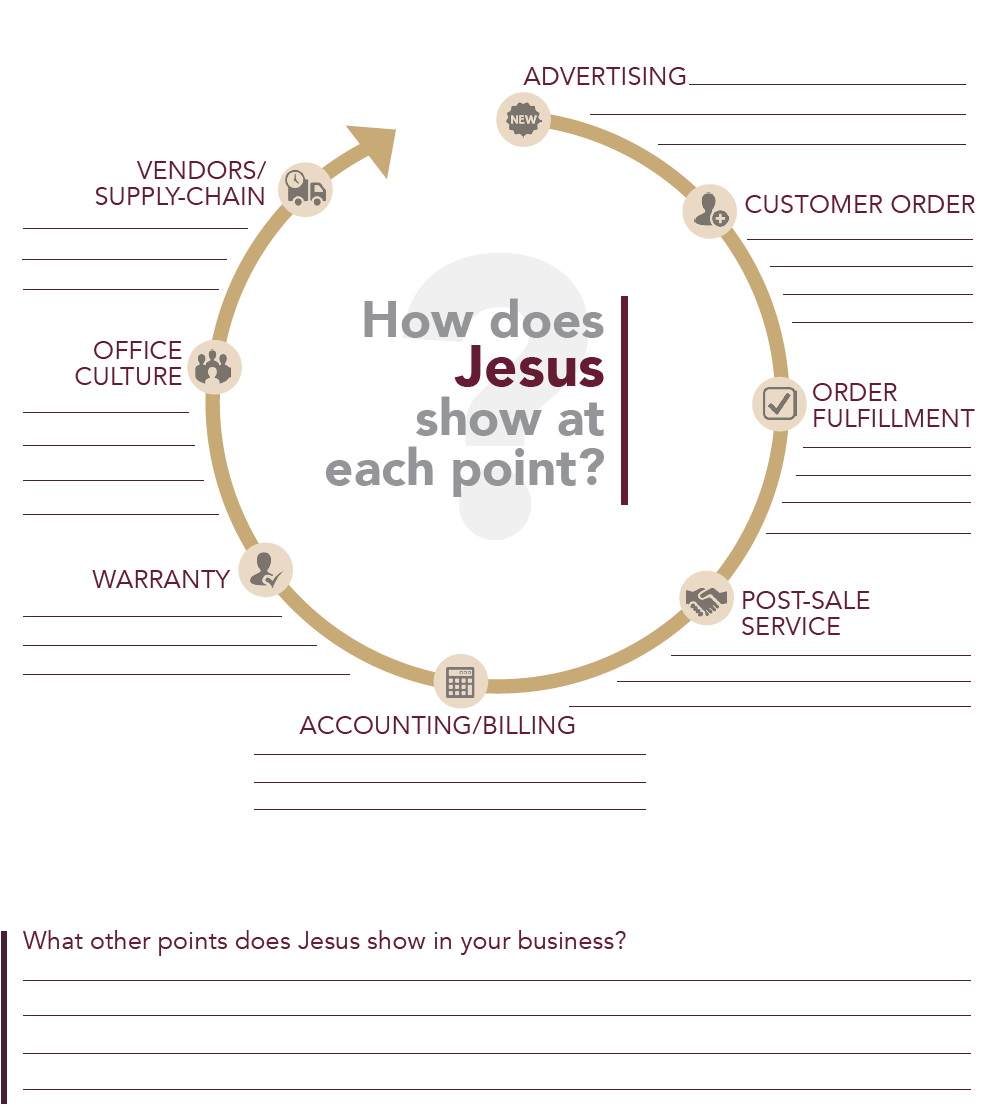
The “Moments of Truth” diagram initially popularized in the 1980s by Jan Carlzon’s famous turnaround of Scandinavian Airline Systems. The helpful diagram behind that concept invites any leader to assess every possible business-to customer touchpoint and assess deficits or opportunities.
So What?
As Christians, isn’t this model equally relevant as a lens through which to evaluate how effectively every element of the company demonstrates Jesus as the true Owner? Doesn’t every point along that process represent an opportunity to either shine or betray our true purpose?
So, what if Jesus was waiting for you at the company entrance tomorrow for His tour? Are you ready? Do you have thoughtful answers for His questions concerning His primary interests? Do you have a plan centered on His values and purposes to guide you as you evaluate and develop each part of the business?
God entrusted you with an incredible platform…what opportunities will you seize? Where or what do you need to change to reflect the true Owner of your business?

Beyond Startup Accelerator

Photo by Croissant on Unsplash
Article originally posted here by Cedarville University
by Dick Blanc
Dick Blanc ’82 is Executive Director of the newly formed Beyond Startup Accelerator, the business incubator at Cedarville University. Blanc has always liked venturing into the unknown, whether it’s sailing across the Atlantic Ocean at age 19 with a bunch of buddies or bootstrapping an entrepreneurial venture. He thrives when he’s given a clean sheet of paper and time to dream. But even a courageous captain needs dependable ways to navigate strange and exciting waters. That’s where Blanc’s yearly practice of reading through the Bible and tapping into the wisdom and counsel of a trustworthy and godly crew of friends comes in.
Blanc is the Executive Director for the Beyond Startup Accelerator, which connects student and alumni entrepreneurs with expert counsel and potential sources of investment.
For the last 25-30 years, Blanc has made a habit of reading the entire Bible through in a year. That habit of soaking in the Scriptures began for Blanc during his undergraduate days. Cedarville offers a four-year Bible-reading plan for students to begin their own habit of feeding themselves from God’s Word.
Bitcoin and Austrian Economies

I probably know what you are thinking—probably the same thing I thought in 2014 when I first heard of Bitcoin. My business serves as an alternative asset custodian, which means that we assist people with investing in all sorts of unique, and sometimes even weird, assets (mostly through tax-free or tax-deferred retirement accounts). One of the best things about the help we provide is that we do not advise or recommend investments. Therefore, it does not matter to us what our customers invest in, so long as we can securely hold and accurately report on the investment.
Believe me: Some people can come up with some strange things to invest in! To me, none were stranger than the one we were asked to custody back in 2015. It was this thing—or was it even a thing? I wasn’t really sure. After quickly researching this “Bitcoin,” I affectionately labeled it as “nothing that is apparently worth something.” To be honest, this was kind of a running joke around the office.
However, I started to notice this sizable following for this mysterious “cryptocurrency,” and no one else in our industry was providing regulated custody to this group. Being an opportunist businessman, I lead my staff to develop a system and technology to custody these assets and protect them from money laundering, bad actors, hackers, and everything else I had read were the greatest risks to a cryptocurrency investment.
Did I believe in Bitcoin? Absolutely not. Did I understand Bitcoin? Absolutely not. Did I have a desire to understand it or invest in it? Absolutely not! But the same could be said for most of the 20,000 assets that we hold for our clients. I simply had a desire to fulfill my passion and the calling of our business which is to empower Americans with the freedom to invest in whatever they wish to invest in without being limited by the government or their investment broker.
This is where I must stop and not confess but profess my Libertarian-leaning views. I might as well, because they are splattered all over my business as well as the remainder of this paper. I am at my very core first a child of God and a passionate Jesus follower. Second, I am a patriotic American. I believe in personal freedom and choice, and I am not a fan (in most cases) of government intervention or manipulation. And, of course, I believe in capitalism.
Years ago, through these beliefs and overall concern about the U.S. economy, I became a follower of Austrian economics. I will cover Austrian economic theory a little later, but first, back to Bitcoin.
As we released our regulated custody product for Bitcoin, I began to meet many people from the industry. Some were real quacks! There were plenty, however, that were smart and had honest contributions to bring to the investment space. So, my company helped organize the discussion, and in late 2016, we helped put on the first Bitcoin conference for institutional investors. I asked the smartest in attendance what excited them so much about Bitcoin—to the point that many were willing to now devote their professional lives to it. The first four I asked provided similar responses, and within the first few sentences, each mentioned Austrian economics and how Bitcoin was a possible way of reintroducing its most important theories to the world.
I must admit, I had studied these theories previously, but I did not get it. How does “nothing that’s worth something” correlate in any way to Austrian economic theory? So, with an open mind, I began to research. Allow me to explain so we can explore the theory and the connection to Bitcoin together!
What is Austrian Economics?
The Austrian School of Economics is a heterodox school of economics based on
methodological individualism, the concept that social phenomena result exclusively from the actions and choices of individuals. This school of thought is typically associated with libertarianism. Austrian Business Cycle Theory (ABCT) explains why many Austrians view commodity-backed (typically gold-backed) currency as superior to fiat currency. In layman’s terms, ABCT claims that excessive inflation of money supply, typically driven by a central bank or government, creates an artificial boom that ultimately results in its own bust.
This boom is driven by malinvestment, which is investing in the wrong lines of production because of a distortion in price signals. This is caused by excessive expansion of credit, often in the form of artificially low interest rates created by the central bank. However, a “bubble” occurs as malinvestment results in an inflation of goods, and eventually a bust will occur when banks become risk-averse to the accelerated pace of the boom and consumers re-establish their preferences of consumption and saving at prevailing interest rates.
The crisis can be delayed by continuing to pump new credit into the economy. But by delaying the inevitable bust, over-leveraging becomes even more severe and, thus, leads to an even bigger bust. At this point, which is full-blown crisis mode, the economy must adjust. As we know, this adjustment period is difficult for the public, as wages fall and unemployment rises, and public sentiment quickly turns from optimistic to depressed and despair during this bust period. Austrian economics is based on true supply and demand that is free from manipulation or “currency printing” by a centralized bank or government.
What is Bitcoin?
I will avoid a deep dive into the technical side of Bitcoin in this paper. Bitcoin was the first use of blockchain technology, which requires its own very technical explanation but is nonetheless very fascinating, has many uses, and in many ways could change our world. That said, for this paper, let’s identify a few key features you should know about Bitcoin:
-
Bitcoin is decentralized. The Bitcoin network is not a company, is not owned or controlled by anyone, and cannot be changed or manipulated by anyone or any government.
-
Bitcoin is truly scarce since only 21mm Bitcoins will be released into distribution. The timing of release of these Bitcoins is pre-programmed and known by all. It is immutable. It is arguably the only form of payment or medium of exchange in the history of mankind that has true unmanipulable scarcity and supply and demand. Because of this, it is deflationary (opposite of inflationary), which is praised by Austrians (and criticized by Keynesians, who believe in using government spending and inflation as a remedy for economic crisis).
-
Bitcoin has all the characteristics of money (durability, portability, scarcity, divisibility, and recognizability) based on the properties of mathematics rather than relying on physical properties (like gold and silver) or trust in centralized authorities (like fiat currencies).
-
Bitcoin is transparent. Everything from the programming of the network to each transaction performed on the network is public and viewable by anyone. While we have all heard about criminals using Bitcoin, misuse of money and money laundering is no more prevalent in Bitcoin than with fiat currencies. Further, as technology expands, Bitcoin and blockchain will play a greater role in helping stop illegal use of funds around the world. A top DOJ official once told me they “wish every criminal would use Bitcoin” because it would make their job much easier.
-
Bitcoin is global. At current growth rates, some estimate that soon, more people in the world will own Bitcoin than own a United States dollar. Bitcoin has no boundaries and is available to anyone with access to the Internet or satellite network. Regardless of government restrictions, it can be accessed by banked or unbanked individuals around the globe.
Bitcoin and Austrian Economics
Bitcoin is a technology and asset birthed by the global financial crisis of 2007-2008. At that time, many Austrian economists dismissed it as fiat “magic money,” much like I did. But just over a decade later, many Austrians are very open to Bitcoin and believe it, at least potentially, qualifies as sound money and is firmly within the ideology of 20 -century pioneers Mises and Hayek.
Many Austrians initially criticized Bitcoin because they felt it came out of nothing and had no use as a commodity in and of itself, thereby breaking Mises’ Regression Theorem and rendering its value baseless. However, Jeffery Tucker helped champion the belief that the value of Bitcoin derives from itself, in the sense that it is simultaneously a technology and a currency—an idea that was understandably complexing to many economists at first, especially those that didn’t understand the technology.
Yet, Bitcoin was indeed the first to be both a payment solution and unit of currency at the same time. The utility of the blockchain provided Bitcoin value before it even became a medium of exchange (which was months after launch) and, thus, actually confirmed Regression Theorem.
Many Austrians now realize that their belief in the gold standard requires governments to institute it and not manipulate it, which will likely never happen. Hayek came to believe in the denationalizing of money, or free banking system, back in the 70s. Bitcoin is likely the first currency of the modern era to put this Hayekian ideal into action.
While some Austrian Economists are still skeptical about Bitcoin, I have found that most true “bitcoiners” (those who believe and invest in it not because it is high or low but because they believe it is the future of money, or “digital gold”) are, whether they realize it or not, proponents of Austrian Economic Theory.
Bitcoin’s value may go up, it may go down, and, who knows, it may even go away. Whether you like it or despise it, I hope this paper helps convey the economic theories driving global Bitcoin adoption. To some, Bitcoin is a joke or a scam, and to others, it is a speculative investment. For others, though, it is a deeply held passion or belief, and for many, it is a lifeboat protecting them from losing their life savings to a failing government-backed currency. I have met many people in each category. Before you speak too loudly (like I did), I challenge you to perform your own research, and then decide in which category you belong. Because, whether you like it or believe in it or not, you really should consider paying attention to it. God Bless!,
Article originally hosted and shared with permission by The Christian Economic Forum, a global network of leaders who join together to collaborate and introduce strategic ideas for the spread of God’s economic principles and the goodness of Jesus Christ. This article was from a collection of White Papers compiled for attendees of the CEF’s Global Event.
Recent Posts
- Episode 220 – Why Charity Alone Can Never Solve The World’s Greatest Problems
- Episode 219 – The Eternal ROI No Investor Should Miss | Randy Alcorn
- Episode 218 – Marks on the Market: Iran, AI, and a Dynamic Market Environment | Brian McClard & Matt Monson
- Episode 217 – How Kingdom Advisors is Shaping The Future of Faith-Driven Finance | Rob West
- Episode 216 – Marks on the Market: America’s Push to Reshore U.S. Manufacturing | Steve Cook (LFM Capital)