Enterprise Stewardship

 Photo by  Paramdeo Singh  on  Unsplash

Photo by Paramdeo Singh on Unsplash

by Pete Ochs

From a Christian perspective, what is the purpose of business?  From the top business schools to the renowned economists of our day, the conventional wisdom is that the purpose of business is to maximize shareholder value. While this paradigm has brought many of the world’s poor out of extreme poverty, capitalism, without values, has created a voracious appetite of personal ambition that can extinguish the very good it fosters.  One must simply look at the likes of Enron, the tech bubble, the financial crisis of 2008, and quotes by well-known socialist politicians calling capitalism “unsustainable” and “irredeemable” (Burke 2019). Capitalism is a system that nurtures economic success, but in and of itself lacks the principles that make it virtuous. 

The purpose of business must be answered with the cross in mind. The redemptive purpose of business is to be a catalyst for flourishing.  Flourishing, the economist Anne Bradley explains, is “God’s Kingdom on earth.” It’s us living in God’s abundance, “as an image bearer of our creator.” Flourishing means becoming everything we were created to be.  Flourishing is what the Old Testament calls a blessed life, shalom.  Shalom, or human flourishing, was fully manifested for a brief period in human history. This period was after the creation of man but before man chose to be his own moral authority. Genesis 2:15-18 lays out this flourishing scenario for us. 

“The Lord God took the man and put him in the Garden of Eden to work it and take care of it. And the Lord God commanded the man, ‘You are free to eat from any tree in the garden; but you must not eat from the tree of the knowledge of good and evil, for when you eat of it you will surely die.’ The Lord God said ‘It is not good for the man to be alone. I will make a helper suitable for him.’”

This passage lays out three essential elements required for flourishing: material provision, authentic relationships, and a purpose for living. 

The first is material provision. God placed man in the garden to work it and take care of it (verse 15). And the result of work is material provision – food, clothing, and shelter. These physical necessities of life we call “economic capital.” 

The second is relationships. Seeing that it was not good for the man to be alone, God created a helper (verse 18). We were created to live in community, to live with deep, authentic relationships with our fellow man.  It happens when like-minded people pursue the common good. This we call “social capital.” 

The third element is a strong purpose for living, a Moral Code, without which man cannot peacefully and successfully live in a free and open society. In verses 16 and 17 God defines the difference between knowing good and evil which is essential if we are to flourish.  The complexities of living in community with market-driven economic transactions, interdependent relationships, private property, and competing interests cannot be beneficially managed without a rule of law, a Moral Code, a Purpose for living for something greater than yourself. This is called “spiritual capital.” 

Over the last twenty years our company, Capital III, has come to fully embrace this triple bottom line approach to business. The philosophy or business model that we employ to ensure that our company creates economic, social, and spiritual capital is called Enterprise Stewardship. 

Enterprise Stewardship

An enterprise is “a business venture, especially one requiring boldness and energy.” Stewardship is “the trusted management and protection of another’s property.” It then follows that “Enterprise Stewardship” is “managing with boldness and energy the business ventures God has entrusted to us.” 

When a business is operating with these principles in mind, the business can be a catalyst for flourishing and the common good. This redeemed enterprise is operating at the intersection of economic, social, and spiritual capital creation. The most thrilling part of embracing this concept of Enterprise Stewardship is that it gives each of us a significant part in solving the world’s greatest problem: the poverty that is simultaneously economic, social, and spiritual.

Economic Capital

Economic capital is the material benefit derived from the stewardship of our LIFE (Labor, Influence, Financial resources, Expertise). It is the result of work that creates wealth that when accumulated results in capital.  The major question surrounding economic capital is this.

How should we as business people, allocate the economic capital (wealth accumulation) created by our businesses?  More specifically, how much should we retain to grow the business?  Should we maximize the bottom line or maximize the benefit to our employees?  How much should be allocated for dividends to the shareholders?  What is an appropriate ROI?  How much of our business profits should be invested in Social and Spiritual capital?  How much should we invest in job creation?  How much is enough?

The answers to these questions are not easy or straightforward, but they are questions we must address if we are to fulfill our role as stewards.  As we do this, we must remember that the primary purpose of economic capital creation is to foster the enjoyment and fulfillment of work itself, not to focus solely on the outcome, profit.   Our work is worship but we should not worship our work.  “So I saw that there is nothing better for a person than to enjoy their work, because that is their lot. For who can bring them to see what will happen after them?” (Ecclesiastes 3:22).  

Social Capital

Social capital is comprised of the mutual benefits (economic, relational, emotional, political, spiritual, etc.) derived by a group of like-minded people pursuing a common cause. The key driver is relationships with the vision to promote the common good.  

Social capital demands mutual trust, common beliefs, and shared rules. In one sense, it’s all the things economic capital can’t buy. Social capital manifests itself in the form of safe communities, good race relations, happy employees, an unpolluted environment, fine art, great music, patriotism, unified families, bipartisan politics, and a genuine love for our fellow human beings.  

Social capital is created when we obey the Great Commandment; “Love your neighbor as we love ourselves” (Matt.22:39).  This then begs the next great capital allocation question.

How do we love our employees as we love ourselves?  Or in other words, how do we promote the common good in our businesses?  How do we help our employees become all that God wants them to become?  Do we truly offer the best benefits and pay?  Are we a place where relationships reign supreme?  Are we the best place to work?  Will our employees wholeheartedly agree that we live up to the values and virtues we espouse? Are we willing to spend the economic capital necessary to create social capital?

Social capital creation is essential if we are to live out the Great Commandment and love our neighbors (employees) as we love ourselves.  

Spiritual Capital

Spiritual capital defines the moral code by which we live and ultimately is the purpose for living.  It defines our why. For those of us who are Christians, it requires our whole-hearted allegiance to living faithful lives devoted to growing in our personal relationship to Jesus Christ and obedience to His Word.  

Spiritual capital is essential because it lays down the rules by which we create economic and social capital.  Capitalism without a moral code results in greed.  Capitalism with God, results in generosity.  Government without a moral code results in totalitarianism.  Government with God, results in political freedom.   When God is taken out of our culture it creates a moral vacuum that must be filled.   Most often this vacuum is filled with GOVERNMENT (rules and regulations) instead of GOD (self-governance) often leading to a loss of religious, political, and economic freedom.   If Spiritual capital is essential for flourishing, here then is the question for those of us in business. 

How do we, using the platform of business, take part in living out the Great Commission?  How do we winsomely share the love of Jesus with our team members?  How do we create a spirit of comradery without establishing a quid pro quo?  How to we honor God in all we do?  How do we publicly profess the name of Jesus to all we encounter?

Spiritual capital creation should be our answer to sharing the Great Commission.

How then should we do business?

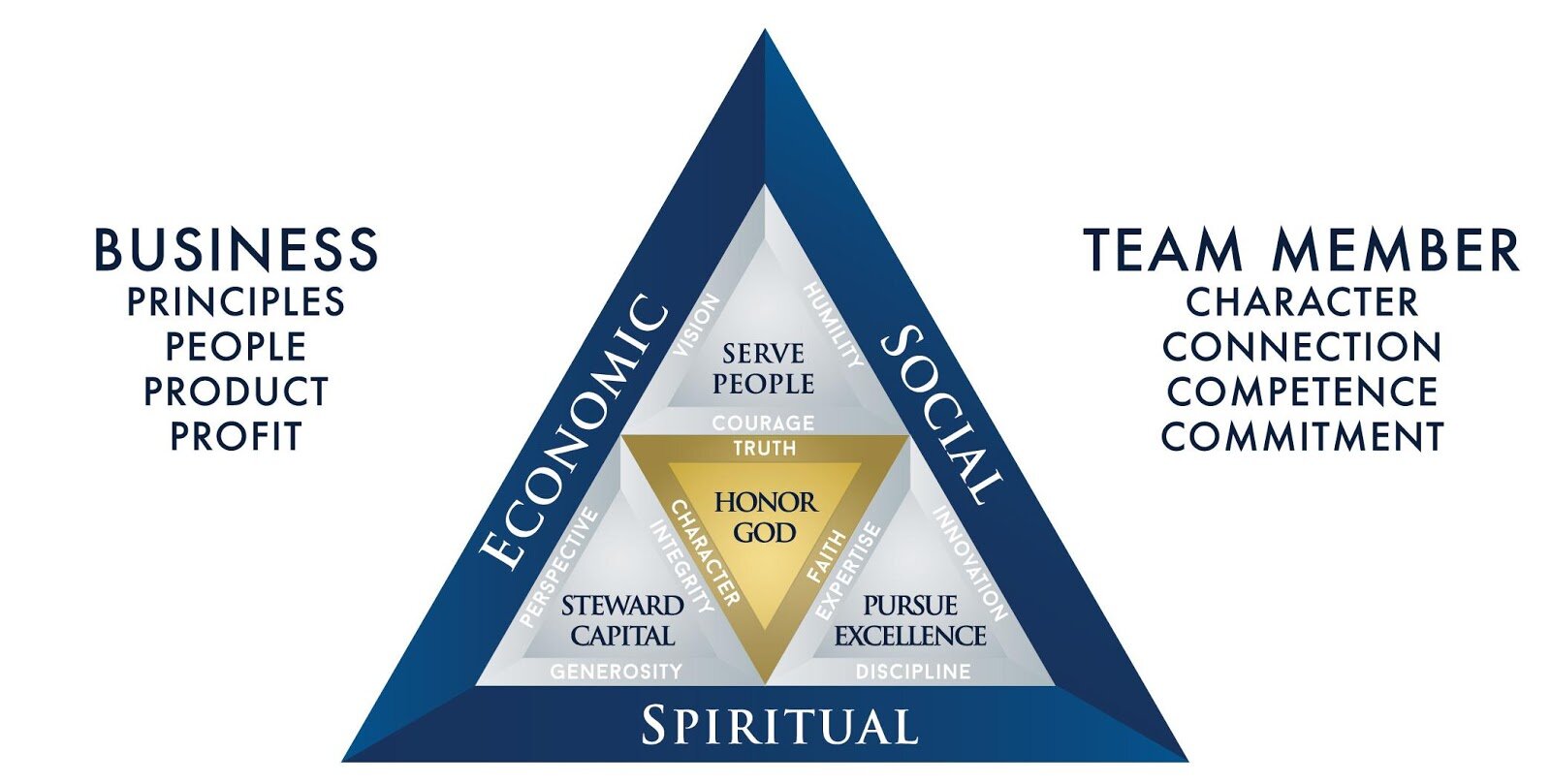
You cannot have a redeemed business, enterprise stewardship, without having a redeemed steward as the leader.  Over the years we have come to embrace the four P’s that are essential for a successful business.  These are Principles, People, Products, and Profit.  Without all four fully functioning in a cohesive manner, the enterprise will not attain its potential impact for good.  Consequently, we have developed our values around the four critical components of business and they are reflected below:

Principles – Honor God

People – Serve People

Product – Pursue Excellence

Profit – Steward Capital

The most effective tool we use in our business is simply to ask these four questions whenever we have a major business decision. 

  1. Will the initiative Honor God?

  2. Will it allow us to truly Serve People?

  3. Can we do it with Excellence?

  4. Are we being good stewards by making this decision (investment)?

The enterprise is operated and evaluated according to the four P’s (Principles, People, Product, and Profit) which are governed by our four values (Honor God, Serve People, Pursue Excellence, and Steward Capital).

How then do we lead and evaluate the steward(s)?  We do this by associating a character trait to each of our four values.   We call these character traits the four C’s.  And their corresponding value is shown below. 

Honor God – Character

Serve People – Connection

Pursue Excellence – Competence

Steward Capital – Commitment

If one is to be a faithful steward they must be a person of Character (they Honor God), they should exercise the gift of Connection (they Serve People), they should be Competent in their respective talent (they Pursue Excellence), and they are Committed to managing well the resources at their disposal (they Steward Capital).

SUMMARY

Enterprise Stewardship is a tool to be used to redeem business.  It can have great impact as a catalyst for economic, social, and spiritual capital creation.  But business cannot be redeemed without a redeemed steward who will commit to Honoring God, Serving People, Pursuing Excellence, and Stewarding Capital as they live as stewards with great Character, Connection, Competence, and Commitment.  Below is a graphic representing the Enterprise Stewardship model.  

Citations: 

Bradley, A. (2015, July 2). Flourishing. [Institute for Faith, Work & Economics]. Retrieved from https://tifwe.org/flourishing/

Burke, M. (2019, March 10). Ocasio-Cortez: ‘Capitalism is irredeemable’ Retrieved March 24, 2019, from https://thehill.com/homenews/house/433394-ocasio-cortez-capitalism-is-irredeemable

Deeply Rooted for the Future

 Photo by  Eilis Garvey  on  Unsplash

Photo by Eilis Garvey on Unsplash

Article originally posted here by Mats Tunehag

by Mats Tunehag

He who marries the latest trend will soon be a widower

In times of crisis things are sifted. We often see and then focus on what is important. A crisis can reveal what we really value and should prioritize. It applies when we get seriously sick, when there is an upheaval in our family or even during a pandemic. The sifting process may also show what really stands the test of time, and what is a mere short-lived trend.

The global crisis and cataclysmic disruption in recent times has clearly shown that Business as Mission, BAM, God honoring and people serving business, is not a flickering trend. But as we continue to pursue business for God, people and planet, we must be well grounded in the Holy Scriptures, and deeply rooted in history as well as in the teachings of the Church.

Deeply Rooted

It is of utmost importance for the global BAM movement to dig deep into its roots, to draw on the rich heritage we have. We must recognize our roots and understand our history, and acknowledge that we are standing on shoulders of giants who have gone before us.

Remember that Martin Luther was a Catholic and Jesus was a Jew. Our worldview and business practice must be thoroughly infused and constantly informed by a few millenniums worth of Judeo-Christian thought[1]. BAM and faith driven entrepreneurship did not start with us, even though it is experiencing a global surge in our generation. But it will only have a lasting impact if we are deeply rooted for the future.

Our Jewish Heritage

The late Lord Rabbi Jonathan Sacks, an intellectual giant, wrote an essay 20 years ago which helps us understand our Jewish roots when it comes to a worldview conducive for problem solving and innovation, the sanctity of work, and the role of business for human flourishing[2].

Biblical thought has demythologized nature, which can be rationally understood and thus stewarded for creative solutions to human needs.[3] Furthermore, a linear concept of time is essential to human progress. We are not stuck in an endless, repetitive and meaningless circle of life. God himself is orchestrating a narrative from the garden to the city. Yes, history is His story. These are essential ingredients shaping our worldview and, consequently, our involvement in business.

The Genesis account of the creation mandate is clear: “God, taught Rabbi Akiva in the second century, deliberately left the world unfinished so that it could be completed by the work of man. Industry is more than mere labor. It is the arena in which we transform the world.” [4]

The BAM movement is aligned with this aim of transforming the world. It is related to what the Jews call tikkun olam: repairing the world. Tikkun olam means co-creating with God, and bridging the gap between the world which is, and to a world as it ought to be.[5]

Work is Sacred

Work, creativity and human dignity are related, because we are created in God’s image. Rabbis Sacks contrasts animals and human beings: “Work, in other words, has spiritual value, because earning our food is part of the essential dignity of the human condition. Animals find sustenance; only mankind creates it.” [6]

This relates to the Hebrew word Avodah which means to workworship, and serve. Thus, BAM pursues a seamless integration of work, worship and service. The thirteenth-century commentator Rabbenu Bachya said: “The active participation of man in the creation of his own wealth is a sign of his spiritual greatness.” [7]

Professor Angelo Nicolaides expresses an Orthodox Church perspective on this: “In Old Testament times work was the way in which one worshipped God.” He goes on to say: “Christians should thus view work as a mission”. [8]

Judaism values work, wealth creation and a framework of freedom which accommodates dignified work and the creation of wealth through business. They do not struggle with sacred – secular divide which so often is prevalent among Christians.

But as we search our roots and traditions, we will discover – thankfully – that the Church has never endorsed this dichotomy.[9] Bishop Barron[10]“When God came among us in Christ, he effected the work of repairing his broken and hurting creation. He is not interested simply in souls but in bodies as well.” [11]

Work and business are reflections of the trinitarian God, and also who we are created in His image. God is love and collaboration[12], God created in community and for community[13]. So, being a faithful worker individually, and being creative collectively – also in business – are both deeply divine and deeply human.

As Angelo Nicolaides rightly observes: “The notion of business is recognized within the creation account where it is clear that man cannot work alone.” [14]

Private Property

The right to private property is intrinsically linked to freedom and human dignity. This is a long and strong Judeo-Christian tradition, and the teaching is clear.

Rabbi Sacks again: “For a ruler to abuse property rights is, for the Hebrew Bible, one of the great corruptions of power. Judaism is the religion of a people born in slavery and longing for redemption; and the great assault of slavery against human dignity is that it deprives me of the ownership of the wealth I create. At the heart of the Hebrew Bible is the God who seeks the free worship of free human beings, and two of the most powerful safeguards of freedom are private property and economic independence.” [15]

Pope Francis published an encyclical latter called Fratelli Tutti in October 2020.[16] Some accused him of diminishing the right of private property or rejecting democratic capitalism.[17] A problem with modern journalism is often the lack of understanding, or the will to understand, historical contexts. To comprehend the Catholic church and its teachings, one has to review centuries of profound thinking, often expressed in encyclicals. More on this later.

Pope Francis “stands firmly in the tradition of St. John Paul II, who saw the market economy as an arena for the exercise of human creativity, ingenuity, and courage. … He also reiterates the teaching of the founder of the modern Catholic social tradition, the great Leo XIII, who, in Rerum Novarum, strenuously defended private property and, using a number of arguments, repudiated socialist economic arrangements.” [18]

In numerous Papal Encyclicals stretching from Rerum Novarum (1891) to Centesimus Annus (1991) there is an unambiguous affirmation of private property, and linked to that the obligation to share with others, especially the poor.

While affirming private property the Judeo-Christian tradition also acknowledges that God is the ultimate owner and stresses our responsibility to be generous stewards. Rabbis Sacks: “Ultimately everything belongs to God. What we have, we hold in trust. And there are conditions to that trust—or as the great Victorian Jew Sir Moses Montefiore put it, “We are worth what we are willing to share with others.” [19]

Dignifying Way to Help the Poor

Caring for the poor and needy is a commonly held belief and practice among Jews and Christians along a broad spectrum. Christians have in general – and throughout history – focused on charity responses and handouts.[20] But in the Jewish tradition “the highest degree of charity, exceeded by none, is that of a person who assists a poor Jew by providing him with a gift or a loan or by accepting him into a business partnership or by helping him to find employment—in a word, by putting him where he can dispense with other people’s aid.” [21]

Handouts never give dignity. Jobs do! How can we best help a poor child, what is a long term and dignifying solution? Give the parents a job!

Jews, Catholics, Orthodox and Protestants on Wealth Creation

This leads us into the conversation about wealth creation and wealth sharing. Hoarding of wealth is wrong, but both creating and sharing wealth are commended. But there is no wealth to be shared unless it has been created. Generosity is a virtue, but aid is not the ultimate answer to poverty.

“The sages were not so much concerned with the elimination of poverty through redistributive taxation. Instead, what they sought to create was a society in which the poor had access to help when they needed it, through charity to be sure, but also and especially through job creation.” [22]

As we connect with our roots, we build a stronger foundation for the future. And if you want to build a skyscraper you need to first dig deep and establish a firm foundation. As we build a BAM movement that will rise high and last long, we should pour Jewish and Christian lessons learned into the foundations of our businesses and other BAM related initiatives.

The value of creating different kinds of wealth through business is endorsed in both rabbinic and Christian traditions. As Pope Francis says: “Business is a noble vocation, directed to producing wealth and improving the world. It can be a fruitful source of prosperity for the area in which it operates, especially if it sees the creation of jobs as an essential part of its service to the common good.” [23]

BAM Global[24], together with the Evangelical Lausanne movement[25], organised a global consultation in 2017 around the issue of wealth creation for holistic transformation. Our findings were documented in seven papers, a summarising manifesto and an educational video series.[26]

The Wealth Creation Manifesto[27] is deeply rooted in Judeo-Christian thought, but also adds to a firm foundation for our day and age. Excerpts:

  1. Wealth creation is rooted in God the Creator, who created a world that flourishes with abundance and diversity.

  2. We are created in God’s image, to co-create with Him and for Him, to create products and services for the common good.

  3. Wealth creation is a holy calling, and a God-given gift, which is commended in the Bible.

This is also mentioned within the Orthodox Church tradition. God is giving ”wealth to serve His purposes”.[28]

Each generation has to review and highlight old age concepts and truths, and see how they apply to today’s context. That includes various arenas and constituencies, like business, church, and academia.

Intellectual Wealth

It would be a costly mistake to neglect the intellectual wealth generated over the centuries in both Jewish and Christian traditions. Please allow me to recommend one of the better books I’ve read recently: Papal Economics, by Maciej Zieba.[29] He does an insightful overview and critical analysis of a dozen Papal encyclicals published over 100 plus years. They deal with issues like work, business, wealth, property rights, democracy, market economy, socialism, and human dignity and freedom.

The author, philosopher and theologian Michael Novak, who has written the foreword says: “For a long time to come, this book may well be the definitive work on the economic teaching of the modern popes.”

Beyond an Academic Exercise

A tree can flourish and give fruit as long as it has roots through which it can draw life giving water. An olive tree can produce fruit for over a thousand years – if rooted and nurtured. The purpose of this article is beyond an academic exercise. We want to serve God and people through business – among all peoples ­– in our lifetime but also for generations to come. Thus, we need to be deeply rooted for the future.

[1] All truth is God’s truth! We mustn’t be afraid of or instinctively reject statements just because they come from sources we are less familiar with or skeptical to.

[2] Market and Morals, by Jonathan Sacks. Aug 2020. I am indebted to Sacks’ books, articles, and lectures, and will draw especially from this essay in this article. https://www.firstthings.com/article/2000/08/markets-and-morals

[3] At its core it is a Jewish heritage, and fully embraced by the Church. This is also mentioned in Laudato Si, #78, by Pope Francis. 2015

[4] Ibid.

[5] See http://matstunehag.com/2020/10/04/tikkun-olam-repair-the-world/

[6] Market and Morals, by Jonathan Sacks. Aug 2020

[7] Ibid

[8] Ethics and the dignity of work: An Orthodox Christian perspective, by Angelo Nicolaides. Pharos Journal of Theology ISSN 2414-3324 online Volume 101 – (2020)

[9] “There cannot be two parallel lives in their existence: on the one hand, the so-called “spiritual” life, with its values and demands; and on the other, the so-called “secular” life, that is, life in a family, at work, in social relationships, in the responsibilities of public life and in culture. … This split between the faith which many profess and their daily lives deserves to be counted among the more serious errors of our age”.  Christifideles Laici: The Vocation and Mission of the Lay Faithful in the Church and the World: Post-Synodal Apostolic Exhortation of Pope John Paul II to bishops, priests, deacons, women and men religious and all the lay faithful (December 30, 1988)

[10] Advent Gospel Reflection, by Bishop Robert Barron, 16 Dec 2020.

[11] See short vignette in the Wealth Creation video series: https://www.youtube.com/watch?v=SJajgVcPyzo&list=PLYGxDL2dvuo5k-Uk8FGxZj1QYcBe70_Vx&index=2

[12] The trinitarian reciprocal love, interdependence and collaboration, have bearings on our relationships and responsibilities, also for the planet: “Relational human existence involves interdependence and interaction simultaneously between human beings themselves and the nature they commonly share and companies need to be clear on this. … They should also endeavour to serve environmentally friendly planetary needs so that future generations may also enjoy God’s creation.” Ethics and the dignity of work: An Orthodox Christian perspective, by Angelo Nicolaides. Pharos Journal of Theology ISSN 2414-3324 online Volume 101 – (2020)

[13] John Paul II consequently describes the essential community aspects of business, saying that a company is a “community of persons who in various ways are endeavouring to satisfy their basic needs, and who form a particular group at the service of the whole of society.” Centesimus Annus, 1991

[14] Ibid

[15] Market and Morals, by Jonathan Sacks. Aug 2020

[16] http://www.vatican.va/content/francesco/en/encyclicals/documents/papa-francesco_20201003_enciclica-fratelli-tutti.html

[17] See Bishop Barron’s clarifying article: https://www.wordonfire.org/resources/article/pope-francis-fratelli-tutti-and-the-universal-destination-of-goods/28906/

[18] Ibid

[19] Market and Morals, by Jonathan Sacks. Aug 2020

[20] There is of course, as in life in general, often a tension between orthodoxy and orthopraxy. “Helping the poor financially must always be a provisional solution in the face of pressing needs. The broader objective should always be to allow them a dignified life through work.” Laudato Si, #128, by Pope Francis. 2015.

[21] Market and Morals, by Jonathan Sacks. Aug 2020

[22] Ibid

[23] Laudato Si, #129, by Pope Francis. 2015.

[24] https://www.bamglobal.org/

[25] https://www.lausanne.org/

[26] http://matstunehag.com/wealth-creation/

[27] https://bamglobal.org/report-wealth-creation-manifesto/

[28] Ethics and the dignity of work: An Orthodox Christian perspective, by Angelo Nicolaides. Pharos Journal of Theology ISSN 2414-3324 online Volume 101 – (2020)

[29] Maciej Zięba, OP. “Papal Economics: The Catholic Church on Democratic Capitalism, from Rerum Novarum to Caritas in Veritate. 2013

Display An Alternative Way Until They Ask You About It

 Photo by  Fidel Fernando  on  Unsplash

Photo by Fidel Fernando on Unsplash

This article was originally presented at the Christian Economic Forum. CEF is a platform that provides a relational learning environment where leaders and experts from around the world gather to discuss and address some of the world’s greatest challenges and most pressing needs. Learn more about them here.

by Johan du Preez

If business was the ultimate game, it would not be too hard to amass a winning score. But given that only Kingdom scores will count when the final whistle blows, our actions in the business arena should influence others to understand the scoring system.

Business is the perfect earthly alibi for promoting the Kingdom. That is my opinion anyway, but only if you use it wisely. There are a few principles I have found helpful in this regard.

It Is a Nicodemus Ministry

The chances of a board member, CEO, or senior executive asking you a question relating to a topic of eternal value in a public forum is remote.

Nicodemus was a “board member,” observing the life of Jesus. We don’t have the benefit of the detail related to his thought processes during this period, but we do know it culminated in a one-on-one meeting with Jesus late at night, where Nicodemus made the statement, “We know that thou art a teacher come from God: for no man can do these miracles that thou doest, except God be with him” (John 3:2).

Our responsibility is to faithfully display the practical application of “God in us” in the business world, and to rejoice when a Nicodemus asks for a private meeting. Pursuing business executives with the gospel is second prize. First prize is to pursue the Kingdom in the business world to the point where key individuals will find it intolerable not to have insight into the “magic.”

Protect the Alibi In Your Conversations and Actions

“Christianese” or religious language is bound to scare off business people—not only non-believers, but also believers who are longing for more of Christ in their lives.

I have found the use of generic non-threatening phrases/words to be very effective. As an example, I often use the statement that the Truth is my friend when serving on a board or other governing body. A few years ago I was approached to serve on the board of a publicly listed company. At the first board meeting I attended (after the normal welcoming by the chairman and the typical response of being honored to serve . . . ), I waited for the right opportunity to share this:

“I would like all of you to know that my best friend is called the Truth. Therefore if any one of you picks a fight with my friend, just know that I will be on his side,” I said with a smile.

At this very same board we faced an issue of public disclosure a year or two after I joined. We discovered something that was wrong/misrepresented in the financial figures and although it was not financially material it was definitely something that investors needed to be informed about. But since the nature of the disclosure would reflect poorly on the board/their oversight, the majority of the board felt we should not report it. We ended up debating the issue well into the night. I will never forget the moment when the decision to not disclose it was all but final and one of the board members (who up to that point supported the decision) said: “Johan’s friend is not going to like this.” It changed the discussion. We went from arguing about financial disclosure requirements, materiality thresholds, etc. to “what is the truth?” The decision became obvious. We disclosed it.

Door Openers and Party Tricks

Innovative change management techniques, commercial acumen, and exceptional people skills will only take you so far in putting points on the eternal scoreboard. The door openers and party tricks (I say this respectfully) are when God works through us in a defining moment.

We serve the King of the universe who is omnipotent, all-knowing, and ever-present. There are few things as exhilarating as Him giving us insight into something that would otherwise be impossible to know, such as a word of wisdom in an impossible situation or a word of knowledge about a relevant but undisclosed fact. Recall the words of Nicodemus: “for no man can do these miracles that thou doest, except God be with him.” Nicodemus had no doubt rubbed shoulders with some of the most gifted men of his time—people of great intellect and ability. But he was acutely aware of the fact there was no explanation, outside of God, for the things Jesus did. Imagine the same was true for each of us in the boardroom.

Be Ready to Spill the Beans

Just as our approach must often be subtle in the board room, our approach should be brutally honest when a Nicodemus does show up for a private meeting. If the John 3 account is something to imitate, Jesus seemed to skip small talk or an incremental approach and jumped straight to the topic of being born again. There is something very profound in this, and we know it is true. When it comes to the eternal scoreboard (i.e., bearing fruit), it is ultimately either Him working through us (and therefore “I can do all things,” Philippians 4:13) or us working alone (“without Me you can do nothing,” John 15:5). We have no business keeping this secret to ourselves or tiptoeing around it when the opportunity presents itself to share it boldly.

Lifelong Learning

The business world has fully embraced the concept of lifelong learning—acknowledging we need to continually renew and improve our knowledge base to maintain a competitive advantage. To this end we have available to us executive training programs, mentors, on-line courses, and numerous web-based forums with excellent content.

Equipping our soul (intellect, emotions, and will) is of paramount importance but it is ultimately just the “ticket to the game.” The question is whether we put the same effort into continuous learning for our spirit which, when filled with God’s spirit, provides the competitive advantage as discussed in “Door Openers and Party Tricks.”

In Summary

A calling to represent the Kingdom in the business world carries with it some of the best fringe benefits (when compared to other callings), but it also brings significant responsibility.

The safest place to be is abiding in Him—trusting Him to work through us to the extent that our lives will be such an attractive but humanly inexplicable example that key business leaders will feel compelled to privately ask us about Him.

Distressed M&A Dealmaking during the Covid-19 Crisis

 Image by  Frans Ruiter

Image by Frans Ruiter

by Jerome Fogel

There are deals to be made during the COVID-19 crisis. Doing this well requires a tailored approach, shaped by current forces and trends. What follows is a brief overview of them, followed by a call to redemptive action.

The Market Impact 

The hardest-hit areas include energy, retail, restaurants, traditional entertainment, hospitality, travel, auto manufacturing, and home construction. 

That said, opportunities include telemedicine, direct to consumer/distribution, commercial cleaning technology, software applications, entertainment (online gaming, esports, animation), remote working technology, community-based platforms, and online learning.

The Market Response

Analysts predict an estimated 20-30% drop in GDP (and some higher) for Q2, and the stock market has priced that into its models. That said, the market going forward will continue to attempt to accurately price the disruption of COVID-19. Volatility will continue. This creates more action in the small and middle-market as money moves from the volatility of public markets to private markets. 

Business Response

Businesses are focused on workforce and supply chain stability, customer engagement, ongoing working capital requirements, business retooling, workplace and customer safety, innovation, and strategy. 

Mergers and Acquisitions Dealmaking

Here are some of the trends to expect in mergers and acquisitions:

Deal Flow Will Be Slow – Social distancing has two effects: it slows the relational dynamics that kickstart deals and throws a wrench into on site due diligence plans. However, where states and counties begin reopening, M&A activity will return. There are also tightening credit markets for M&A financing. So, expect at least 1 or 2 quarters of holding patterns for many transactions. 

Reduced Seller Expectations – On the other hand, the market is reining in seller expectations, which now fall more in line with buyer expectations. And opportunistic buyers are actively canvassing for value-based targets that are looking for a life preserver. 

Preference for Cash vs. Stock Deals – Targets likely will want cash vs. stock in an uncertain environment. Typical backend restricted stock offers are less appealing for sellers seeking the certainty of upfront cash. Earn-outs will continue to be a hot topic.

Negotiations 

What’s “market” is more fluid as businesses adjust and adapt to the new environment. Some deal terms will be heavily negotiated that include:

Explicit Language for COVID-19 Risk Allocation – Sellers will push for COVID-19 risk to fall on buyers, and vice versa – but parties will need to come to a meeting of the minds tailored to each transaction. The solution is thoughtful, fair, and explicit language for COVID-19 risk allocation.

Reps & Warranties – Expect discussion around emergency planning and business continuity (employee and labor, occupational safety, internal financial and disclosure controls, regulatory compliance, SEC reporting, business interruption insurance, IT, inventory, customer and supply chain, material contracts, undisclosed liabilities). And by the time parties get to signing, the seller may already have experienced multiple material changes to the business.  The seller’s business may be moving target that is hard to pin down.

Reverse Break-Up Fee – Expect sellers to protect themselves with significant reverse break-up fees if the buyer’s financing falls through.

Increased Due Diligence – Expect slowdown of the due diligence process and increased scrutiny of 2020 financials.

Interim Operating Covenants – Expect spirited discussions over such items as liquidity, debt levels, working capital, and human capital. 

Termination Rights – Expect lively debate on what triggers buyer’s termination right to the deal. The action will center around pre-closing key performance indicators.  

Insurance – Buyers should examine coverage very closely as well as the target’s business interruption insurance. 

Lenders/Financing – Review credit agreements and other loan documents to avoid “foot faults,” minor violations which nonetheless require a waiver from the bank. Credit agreements require notification of material adverse effect, material casualty events, material litigation, or loss/breach of material contracts. Examples include borrower receives a notice that a material customer is terminating its contract; borrower makes a claim on business interruption insurance; or borrower receives service of process in connection with a lawsuit. 

Material Contracts – Companies who are the subject of a potential acquisition should evaluate credit agreements before waiving material terms.

Force Majeure – Expect new normal of additional negotiations of force majeure clauses in deal terms, executive employment agreements, and other material agreements. 

Savvy buyers who are making a strategic acquisition have an opportunity to create long-term value from and for companies in distress. And sellers of privately held companies who are looking to hedge their position by cashing out all or some of their interest can expect lucrative returns in areas where there is market growth and tempered returns where there is market contraction. This presents a great opportunity. God is the great Redeemer, and thus the goal can be more than simply maximizing deal value.  Parties can look for the greater good of all stakeholders – employees, shareholders, vendors, sellers, buyers, and the cities where these companies reside. And so, the distressed dealmaker can also become the redemptive one.

FOR MORE INFORMATION ON COVID-19, PLEASE SEE OUR PAGE HIGHLIGHTING SOME OF THE BEST RESOURCES OUT THERE FOR FAITH DRIVEN INVESTORS & ENTREPRENEURS IN THIS SEASON.

Diversity Illusion

 Photo by  Randy Fath  on  Unsplash

Photo by Randy Fath on Unsplash

by Dr. Paul Campbell

“We are an Inclusive Workplace and will hire the most qualified candidate period.” Sound familiar? By its very nature, this statement is a contradiction in and of itself. You can’t hire the most qualified candidate without he or she first having the opportunity to acquire the right balance of experience, education and social network. As such, this necessarily excludes a majority of Black and Brown contributors from the Diversity & Inclusion conversation. How so you may ask? The biases which created a need for the D&I division within organizations are in fact the very cause of their lack of effectiveness. This article highlights 3 main reasons why many D&I initiatives fail to make significant progress for People of Color. Moreover, it provides strategic insights that organizations can use to increase the effectiveness of their D&I initiatives. Let us start by unpacking the first cause of failure, Premature Diagnosis.

Premature Diagnosis 

Oftentimes D&I initiatives fall short because they start off with the wrong set of assumptions. Asking “How do we attract and retain top underrepresented talent” leads organizations to premature solutions such as measuring Diversity as a singular KPI. Put differently, leaders are settling for check the box diversity compliance rather than digging deeper to understand the barriers preventing underrepresented contributors from becoming the “most qualified candidate”. Take for example the development of experience and the critical first-time job. According to data provided by the US. Bureau of Labor Statistics in 2018 the unemployment rate of African Americans between the ages of 16-19 years old was 24.8% (double that of their white counterparts at 12.1%). Moreover, today in 2019, the unemployment rate of African Americans between the ages of 20-24 is 14.3%. To put these numbers in perspective, the highest rate of unemployment in America during the Great Depression was 24.9% and hovered around 14% from 1931-1940. Why is this number significate? Without experiencing creating first-time jobs Black and Brown contributors are failing to gain the necessary work experience which leads to higher salaries. Before we jump to conclusions of the causal nature of these huge employment gaps in Communities of Color, let us explore the second reason for D&I failure, Racial Discounting 

Racial Discounting         

According to a study published in 2017 by researchers at Northwestern University, Harvard and the Institute of Social Research in Norway, racism was still a problem as it pertains to hiring top talent. For example, in one experiment researchers sent out resumes with similar levels of education and experience. One set of resumes were sent out with stereotypically Black or Latino names and another set were sent out with stereotypically White names. What they discovered, unfortunately, was that anti-black racism in hiring had gone unchanged from 1989-2015. The cause of this discounting could be best understood through the lens of Racial Economics, that is, the study of racism which builds on behavioral economics, the groundbreaking work of cognitive scientist Amos Tversky and Daniel Kahneman. Racial Economics focuses on the implications of concepts such as bounded rationality (i.e. the cognitive limitations on decision makers) and confirmation bias (i.e. a cognitive bias to support beliefs already held) on the economic flourishing of Communities of Color. For example, according to the National Center for Education Statistics, in 2016 Black women officially became the most educated group in America. However due to racial and gender discounting, in 2019 unemployment amongst African American women between the ages 20-24 still hovered around 11.4%. In other words, despite having similar qualifications and education; Black and Brown professionals are being excluded from consideration of entry-level positions. Let us consider now the final failure of D&I, Strategic Misalignment. 

  Strategic Misalignment  

One Black Executive I interviewed stated, “Upper Management used to be a “Good Ol’ White boys club”, then companies gave us a little hope by implementing Diversity & Inclusion programs. What we got instead was a “Good Ol’ White girls club”. What this statement highlights, is that the strategies used for promoting gender equality have made noticeable progress. Although this progress is a step in the right direction as it pertains to the Diversity & Inclusion conversation if organizations fail to customize their strategies to address barriers such as racial discounting than what they will get instead is Diversity Illusion, that is, the false sense of D&I progress within their organization. The reality is that each underrepresented group has a different set of Ism’s in which to overcome and as such, requires a different set of strategies to make meaningful progress. 

In conclusion, if leaders truly want to increase the opportunities for underrepresented contributors, then they must first stop attempting to address the symptoms of inequality and strike at its root. Meaning, we must move beyond policy formation and design talent acquisition and talent development systems that neutralize racial, gender, and other such biases. This is going to require a radical approach to Diversity & Inclusion. Organizations will need to form robust experience development initiatives in underserved communities. It will also require leaders to think through how racial discounting is affecting their bottom line or their organization’s ability to hire and retain top talent. Finally, it will require leaders to create newly tailored designed KPI’s which objectively move the needle for all underrepresented contributors. The bottom line is, we will never move past the Diversity Illusion without intentionally designing systems which neutralize cognitive biases.

Don’t Steal

 Photo by   Samson Katt   from   Pexels

Photo by Samson Katt from Pexels

At the end of every podcast recording, we like to ask our guest where God has them in this season. This is what Jimmy Song shared with us.

by Jimmy Song

Anyone who has been stealing must steal no longer, but must work, doing something useful with their own hands, that they may have something to share with those in need.

Ephesians 4:28

I love that verse first of all, because it says don’t steal. And I think at least in the fiat economy, I think we’re all guilty of that, whether we know it or not. And stopping from that and working with our own hands, creating something that is good. So he will have something to share with one who has need. That to me sometimes is interpreted as go and make money so you can give alms to the poor. For me it means go make something with your hands so that you can contribute something to civilization, to someone else in the market that can get value from whatever it is that you create.

And the verse is really about money and the role of money, which from a spiritual sense is a signal to you, to each individual to know how it is that you can provide most value to other people. And when the money is not corrupt, it’s the purest sort of signal for what we should be doing because it tells other people, I find what you’re doing, your goods or services more valuable than the money that I am willing to give it up for. So for me, that’s what it is. The other thing I’ll share is that this book for me is sort of like, as I mentioned before, the merging of two huge passions in my life, Christianity and Bitcoin.

I was at a conference last year, a big block boom. It was Bitcoin conference and it was in Dallas. And I gave a talk and somebody asked a question and I revealed that I was a Christian at that conference. And I also told the audience at the end, hey, I’m writing a book about this, if you’re interested, please. Talk to me afterwards, no less than 30 people throughout the next two days came up to me and told me that they are Christian, that they are Bitcoin. They were afraid of saying something. And for me, that was a huge validation of what God was doing, because it was clear that there are a lot of Christians that don’t want to be known as Christians. And a thing for me when I think about that is, wow, how sad is that? Because according to the Bible, these are Jesus’s words. He says, if you are ashamed of me, I will be ashamed of you before my father

My hope for your listeners is that they learn to be bold with their faith. And, you know, we tend to think, OK, God doesn’t want me to be ashamed of him, but then I’m going to get embarrassed. That’s not the way it is, at least for me. My experience has been that God has blessed me, that he wants me to be bold so that he can bless me and what I am doing. And this book has come out as a result of that. We’ve got a lot of reviewers from that conference that were able to chime in on Bitcoin and Christianity and give us some really good feedback that we incorporated. But for all your listeners that are thinking about investing better in these industries where, you know, it might not be cool to talk about Jesus, take a chance people about it, because God wants to bless you.