Epistemology, Eschatology, and Investing

Article originally hosted and shared with permission by The Christian Economic Forum, a global network of leaders who join together to collaborate and introduce strategic ideas for the spread of God’s economic principles and the goodness of Jesus Christ. This article was from a collection of White Papers compiled for attendees of the CEF’s Global Event.

by Erik Fast

“Behold, I am coming soon!”

King Jesus

There is a great disconnect between what people believe, especially about what people believe in relation to Biblical end times, and how they invest in their financial resources. Twenty-four percent of Americans believe the Bible is the actual, literal Word of God. Another 47% believe the Bible is at least inspired by God.[1]But of the approximate $75 Trillion in financial assets (stocks, mutual funds, retirement accounts, and closely held businesses) held by US households, only approximately $300 Billion (.4%) is invested defensively in Biblically Responsible Investing (BRI) portfolios.[2] And, at most, $3 Billion is invested offensively in Kingdom impact investments.[3] The result is that many Christ followers are ignorantly or blatantly profiting from companies that promote immoral, anti-life, and anti-family agendas, and very, very few are actively investing in companies that are earnestly promoting the Gospel.

What does this look like? Robert Netzly, who wrote the book Biblically Responsible Investing: For God’s Glory and Your Joy, illustrates the predicament most Christian investors, often ignorantly, find themselves in. He states: “Here I was, the president of our local pro-life pregnancy center, while at the same time owning three stocks of companies that were manufacturing abortion drugs. It struck me that every time a young lady walked into the Planned Parenthood across the street and had an abortion, I was making money on that transaction. With God’s money, no less.”

If we start with the presupposition that the Bible is the infallible and inerrant Word of God, then we also believe that Heaven and Hell are real, that this life is only a short blip on the timeline of eternity, that Jesus is the only way to Heaven, and that He rewards those who obey Him. If we believe the Bible is absolutely true, we also believe that Christ’s return is imminent.

According to a recent Lifeway research poll, 76% of pastors at evangelical and historically black churches expect that Jesus will literally and personally return to earth again in their lifetimes. Even more—90%—see at least some current events matching those Jesus said would occur shortly before He returns to Earth.[4] Every one of the many prophecies that the Bible has predicted would happen to this point has happened. And much of what the Bible foretells is related to the final events of the earth. As Christians, our eschatology—our beliefs about these end times—should inform how we think about investing and money.

Investing, by its very nature, is forward looking. Professional investors make decisions for the future based upon past data, market analysis, experience, and many other factors. Epistemology is the branch of philosophy concerned with knowledge and how we know what we know or believe to know. Investors, whether knowingly or not, have developed an epistemological set of beliefs that guides their decision making. Does the epistemology of most investors include a belief that the world may soon end? The Bible warns us that, in the last days, scoffers of the Bible will voice doubts that Jesus is coming soon and believe that the world will remain the same year after year. These scoffers deliberately forget that the Lord destroyed the world once before with a flood and that the judgement and destruction of the world is coming.[5]

If the Bible is true and the world will end one day, and if evangelical pastors are right in interpreting the signs Jesus said would happen before His return and in believing His return is soon, then Christian investors should factor eschatological beliefs into their investing decisions. What would that look like? I propose that if how we steward our resources was informed by our Biblical beliefs, especially in relation to what we believe about the end times, we would:

Not Be Ignorant Concerning the Season We Are In.

Jesus compares the signs of the end times to labor pains—which increase in duration and intensity. Jesus said end-time events would take place “soon,”[6] and the word used here in Greek is “tachos,” where we get the English word tachometer. The implication is that these events will “rev” up, like an engine increases in speed over time. Bible believers should expect increasing attacks against Christian morals and values. While these attacks may subside like the temporary reprieve in between labor pains, we should anticipate that cultural shifts will continue to increase and become more severe.

We know that, in the last days, there will be perilous times—that people will love only themselves and their money.[7] Alongside wars, earthquakes, pestilences (pandemics), and fighting, the Bible says that, in the last days, the love of many [Christ followers] will grow cold.[8] As it relates to investing, we can anticipate that many privately held and publicly traded companies—even those with previously good morals—will capitulate to the influence of the world and will promote immoral agendas. Subsequently, our investment portfolios will be increasingly tainted with companies that promote immorality.

Invest Defensively.

If we believe in the Bible, we also believe that we should “not be unequally yoked together with unbelievers,”[9] and that we “cannot serve both God and money.”[10] It would be evil on our part to invest the resources God has entrusted to us into enterprises influenced by Satan and which achieve his purposes—to steal, kill, and destroy.[11] Companies that censor Christians, that promote immoral and anti-life agendas, and that deal in narcotics that harm people have no place in the portfolio of any Christ follower—unless, of course, that Christ follower can individually or with others help to end a company’s evil behavior. Profiting from such investments is tantamount to gaining the whole world but losing your soul.[12] Simply not aiding and abetting the enemy produces no reward for a citizen, soldier, or ambassador. Rather, it is the expected behavior for a person whose Kingdom is under attack.

Christ followers can invest defensively by putting their investable assets into BRI investment funds that filter out immoral and un-Biblical investments.

Invest Offensively.

We can utilize the resources the Lord has given us to steward offensively—to further the Kingdom—in three main ways:

1) We can directly use the resources the Lord has given us to further His Kingdom ourselves. (e.g., We can buy someone a meal and share the Gospel with them over food.)

2) We can donate funds to a church, parachurch, or Christian nonprofit organization that serves Kingdom purposes.

3) We can make impact investments into for-profit businesses that further the Kingdom. (e.g., We can invest in companies that hire formerly exploited or trafficked people and share the love of Christ with them, businesses that use their presence in countries that are difficult for traditional missionaries to access to share the Gospel, and/or companies that seek to use their businesses as a platform for sharing truth and love to a hurting world.)

Of these three areas in which Christ followers have the ability to make a difference for the Kingdom, they are usually familiar with only two (and most Christians don’t know or understand about impact investing). However, this is the area where Christ followers may have the greatest opportunity. Many assume that the reason for such limited Kingdom impact investments—investments into companies that use their businesses as a platform for sharing the Gospel—is because of a lack of investable deal flow from such companies. From personal experience and from conducting a wide-ranging market study over two years, I am convinced that this is not the case.

In order for greater and expanded impact for the Kingdom, the collective Christian church must consider advancing and increasing Kingdom impact investments.

Educate About Stewardship.

From personal experience and anecdotal evidence, when pastors in America talk about money, they usually talk about tithing and giving to the Lord. Sometimes they speak about the problems with debt. But rarely do American pastors teach about being unequally yoked to companies with immoral agendas through our investments and the problem of profiting from immoral companies. American pastors will often encourage their parishioners to vote—and to vote according to their Biblical beliefs. But very infrequently, if ever, will American pastors teach their flocks that their investments have as much, if not more, influence than their votes.

In order to increase the Kingdom impact of individual Christians, the BRI and Kingdom impact investment community must work to educate pastors who can then educate their congregations about investing. Further, moving this education into churches through seminars and classes, like what Dave Ramsey has done regarding debt, is critical for increasing this movement. This is not a hard sell: 87% of millennials say they would stay with or move to a wealth advisor who communicates with them about BRI.[13]

Measure Impact. 

While God alone judges our obedience to His commands, and He alone is the One who rewards His followers with eternal rewards, faithful stewards seeking to honor their King will desire to compare and measure Kingdom impact secured from investing in different methods. If a Christian gives significantly to a nonprofit parachurch organization that squanders donated funds through mismanagement, and then the Christian learns of this mismanagement, they could rightly doubt as to whether future gifts to this nonprofit will secure rewards in Heaven. In contrast, a Christian who gives generously to a church that subsequently is used mightily in its community could presume that such an investment was a good use of resources entrusted to them.

When we make investments, we often hire an impartial party to conduct an audit to measure and quantify financial returns. Can such an audit be done to measure Kingdom impact, both for giving and impact investing?[14] And then, can impact for giving be compared to investing? Such an audit would necessarily factor in the financial returns from an impact investment, which could then be used for further impact investing or generous giving. A steward who truly believes in the reality of Heaven and eternity and who desires to store up treasures in Heaven would desire to conduct such an audit and invest accordingly.[15]

Conclusion

We are called to be stewards of resources the Lord has given us, and He will reward us according to the increase we realize investing His funds.[16] A simple understanding of Biblical principles tells us that Jesus isn’t going to reward people for eternity based purely upon their financial gains here on earth. It’s quite the opposite: Jesus said that it is easier for a camel to go through the eye of a needle than for a rich man to enter the Kingdom of God.[17] Every one of us was created for God’s pleasure.[18] First and foremost, we bring God pleasure by confessing with our mouths the Lord Jesus and believing in our hearts that God has raised Him from the dead.[19] But after this, how do we bring Him pleasure? We show Him love by obeying His commands.[20] His commandments can all be summarized by the Great Commandment (love God, love your neighbor)[21] and the Great Commission (make disciples of all nations).[22] If we believe this, and if we believe that He is coming soon, we will desire to ensure that our funds are advancing the Kingdom to earn an eternal reward and are not invested in businesses that steal, kill, and destroy. We will educate others about how to store up treasures in Heaven, and we will do as best as we can to measure impact in order to know how best to advance Kingdom causes. If we believe this, we will seek first the Kingdom in all that we do.


 ——

[1] https://news.gallup.com/poll/210704/record-few-americans-believe-bible-literal-word-god.aspx

[2] This estimate is based upon data from the Nexus Impact Advisors’ Landscape of Christian Investing report and increased to account for growth over the last two years. See http://nexusimpactadvisors.com/christian-investing-landscape

[3] No published data exists to quantify this number. This estimate is based upon the author’s knowledge of the Kingdom Impact Investing landscape.

[4] https://lifewayresearch.com/2020/04/07/vast-majority-of-pastors-see-signs-of-end-times-in-current-events/

[5] 2 Peter 3:3-10

[6] Revelation 1:1, 22:6

[7] 2 Timothy 3:1-2

[8] Matthew 24:12

[9] 2 Corinthians 6:14

[10] Matthew 6:24

[11] John 10:10

[12] Mark 8:34-38

[13] http://www.briinvesting.com

[14] Two firms, Eido Research and Calvin Edwards and Company are working to develop such audits.

[15] M6:33 Capital plans to conduct such a Kingdom impact audit on companies that it invests in.

[16] Matthew 25:14-30

[17] Matthew 19:23-24

[18] Revelation 4:11

[19] Romans 10:9

[20] John 14:15

[21] Matthew 22:36-40

[22] Matthew 28:18-20

Equitable Equity

 Photo by  timJ  on  Unsplash

Photo by timJ on Unsplash

by Amanda Lawson

Business is creating a solution to a problem. The problem is that it’s the people with capital who typically decide which problems get solved. 

So, what happens when systems and institutions are set up in ways that tend to overlook people and communities facing some of the most deeply-rooted problems? What do we do when capital rests exclusively in the hands of those who remain unaware of these problems? 

Oye Waddell, founder of Hustle PHX (Phoenix), explained that communities are rife with latent talent that has been stifled due to systemic racism and limited opportunities. He claimed that “people do business with people they know, like, and trust” but if communities with capital and resources are not engaged with minority communities, that talent remains untapped. 

A burgeoning group of investors has decided to do something about this gap. In recent years, several accelerators and funds have emerged with the focus of enabling growth of sustainable business run by people in traditionally underserved communities, especially people of color.  Here, we highlight four that are driven to this mission as a result of their faith. 

Hustle PHX

https://hustlephx.com

Oye Waddell founded Hustle PHX with a desire to redeem the notion of hustle. A start-up accelerator and early stage fund, Hustle is branching into other major cities around the US to support entrepreneurs of color with intellectual, social, and financial capital. Hustle understands “some of the best natural entrepreneurs in the United States are in underserved urban communities. They are called hustlers—visionary risk-takers who seize the opportunity to move product and turn a profit. They have the God-given skills, attributes, and talents of an entrepreneur, but they lack key resources needed to create sustainable businesses that benefit the broader community. At Hustle PHX, we want to let the hustlers hustle—for the common good.” Waddell used his own experience growing up in underserved communities—and those of his peers—to develop a program that break cycles of poverty by building relational support systems and putting intellectual and financial capital in the hands of entrepreneurs of color. 

Collab Capital

https://collab.capital

Collab Capital is an Atlanta-based accelerator studio and fund that creates “a growth solution for black founders seeking capital, who value profitability, ownership, and optionality.” Its founders, Barry Givens, Jewel Burks, and Justin Dawkins built Collab on the belief that “a key pillar to solving the growing US racial wealth gap is business formation and growth in the Black community. In order to ensure more black founded businesses have the resources they need to be successful, the ability to maintain majority ownership, and increase revenue, we’ve designed a new investment model which aligns our interests with those of the founders we support.” 

To overcome the lack of generational wealth that often aids entrepreneurs in startup culture, Collab’s mission is to pave a pathway to sustained wealth for the Black community by investing in tech and tech-enabled companies through efficient capital and effective connections between Black innovators, investors, and influencers.

KNGDM Group

https://kngdmgroup.com

Specifically targeting founders passionate about community and social justice, KNGDM Group is driven by guiding principles grounded in “a strong set of values, guiding how our network engages with communities, partners, and government agencies, to ultimately benefit residents & business owners. We believe social impact investments can break systemic cycles.” Founded in 2019,  KNGDM Group already exists in several major US cities as an impact fund that empowers and uplifts communities by building a network of investors and influencers that bring capital and voice to those traditional VC practices have often overlooked. As a private equity/VC fund, KNGDM Group is deeply invested in ensuring a faith-based impact that is both measurable and sustainable. 

Brown Venture Group

https://brownventuregroup.com

Paul Campbell founded Brown Venture Group after a frustrating personal experience forced him to confront racism in the business world. Brown is an early stage seed accelerator VC firm focused on emerging technologies that will build generational wealth and remove barriers that have inhibited people of color from realizing their full potential as entrepreneurs. Because of his faith, Campbell ensured that Brown was not only about business success but also deeply passionate about positive community impact. The hope is that by helping groups that have historically struggled to receive support or access to opportunities in entrepreneurship, Brown Venture Group can be a part of raising up entire communities through sustainable wealth generation. 

“If your why doesn’t make you cry, it’s not big enough.” -Oye Waddell 

When presented with an opportunity to address and overcome deeply rooted barriers to business for communities of color, these are the men and women for whom the why is personal. They are the ones passionately working to put money in the hands of people who need it—people who have consistently been overlooked and ignored. They’re challenging the norm and setting the standards for today’s Faith Driven Investors by helping create tomorrow’s Faith Driven Entrepreneurs.

ESG: Three Letters with Global Importance

Article originally hosted and shared with permission by The Christian Economic Forum, a global network of leaders who join together to collaborate and introduce strategic ideas for the spread of God’s economic principles and the goodness of Jesus Christ. This article was from a collection of White Papers compiled for attendees of the CEF’s Global Event.

by Matthew Raines

When former UN Secretary General Kofi Annan stepped to the stage in January 2004 to share a call to action for the global investment community to address the growing environmental, societal, and governance concerns that were interwoven into the capital markets, he began the first ripple in a wave that would grow the following year with the seminal 2005 paper, “Who Cares, Wins.” This led to the historic coming together of the heads of leading institutions from 16 countries to launch the Principles for Responsible Investment in 2006. From that point forward, the tidal wave that became ESG investing has become pervasive in all aspects of the international capital markets and continues to grow at an unprecedented rate. As momentum grows and curiosity is peaked, the question is asked: Just what is ESG investing? At the simplest of levels, ESG investing is defined as “Environmental, Social, and Governance” (ESG), and the criteria are a set of standards for a company’s operations that socially-conscious investors use to screen potential investments. Environmental criteria consider how a company performs as a steward of nature. Social criteria examine how it manages relationships with employees, suppliers, customers, and the communities where it operates. Governance deals with a company’s leadership, executive pay, audits, internal controls, and shareholder rights. 

Environmental criteria may include a company’s energy use, waste, pollution, natural resource conservation, and treatment of animals. The criteria can also be used in evaluating any environmental risks a company might face and how the company is managing those risks. 

Social criteria look at the company’s business relationships. This includes all relationships and qualities regarding employees, vendors, suppliers, and customers. 

Governance criteria pertain to areas where investors may want to know that a company uses accurate and transparent accounting methods and that stockholders are given an opportunity to vote on important issues. They may also want assurances that companies avoid conflicts of interest in their choice of board members and any illegal practices and that they adhere to the proper use of political contributions, executive compensation, and internal controls. 

While there are many offshoots to the traditional ESG ecosystem (Socially Responsible Investing, Biblically Responsible Investing, Impact Investing, Sustainable Investing, and more), we will stick to the terminology and broad application of ESG investing for the remainder of the paper. 

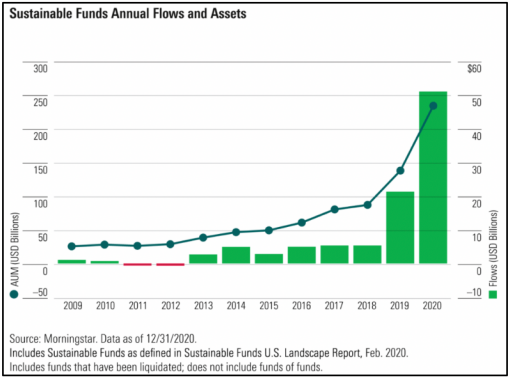
Over the next two decades, estimates hold that nearly $30 trillion USD in wealth will transfer from the Baby Boomers, the generation of the population born between 1944 and 1964, into 2 the hands of younger generations. Many columnists, journalists, and financial experts have coined this “the great wealth transfer.” As capital flows from one hand to another, the expectation can be set that the way in which that capital is allocated will also shift over time with the transfer of wealth. Why does this matter? With the first sustainable mutual fund launched back in the 1970s, ESG investing is by no means a fresh or new idea, but the larger identifying factor is found in the chart below: 

When a character in Ernest Hemingway’s The Sun Also Rises is asked how he went bankrupt, he replies, “Gradually…then suddenly.” The same can be said of how ESG investing came to be what it is today—gradually…then suddenly. 

As the millennial generation has come to develop in the form of career-establishing adults, the capital that they have invested, coupled with the “great wealth transfer” noted above, has driven much of the momentum that has been seen in this movement. 76% of millennials think climate change poses a serious threat to society, based on a survey by The Harris Poll, with one-third of millennials investing exclusively in investments that take ESG factors into account. Based on the potential $30 trillion wealth transfer projected over the coming two decades, one could conservatively estimate a nearly $10-$15 trillion inflow into the ESG space. This could push Global ESG assets to nearly $50 trillion by 2025, representing more than a third of the $140.5 trillion in projected total assets under management. 

With the millennial generation pushing towards this initiative, it has led a larger group of investors and the capital market ecosystem to join in the conversation. A recent survey conducted by U.S.-based investment management firm, Nuveen, noted that 89% of clients surveyed said that it is “absolutely essential for companies to actively manage against the risk of pollution, spills, and other disasters.” While much of the ESG conversations focus on climate change and the “E” component, investors are becoming more alert to the “G” role, with 91% of clients in the same Nuveen survey stating that companies need to enact more policies to make them more accountable to shareholder concerns. 

Groups such as the Business Roundtable in the United States have shifted to a stakeholder value model, whereas individual companies have also stated goals in the space, including Microsoft (MSFT) announcing it would become 100% carbon-negative by 2030, remove its historical carbon emissions by 2050, and launch a $1 billion climate innovation fund. 

Starbucks’ (SBUX) “new sustainability commitment” is to become resource positive in terms of carbon emissions, eliminating waste, and water usage. “By embracing a longer-term economic, equitable, and planetary value proposition for our company,” writes CEO Kevin Johnson, “we will create greater value for all stakeholders.” 

As Christians, we recognize that the Gospel affects everything and that the Gospel changes everything. When we look at ESG investing, we must do so through the lens of the Gospel. As mentioned in earlier paragraphs, ESG investing has been a movement that can be distinguished by more than just morals but as one that has been observed by real dollars flowing into investments. It is a reminder as stated in Matthew 6:21: “For where your treasure is, there your heart will be also.” 

The marketplace will inevitably become more mature, and with that maturity comes an opportunity for Christians to enter the public square and be a voice for the direction that this industry can take. As stated in Proverbs 1:20: “Wisdom cries aloud in the street, in the markets she raises her voice.” 

How does a Christian approach ESG investing? How do we find ways to be a representative of Christ as we pursue these investments? We must first remember that in all we do, we must show our love for God by seeking His glory. As the Westminster Shorter Catechism says, “Man’s chief end is to glorify God and enjoy him forever.” Glorifying God through our investments highlights our view that the Father invites us to share in His kingdom. The Christian worldview privileges stewardship, and stewardship does look for growth, stewardship does give a privilege to investment, and stewardship does value savings and thrift. It does prioritize productivity and growth and flourishing. 

The Christian is called to be salt of the earth and light of the world (Matthew 5:13-16). As salt acts to prevent decay in food, so should believers act to restrain evil on this earth—which includes doing so with our investable capital. As light illuminates a dark place, so believers should bear witness to the truth. God’s Word is the truth, and it is a public truth which is true for everyone. Christians can utilize their investments within the ESG space as an evangelical tool—one that highlights the goodness of God’s creation, our desire to worship Him in deed, and our ability to demonstrate our trust and faith in Him by way of our investment allocations. As 1 Timothy 6:17-19 states: “As for the rich in this present age, charge them not to be haughty, nor to set their hopes on the uncertainty of riches, but on God, who richly provides us with everything to enjoy. They are to do good, to be rich in good works, to be generous and ready to share, thus storing up treasure for themselves as a good foundation for the future, so that they may take hold of that which is truly life.” 

The movement within the ESG space seems to be accelerating with the onset of COVID-19, and the greater focus on societal good and solving for injustices is poised to expand further. Christians must meet the demand for ESG with distinguished and disciplined views based on scripture. A sharper understanding is emerging as to which ESG approaches are financially, or performance, relevant and which are more focused on social objectives. Though we did not explore in any detail in this paper the topic of ratings and scoring, screening criteria, or the development of industry norms (such as the UN Sustainability Goals), these are items to investigate and understand further as you step into this space. 

As we evaluate and determine various aspects of ESG investing and recognize that the secular world will continue to push and look to define this space, I am reminded of a short quote from John Bunyan’s Pilgrims Progress, “I focused on the fact that what God says is indeed best. It does not matter if all the men in the world are against it.”

Eternal Economics

by Matt Glass

We have seen the problems of our economic system and the seemingly insurmountable effects of debt and deflation that could lead to a crash (and soon). Now, let’s flip the coin and think about not the way things are but the way things are supposed to be.

This is something the Father has laid heavy on my heart in recent years. He did this through three simple questions. Let me ask you these three questions as we start to consider together what Eternal Economics should look like.
1. When we get to heaven, will you have to work for food and shelter in order to provide or survive?
2. When we get to heaven, will there be a physical currency that you will have to exchange for goods and services?
3. What would it look like for Heaven’s economy to be established on the earth today?

Now, please don’t expect me to pull out some earth-shattering theology from the Scriptures to provide evidence that answers the first two questions. But as I have meditated on these questions and on God’s Word, I have developed opinions and beliefs that match what I find in Scripture. They also match what I hear whenever I raise these two questions to others. In fact, I have yet to have someone answer yes to either of the first two questions.

A fundamental belief we gather from knowing the Father and from reading the Scriptures is that we will have abundance and not lack in heaven. People will not be providing for themselves by the sweat of their brow anymore. We relish that thought of financial freedom and of an economic model that isn’t built around accumulating a currency or even resources. Will there be gold and luxurious resources in heaven? Of course, more than we could imagine! “And the twelve gates were twelve pearls, each of the gates made of a single pearl, and the street of the city was pure gold, like transparent glass.” (Revelation 21:21)

But what is the purpose of those resources? Will they be required for basic needs? Or will they be a luxury on top of all of our needs already being provided by the Father and the heavenly system he has created? I believe it will be a luxury because all of our needs will be provided for. The dialogue I have had with many indicates that this isn’t a challenging concept to accept or believe. Most people have never thought about details until I probe, but after some questions, it is clear that they inherently believe that Heaven’s system will be provisional instead of transactional. While the first two questions incite the same answers from most people, the third question is where things diverge. Think about the question for yourself for a moment. In light of your answers to the first two questions, how would it look if Heaven’s economy were to be established on earth today? It doesn’t take long to realize that what we believe Heaven’s system will be like (as answered by the first two questions) violates everything we know and believe about how economies are supposed to function in our world, mainly in the West but worldwide. Many authoritative bodies have spent great effort teaching us (through engineered consent) to label economic ideas as Democratic or Republican, conservative or liberal, fascist or communist. As a result, our minds try to affix the proper label to any new economic idea we hear. But the new lens of these three questions has led me to consider economic ideas in a new way. And I soon realized that it is foolish for us to try to understand the economic system built by the Most High through the lenses of a system built by man.

In the Bible, we find a story in which Joshua, the leader of Israel, is on top of a mountain strategizing the nation’s next battle. A man with a drawn sword appears. Most scholars believe this was the Lord himself. Joshua asks the Lord, “Who are you for? Us or them”? He wanted to know which side the Lord was going to take. The Lord answers, “No, but I am the commander of the army of the LORD. Now have I come.”(Joshua 5:14) Even though it was abundantly clear that the Israelites were the people of the Lord, the Lord made it a point for Joshua to understand that he doesn’t come to take sides, He comes to take over. He is the King of a Kingdom that is supreme over all other kingdoms. So when he comes, he doesn’t come to fix our economy, He comes to replace it. So we must ask ourselves the question of whether we want him to come—of whether we want his Kingdom to come on earth as it is in heaven, even when it comes to economics. As we consider our own hearts, we must realize that his Kingdom may not be well received by many who are accustomed to, or even benefiting from, our current economic system. This shouldn’t be a surprise. “His ways are not our ways, His thoughts are not our thoughts.”32 “Instead, God chose things the world considers foolish in order to shame those who think they are wise. And he chose things that are powerless to shame those who are powerful.”

To gain insight into what the Kingdom’s Economy actually looks like, we have to accept that the Father’s ways could be and more than likely are completely different than ours. I encourage you to have an open, unbiased mind as we explore what the Kingdom of Heaven established on earth could look like economically.

Photo by Marta Bibi on Unsplash

Eventide: Shaping the Future of Investing

by The Faith Driven Investor Team

Very few things are free in today’s world. 

Money and the financial markets have the power to drive change and standards across industries and lifestyles alike. But with such power comes great responsibility. 

Positive return on investment alone is not enough for effective and positive developments to occur. Investors must invoke values alongside capital. 

Eventide Asset Management, a Boston-based investment firm, believes that faith is essential to the intentional allocation of capital. And the firm is working to promote investing that in their words, “makes the world rejoice.”

Just recently, Eventide Asset Management CEO and co-founder Robin John and manager of investment marketing Shaun Morgan sat down for an interview with the World Economic Forum to discuss the company’s longstanding and Kingdom-focused vision.

“Investors have a huge opportunity and responsibility to lead and be leaders of change,” Robin John said during the 9-minute segment. You can watch the full interview below:

For more than 50 years, the World Economic Forum, also known as the Davos Forum, has served as a global platform where leaders from business, government, international organizations, civil society, and academia come together at the start of each year to address critical issues.

After two years of pandemic-related restrictions, the Davos Forum returned to an in-person meeting format May 22-26. This edition is one of the most critical so far—the world has seen vast changes since last year’s event and society now faces some severe tests. 

With the pandemic in the background and the invasion of Ukraine in the foreground, the summit comes at a crucial geopolitical and economic moment. The world faces urgent challenges in humanitarian emergencies, energy, and security, while not losing sight of the long-term commitments to transform, feed and decarbonize the planet.

And yet in the midst of a world in chaos, Eventide is able to share the hope of the Gospel. With God at the heart of everything they do, Robin, Shaun, and other Christ-following investors are compelled to look beyond current circumstances and see an eternity of possibility and promise.

Deeply Rooted for the Future

 Photo by  Eilis Garvey  on  Unsplash

Photo by Eilis Garvey on Unsplash

Article originally posted here by Mats Tunehag

by Mats Tunehag

He who marries the latest trend will soon be a widower

In times of crisis things are sifted. We often see and then focus on what is important. A crisis can reveal what we really value and should prioritize. It applies when we get seriously sick, when there is an upheaval in our family or even during a pandemic. The sifting process may also show what really stands the test of time, and what is a mere short-lived trend.

The global crisis and cataclysmic disruption in recent times has clearly shown that Business as Mission, BAM, God honoring and people serving business, is not a flickering trend. But as we continue to pursue business for God, people and planet, we must be well grounded in the Holy Scriptures, and deeply rooted in history as well as in the teachings of the Church.

Deeply Rooted

It is of utmost importance for the global BAM movement to dig deep into its roots, to draw on the rich heritage we have. We must recognize our roots and understand our history, and acknowledge that we are standing on shoulders of giants who have gone before us.

Remember that Martin Luther was a Catholic and Jesus was a Jew. Our worldview and business practice must be thoroughly infused and constantly informed by a few millenniums worth of Judeo-Christian thought[1]. BAM and faith driven entrepreneurship did not start with us, even though it is experiencing a global surge in our generation. But it will only have a lasting impact if we are deeply rooted for the future.

Our Jewish Heritage

The late Lord Rabbi Jonathan Sacks, an intellectual giant, wrote an essay 20 years ago which helps us understand our Jewish roots when it comes to a worldview conducive for problem solving and innovation, the sanctity of work, and the role of business for human flourishing[2].

Biblical thought has demythologized nature, which can be rationally understood and thus stewarded for creative solutions to human needs.[3] Furthermore, a linear concept of time is essential to human progress. We are not stuck in an endless, repetitive and meaningless circle of life. God himself is orchestrating a narrative from the garden to the city. Yes, history is His story. These are essential ingredients shaping our worldview and, consequently, our involvement in business.

The Genesis account of the creation mandate is clear: “God, taught Rabbi Akiva in the second century, deliberately left the world unfinished so that it could be completed by the work of man. Industry is more than mere labor. It is the arena in which we transform the world.” [4]

The BAM movement is aligned with this aim of transforming the world. It is related to what the Jews call tikkun olam: repairing the world. Tikkun olam means co-creating with God, and bridging the gap between the world which is, and to a world as it ought to be.[5]

Work is Sacred

Work, creativity and human dignity are related, because we are created in God’s image. Rabbis Sacks contrasts animals and human beings: “Work, in other words, has spiritual value, because earning our food is part of the essential dignity of the human condition. Animals find sustenance; only mankind creates it.” [6]

This relates to the Hebrew word Avodah which means to workworship, and serve. Thus, BAM pursues a seamless integration of work, worship and service. The thirteenth-century commentator Rabbenu Bachya said: “The active participation of man in the creation of his own wealth is a sign of his spiritual greatness.” [7]

Professor Angelo Nicolaides expresses an Orthodox Church perspective on this: “In Old Testament times work was the way in which one worshipped God.” He goes on to say: “Christians should thus view work as a mission”. [8]

Judaism values work, wealth creation and a framework of freedom which accommodates dignified work and the creation of wealth through business. They do not struggle with sacred – secular divide which so often is prevalent among Christians.

But as we search our roots and traditions, we will discover – thankfully – that the Church has never endorsed this dichotomy.[9] Bishop Barron[10]“When God came among us in Christ, he effected the work of repairing his broken and hurting creation. He is not interested simply in souls but in bodies as well.” [11]

Work and business are reflections of the trinitarian God, and also who we are created in His image. God is love and collaboration[12], God created in community and for community[13]. So, being a faithful worker individually, and being creative collectively – also in business – are both deeply divine and deeply human.

As Angelo Nicolaides rightly observes: “The notion of business is recognized within the creation account where it is clear that man cannot work alone.” [14]

Private Property

The right to private property is intrinsically linked to freedom and human dignity. This is a long and strong Judeo-Christian tradition, and the teaching is clear.

Rabbi Sacks again: “For a ruler to abuse property rights is, for the Hebrew Bible, one of the great corruptions of power. Judaism is the religion of a people born in slavery and longing for redemption; and the great assault of slavery against human dignity is that it deprives me of the ownership of the wealth I create. At the heart of the Hebrew Bible is the God who seeks the free worship of free human beings, and two of the most powerful safeguards of freedom are private property and economic independence.” [15]

Pope Francis published an encyclical latter called Fratelli Tutti in October 2020.[16] Some accused him of diminishing the right of private property or rejecting democratic capitalism.[17] A problem with modern journalism is often the lack of understanding, or the will to understand, historical contexts. To comprehend the Catholic church and its teachings, one has to review centuries of profound thinking, often expressed in encyclicals. More on this later.

Pope Francis “stands firmly in the tradition of St. John Paul II, who saw the market economy as an arena for the exercise of human creativity, ingenuity, and courage. … He also reiterates the teaching of the founder of the modern Catholic social tradition, the great Leo XIII, who, in Rerum Novarum, strenuously defended private property and, using a number of arguments, repudiated socialist economic arrangements.” [18]

In numerous Papal Encyclicals stretching from Rerum Novarum (1891) to Centesimus Annus (1991) there is an unambiguous affirmation of private property, and linked to that the obligation to share with others, especially the poor.

While affirming private property the Judeo-Christian tradition also acknowledges that God is the ultimate owner and stresses our responsibility to be generous stewards. Rabbis Sacks: “Ultimately everything belongs to God. What we have, we hold in trust. And there are conditions to that trust—or as the great Victorian Jew Sir Moses Montefiore put it, “We are worth what we are willing to share with others.” [19]

Dignifying Way to Help the Poor

Caring for the poor and needy is a commonly held belief and practice among Jews and Christians along a broad spectrum. Christians have in general – and throughout history – focused on charity responses and handouts.[20] But in the Jewish tradition “the highest degree of charity, exceeded by none, is that of a person who assists a poor Jew by providing him with a gift or a loan or by accepting him into a business partnership or by helping him to find employment—in a word, by putting him where he can dispense with other people’s aid.” [21]

Handouts never give dignity. Jobs do! How can we best help a poor child, what is a long term and dignifying solution? Give the parents a job!

Jews, Catholics, Orthodox and Protestants on Wealth Creation

This leads us into the conversation about wealth creation and wealth sharing. Hoarding of wealth is wrong, but both creating and sharing wealth are commended. But there is no wealth to be shared unless it has been created. Generosity is a virtue, but aid is not the ultimate answer to poverty.

“The sages were not so much concerned with the elimination of poverty through redistributive taxation. Instead, what they sought to create was a society in which the poor had access to help when they needed it, through charity to be sure, but also and especially through job creation.” [22]

As we connect with our roots, we build a stronger foundation for the future. And if you want to build a skyscraper you need to first dig deep and establish a firm foundation. As we build a BAM movement that will rise high and last long, we should pour Jewish and Christian lessons learned into the foundations of our businesses and other BAM related initiatives.

The value of creating different kinds of wealth through business is endorsed in both rabbinic and Christian traditions. As Pope Francis says: “Business is a noble vocation, directed to producing wealth and improving the world. It can be a fruitful source of prosperity for the area in which it operates, especially if it sees the creation of jobs as an essential part of its service to the common good.” [23]

BAM Global[24], together with the Evangelical Lausanne movement[25], organised a global consultation in 2017 around the issue of wealth creation for holistic transformation. Our findings were documented in seven papers, a summarising manifesto and an educational video series.[26]

The Wealth Creation Manifesto[27] is deeply rooted in Judeo-Christian thought, but also adds to a firm foundation for our day and age. Excerpts:

  1. Wealth creation is rooted in God the Creator, who created a world that flourishes with abundance and diversity.

  2. We are created in God’s image, to co-create with Him and for Him, to create products and services for the common good.

  3. Wealth creation is a holy calling, and a God-given gift, which is commended in the Bible.

This is also mentioned within the Orthodox Church tradition. God is giving ”wealth to serve His purposes”.[28]

Each generation has to review and highlight old age concepts and truths, and see how they apply to today’s context. That includes various arenas and constituencies, like business, church, and academia.

Intellectual Wealth

It would be a costly mistake to neglect the intellectual wealth generated over the centuries in both Jewish and Christian traditions. Please allow me to recommend one of the better books I’ve read recently: Papal Economics, by Maciej Zieba.[29] He does an insightful overview and critical analysis of a dozen Papal encyclicals published over 100 plus years. They deal with issues like work, business, wealth, property rights, democracy, market economy, socialism, and human dignity and freedom.

The author, philosopher and theologian Michael Novak, who has written the foreword says: “For a long time to come, this book may well be the definitive work on the economic teaching of the modern popes.”

Beyond an Academic Exercise

A tree can flourish and give fruit as long as it has roots through which it can draw life giving water. An olive tree can produce fruit for over a thousand years – if rooted and nurtured. The purpose of this article is beyond an academic exercise. We want to serve God and people through business – among all peoples ­– in our lifetime but also for generations to come. Thus, we need to be deeply rooted for the future.

[1] All truth is God’s truth! We mustn’t be afraid of or instinctively reject statements just because they come from sources we are less familiar with or skeptical to.

[2] Market and Morals, by Jonathan Sacks. Aug 2020. I am indebted to Sacks’ books, articles, and lectures, and will draw especially from this essay in this article. https://www.firstthings.com/article/2000/08/markets-and-morals

[3] At its core it is a Jewish heritage, and fully embraced by the Church. This is also mentioned in Laudato Si, #78, by Pope Francis. 2015

[4] Ibid.

[5] See http://matstunehag.com/2020/10/04/tikkun-olam-repair-the-world/

[6] Market and Morals, by Jonathan Sacks. Aug 2020

[7] Ibid

[8] Ethics and the dignity of work: An Orthodox Christian perspective, by Angelo Nicolaides. Pharos Journal of Theology ISSN 2414-3324 online Volume 101 – (2020)

[9] “There cannot be two parallel lives in their existence: on the one hand, the so-called “spiritual” life, with its values and demands; and on the other, the so-called “secular” life, that is, life in a family, at work, in social relationships, in the responsibilities of public life and in culture. … This split between the faith which many profess and their daily lives deserves to be counted among the more serious errors of our age”.  Christifideles Laici: The Vocation and Mission of the Lay Faithful in the Church and the World: Post-Synodal Apostolic Exhortation of Pope John Paul II to bishops, priests, deacons, women and men religious and all the lay faithful (December 30, 1988)

[10] Advent Gospel Reflection, by Bishop Robert Barron, 16 Dec 2020.

[11] See short vignette in the Wealth Creation video series: https://www.youtube.com/watch?v=SJajgVcPyzo&list=PLYGxDL2dvuo5k-Uk8FGxZj1QYcBe70_Vx&index=2

[12] The trinitarian reciprocal love, interdependence and collaboration, have bearings on our relationships and responsibilities, also for the planet: “Relational human existence involves interdependence and interaction simultaneously between human beings themselves and the nature they commonly share and companies need to be clear on this. … They should also endeavour to serve environmentally friendly planetary needs so that future generations may also enjoy God’s creation.” Ethics and the dignity of work: An Orthodox Christian perspective, by Angelo Nicolaides. Pharos Journal of Theology ISSN 2414-3324 online Volume 101 – (2020)

[13] John Paul II consequently describes the essential community aspects of business, saying that a company is a “community of persons who in various ways are endeavouring to satisfy their basic needs, and who form a particular group at the service of the whole of society.” Centesimus Annus, 1991

[14] Ibid

[15] Market and Morals, by Jonathan Sacks. Aug 2020

[16] http://www.vatican.va/content/francesco/en/encyclicals/documents/papa-francesco_20201003_enciclica-fratelli-tutti.html

[17] See Bishop Barron’s clarifying article: https://www.wordonfire.org/resources/article/pope-francis-fratelli-tutti-and-the-universal-destination-of-goods/28906/

[18] Ibid

[19] Market and Morals, by Jonathan Sacks. Aug 2020

[20] There is of course, as in life in general, often a tension between orthodoxy and orthopraxy. “Helping the poor financially must always be a provisional solution in the face of pressing needs. The broader objective should always be to allow them a dignified life through work.” Laudato Si, #128, by Pope Francis. 2015.

[21] Market and Morals, by Jonathan Sacks. Aug 2020

[22] Ibid

[23] Laudato Si, #129, by Pope Francis. 2015.

[24] https://www.bamglobal.org/

[25] https://www.lausanne.org/

[26] http://matstunehag.com/wealth-creation/

[27] https://bamglobal.org/report-wealth-creation-manifesto/

[28] Ethics and the dignity of work: An Orthodox Christian perspective, by Angelo Nicolaides. Pharos Journal of Theology ISSN 2414-3324 online Volume 101 – (2020)

[29] Maciej Zięba, OP. “Papal Economics: The Catholic Church on Democratic Capitalism, from Rerum Novarum to Caritas in Veritate. 2013