This article was originally presented at the Christian Economic Forum. CEF is a platform that provides a relational learning environment where leaders and experts from around the world gather to discuss and address some of the world’s greatest challenges and most pressing needs.
Learn more about them here.
by Chris Conant
It was June of 2017. I was at a Christian business conference when a pastor got up on stage and repented on behalf of the church-at-large. The apology was to God and all the Kingdom-minded CEOs and business owners in the room. The offense was: “treating business leaders like a second-class citizen, like you have one foot in the world and one foot in the church; for downplaying your assignment in the Kingdom; for not sharing you with others; and thinking that you are the source of our financial provision for ministry.”
He had the right words. And the offense depicted the treatment of a misunderstood Kingdom-minded CEO, owner, or managing director.
CEOs/owners are leaders with many talents. Much like Bezalel of Exodus 35—36, the Holy Spirit fills CEOs with wisdom, understanding, and knowledge. God made them multi-skilled to know how to carry out the work He commands.
As a former owner/CEO for 18 years and now Managing Director of Monmouth Society, I understand the life, challenges, and assignment of a Kingdom-minded owner. About five years ago the Lord revealed to me why we need to link Kingdom-minded investments to Christian leaders of companies.
When we compared the segments of the US population to Pew Research Center’s data indicating how many church-attending Christians there are in the US,[1] and then applied that metric against Gallup data on the number of small businesses in the country,[2] [3] [4]we identified there are approximately 459,000 Christian CEOs/owners/managing directors of companies in the USA with 10 or more employees.
Let me ask the reader: How many private investments do you have in these Kingdom-minded CEOs? If the answer is zero, you’re not alone. There are currently very few private equity companies taking capital from investors who were only Kingdom-minded for the purposes of supporting Christian CEOs and their companies. Second, the infrastructure in the Christian business sector is not yet mature for incubating mass deal flow from God-honoring companies, plus the due diligence is complex. Third, we noticed universally that the Christian community frets about the direction of America, yet continues to purchase public stock, thereby preferring to invest in secular companies that support values in opposition to theirs so the Christians can sustain provision for their family. That sentence just saddens me to write.
If a young Jewish entrepreneur today starts a business, the elders in the temple are likely to come around him and invest, and they very well could become his or her board of advisors. The Mormons do this well. Even the Muslims have a $1B Sharia fund. But where are the Christ-follower investors and why have we not taken care of our own or our culture?
To answer this question we must examine a strong argument as to why we should invest in a Kingdom-minded CEO.
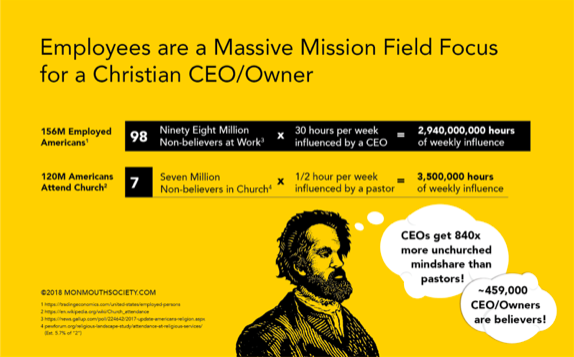
The Monmouth Society compared the population of unbelievers in the workforce versus in the church on an average week. Approximately 98 million unchurched Americans are in the workplace for 30+ hours a week, versus an estimated 7 million in church for a 30+ minute service on a Sunday3. (See figure 1.) The results should compel us into this mission field.
In the workplace, Kingdom-minded CEO/Owners get 2,940 million hours per week of “unbeliever mindshare” versus a pastor who would get about 3.5 million hours per week of “unbeliever mindshare.” At large, CEOs/Owners get 840 times more influence!
Imagine the shift inside corporate culture when Christian CEOs/owners are supported to steward their influence for Christ! Non-believers would speak highly of the amazing workplaces and their value on people. Customer satisfaction would shoot through the roof. Profit would follow. The Holy Spirit would be present in the organization: physical healings, answered prayer, marriages restored, and more. The gospel would be getting preached, and His kingdom would advance while He gets the glory!
These statistics made us realize that Christian CEOs and owners are perhaps the most underserved and misunderstood US missionary today. As I recall Billy Graham’s words, “the next great revival will be in the marketplace,” Kingdom-minded investors cannot solely expect financial ROI without understanding the value of very tangible outcomes from eternal ROI, when we support our own (like 1 Timothy 5:8).
Many investors are or have been CEOs or owners, so we, myself included, understand a Kingdom-minded CEO/Owner has to function in the role of both king and priest; balancing work and home, while always being “on” for crises, relationships, sales, vision, spiritual leadership, and the like. It can be lonely, exhausting, and isolating, sometimes unto sin.
Intercession, Peer Advisory, and Capital
These are the three investments CEOs have expressed they need in order to build godly cultures and fulfill their assignment.
“Intercession” means standing with the CEO to fellowship closely with God, but we use the word “intercession” to also encapsulate all chaplain efforts, journaling prayer, prophecy, and ministry to the CEOs (and their companies and families). Prayer gives us access to God, and we want the CEOs to experience Him daily.
“Peer advisory” means flourishing in a Christian CEO group and receiving counsel from peers because it is lonely at the top, and sometimes non-CEOs, including a senior pastor, can’t effectively counsel on business issues.
“Capital” means being a resource to fund the vision, including using it to make critical hires, build inventory, and grow the Kingdom impact.
The investor benefits here when an approved Kingdom-minded CEO/Owner builds an organization that hosts the presence of the Holy Spirit and models God’s love. We invest in Kingdom-minded CEO/owners/managing directors because they are our agents or carriers of ministry and evangelism. They lead the companies that steward the influence. In this regard, we are truly operating in a spiritual economy, by letting our fruit grow on someone else’s tree.
This eternal ROI is a great success even without an IPO. Sometimes an aging Christian CEO may want to sell his company, but not to a secular private equity firm. Instead he could seek out a Kingdom-minded private equity firm to do a fair deal (that honors all), and assures the spiritual equity inside the culture is maintained first and foremost.
Speaking of going public, another challenge investors face is the allure of the “spirit of mammon.” As the Word of God clearly states, we cannot serve both God and mammon (the love of money, greed, putting ourselves first, the spirit of relying on self-provision instead of God).[5] And yet, sometimes we meet Christian investors who, within minutes of introduction, direct the conversation to what the financial returns are because “they are being good stewards.” If they are truly stewards of God’s money, then are they saying God wants financial returns first and foremost, at the expense of compassion, love, or salvation?
I wrote that rhetorical question only to provoke thought.
It’s not wrong to ask about financial ROI, but the timing of the question and the focus on money seems to suggest that mammon motivates that person. I will admit, we can all be influenced by mammon to some degree because we participate in the world economy, but, we are also a redeemed people, so it is important to recognize mammon and reject its influence.
If you’re a Kingdom-minded investor, may I propose that you seek the Holy Spirit and ask which investments matter to Him and where He wants you to invest His money. The parable of Luke 19:12–25 clearly tells us of a master who leaves his wealth in the hands of a faithful steward who figures out how to multiply his master’s money. The master was so pleased with the outcomes that he put the steward in charge of many cities. Why cities? Because if one can build a wealth ecosystem with someone else’s money, then that impressive act deserves a reward worthy of leading cities. Here on earth, our Master will return one day and we will be held accountable for where, how, in whom, and possibly even why we invested His money.
I still acknowledge that investors want to invest in something that will make a financial ROI, so they feel connected to stewardship, perpetuating giving to Kingdom work. Perhaps I can address financial ROI this way. The due diligence on a potential asset must be thorough and intelligent, management and company fully researched, investment committee advisors consulted, returns experienced should be excellent, and in most all regards, above market; but all this excellence is not to our credit. It is trusting God, by obeying His leading—that is what qualifies us for Kingdom work—obedience. It’s also what qualifies our CEOs and owners to perform well—spending time in prayer, listening to the Holy Spirit, and then doing what He says. Obeying His voice commands a blessing.[6]
Our SEC attorney will tell a fund manager, “You have a fiduciary responsibility to your investors.” However, if you ask anyone at Monmouth Ventures (including the investors) who the number one responsibility is directed to, they will say, “the Kingdom-minded CEO/Owner.” When the focus is on hearing God in prayer, then Matthew 6:33 is at work (“Seek first the Kingdom of God and his righteousness, then all these things shall be added to you”). Plus, there are countless benefits and blessings fulfilled as we come into agreement with the promises of God.
One might ask, “Why not receive the wealth from unbelievers as investment into Christian CEOs?” To that I would answer, “That is not what we believe to be our assignment from the Lord,” and “Asking non-believer investors to give spiritual counsel to our Christian CEOs doesn’t work,” and “That would be off-mission for us.” Furthermore, I would add that receiving wealth from unbelievers does happen for us below the CEO level, since the company should be a light to the world, selling products and services that attract and minister God’s attributes to all customers.
With this Kingdom wealth ecosystem at work, the investor serves as steward of the Master’s money. ROI can be used for re-investment into more Kingdom-led companies or for funding Christian agendas. Just like the Parable of the Minas, the Kingdom investor puts the Master’s money to work. This same Master reaps where He hasn’t sown.[7] We understand that God’s ways and purposes are higher than ours, and He does abundantly more than we can ever ask or think, including causing increase where we haven’t strived.
By investing in Christian CEOs/owners for the primary purposes of reaching the lost and shifting culture, Kingdom-minded investors will feel fulfilled by participating in acts of redemptive stewardship and advancing the Kingdom of God.
Ultimately we want to see unbelievers in the workplace turning to Christ. It’s what matters most long after the company is gone. As the Christian CEO/Owner is empowered by intercession, peer advisory, and financial capital they can more effectively encounter God themselves, and then with the love of Christ they can reach the lost among their employees, their clients, their vendors, and their communities. There will be true culture change, and the Kingdom-minded investor and the CEO will both be rewarded (1 Corinthians 3:8).
Deuteronomy 8:17-18 states, “You may say to yourself, ‘My power and the strength of my hands have produced this wealth for me.’ But remember the Lord your God, for it is He who gives you the ability to produce wealth, and so confirms His covenant, which He swore to your ancestors, as it is today.”
—
[1] pewforum.org/religious-landscape-study/attendance-at-religious-services/ (Est. 5.7% of “2”).
[2] https://tradingeconomics.com/united-states/employed-persons.
[3] https://en.wikipedia.org/wiki/Church_attendance.
[4] https://news.gallup.com/poll/224642/2017-update-americans-religion.aspx.
[5] Luke 16:9-11 (NKJV), “You cannot serve God and mammon.”
[6] Deuteronomy 28:1-2 (NIV), “If you fully obey the Lord your God . . . All these blessings will come. . .”
[7] Matthew 25:26 (NKJV), “you knew that I reap where I have not sown.”