Redefining the Concept of Legacy

Article originally posted here by Trust Bridge Global

by Bob Collins

Originally published in The Business Times TUE, JUL 02, 2019 – 5:50 AM

FOR a millennia, Asia’s thinking about legacy has been framed by the Confucian ideals of family.

This is changing. A new HSBC commissioned report by The Economist on high-net-worth individuals – defined as people with more than US$1 million in liquid assets – in China, Hong Kong and Singapore reveals that rather than narrowly focusing on passing on the family business, this generation focuses on giving the heirs flexibility and securing their aspirations, while grappling with life priorities.

A combination of new money and new ideas has meant that a new generation of affluent Asians are expanding the concept, looking for ways to actively improve a much broader impact to the society in the long term, preserve culture, or take an existing family legacy in a new direction.

The study, Passing the Torch: Bridging mindset gaps between high-net-worth generations in Hong Kong, mainland China and Singapore, also highlighted that the new generation’s business focus is shifting.

Many members of the younger generations are deciding to start their own businesses, frequently under the umbrella of the family business, and set up a charitable foundation or engage in corporate social responsibility.

For example, in Singapore, Mark Lee, the third-generation CEO of Sing Lun Holdings, has seen the vision of his family business change since his grandfather started the firm in 1951. While previous generations were focused on chasing opportunities, this generation is more concerned about stewardship or social investing.

He shared that a company is like a tree and each generation will create new branches, taking the company in new directions. His job is to ensure that the branches do not turn into splinters.

This generation is also expanding the concept of legacy to include the long-term impact they have on society. Beyond financial security, peace of mind of knowing your legacy will preserve not just the business, but also harmony within the family including philanthropic giving. As part of business succession planning, there is also a growing openness among entrepreneurs on letting professional managers run the business, something that was rare and culturally challenging even 20 years ago.

When business owners choose not to pass on their companies to familial relations, they tend to sell and shift into philanthropy and in many cases, see their philanthropy as the everlasting legacy. They want their children to invest time and talent, and cultivate enduring value, not just money.

There is a radical shift in legacy planning among East Asia’s wealthy. The days when the patriarch went to his grave assuming that his eldest son would automatically take over the family business are fading fast. A large number of family-owned companies fail to transition to the next generation of leaders when the founder died. Even the most sophisticated and knowledgeable business professionals get caught in a web of complicated issues and fall victim to intra-family feuding.

This has amplified the necessity of effective estate planning for an increasing number of families that have assets spread around the world, crossing multiple tax jurisdictions. The fact that many people are redefining for themselves what they mean by legacy, and what they want their own legacy to be, has led to a welcome increase in the numbers who are seeking advice early on how to shape, manage and preserve their legacies.

It is tempting to see these shifts as symptomatic of a broader move towards an alien concept of Western-style individualism, and in some cases it is. But many are using their legacy to preserve the best aspects of their culture, such as buying back cultural artifacts and making sure they are accessible to the broader population, or supporting the villages that were home to their ancestors.

In the Asian context, it seems modern legacy planning combines the best of the family-oriented traditions of old with a more flexible and better-planned future.

[ Photo by Florian Wehde on Unsplash ]

Redemptive Opportunities in Judea & Samaria

by Drayton Wade, Greg Spencer, James Smith, Mike Humphrey, & Jay Hein

Intro:

For thousands of years, a small semi-arid strip of land on the southeastern border of the Mediterranean known as Israel has been the center of competing religious, historical, and geopolitical claims for members of the three primary Abrahamic faiths. Numerous historical shifts have changed the control of this territory, each adding to the complex legacy and memory of its inhabitants. This legacy arguably begins with the Jewish conquest of the “Promised Land,” described in Judges of the Old Testament, and includes the destruction of the second temple by the Roman Empire in 70 AD, the Muslim Conquest of Palestine in 635 AD, the centuries of Christian crusades, and the long reign and later dissolution of the Ottoman Empire in 1918. In the modern context, however, no event has had as significant global implications for this region than the establishment of the State of Israel in 1948. This single event led to numerous wars between the Israeli populace and the many surrounding Arab Muslim states resulting in the effective diplomatic and economic boycott of Israel after the Arab League Summit of 1967 which proclaimed “The Three Nos”: no peace with Israel, no recognition of Israel, and no negotiations with Israel. Tragically, this situation left one group in particular, the Palestinians inhabiting the West Bank and Gaza Strip, in a state of limbo for over five decades, with dire economic, humanitarian, and political consequences.

Yet, despite the complex, scarred, and overlapping cultural and historical legacy of Israel and Palestine, and despite the numerous failures of foreign aid and political dictates to reach a lasting solution of peace and prosperity in the region, opportunities are arising that demonstrate how co-prosperity and the laying of a foundation of trust can be achieved through an unlikely source: the marketplace. This paper sets out to describe the opportunity of business to help heal millennia of cultural wounds through the creation of an integrated (Christian, Jewish, and Muslim) emergent economy in the West Bank of Palestine (also known as Judea and Samaria). This white paper, jointly authored by the CEF Middle East Strategy Group, will first at a high level describe the present situation in the West Bank by contrasting it with that of Israel proper. Second, the question of “Why Now?” will be addressed, outlining the unique factors creating the opportunity for the development of an emergent, integrated economy in the third decade of the twentieth century. Lastly, the paper will outline “What Can I Do?” by providing as examples two areas of particular opportunity where CEF members and other investors/entrepreneurs/philanthropists could be involved. We will also provide case studies of two CEF members using commerce to generate returns and see prosperity and the love of Christ flow throughout the Holy Land.

A Tale of Two Territories:

Standing up to eight feet high in some places, the Israeli West Bank Barrier, built during the Second Intifada in 2000, effectively separates the predominantly Jewish “Israel” from the primarily Arab “West Bank.” The controversial wall, while documented to have a significant effect on decreasing violence in the region, divides two territories starkly contrasted in terms of human development, economic prosperity, and political stability.

On the “Israeli” side of the wall, there is one of the most remarkable economic stories in modern history. Israel, a new and at first primarily agrarian state built by poor refugees from across Europe and even parts of Africa and the Middle East (Ethiopia, Egypt, and Yemen predominantly), now stands as the most prosperous economy in the Middle East, despite limited natural energy resources. Hailed as a “Startup Nation” in the best-selling 2009 book of the same name, Israel, in the early 2000’s, produced more tech companies listed on U.S. stock exchanges than any country in the world outside of the United States.[1] Israel, today, has some of the highest education rates in the world at 83%, compared to the OECD average of 67%, and is home to thriving technology, bio-medical, and renewable energy industries. All three of these industries are poised to exponentially grow throughout the twenty-first century.[2]

On the Palestinian side, a very different situation exists. The economy in the West Bank is largely dependent on foreign aid, primarily from Europe, The United States, and Arab countries in the region. The economy is dominated by public service jobs provided by the Palestinian Authority and a significant SME sector. Though education levels are strong throughout the West Bank, unemployment, especially youth unemployment, is terribly high at nearly 50% in mid 2018,[3] with GNI per capita relatively stagnant. The specific challenges affecting a few of these sectors in particular (SME, Advanced Manufacturing, and Technology) will be explored in greater detail later, but the drastic disparities between life on each side of the wall create a cauldron for political distrust, anger, radicalism, and violence.

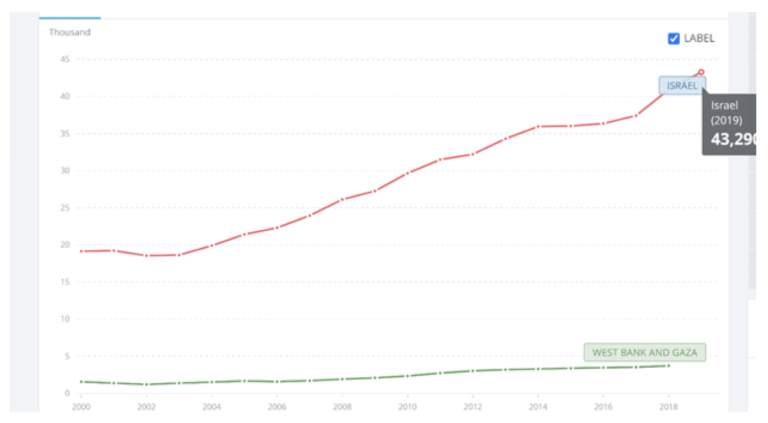
To understand the breadth of the gap between the Israeli and Palestinian economies, it is helpful to consider a few key development indicators. At a gross level, Israel’s overall economic production per capita is vastly greater than the West Bank & Gaza Strip, and the gulf between the two is growing rapidly. As illustrated in the chart below, over the last twenty years, Israel’s economy has grown 126% to almost $45,000 GNI per capita, while Palestine’s economy remains less than $3,710.[4] COVID has additionally disproportionately affected the West Bank with a contraction of its GDP by 7.6%[5] compared to only 4.1% across the Middle East and Central Asia region,[6] thus causing an economy that is highly dependent on foreign aid and public service jobs to be teetering in many respects.

Why Does This Matter?

Along with the historical and biblical significance of the Holy Land for Christians and the broader geo-political consequences related to gulf-competition between Iran and GCC states (which this paper will not address), the significance and importance of flourishing in the West Bank has far greater consequences for Christians around the world. The plight of the Palestinian people has been a major destabilizing factor in the broader region surrounding Israel, often used as a rallying cry for Islamic terrorist organizations including Hamas, Hezbollah, Islamic Jihad, and others. Potentially even more significantly, the undecided status of the Palestinian refugee question inflicts severe economic ramifications on the broader regional market at large. The boycott of Israel by the Arab bloc has prevented the development of a strong economic market in a region with abundant natural resources and geographic significance for international trade between Asia and Europe. Even recently, the boycott has limited exportation to MENA economies of Israel’s bio-medical and tech sectors, notably during a time when many of the wealthy oil-based Gulf States are desperately trying to diversify their economies. It can be argued that the plight of the Palestinian people in the West Bank and Gaza strip, and subsequent boycott by the Arab nations, has affected the development and flourishment of 300 million Arabs by preventing the development of a true regional market.

As Christian businessmen and women, we should lament the lack of development in this region, its associated social and humanitarian effects, and the missed opportunities for the market to bring about human flourishing. Likewise, as we are called to love the ‘least of these,’ our hearts should break over the decades of suffering that many of our Jewish and Arab brothers and sisters have faced due to the languishing geo-political and socio-economic conditions mentioned above. Thankfully, recent events have opened opportunities for a change in the stagnant status-quo, for market opportunities to be seized, and for driving innovation, prosperity, and hope to millions of people living in this historic region.  This “opening” offers the chance for the disciples of Christ to minister both in word and deed to the inhabitants of the Holy Land and Arab Gulf by building a market of thriving businesses and deep-rooted relationships that transcend historical legacies and differences.

The Current Opportunity:

“The digital economy can overcome geographic obstacles, foster economic growth and create better job opportunities for Palestinians. With its tech-savvy young population, the potential is huge. However, Palestinians should be able to access resources similar to those of their neighbors, and they should be able to rapidly develop their digital infrastructure as well.” –Kanthan Shankar, World Bank Country Director for West Bank and Gaza

Until 2020, only three states in the region surrounding Israel had formally recognized the state and opened their doors to trade and mutual prosperity: Turkey, Egypt, and, lastly, Jordan in the early 1990s. Numerous security and political attempts to solve the situation had failed. However, a monumental shift changed the trajectory in a positive direction on September 15, 2020, when the United Arab Emirates signed the now named “Abraham Accords” with Israel, opening the door to trade, diplomatic relationships, and exchange with not only a wealthy gulf state but also a global center of finance and trade. Soon after, Bahrain, Sudan, and Morocco followed suit with others expected to follow, most notably a potential reconciliation with Saudi Arabia. While the long-term political ramifications remain to be seen, the economic impact creates numerous opportunities for investors, corporations, and startups to engage in what is likely to be a quickly developing market.

Coinciding with the macro-economic changes for Israel, the West Bank, and the Western Middle East, a unique set of collaborations is developing to foster “integrated” opportunities for prosperity between people of multiple faiths in Israel and the West Bank. An amalgamation of investors, including Sir Ronald Cohen of Portland Trust and Michael Milken of the Milken Center as well as organizations including Sagamore Institute, is looking to help develop startups and small businesses not only with high growth potential but also creating new markets entirely. Research by Harvard professor Clayton Christensen, well-known author of The Innovator’s Dilemma, suggests that investment in businesses with “market creating innovations,” targeting previous non-consumers or markets of non-consumption, is a core means of nation-states rising out of poverty and into prosperity.

“…every successful new market that is created, regardless of the product or service being sold, has three distinct outcomes: profits, jobs, and the most difficult to track but perhaps most powerful of the three, cultural change.”– Clayton Christensen[7]

With the recent Abraham Accords and hopeful future normalization between more Arab states and Israel, entrepreneurs and investors in Judea and Samaria now have the opportunity to provide such innovations to a market of hundreds of millions of Arabs in rapidly modernizing economies, many with categories previously untouched. While many such industries for “market creating innovations” will become possible in the coming years, including areas of tourism, trade, logistics, and finance, the remainder of this paper will focus on the opportunity for impact investors, entrepreneurs, and business leaders in two industries: Technology Services and Advanced Manufacturing. Each is well-positioned to create or cater to new markets, helping to provide prosperity through local jobs and cultural exchange.

Technology Services

Unsurprisingly, one of the biggest industries of opportunity for the West Bank in this emergent economy is the specialty of its neighbor Israel. Technology services have a tremendous amount of potential to bolster the economy of the West Bank, creating well-paying, meaningful jobs while boosting the quality of life for local inhabitants at the same time. While many industries are severely limited by the security constraints that limit movement in and out of the territory, technology is far less affected, needing only sufficient, undisrupted connectivity. The proximity to Israeli entrepreneurs, operating in arguably the world’s second most significant technology hub, enables ripe interaction and the exchange of ideas. The recent Abraham Accords and the expected emergence of a regional market among the Gulf Arab states and Israel removes the economic boycott barrier and opens the doors for the labor force of the West Bank to provide technology services to the rapidly digitizing Arab States.

Tech Market Opportunity

Prior to the recent Abraham Accords, Israel’s entrepreneurs faced highly-limited market opportunities in the Middle East due to the economic blockade of Israel. Because of this, the vast majority of Israel’s exports, over 50% of which fall in the technology sector, now go to Europe and North America. As such, the total addressable market for these innovative companies remained constrained, with the associated effect of limiting the total amount of labor needed to sustain development, support, and other technology services. The Abraham Accords have drastically changed the market opportunity for Israel’s tech sector, as these businesses will now have access to the more than 500 million people living in Arab League countries who are simultaneously coming online with high levels of digital engagement. For example, their citizens have some of the highest digital rates in the world including e-commerce usage, hours spent online daily, and smartphone usage. Internet usage in GCC states grew 2000% from 2000 to 2012.[8] The demand for technology and supporting technology services in these opening markets is far more rich than many would presume. The Arab world has very high levels of digital engagement and are buoyed by significant capital deployed into this sector by Gulf State sovereign funds, which are rapidly attempting to diversify their economies away from a total dependence on petrochemicals, such as Saudi Arabia’s Vision 2030 fund.

As technology companies grow, the need for skilled but low-cost back-end labor grows significantly. Traditionally, this has been largely supplied through the outsourcing powerhouses of South and Southeast Asia. However, demand from technology customers and even non-technology customers looking to outsource IT services has shifted in the last decade with a greater focus not only on low cost, but also for “nearshore” pods who share culture, language, and timezones with their respective customers. Evidence of such can be seen in the vast growth in the technology-services sector in LATAM countries, such as Colombia, and in moves by technology service powerhouses like Infosys in “localization,” opening service-hubs in various LATAM and US cities to support the American market.[9] As the Arab-Israeli market emerges, demand for local, or “nearshore,” technology resources will increase significantly in order to support not only Israel’s vast technology sector but also the growing financial, trade, and energy hubs of the Arab world. However, opportunity alone will not lead to the development of a technology-services sector in the West Bank. Experience shows that certain conditions are required for a services hub to emerge.

Requirements for a Thriving Technology-Services Sector

Connectivity is only one of the conditions needed for a successful technology-services industry to develop. In addition to access to digital networks, service providers identify the following conditions as primary considerations when looking at different outsourcing locations:

  1. Education: Is there a substantial education system able to produce critical thinking and problem solving among its students?

  2. Language: Are the language skills of the average worker commiserate with the typical firm’s customers?

  3. Affordability: Is the typical wage for a high-skilled job within a range that would still support an outsourcing model?

  4. Labor Market Size: Are there enough workers, who are either trained or who could be reasonably trained, to provide the particular technology services in demand?

  5. Risk: What are the considerations regarding rule of law, transparency, nepotism, political violence, systemic financial risk, etc.?

To date, the West Bank meets some of these conditions, while others, most notably risk, are still question marks in order for the technology-services industry to thrive. Palestinians pride themselves on high rates of education, with universities both in Israel and in the West Bank providing many opportunities for enterprising youth. Likewise, language is a strength for the West Bank. As a regional market develops with increased trade among Arab states and Israel, the Arabic language will provide a differentiated edge. The average hourly wage of $4 would certainly enable firms to provide above-average pay for skilled labor and still be competitive in a “nearshore” type offering. A total labor force of roughly 1.3 million people is certainly a small labor market, but with 86% of working men possessing advanced education, the pool of potential talent for high-skill, outsource labor is larger than one would initially assume.[10]

According to a 2018 World Bank’s report, “Tech Startup Ecosystem in the West Bank and Gaza,” plenty of investible tech startups exist, but the primary issue is managerial experience, which must be supported by foreign investors willing to support entrepreneurs in mentorship roles.[11] Impact investment in such technology services and tech startups not only has potential for return due to the developing regional market and the demand generated by Arab states but also can help lead to the development of the West Bank itself, improving human quality of life outcomes and building relationships across ethnic lines.

“Stimulating the emergence of an effective entrepreneurial ecosystem offers one of the most promising mechanisms for creating such [vertical] progress, precisely because the nature of Palestinian economic challenges cannot be addressed through incremental gains.”- The World Bank[12]

Impact Investment Opportunity

Thirty-five miles from Bethlehem, Tel Aviv is home to the highest number of start-ups in the world behind only Silicon Valley.[13] As real estate prices are pushing people out past the “green line,” even Samaria and parts of the West Bank are becoming a piece of the commuting zone for a start-up nation with talks of annexation.[14] Despite the economic successes of Israel, Palestine has seemed to be left behind. With the introduction of the Abraham Accords and focus of impact investors on the region, several of the factors necessary to drive impact investment into Palestine are taking shape.

Requirements for a Thriving Investment Sector

With the booming economy of Israel only a short distance from Palestine, the issue is not necessarily lack of exposure to start ups, economic development, and funding, but, instead, other pieces are missing. All together, these missing pieces form an investment ecosystem that creates sustainable economic growth through the symbiotic relationship between businesses of all sizes and investors as well as the communities in which they operate.

Key pieces necessary for entrepreneurs to participate in this ecosystem include:

  1. Mentoring: Are there resources in place (i.e., mentors, startup hubs, accelerators, etc.) to help entrepreneurs navigate growth and scale their businesses?

  2. Capital: Is there sufficient investment capital flowing into the region to grow new ventures?

  3. Multinational Corporations: Are multinational corporations present in the area to create jobs, pull in periphery industries, and drive a regional development?

Thus far, these conditions are improving in Palestine as spillover from Israel pushes investment further out in the region and the initial cohort of investors commit their skills, capital, and networks to the region.

Conversely, to reach the inflection point of continued and sustainable growth, investors require the following pieces:

  1. Qualified Startups: Are there startups with skilled founders building a defensible business model?

  2. Pipeline of Deal Flow: Is there an adequate amount of companies meeting the proper investment criteria to warrant a focus on the region?

  3. Network of Other Investors: Are other investors investing in the region in order to co-invest in deals and create a broader investment ecosystem?

Signs of Progress and Opportunity

Initial investors in the region have seen success in Israel, and similar success is seen in the West Bank, although it is in the early stages. A nearby case study that created the ecosystem necessary to drive investment in the region involves Jerusalem-based OurCrowd, which operates as a platform for accredited investors and institutions to invest in startups and venture funds. Since 2014, OurCrowd has participated in over 138 deals in Israel and is ranked by Pitchbook as Israel’s most active VC fund.[1] The investment platform extended its impact on the region through its Global Investor Summit, which brings together VC leaders, multinational corporations, institutional and individual investors, entrepreneurs, and other professionals. Its event in 2019 saw 18,000 registrants and a number of top-tier speakers, which has historically included Sir Ronald Cohen, an active impact investor in the region.

In 2003, Sir Ronald Cohen co-founded the Portland Trust with Sir Harry Solomon with the aim of developing the Palestinian private sector and reducing poverty in Israel through social investment and social entrepreneurship.

As institutions such as The Portland Trust bring growth to the region, the Abraham Accords have only accelerated this process by delivering committed capital. The Abraham Accords and related peace agreements have ended decades-long boycotts of Israeli businesses and products by Arab states.[15] On the heels of this agreement, OurCrowd CEO and Founder, Jonathan MedVed, announced a $100m partnership with UAE’s Al Naboodah’s Phoenix, stating, “The sand curtain that existed between Israel and the Gulf has now come down, and there’s no rebuilding it.” OurCrowd is looking to sell Israeli products to the Gulf and to build new ones with Emirati partners to establish joint long-term investment platforms beneficial to both sides. There are also initial discussions around building an R&D center.[16]

Emirati entrepreneur Sabah Al Binali said, “Everybody is just looking at Israel and the UAE as endpoints, looking at domestic demand in one country as total demand from the other, but Israel and the UAE are complimentary global trade partners; Israel has comparatively stronger links to the Western world, while the UAE comparatively to East Asia.”

Other pieces of the puzzle continue to fall in place for the West Bank, such as the Milken Innovation Center, Israeli-Palestinian Business Accelerator, and Integrated Business Roundtable, taking significant steps to continue the development of a sophisticated investor ecosystem.

In October 2020, the Integrated Business Roundtable held its inaugural pitch competition which showcased two promising West Bank startups: an energy storage company and an AI-based wellness platform catering to the traditional Arab diet. After a brief presentation by the entrepreneurs, the judges awarded the companies 500k shekels each to fund their next stage of growth. Following the pitch competition, both startups have been connected with other investors, corporate leaders, and vendors that have further assisted their growth and will benefit not only from outside capital but also from the expertise and networks of investors and the organizations mentioned above.

Similar to the examples above, as organizations lay the groundwork to begin building out a thriving investment ecosystem in Palestine, there are numerous opportunities to have an impact by executing a “pull” strategy of development (in which the necessary institutions and infrastructure are pulled into a society once the markets demand them). We believe that the next piece of development involves multinational corporations taking a stake in the region by  developing a physical presence.

Cisco has been doing exactly this since 2008, outsourcing projects from its Israeli office to three companies in Palestine Territories. Cisco ultimately contributed $15 million to the Palestinian economic development, including millions of dollars in incubation, venture capital, and equity funding for ICT companies as well as a capacity building program for entrepreneurs.[17]

Advanced Manufacturing: Industrial and Special Economic Zones

Industrial and Special Economic Zones are concentrated geographic areas designated for specific priority industries or manufacturing that receives investment incentives from the local government, including reduced tax rates, established facilities, access to export services, and others, to attract foreign investment. These zones can provide critical infrastructure in developing economies to increase local production capacity, reduce dependence on imports, generate employment, and spur economic growth. China has leveraged this model throughout the world as part of its Belt and Road Initiative, which has been a centerpiece of its foreign policy that has created special economic zones and industrial parks in 70 developing countries across the world to lower transportation, labor, and overall costs. Initial development of these zones has been completed by both the Israeli government and the Palestinian Authority through its Investment Fund, though additional supporting infrastructure must be developed for the Palestinian zones, in particular, to thrive.

There are 15 Israeli-run industrial zones in the West Bank that provide Israeli production capacity and Palestinian and Israeli jobs and that contribute to both economies, though more heavily to the Israeli economy. The Palestenian Investment Fund has established two Industrial Zones, Tarqumia, located near Hebron, and the Jericho Agro Industrial Park (JAIP), just 30 kilometers from Jerusalem, both of which are operational and currently house 10 active companies with another 30 companies signed to establish operations in the near future. Tarqumia is designed to be a bonded area to facilitate the export of goods from Palestine, while the JAIP is touted as a sustainable development project designed to be Palestine’s largest industrial city focused on agro-industrial projects.

Palestine’s Industrial sector is under capacity and has been in a slow decline since the mid-1990s. Its contribution to its GDP has fallen from over 22% in 1994 to roughly 11% in 2018. In addition to falling industrial-sector contribution, production capacity of existing firms has fallen to 50%. This decline is primarily due to the restrictions on Palestinian businesses which affect both access to raw materials for production of goods and a lack of access to Israeli and other regional markets.[18] Palestine remains a challenging place to do business, with its consistent ranking in the bottom quartile of the East of Business ranking. However, with the passing of the Abraham Accords, many hope that increased access to domestic regional markets as well as leverage of the underutilized and highly-educated labor force can create a boom of employment, export, and overall economic growth. In addition to increased access to regional markets, one of the government’s top priorities is boosting industrial production and contribution to the national GDP.

To achieve this, the Palestinian government is updating and increasing its investment incentives, improving and easing regulations on business, increasing access to credit facilities, and intensifying its strategy for developing economic clusters or geographically concentrated groups of similar businesses to achieve economies of scale.[19]Lastly, the Palestinian Government’s Recovery Plan aims to create conditions for stronger exports and a more resilient local supply chain through tax incentives and regulations on imports from Isreal.

Post Covid-19, Palestine can build a resilient, localized manufacturing base if it can address these primary barriers:

  1. Stable supply of electricity, water, and communications to Industrial and Special Economic Zones

  2. Executed policy reforms and investment incentives

  3. Israeli government support and facilitation of access to imports, transportation, and regional markets

If these critical barriers cannot be overcome, then Palestine’s industrial output is likely to continue its decline, and resources would be better allocated to developing a robust tech ecosystem that leverages local talent and is insulated from the logistical and regulation barriers holding back capacity.

Case Studies:

This paper has provided ample evidence of the macro-economic and theoretical opportunities for Christian entrepreneurs, investors, and business leaders to take part in the development of prosperity in the emergent economy of Judea and Samaria. But, all good theories need to be tested. The following two examples, one of an investable, well-positioned startup and the other of a way a CEF member became involved in the region, demonstrate how CEF members reading this paper could become involved in this emergent market should they feel called to do so.

The following example, stemming from the recent Integrated Business Roundtable Start-Up Showcase, provides a strong initial data point of such opportunities.

Startup Case Study

One promising startup arising in the West Bank is a wellness mobile app based on a dietary points system designed specifically for the Arab world. Led by an unlikely partnership between a former American-Israeli corporate lawyer/investment banker and a Palestinian nutritionist, this startup is well-positioned to cater to the highly digital Arab world while tackling one of the biggest healthcare challenges in the region. Noticing the pervasive problem of obesity and diabetes among women in the Arab World and the drain this problem has on public healthcare funding, these two entrepreneurial women set out to create a “Market Innovating Solution” that is accessible, affordable, and effective. Through their mobile app containing a weight-watchers-esque points system, curated recipes, and algorithmic dieting suggestions, this startup helps its users live a healthier lifestyle and manage or decrease the likelihood of diabetes. Diabetes is a massive problem in the Arab world and is one of the leading contributors to public-sector healthcare costs for GCC states.[20] As a part of the technology-services business, this multi-ethnic startup has a pathway to significant growth due to market demand and conditions. It will provide jobs in the West Bank that will help develop the local economy, and it will help improve the health of Arab men and women throughout the region, which should decrease the strain on the public sector.

CEF Member Case Study: Jay Hein

As noted above, many opportunities abound for entrepreneurs and investors around the world to participate in the emergent economy of Judea/Samaria. One such example comes from CEF member Jay Hein below:

At Sagamore Institute, I’ve been involved in policy development and business solutions to the world’s biggest problems for decades. And, there is no problem bigger than the Israeli / Palestinian conflict. Until recently, my interest in Israel was bifurcated.  Professionally, I was a champion of the state of Israel due to its vital role as America’s essential ally in the Middle East. The bilateral relationship was forged during the Cold War as Israel served as America’s military and intelligence asset in the Middle East.  Today, the partnership has been accelerated by Israel’s economic innovations.

Personally, I have been deeply interested in God’s love for the land and all the ways heaven has met earth on the hills of Judea and Samaria. Of course, Gen 12:13 sets the scene: “I will bless those who bless you, and whoever curses you I will curse and all peoples on earth will be blessed through you.”

 Thanks to the Integrated Business Roundtable, I have been able to unify these two interests. Bigger picture, it’s both humbling and exciting to live in a time in history when three forces have converged: the state of Israel was re-established after a couple-thousand year dispersion; the biblical heartland of Judea and Samaria is experiencing an economic renewal; and the Abraham Accords have ushered in a new era of Jewish and Arab collaboration. The opportunity to bless Israel through impact investment and business development is one of my life’s great privileges. And, to join forces with faith-driven colleagues at the Integrated Business Roundtable is one of my life’s great joys.

Conclusion:

As many in the CEF community are well aware from first-hand experience, investing and building businesses in the developing world is never easy and is often highly dependent on an alignment of resources, knowledge, networks, market conditions, and timing. This paper has made the case that these criteria are falling into place within the Holy Land, presenting Christians with the unique opportunity to be the hands and feet of Christ in Judea and Samaria through participation in the development of an emerging economy. The Abraham Accords combined with the efforts and investments of organizations and high net-worth individuals such as those mentioned above have produced an opening for commerce in partnership with philanthropy and government to begin doing what billions of dollars of foreign aid have failed to do for Palestine — create a thriving society for human flourishing of all ethnicities. Christian businessmen and women have numerous avenues through which to participate in such an opportunity, either through investing, partnering with key capacity building organizations on the ground, or using their considerable expertise and knowledge to mentor and connect hard-working entrepreneurs in the region. The potential for spiritual and financial returns abounds, prompting those of us who are interested in seeing peace in the Holy Land to ask: How might the Lord call our capital, our time, and our hearts to be a part of this unique redemptive time in the land where Christ and our spiritual forefathers walked some two thousand years ago?


——

Jay Hein is President at Sagamore Institute and lives in Indianapolis, Indiana, USA.

Mike Humphrey is Co-Founder at Socratic Ventures, LLC and lives in Houston, Texas, USA.

James Smith is a Consultant at 19Y Advisors and lives in Atlanta, Georgia, USA.

Greg W. Spencer is CEO at Common Goods Marketplace and lives in Greensboro, North Carolina, USA.

Drayton Wade is aPrincipal at Commonwealth Ventures and lives in Winston-Salem, North Carolina, USA.


 ——

[1] Senor, Dan and Saul Singer, Start-Up Nation: The Story of Israel’s Economic Miracle, (New York, 2009), Hatchette Book Group Inc.

[2] https://www.oecd.org/education. Accessed Dec 1, 2020.

[3] https://tradingeconomics.com/palestine/youth-unemployment-rate. Accessed Dec 1, 2020.

[4] https://data.worldbank.org/indicator/NY.GNP.PCAP.CD?locations=PS. Accessed Dec 1, 2020.

[5] https://data.worldbank.org/country/PS. Accessed Dec 9, 2020

[6]https://www.imf.org/en/News/Articles/2020/07/14/na071420-five-charts-that-illustrate-covid19s-impact-on-the-middle-east-and-central-asia. Accessed Dec 9, 2020.

[7] Christensen, Clayton M., Efosa Ojomo and Karen Dillon, The Prosperity Paradox: How Innovation Can Lift Nations Out Of Poverty, (New York, 2019) Harper Collins Publishing

[8] Miller, Rory, Desert Kingdoms to Global Powers: The Rise of the Arab Gulf, (Great Britain, 2016), Yale University Press

[9]https://www.businesstoday.in/sectors/it/h1b-visa-ban-infosys-ceo-salil-parekh-american-workers-hiring-us-government/story/408294.html, Accessed December 3 2020

[10]https://databank.worldbank.org/views/reports/reportwidget.aspx?Report_Name=CountryProfile&Id=b450fd57&tbar=y&dd=y&inf=n&zm=n&country=PSE, Accessed 1 January 2021

[11]https://www.worldbank.org/en/news/press-release/2018/07/11/new-world-bank-report-highlights-what-it-takes-to-build-a-robust-palestinian-startup-ecosystem, Accessed Dec 28, 2020.

[12] https://www.dai.com/our-work/projects/palestine-innovative-private-sector-development-project-ipsdp, Accessed Dec 28, 2020

[13]https://www.zdnet.com/article/israel-and-palestine-how-software-developer-shortage-could-create-common-ground/ Accessed 31 October 2020

[14]https://www.bloomberg.com/news/articles/2020-06-24/west-bank-property-prices-rise-as-israel-pledges-annexation, Accessed 31 October 2020

[15]https://www.hklaw.com/en/insights/publications/2020/12/israels-abraham-accords-unlocking-new-business-opportunities Accessed 29 December 2020

[16]https://www.khaleejtimes.com/business/economy/sand-curtain-has-come-down-says-ourcrowd-ceo-on-uae-israel-ties  Accessed 29 December 2020

[17] Christensen, Clayton M., Efosa Ojomo and Karen Dillon, The Prosperity Paradox: How Innovation Can Lift Nations Out Of Poverty, (New York, 2019) Harper Collins Publishing

[18] Obstacles to west bank industrial development caused by the palestinian lack of control over its external and internal borders, Nunes, Aburaida 2018.

[19]Bulletin 169, Portland Trust, October 2020

[20] Miller, Rory (pg. 133)

Article originally hosted and shared with permission by The Christian Economic Forum, a global network of leaders who join together to collaborate and introduce strategic ideas for the spread of God’s economic principles and the goodness of Jesus Christ. This article was from a collection of White Papers compiled for attendees of the CEF’s Global Event.

Redemptive Stewardship Practices

Article originally hosted and shared with permission by The Christian Economic Forum, a global network of leaders who join together to collaborate and introduce strategic ideas for the spread of God’s economic principles and the goodness of Jesus Christ. This article was from a collection of White Papers compiled for attendees of the CEF’s Global Event.

by Nick Bonner

The Stakes Are High 

A recent report commissioned by the Pinetops Foundation, titled The Great Opportunity, found that between now and 2050 over 40 million youth (Millennials and Gen Z) in America who were raised in Christian homes are likely to disaffiliate from the faith of their parents. However, if the church can help them engage with Christ at rates from just two decades ago, over 20 million will come to know a life with Jesus. To put it in perspective, that is more than the combined total of every revival and Billy Graham crusade in US history! We are literally at the brink of the greatest opportunity for evangelism and discipleship in US history and, based on the age at which youth determine their religious beliefs, the window of opportunity for Millennials is closing quickly.1 

One of the five most catalytic strategies the report recommends is to find a way to triple church planting, promoting it as the single most effective method for reaching the unchurched. This goal is entirely attainable, but it will take much more than pastors and planters to address this challenge. It will take redemptive stewardship, or what Stan Dobbs refers to as “Businistry.” 

Do We Really Need More Church Plants? 

The data strongly suggests yes. Currently about 4,000 Christian churches are planted annually in America. That may sound like a big number, but it is only about a quarter of the number of churches planted per capita in the 1800s. With the current church closure rate at about 3,700 per year, 4,000 plants are not enough to keep up with population growth or immigration; the number of church closures is forecasted to increase to 5,500 per year within the next decade. Keep in mind that only about 68% of the aforementioned church plants succeed and the need to double or ideally triple, our current rate of church plants to 11,200 for the next 30 years becomes apparent.

Don’t Church Plants Cannibalize Existing Churches? 

The simple answer is no. Consider the following statistics: 

  • The average well-trained, and equipped church plant will grow to an average of 250 weekly participants within four years. Of those, 42% (or almost half of the congregation) will be comprised of previously unchurched or unaffiliated people. 

  • The average church 10 years of age and over has an 89:1 ratio of congregants to conversions. Churches 3 to 9 years of age have a 7:1 ratio. And, churches under 3 years of age have an astounding 3:1 ratio of congregants to conversions.3 There is something systemic in the inherent life cycle of a church that, unless it is replanted, will eventually turn inward— prioritizing programs and churched people over evangelism.4 

  • The relationship between the number of churches to churchgoers is exponential, not linear:

    • If there is one church for every 10,000 residents, then ~1% of the population will attend. 

    • If there is one church for every 1,000 residents, then ~15-20% of the population will attend.

    • If there is one church for every 500 residents, then ~40% of the population will attend.5 

Put differently, the more churches someone sees, the more relevant and inviting the prospect of entering one becomes. The greater the supply, the greater the demand. Case in point, Starbucks. 

So Why Aren’t We Planting More Churches? 

The problem is that the average cost of a middle-class church plant in the US ranges from $250K–$500K which, when multiplied by the 11,200 church plants we ideally need, equates to roughly $2.8–$5.6 billion annually. While we serve a mighty God with limitless resources, the status quo is not a practical annual fundraising expectation for church planting. We need to dramatically lower the barriers of entry for planting new churches and, in many cases, reconsider how we operate church entirely. 

The church needs Kingdom-minded leaders to innovate and solve these challenges. We need to sacralize our business practices and leverage the massive trust of human capital we have sitting in the pews to start thinking of stewardship as something far beyond tithing. Perhaps one way we could start leading the charge is with our most visible, underutilized, and sacred place: the church building itself. But first, please humor me with a brief etymology in order to lay the theological backdrop. 

What Is a Church? 

The word “church” comes from the Gothic (or Germanic) word kirika, which became kirche in modern German, meaning “house of the Lord” or a ritual gathering place. But the original Greek word for church was “ekklesia,” which was a simple gathering or assembly of people for a specific purpose. My point, or rather Andy Stanley’s point, is that Jesus’ church was never meant to be a location or a building. It has and always will be a people.6 

The implications of this are huge. Churches don’t just have to meet in buildings with steeples. They could meet in offices, hotels, event centers, movie theaters, and coffee shops. While traditional church goers love a 9 and 11 AM Sunday morning service, what if we gathered at other times instead? What if Jesus could be found in community gatherings seven days a week? 

There is much I would like to unpack about how this opens up the opportunity for us to support the church in all of her forms, be it mega, multi-site, or micro, but for the purpose of this paper I want to focus specifically on one idea for a pivot to the traditional model. 

Is the Current Model Really Broken? 

Four years ago, the City of San Diego forced my church out of our building because the zoning changed and we had not previously secured a permit. I volunteered to help my church find a new location, having worked and invested in commercial real estate for the last 15 years. It was the hardest assignment of my career. From zoning to parking to ceiling heights to floor plans, church facilities are highly specialized and expensive. As a result, attractive facilities are very difficult to come by and rarely meet the budget, which makes finding the right facility a huge hurdle for churches of all sizes. The church-in-a-box model is not sustainable either. The lack of permanence and hours of set-up and tear down every Sunday take a toll on the volunteers, which is why this model has a limited shelf life. Occupying a facility is just the beginning of the problem. 

Consider the following statistics: 

  • The average church building is only fully utilized about 5% of the week. 

  • Over 90% of most church budgets are geared towards a Sunday experience.7

  • Totaling the cost of buildings, programs, and salaries, we spend approximately $1.5 million for every baptism in the US.8

With stewardship like this, it is no surprise that roughly 80% of the churches in America are in plateau or decline. Sadly, this isn’t just an American problem, nor is this a model that will get any easier in the future.9 Currently, 69% of all charitable donations come from people above the age of 49, and studies anticipate church income falling by 60–70% over the next 30 years based on the Millennial generation’s giving history.10 11 12 How can we expect Christians to shed the consumeristic, country club church mindset when everything about the Sunday experience is structured that way? I’m convinced that this is part of what is turning off our youth. However, what if we could change church to make a statement that it is not a building, it is a people? We need to balance our “come and see” approach with the “go and be” approach in Matthew 28:19.13 Jesus went to public gathering places like wells, markets, synagogues, and forums to meet people where they were. As Daniel Cook says, “we need to become fishers of men and not keepers of aquariums.”14 My friends, we need a new model. Perhaps a lot of new models. 

A “Businistry” Idea 

The two biggest line items in a church budget are staff and real estate, which comprise roughly 97% of most church budgets.15 What if we could substantially reduce those while meeting the practical needs of the surrounding community and increasing the amount of people that set foot inside the church? What if we lowered the real estate barriers of entry for church planters to the extent that we could open the door for far more pastors to be bi-vocational? What if multiple churches could share the same building and not only reduce their costs of occupancy but use that cost savings to collaborate and reach their local community together? I think there is an incredible opportunity to live out John 13:35 and John 17:23 through the way we utilize our real estate. Can you imagine what would happen if multiple monoethnic churches shared a building and intentionally found ways for their ministries to strategically address the needs of their non-Christian communities? What edification would take place as our cultures and theology intertwined? What if these churches were held to a standard of ministering “through” their congregation as opposed to ministering “to” their congregation?16 How many millennials and Gen Zers would be inspired by the relevance of the church and become part of the 42% of the congregants in these church plants? 

These are questions that have consumed the last nine months of my life. While this plan is in the early stages of development, there is a way to subsidize the costs of the facility with preschools, coffee shops, coworking, events, sports, hotels, and many other uses that the surrounding community would be drawn to utilize throughout the week. This in turn would create “people flow,” which creates opportunity for divine collisions and community with people who might not otherwise set foot inside a church building. Daniel Cook Architect, Mission Based Solutions, and Lionheart Academy are a few of the groups pioneering some of these concepts. They are doing great work figuring out not only how to unlock church buildings seven days a week but also how to create sustainable business models that redeem church facilities to their highest and best use for the Kingdom. But we need many more people involved. We need Christian investors and professionals willing to collaborate with the church using their businistry gifting to their fullest potential in order to curate radical new models of redemptive social enterprise. The stakes are high and the great opportunity of businistry awaits us.


1 The Great Opportunity (www.greatopportunity.org) (Pinetops Foundation). 

2 Ibid. 

3 Bob Logan, training material for The Church Multiplication Center.

4 William Mallick, Kenneth Priddy, and Steven Ogne, training material from Fresh Start: A Missional Road Map For Restarting Ministry (2016). 

5 Timothy Keller, “Center Church” (Redeemer City to City, 2012). 

6 Andy Stanley, Deep and Wide, (Grand Rapids, MI: Zondervan, 2016). 

7 Daniel Cook, 10 Tsunamis Impacting Ministries: How do we survive what’s coming? (Ogden, UT Building God’s Way Services, 2015). 

8 David Barrett and Todd Johnson, World Christian Trends (Pasadena, CA William Carey Library, 2001)

9 Mark Clifton, Reclaiming Glory (2016). 

10 Cook, op. cit. 

11 Clifton, op. cit. 

12 Carol Fleck, “The Boomers Most Generous at Charitable Giving” (AARP Money Talk, August 8, 2013). 

13 Clifton, op. cit. 

14 Cook, op. cit. 

15 Ibid. 

16 Mallick, et. al., op. cit.

Reigniting the City on the Hill

 Photo by  Leo Rivas  on  Unsplash

Photo by Leo Rivas on Unsplash

by Amanda Lawson

It’s no secret that COVID-19 is disruptive. Businesses have transitioned to work-from-home models, churches have moved to online streaming, and schools are preparing for another semester of remote or hybrid learning. 

These recent transitions have many organizations reconsidering their use of physical space in their operations. Overhead costs for building operations can be staggering regardless of industry. As some businesses are slowly returning to work—and for those essential workers who have been unable to work from home—working parents are faced with a decision about childcare. Communities across the board are facing ramifications of economic downturn and more families are experiencing dual parent employment, resulting in a childcare need beyond that of an occasional babysitter. 

On top of the general stress of finding appropriate childcare, COVID-19 has added several layers of tension for families and communities. Anxieties of parents returning to work in the midst of the uncertainty and inconsistency of responses to COVID-19 center on the health and well-being of their children. Few parents can afford an in-home nanny, and options of sending their children to another’s home seems equally as risky. With schools, daycares, and after-school programs still unsure of their plans, working parents are saddled with a difficult decision about their childcare. 

Meanwhile, the vast majority of churches have sat unoccupied since late March. 

Buildings that are staples for many communities have been closed down, vacated, and unlit—these cities on a hill have become (at least physically) more difficult to see—and an unfortunate representation of community morale in recent months. For churches, even before COVID-19, attendance and giving were on a steep decline, increasing the difficulty for churches to maintain their facilities and also reach their communities with the gospel. Now, their struggle has magnified, alongside parent anxieties about childcare and surmounting societal tensions and division. 

This is the time when the church can and should lead the change. And one organization in particular is capitalizing on the opportunity to serve both the church and the community, all while keeping the message of Christ at the forefront. 

Stan Dobbs is CEO of Lionheart Academy, and according to him, may of the needs faced by a world in crisis can be met through the church taking a leadership role in the childcare industry. But Dobbs was clear: the true mission is the gospel. 

Dobbs pointed out that there are two formative periods in life where people are most receptive to the gospel: early childhood, and early parenthood. Currently, 75% of the childcare industry is in the hands of secular organizations. While many churches participate in week-long camps or VBS programs, these don’t often build lasting relationships or lend to an effective discipleship model; nor do they solve working parents’ problems of sustainable, Christ-centered childcare. A high-quality, Christ-centered childcare program speaks to both. A quality childcare program is “a front porch to get families introduced to the church.” 

Each academy has a Community Director—both on Lionheart’s payroll as well as deeply embedded in the local church and community—whose responsibility is outreach to the community and maintenance of the mission of the gospel as the primary driver of the academy. This person connects with parents, keeps the pulse of the community, and is an active participant in the church. By bringing childcare options to families through the local church, children and parents are supported with a consistent, biblical model of discipleship. Simultaneously, programs like Lionheart engage the church in ways that provide an economic boost for their budgets, draw in new families, and help restore them to shining beacons for entire communities—a much-needed symbol of hope in the uncertainty of our world. 

Lionheart provides an excellent educational atmosphere and gospel-centered environment for childcare for children ages 6-months to 12 years through preschool, after-school, and summer programs. The Lionheart model is rooted in the proven success of Apartment Life, and has seven active academies, with two more set to launch in the next year. Dobbs and his team have also launched a program called Skylark (currently in its proof-of-concept), an 8-10 week summer camp for students in 3rd-7th grades meant to alleviate similar problems addressed by Lionheart, for older students. Apartment Life already has an international reach, and Dobbs hopes that Lionheart and Skylark will also branch out into the global community, reaching families for the gospel and enabling churches to sustain their ministries even in the wake of an uncertain economy. 

The efforts of Lionheart and Skylark make one thing clear: in a society that has found itself continually on the defensive—reeling after every news headline—it’s time for churches to step up and take charge. Doing so will not only solve tangible problems facing families but will enable churches themselves to continue to shine the hope of the gospel on communities everywhere.

FOR MORE INFORMATION ON COVID-19, PLEASE SEE OUR PAGE HIGHLIGHTING SOME OF THE BEST RESOURCES OUT THERE FOR FAITH DRIVEN INVESTORS & ENTREPRENEURS IN THIS SEASON.

Reimagining the Future of Church Real Estate

by Nick Bonner

The Great Opportunity Before Us

Over the last century, the Church in America has seen a precipitous decline despite being one of the wealthiest Christian nations in history. It is clear that our current operational methods of “being the Church” require a more efficacious approach. Unless we change the current model, roughly 40% of Americans born into Christian families over the next 30 years will disaffiliate from the faith of their parents. According to The Great Opportunity report,[1] we are quite literally living in the greatest opportunity for evangelism and discipleship in American history. Based on the age when most people form their world view, we have less than 30 years before that window closes. The GO report unpacks this in detail, but one major takeaway is that thriving churches, particularly church plants, have an outsized impact on reaching the lost. To seize the opportunity, we need to triple the current rate of church planting. The problem is that this solution has a 5.6-billion-dollar annual price tag.

The Church in America is Facing Strong Headwinds

Moreover, the Church in America is not thriving. Initial estimates are that 30,000-70,000 churches will close their doors due to COVID, but even before COVID, the statistics did not look good. Even when COVID is far behind us, these fundamental issues will still be hindering the church unless they are addressed.

  • 80% of churches are in plateau or decline.[2]

  • >60% of a decline in church revenues is projected over the next 30 years.[3] [4] [5]

  • ~50% of most church finances go to real estate.

  • 3,700 churches are closing annually, and this is projected to increase by 50% over the next 30 years.[6]

With revenues declining quickly and half of its finances going to real estate that is actually hindering its operations, the Church desperately needs to reduce its infrastructure cost and increase efficiency in its operations. Like most organizations, the two biggest line items in a church budget are people and real estate. Most church staff already don’t make enough. Therefore, clearly the low hanging fruit for change is in the real estate.

So, what if there was a better story for churches? What if we could reposition the church to turn these headwinds into a tailwind?

Facilities Are Hindering the Church’s Mission

Before I answer those questions, it is important that you understand how facilities are hindering the Church’s mission, especially in urban environments where the largest populations exist.

Most churches do not have access to good facilities. Current options available to churches are typically either an old, high-maintenance building that is surprisingly expensive or something temporary that requires weekly setup/teardown (like in public schools, gyms, or community centers). Whether we like to admit it or not, the current church model is, to some extent, a retail business, and our buildings are actually creating barriers to our “customers”—particularly the unchurched.

Unfortunately, this is the best that most churches can do because quality church buildings are incredibly tough to find and extremely expensive. In my 17 years working in commercial real estate, my hardest assignment by far was locating a space for my church. It was a nightmare. Church real estate is a nightmare, especially in cities, where it is most critical for them to multiply. Culture is being formed in cities, and they are where the ratio of churches per capita is lowest.

Most facilities hinder pastors. Whether it is a young church plant located in a middle school or an established church with an expensive building, pastors either end up managing set-up teams and constant relocations, or in an effort to cover the building cost, they manage the facilities themselves, run building capital campaigns, and manage other tenants in order to provide other income streams. All of these tasks take valuable time away from their God-given callings and are typically outside of their skill sets. Many pastors view their buildings as a security blanket, but in reality, they are more like strait jackets than they may realize. Church facilities have become a golden calf of our era, which has opened the door to “Country Club Christianity,” and we need to help pastors see that they are too often putting their trust in a building instead of in Jesus.

Temporary facilities limit congregations. Most churches in temp spaces start to decline after five years, and they rarely make it past seven in good health. If you think about it in business terms, it makes sense. Their cost of “customer acquisition” is more expensive due to their lack of visibility, and once they have a customer, the customers burn out by running setup/teardown on their Sabbath. So, 12 months later when the school makes them relocate, it is a natural transition for worn out members to part ways.

Put differently, if you were an investor evaluating a company whose core model was migrating from one pop-up location to another in high-maintenance facilities with a CEO who spends a good portion of his/her time managing non-core functions that are likely out of his/her skill set, would you invest? Why do we expect it will be any different with churches?

We need better models to give pastors a better chance. If we can free up pastors and significantly reduce their cost of occupancy for a quality space, then we might really be able to seize the Great Opportunity.

The Church in America Has the Resources to Solve This Problem

The average church spends half of its finances on a building it only fully utilizes 5% of the week. There is an abundance of room in both the schedule and the budget for truly missional work.

Reliable data on church finances is scarce, but what I have aggregated suggests that there is roughly 1 trillion dollars of equity tied up in church real estate in the US, 80% of which is in plateau or decline. If we could unlock that latent capital buried in our real estate and use it for church planting, we could cover the tripling of church planting for even the most expensive plants, for the next 180 years!

So, why are churches so intent on owning their own buildings? 12% of companies in San Diego own their own buildings.[7] Why do 84% of the churches own theirs?[8] Shouldn’t we be investing our resources into our mission in the same way companies do instead of burying them in the real estate? You might argue that there simply are not better long-term solutions for churches, and for the most part, you would be right. But my friends, I have good news for you. We no longer need to settle for 3% annual appreciation and a property tax write-off. The door has been opened to invest in whatever mission God has called His church to so that it will see returns of 30, 60, and 100-fold.

The Way Forward

I have spent the last 3 years researching, ideating, modeling, and praying through the construction of a new model that could answer the above-mentioned questions, and I give it to you freely. Rather, I implore you to please take it, and use it to unlock the potential of church real estate to accelerate the Church’s influence.

Go employ a team of professionals to buy, renovate, lease-up, and then professionally manage all aspects of the real estate facilities for churches so that they can focus on their mission. Provide attractive and affordable facilities that offer a long-term home for multiple church tenants to share for Sunday services and programming throughout the week when they need the space. When they don’t need the entire space during the business hours of the weekdays, lease the children’s area to an anchor preschool tenant, and lease the kitchen, lobby, and sanctuary space to a coffee shop and coworking space that the church and community can use together. This is the third space that communities are looking for. Make it the living room of the community, and make it attractive to the unchurched so that you will give the Church instant credibility by creating an opportunity for the unchurched that did not exist before. Each of these uses will synergistically drive foot traffic for the other as well as subsidize the churches’ cost to rent. In doing so, you will place the proverbial “well” inside of the building so that divine collisions can occur with anyone who wants a cup of coffee, who drops their kids off at preschool, or who wants a desk with Wi-Fi.

By doing this, you will provide 4 big sources of value to churches:

  1. Lower their “customer acquisition cost” by leveraging synergistic models that are already successfully operating across the US and are proven to connect more people to the church. For instance, there is a Christian preschool that makes over 60 church connections on average per year to their unchurched preschool parents across each of their >10 locations.

  2. Facilitate missional collaboration through shared outreach with programs like AWANA, MOPS, and community service that smaller churches could simply not offer on their own.

  3. Enable time savings so that church leadership can stay focused and on mission.

  4. Provide more than a 60% reduction in the cost of the current own or lease models for its most expensive time slot. And since you provide it in turn-key condition, you will save churches millions of dollars in up-front costs so that they can put their capital back on mission.

Can churches really share a building? Roughly 8% of churches in the US already do. Unfortunately, it is typically only considered as a last resort.[9] If secular businesses can figure out how to share space in a coworking environment, then why can’t churches?

Unfortunately, if the stats I shared in the beginning come to bear, most churches are not going to have much of a choice.

Statistics Driving the Need for Density, Multiplication, and Visibility

I support the Church in all of her forms, be it mega, multi-site, or micro. However, as an investor, if I were looking to place a bet on a church from a perspective of eternal ROI, my criteria would be a church intending to stay under 500 people, in the city, and meeting in a public place, that is planting “pregnant” with a church planter in residency who intends to plant another church within its next 5 years. Here is why:

  • New church plants that launch daughter churches within their first 3 to 5 years average more than double as many weekly attenders compared to those that do not replicate—250 versus 100 weekly participants on average after four years. Their long-term success rates also double.[10]

  • Churches that are 200 or less in attendance are four times more likely to plant a church than churches of 1,000 or more in attendance, while churches between 200–500 in

attendance are twice as likely to plant a church than their larger counterparts.[11]

  • Churches that meet in public locations have double the weekly attendance after four years compared to churches meeting in less public spaces.[12]

Conclusion

My friends, we need new wine skins. The stakes are high, and the opportunity is great. As the philanthropists and business leaders that our churches look to in order to help them launch multimillion-dollar building capital campaigns, we have the opportunity to offer a more thoughtful way forward and to influence a more impactful stewardship of Kingdom resources. As the thought leaders and investors in our Christian spheres, we also need to practically encourage the creation of new models for church real estate with our time, talents, and treasures. I hope you will seize this great opportunity before it is too late.


 Article originally hosted and shared with permission by The Christian Economic Forum, a global network of leaders who join together to collaborate and introduce strategic ideas for the spread of God’s economic principles and the goodness of Jesus Christ. This article was from a collection of White Papers compiled for attendees of the CEF’s 2019 Global Event.


[1] The Great Opportunity (www.greatopportunity.org) (Pinetops Foundation).

[2] Mark Clifton, Reclaiming Glory (2016).

[3] Ibid.

[4] Daniel Cook, 10 Tsunamis Impacting Ministries: How do we survive what’s coming? (Ogden, UT Building God’s Way Services, 2015).

[5] Carol Fleck, “The Boomers Most Generous at Charitable Giving” (AARP Money Talk, August 8, 2013)

[6] The Great Opportunity, op. cit.

[7] CBRE, San Diego Research Department

[8] National Congregations Study, Religious Congregations in 21st Century America

[9] Ibid.

[10] The Great Opportunity, op. cit.

[11] Ed Stetzer, Leadership Network Report (2007)

[12] The Great Opportunity, op. cit.

Pursue Prosperity over Profitability

 Photo by  Arisa Chattasa  on  Unsplash

Photo by Arisa Chattasa on Unsplash

by Dr. K. Shelette Stewart

But remember the Lord your God, for it is He who gives you the ability to produce wealth and so confirms His covenant, which He swore to your forefathers, as it is today.

– Deuteronomy 8:18 (NIV)

As business leaders, we are inundated with numbers. Sales, profit, revenue, dividend payouts, market share, ROI, PE ratios, compensation levels, tax brackets, income statements, cash-flow projections, balance sheets, and budgets are often a part of our daily narrative.  Numbers.

From a global perspective, many of us are focused on stock market indices such as the S&P Index, NASDAQ, NYSE Index, Dow Jones Industrial Average, Japan’s Nikkei 225 Index, Hong Kong’s Hang Seng Index, Korea’s KOSPI Index, Britain’s FTSE-100, France’s CAC-40, and Germany’s DAX 30.  More numbers.

The core of most of these numbers, or metrics, is centered on one concept: Profitability.   

Business growth and profitability are certainly important for us as His ambassadors in the workplace and in the marketplace. But, how do we keep all of these numbers in the right perspective?  A Godly, Kingdom perspective?    

One way to keep our focus on God when it comes to the numbers, is to reflect on what His Word says.  We know that it is God who gives us the ability to gain wealth (Deuteronomy 8:18) and that He desires for us to prosper (3 John 1:2). Let’s take a moment to compare and contrast the concepts of profitability and prosperity

Profitability vs. Prosperity

We know that profitability is generally defined as the state or condition of being profitable or yielding a financial profit.  An enterprise is typically deemed profitable or unprofitable based purely on its financial status and results. In this way, profitability is defined based primarily on the parameters of financial results.

Prosperity, on the contrary, is generally defined as a prosperous or successful condition or a state of good fortune. The concept of prosperity is broad in scope and includes a number of elements and criteria that may deem an enterprise or individual as being prosperous. Unlike profitability, prosperity is not based primarily on financial parameters. 

One way to think of prosperity and profitability, in relation to one another, is that prosperity is an overarching umbrella concept, which includes many different forms of success with profitability being just one of them. Unlike profitability, prosperity denotes a broader range of richness and wealth. Prosperity is not just about money. Prosperity is a state of spiritual and material abundance that extends beyond the temporal boundaries of the world. Prosperity transcends beyond the worldly parameters of economics, materialism, and consumerism. Prosperity extends beyond revenue targets, compensation packages, and tax brackets. 

The business world values profitability, but God values prosperity. “Trusting in the Lord leads to prosperity” (Proverbs 28:25, NLT). As Christian business leaders, we must detach ourselves from the world’s value system and not relegate ourselves to just focusing on profitability. We must raise our value systems to a Higher level by pursuing total prosperity instead of just profitability. Don’t pursue money. Don’t worship the numbers. Pursue and worship God. Follow His financial plans for your business and you will prosper (2 Chronicles 26:5). Prosperity should be our primary concern, and profitability should be secondary because profitability is simply one aspect of prosperity. The only place where profitability should come before prosperity is in the dictionary.