Sanctuary Providers

 Photo by  Dave Hoefler  on  Unsplash

Photo by Dave Hoefler on Unsplash

At the end of every podcast, we like to ask our guests to share what God has been teaching them in this season of life. Join David Snyder and Steve Vecchitto as they talk about the changes in multifamily real estate and the potential for social and spiritual impact in local communities.

Exodus 25:8

And let them make me a sanctuary, that I may dwell in their midst.

David Snyder: For some reason, God has just brought the word sanctuary to my mind. And I probably haven’t thought about that word in forever. I don’t know why, but in the last few weeks, I’ve been studying how God gave sanctuary to Moses, he gave sanctuary to Jonah to King David. 

And I just feel I’m very at peace with one of the things I have been called to do in life is provide sanctuary for our residents and where it’s a peaceful place for them to grow socially and spiritually, as they try to take steps along the line. 

I’ve enjoyed sanctuary myself during this time of COVID. Because I’m up here in my mountain cabin. And I’m in the sanctuary. And I think that’s maybe where this came from. I’m just so grateful to provide sanctuary for my residents. 

Steve Vecchitto: if I may actually have two that are meaningful my life today. And the first is Galatians 5:22, which is the fruit of the spirit is love, joy, peace, forbearance, kindness, goodness, faithfulness, gentleness, and self-control. I just love that if I live my life through those words, I’d have a wonderful life. 

Then, in the season we’re in with COVID, I have really been dwelling on Matthew 6:30, which says, Do not be anxious about tomorrow for tomorrow we’ll be anxious for itself. Sufficient for the day is its own troubles. And I think the Lord gives us plenty of mercy today and provides for all we need today. With COVID and wondering what the economy is going to look like and how our business is going to run. I could quickly run to tomorrow and be anxious about that. But instead, I can go to this passage that just gives me peace. 

Race, Materialism, and the False God of Western Civilization

 Photo by  Jan Gottweiss  on  Unsplash

Photo by Jan Gottweiss on Unsplash

Article originally posted here by The Chalmers Center

by The Chalmers Center

As we discussed in the previous article in this series, human beings are transformed into the image of whatever god(s) we worship. And then we create culture in that same image. So we need to ask the following:

  • What sort of god entices a white policeman to grind his knee into the neck of a helpless black man, squeezing the very breath of life out of him?

  • What sort of god urges men to pursue and kill a young black man jogging through their neighborhood?

  • What sort of god lures a nation into systemically discriminating against black Americans in housing, in education, and in employment for centuries?

And the questions don’t end there, for our god(s) are also enticing America to engage in a host of other abhorrent practices such as abortion, sex trafficking, economic injustice, pornography,  consumerism, and more.

The Worship of Homo Economicus

Is America simply worshiping some sort of white god? While we should not downplay in any way, shape, or form the fact that many people believe—consciously or unconsciously—that white people are superior to black people and people of other ethnicities, such beliefs alone cannot explain the degree of violence and oppression committed against black people. For example, older children often believe they are superior to their younger siblings, but such arrogance usually doesn’t lead to violence or murder. In addition, racial prejudice alone cannot explain the other pathologies in our culture mentioned above. America must be bowing the knee to some false god other than simply “whiteness.”

As we discuss in Becoming Whole: Why the Opposite of Poverty isn’t the American Dream, there are two fundamental religious perspectives vying for followers in the United States: 1) Historic Christanity, the faith “once and for all delivered to the saints” (Jude 1:3); and 2) Western Naturalism, which views God and the entire spiritual realm as non-existent, seeing the world is fundamentally material in nature.1

These two religious perspectives have extremely different views about the nature of human beings. Historic Christianity sees human beings as highly-integrated bodies and souls that are deeply wired for relationships with God, self, other, and the rest of creation. In contrast, Western Naturalism’s materialistic worldview reduces this body-soul-relational image bearer to simply a body—a physical creature that derives happiness from ever-increasing levels of material consumption and from other forms of physical pleasure, e.g. gluttony or sexual gratification.

Mainstream economics, more than any other field, has advanced the notion that the goal of life is to serve the horrendous creature at the heart of Western Naturalism, a creature economists refer to as Homo economicus.2

There are three key things to note about Homo economicus for our purposes:

  • First, because Western Naturalism denies the spiritual realm, it puts the human being—or rather Homo economicus, a gross distortion of the human being—in God’s rightful place.3 The creature has replaced the Creator, and this particular creature is a monster.

  • Second, as a self-interested, materialistic creature, Homo economicus views all of creation—including other people—as something that can be used to fulfill his/her physical desires.

  • Third, the worship of Homo economicus is increasing. Consider this: the school of economics4 that dominates Western universities and business schools teaches students that worshiping Homo economicus is the unquestioned goal of life. After graduation, these students go on to become leaders in government and business, where they advance systems and practices that reflect the story they have—usually unconsciously—internalized: the goal of life is to serve Homo economicus. And because globalization continues to expand the role of the economy in daily life, human beings are increasingly—and often unconsciously—internalizing the subtle lie that happiness lies in hyper-individualistic, material prosperity and physical gratification.5

Human beings are transformed into the image of whatever god we worship (Ps. 115:8), and the god of Western Civilization—the god that the West is exporting to the world through globalization—is a self-serving, materialistic, consuming robot.

Homo Economicus vs. Homo Imago Dei

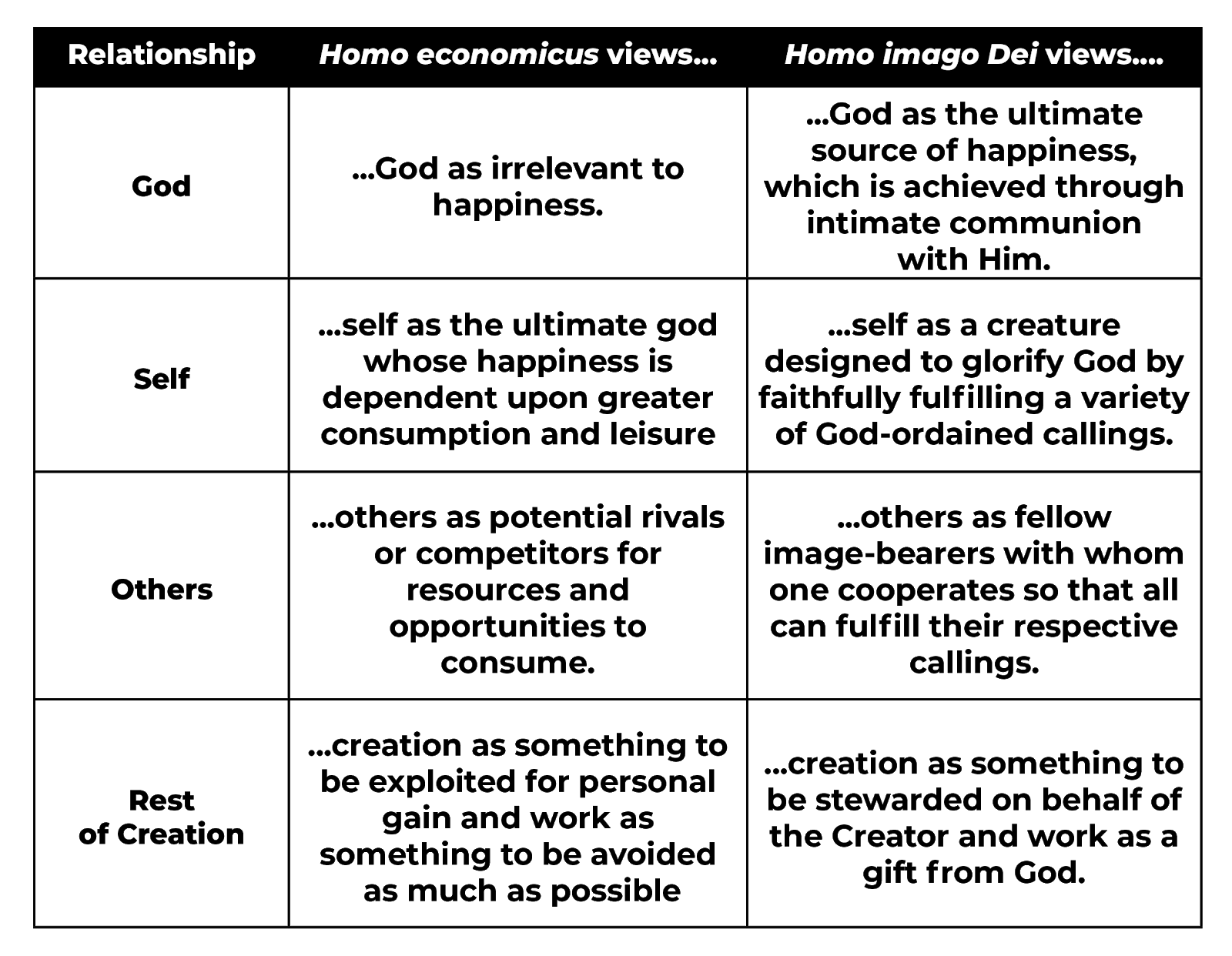
As summarized in this table, there is a stark contrast between Homo economicus and the creatures that God made in His image—what we’ll call Homo imago Dei—especially evident as we consider how they approach the four foundational relationships with God, self, others, and the rest of creation.

It is crucial to remember that Homo economicus is not just an alternative perspective on the nature of human beings to Homo imago Dei. On the contrary, Homo economicus is the god of Western Naturalism, a god that conforms human beings into its image. So we should ask: What would the followers of Homo economicus be like in daily life? As image-bearers of their hyper-individualistic, materialistic god, the worshippers of Homo economicus would do the following:

  • Economically exploit people from other ethnic groups, incarcerating them, or even killing them if they threaten “our way of life”;

  • Abort or abandon inconvenient babies;

  • Sexually exploit women and girls for personal gratification;

  • Participate In the sex trade by being immersed in pornography;

  • Enslave children in sweatshops to generate more profits;

  • Become a workaholic to earn and spend more;

  • Shrink into loneliness and isolation.

Martin Luther King Jr. Predicted This

It might seem strange to link racial injustice to the materialistic idolatry of Western Naturalism, but Martin Luther King Jr. made a similar link. Although he used different terminology, King taught that Western Naturalism’s denial of the existence of God elevates Homo economicus to God’s rightful place. And given the opportunity, the particular Homo economicus that was in power would exploit the powerless, including black people.6

For example, in 1961 King preached a sermon based on Luke 12:16-21 entitled, “The Man Who Was a Fool” in which he described the deforming impacts of a purely material understanding of the cosmos:

[The fool] failed to realize his dependence on God. Go back again and read his words. He talked as if he regulated the seasons. He talked as if he produced the rain. He talked as if he controlled the setting and the rising of the sun. This man was a fool because he felt that he was the creator instead of a creature. And so he sought to live life without a sky. He sought to live life merely on the horizontal plane, devoid of the vertical.

Now there is nothing new about this foolishness. It is still alive today. We find it in a collective sense at times when whole nations rise up and say that God is an irrelevant item on the agenda of life. This is something of what communism says; it talks about its dialectical materialism, and thinks of the whole of reality being pulled on by certain economic, materialistic forces. And so God is eliminated from the whole program of life.

But not only do we find theoretical denials; at times we find another type of atheism, which is even worse. It is a practical atheism, living as if there is no God. A part of the secularism and the materialism of modern life is found in this practical atheism, not where the individual denies the existence of God with his lips, not where the individual goes through the intellectual process of arguing this question of the reality of God, where the individual affirms the reality of God with his lips and denies His existence with his life. This is an even greater type of atheism and a more dangerous type.7

And King went on to link this materialism—Western Naturalism—to the plight of black Americans. King saw that without a spiritual realm, black people are nothing more than material things: like paper plates they can be used and then thrown away. King warned:

“A nation that will keep people in slavery for 244 years will ‘thingify’ them and make them things. And therefore, they will exploit them and poor people generally economically.”8

Homo economicus has no problem with exploiting anybody or anything. If racial categories serve this purpose, so be it.9

Confronting Racism and Helping Without Hurting

In every setting, the church is tempted to be influenced by the surrounding culture. Although we try to be “in the world but not of it,” too often we absorb—often unconsciously—lies from the culture in which we live.

Indeed, the sad reality is that American Christianity is often a mix between Historic Christianity and Western Naturalism. In particular, like Western Naturalists, we often do the following:

  1. We tend to view the world, including human beings, as being material in nature;

  2. We often exhibit the pride that comes from putting human beings, especially those
    from the dominant culture, in the role of God;

Those familiar with the Chalmers Center’s work have seen these two problems before. In When Helping Hurts, we argue that poverty alleviation strategies often fail because we try to address relational problems through material resources alone and because we operate out of a god-complex, a sense that we are called to fix materially poor people. When combined with the sense of inferiority that characterizes many materially poor people, these two attitudes can result in harm to both parties. When Helping Hurts summarizes this dynamic in the following equation:10

In this light, the first step in both helping without hurting and in overcoming racism is the same thing—repentance:

  • Repentance of a material understanding of the world, including human beings;

  • Repentance from the pride that comes from putting ourselves in the role of God;

Repentance, because the first commandment is “You shall have no other gods before me,” so Homo economicus must be dethroned.

  1. Gailyn Van Rheenen, “Animism, Secularism and Theism: Developing a Tripartite Model for Understanding World Cultures,” International Journal of Frontier Missions, 10:4 (October 1993): 169–171. See also Darrow L. Miller with Stan Guthrie, Discipling the Nations: The Power of Truth to Transform Cultures (Seattle: YWAM Publishers, 1998).

  2. See Brian Fikkert and Kelly M. Kapic, Becoming Whole: Why the Opposite of Poverty Isn’t the American Dream, 2019 (Chicago: Moody Publishers), 78-83; Brian Fikkert and Michael Rhodes, “Homo Economicus Versus Homo Imago Dei,” Journal of Markets and Morality 20, no.1 (Spring 2017): 101-26.

  3. See “What Is the Root of Racism?” from Carl Ellis, Jr., https://rts.edu/resources/what-is-the-root-of-racism/.

  4. “Neoclassical economics” has come to dominate economics departments and business schools in the West. 

  5. See Fikkert and Kapic  Becoming Whole, 77, 87. Fikkert and Rhodes 112-113.

  6. See the sermons “The False God of Science” and “The False God of Money,” https://kinginstitute.stanford.edu/king-papers/documents/false-gods-we-worship#

  7. From The Papers of Martin Luther King, Jr. Volume VI: Advocate of the Social Gospel, September 1948 – March 1963, Clayborne Carson, Susan Carson, Susan Englander, Troy Jackson, and Gerald L. Smith, eds., accessessed online at https://kinginstitute.stanford.edu/king-papers/documents/man-who-was-fool-sermon-delivered-detroit-council-churches-noon-lenten.

  8. “Where Do We Go From Here?,” as collected in A Call to Conscience: The Landmark Speeches of Martin Luther King, Jr., Clayborne Carson, ed., accessed online at https://kinginstitute.stanford.edu/king-papers/documents/where-do-we-go-here-address-delivered-eleventh-annual-sclc-convention.

  9. As mentioned earlier, it is true that some people simply hate black people, but Western Naturalism complements this and often is the more fundamental issue. In fact, recent social science research has found that more materialistic people are more likely to have racist attitudes. See Anne Roets, Alain Van Hiel, and Ilse Cornelis, “Does Materialism Predict Racism? Materialism as a Distinctive Social Attitude and a Predictor of Prejudice,” European Journal of Personality, 20, 155-168 (2006).

  10.  Adapted from Steve Corbett and Brian Fikkert, When Helping Hurts: How to Alleviate Poverty without Hurting the Poor…and Yourself, 2012 (Chicago: Moody Publishers), 64.

Racial wealth gaps and what your church can do about it

 Photo by Hans M on Unsplash

Photo by Hans M on Unsplash

Article originally posted here by Made to Flourish

by Amy L. Sherman

A few years ago in a powerful op-ed in the New York Times, Nicholas Kristof wrote that “the United States now has a greater wealth gap by race than South Africa did during apartheid. Whites in America on average own almost 18 times as much as blacks; in South Africa in 1970, the ratio was about 15 times.”

According to 2013 census data, median net worth for black households in the U.S. is $9,000 compared with $132,000 for white families.

It’s not an accident that we’ve gotten to this place. The reasons are admittedly diverse and complicated, but one thing’s clear. Racism has played a significant part.

Luke Bobo, Made to Flourish’s director of curriculum and resources, recently published a helpful yet unsettling monograph, Race, Economics, and Apologetics: Is There A Connection? In it, he briefly summarizes how decades of racial discrimination in housing, finance, employment, and the criminal justice system have systematically reduced wealth-building opportunities for African-Americans. Banks “redlined” African-American neighborhoods, meaning they avoided making home repair loans to black homeowners. As a result, those properties depreciated in value. Similar actions limited mortgage loans to black applicants, preventing them from homeownership. Discrimination by real estate agents and sellers/landlords further limited where blacks could live, contributing to racially segregated neighborhoods. Jim Crow restricted blacks from many job and education opportunities.

These are not just problems from long ago:

  • A 2014-2016 research study led by Harvard professor Katherine DeCelles created resumes and sent them out for 1,600 entry-level jobs. Some resumes showed applicants’ minority status while others were “whitened or scrubbed of racial clues.” The result? “Employer callbacks for resumes that were whitened fared much better in the application pile than those that included ethnic information, even though the qualifications listed were identical. Twenty-five percent of black candidates received callbacks from their whitened resumes, while only 10 percent got calls when they left ethnic details intact.”

  • 2017 study of housing finance records in 61 metro areas found that black Americans are more likely than whites with the same qualifications and credit scores to be denied mortgage loans (in some locales, more than twice as likely).

  • Considerable research indicates racial bias in sentencing, with defendants of color more likely to receive harsher sentences than whites with similar charges and backgrounds. Blacks are more likely to be arrested than whites for the same crimes. While the gap in rates of incarceration for blacks compared with whites has been shrinking since 2009, it is still the case that blacks are seriously overrepresented in prison: although they comprise only 12 percent of the general population they comprise 33 percent of the prison population. And if you’re in prison, you’re not working and earning.

The problems feel overwhelming. What can the average church do in response? A variety of approaches are needed: Education initiatives that provide better schooling for minorities and the poor, passionate advocacy for policies to redress the kinds of glaring injustices just noted,  job training programs, investments in minority entrepreneurs, and more. Congregations vary in their capacities for doing these things. But one thing many churches could do is shift some of their benevolence dollars toward matched savings programs.

One church’s story

Since 2013 North Avenue Presbyterian Church in Atlanta has offered “Faith and Finances,” a biblically based financial literacy class that includes mentoring and a 1:1 matched savings program. Class graduates can earn up to $1,000 in the months following the program. The church matches every dollar saved with one of its own.

Dion Miller used his savings to pay for truck driving school. His new commercial driver’s license earned him a position with a food distribution company that paid $1,000 a month more than his previous job. Dion and his wife, Renae, continue to save, working toward their dream of buying their first home.

Two other graduates have used their savings for college tuition, another bought a used pickup truck, and another replaced the windows on the house he’d purchased at a foreclosure auction. In short, graduates are increasing their human and financial capital. The program also gets people banked, says Matt Seadore, North Avenue’s director of mission and ministry. “We had a 90% unbanked rate upon entrance to Faith and Finances.  We have had nearly a 100% success rate with getting participants to open a savings account at a bank or credit union.” This cuts down on participants’ use of expensive check-cashing services.

Most churches respond to poverty by offering short-term income/consumption supports: free food, free clothes, a check to pay the overdue utility bill or rent. Such relief is sometimes needed and appropriate. But often it’s nothing but a Band-Aid that helps people manage their poverty for another month or so.

By contrast, asset-building strategies can actually help people escape their poverty over time. When a family develops a savings account, it has a buffer against “rainy days.” And assets can create more wealth: a house increasing in value or a mutual fund that pays a dividend.

An ambitious, randomized 2016 evaluation of matched saving programs by scholars from The Brookings Institution concluded that they’d contributed to a nine percent growth in participants’ liquid assets (e.g., savings, checking, and money market accounts); a 39 percent decrease in the use of non-bank check cashing services, and a 34 percent decrease in “hardships related to utilities, housing and health.”

So one important reason why churches should be running matched savings programs is that they work. Seadore was delighted to repurpose a $15,000 benevolence budget towards the 1:1 savings matches. “We were aware that benevolence monies were not always well-spent,” he says.

A second reason is that this ministry creates a context for relationships. As Steve Corbett, co-author of When Helping Hurts, explains: “The process of saving money for an asset purchase, even with match funding, is not quick….This is time that the church and its volunteers can spend loving the individuals in the program as well as their families.” These relationships have the potential to be mutually transforming and to promote cross-class and cross-race friendships.

But perhaps the most important reason for doing this kind of ministry is that for minority and low-income class participants it’s a small way of pushing back against economic injustice. Middle and upper-class Americans already have access to wealth-building opportunities through policies like the home mortgage deduction and retirement benefits like 401ks — which are essentially matched savings programs with employers contributing the matches. Since low-income earners rarely benefit from such programs the church can help by creating access to asset-builders like matched savings accounts.

Obviously, this approach alone isn’t going to reverse the wealth gap. But it’s one realistic concrete, and proven way a church can come alongside people long shut out from economic opportunities.

The Bible’s call to “do justice” means we can do no less.

Rebuilding Dreams

 Photo by  HS Spender  on  Unsplash

Photo by HS Spender on Unsplash

by Chris Horst

Graphs! Charts! Phases!

Never in all my life have I seen (or sent) so many. With the onslaught of pandemic analysis, we’re awash in models attempting to make sense of our world. Regions, organizations, and churches are employing tools to make it clear to their communities where they are and where they’re going, such as: Red → Yellow → Green. In Colorado, our three phases are: 

Phase 1) Stay at Home   →   Phase 2) Safer at Home   →   Phase 3) Protect our Neighbors

These tools help us interpret our current moment. As I’ve navigated the pandemic through the eyes of the one million families HOPE serves around the world, I’ve begun to see the situation through, you guessed it, three phases. 

Phase 1: The Precedented Crisis → Emergency Relief

What feels abrupt and jarring to us in the United States unfortunately feels familiar in many places around the world. A shock of this scale has not hit my country in my lifetime. But crises like this are far more normal in places like Zimbabwe, Haiti, and Moldova. 

We surveyed members of HOPE’s savings groups about facing financial emergencies. In Malawi, 28% shared they lost about half (or more) of their wealth over the previous year due to crises like drought, food insecurity, and violence. I have no family members nor close friends (read: 0%) who lost half their wealth last year. Here, we expect certainty and predictability. For many, certainty and predictability seem impossible.

When countries went into lockdown, we collectively leaned into our safety nets. In crises, we all rely on some combination of family and friends, our savings accounts, government stimulus checks, and even deep pantries to sustain us while we hunkered down. 

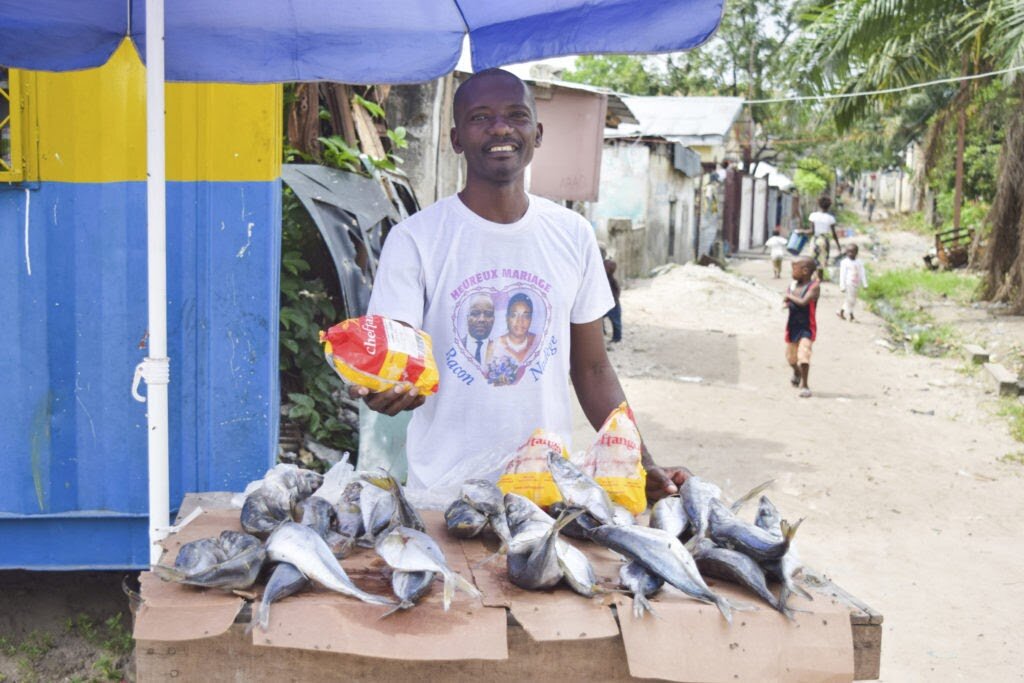
 Saturnin Lembouono, entrepreneur, Congo

Saturnin Lembouono, entrepreneur, Congo

The families HOPE serves are no different. Farmers in some cases harvested their safety nets— eating their cows and chickens, rather than selling their milk and eggs. Corner shop owners ate the inventory, using the flour and oil they intended to sell. 

In that same survey in Malawi last year, we asked HOPE savings group members about their readiness to respond to an emergency. 81% reported being able to meet a significant emergency need ($19), compared to just 37% of the broader Malawian population. Some have been able to do even more than sustain their own families. Amazingly, HOPE’s Rwandan savings groups have purchased and donated more than 2.3 tons of food to their most vulnerable neighbors. For the first time in our history, HOPE joined these savings groups by providing food relief to those most severely affected by the virus and lockdowns across the globe.

Those we serve were ready to both stay afloat and help their neighbors through this crisis. But for many, the cost of serving as a safety net to others meant wiping out their own fragile safety nets. 

Phase 2: Emerging from Lockdown → Grace Periods 

As lockdowns begin to ease, economies churn back to life, and people return to work, new challenges confront entrepreneurs as they try and restart. With threadbare safety nets and slowly emerging customers, it’s not feasible to simply flip the livelihood switch back on. 

Many of the entrepreneurs we serve are unable to repay their business loans. To meet these entrepreneurs in this vulnerable place, we rewrote our rules entirely. HOPE’s microfinance institutions and partners extended wide-ranging loan rescheduling, grace periods, and flexibility so entrepreneurs like Jofrey can get back to work quickly.

Jofrey, a grocer and restauranteur we serve in Congo, said, “The confinement imposed to fight COVID-19 has been a tough and unexpected time, but I am grateful to God as my grill and grocery business were authorized to open three days a week… The grace period helped me a lot and I have been able to save while keeping in mind the repayments resumption.”

Phase 3: Rebuilding Dreams → Kickstart Capital

We’re now seeing opportunities to invest big in the old and new dreams of bakers, barbers, and blacksmiths. Recovery lending is an essential service for communities lacking stimulus funding and the Paycheck Protection Program many can take advantage of in the United States. For asset and cash-depleted entrepreneurs, we’re rolling out new loan products with flexible terms and delayed repayment schedules to allow them to jumpstart their livelihoods

And we’re beginning to see the fruit of this approach. After reopening his business, Jofrey paid it forward. He decided to extend a grace period to some of his customers—taxi drivers who could not work during the lockdown—allowing them to buy food for their family on credit. For millions of entrepreneurs like Jofrey, rebuilding will require perseverance. But, we have witnessed this resilience before and are confident we will see it again.

Reclaiming Stewardship

 Photo by  Annie Spratt  on  Unsplash

Photo by Annie Spratt on Unsplash

by Mike Sharrow

If you grew up around the Western Church, it’s easy to associate “stewardship” with finances. Nobody is confused when a local church or faith-based NGO introduces a “stewardship campaign” that it’s a capital raising initiative or a focus on embracing the Biblical call to Kingdom generosity. None of that is wrong, but it’s easy to have a shallow understanding of the idea of stewardship and how radical it is.  Let’s broaden the aperture of our thinking and let the radioactive idea of our subordinate posture before the Living God rattle our cages just a bit.

What do you have? What is yours?  

Financially it’s easy to go to net worth calculations, portfolio summaries and balance sheets. Perhaps you thought of your home, cars, a spouse and children or even grandchildren. Maybe a collection of stuff, a contact list, a network, or knowledge and intangible wealth?  

This Christmas my girls (7 and 10) discussed what gifts to get friends and family. On Christmas morning they came out of “their” rooms to see what new stuff was “theirs.” During the day we navigated a few training opportunities around the ideals of sharing and respecting “what is yours” and what is not. Every parent appreciates the irony of helping 2 dependents grapple with respecting the stuff you gave them, how to spend the money you gave them and then how they treat the treasures you bestow upon them. You know the joy when a child, with great delight, awaits your response to the gift they bought you with your own money. Or, maybe you’ve opened the fridge to have someone shout, “Dad, you’re not going to eat ___, are you? That’s ours!” 

When I’m most perplexed at my kids failure to recognize all of this “mine” business is a farse – that everything they have is only because I’ve allowed them to “have it” and there’s nothing in our house they can claim original ownership of that it hits me…that’s me.  That’s us.  

Stewardship means I’m a manager of stuff that actually belongs to and is sourced in a sovereign God.  I’ve discussed previously the seductive idea that we do stuff for God to the idea His plans hinge upon our financial creativity.  As I like to say, we serve a God who’s loaded!  If I’m an assigned manager to a portfolio company within God’s Holding Company, and even my family, resources, and intangibles are entrusted to me for His good purposes – that’s a game-changer. 

So what? It’s all His (story) and He cares about what we do with everything (time, talent, treasure, influence, etc). 

Then Stewardship, rightly understood, changes what I do, how I do it, and why I do it. That investment decision? It’s God’s money. That hiring decision? That person is made in the image of God and how I treat people is getting into the actual currency of heaven.  

One day we’ll all stand before Jesus for a performance review. Praise God it’s not an entrance exam!  But there will be an accounting before something called the Bema Seat of Christ (I love this drama by Pete Briscoe on that moment). I like to say, there is a final exam but it’s an open book test!  

How do I reinforce a stewardship mindset in life and business? 

Here are some resources that help me lean into an identity-driven stewardship lifestyle: 

Weekly Marble Move. Yup, I explain this Saturday night discipline HERE.

My wife and I attended a Journey of Generosity (no money asks!), and left with a set of 30 fantastic questions we’ve been working through – HERE.

I evaluate each dimension of the business I lead as if it were a ministry (#BaaM), a for-profit enterprise where the true Owner cares about each aspect of the operation not just the distribution of profits.  I use exercises like THIS to facilitate this annual stewardship exercise. 

Stewardship means the ownership group is fanatical in pursuit of “Mission True” best practices.

Every December I complete this annual reflection, and then monthly I’m in a peer group that challenges me on this snapshot.

I gather with leaders who treat stewardship and Kingdom investments rigorously (like this), or who passionately embrace opportunities to create caring cultures of people stewardship (like this).

A friend asked me this once.  “If you had a write a proposal to the Heavenly Holding Company on why they should renew your contract as CEO of the current operating company you’re assigned to based upon your stewardship results of the previous year…what would that proposal sound like?  Why would God “re-up” your contract?” What does good stewardship mean to you?

Reconciliation, the church, and economic justice

 Photo by  Tabea Damm  on  Unsplash

Photo by Tabea Damm on Unsplash

This article was originally published here by Made to Flourish

by Luke Bobo 

These three phrases — reconciliation, economic wisdom, and the church — belong together. Why? Let’s begin with a definition of reconciliation. Brenda Salter McNeil’s book, Roadmap to Reconciliation: Moving Communities into Unity, Wholeness and Justice, helps us.

McNeil, featured as one of the 50 most influential women to watch by Christianity Today in 2012, and associate professor of reconciliation studies in the School of Theology at Seattle Pacific University, defines reconciliation as “…an ongoing spiritual process involving forgiveness, repentance and justice that restores broken relationships and systems [institutions] to reflect God’s original intention for all creation to flourish.”

Click here to read the full article!