Sermon On The Mount vs. Sermon On The Plain: Different Messages For Different Economies

 Image from original article

Image from original article

Article originally posted here by Townhall Finance

by Jerry Bowyer

As we have seen there were major differences between the Galilean political economy and that of Judea. This difference in economic base was partly due to providence as expressed in the geographical differences. According to the Lexham Geographic Commentary on the Gospels:

“Matthew 5:13–16; 6:25–33; 7:13, 24–27; 13:3–9, 24–30; Luke 15:11–15

Unlike the southern Central Hill Country, which is almost exclusively hard limestone (Cenomanian), Galilee is a mixture of hard (Cenomanian), soft (Eocene), and chalky (Senonian) limestones.

Matthew 5:13–16; 6:25–33; 7:13, 24–27; 13:3–9, 24–30; Luke 15:11–15

Unlike Judea and Samaria, which had limited areas to sow grain, Galilee possessed large valleys and plains.

(Alexander, V. H. (2016). The Words and Teachings of Jesus in the Context of Galilee. In B. J. Beitzel & K. A. Lyle (Eds.), Lexham Geographic Commentary on the Gospels (Mt 5:13–Lk 15:15). Bellingham, WA: Lexham Press.)

Lower Galilee (where Jesus lived and had his early ministry) had better farm land than upper Galilee (which was more mountainous and less prosperous) or than Samaria to the South. Flat land made both for better farming and also for more trade routes. Mountains are barriers to trade. They didn’t have gunpowder and could not blow the tops off of mountains or easily cut tunnels through them.

I argue that the differences in economic base should not be ignored when looking at the different ways in which Jesus talked about money in these different economic contexts; because he did, indeed, speak differently to Galileans about economic matters than he did to Judeans. One powerful way to demonstrate this is by looking at parallel sections of the Bible which are very similar, but not completely identical. There are often called ‘parallel passages’, but sometimes people use that phrase to refer to sections of the Bible which are talking about the same event at the same place and time, while others who use that phrase include in it passages which do not describe the same events, but rather similar events.

I’m using the phrase in that latter way: different events which have very similar messages. The Sermon on the Mount (starting in Matthew 5) and the Sermon on the Plain (starting in Luke 6) are so similar that those who wish to assault the veracity of the Scriptures try to use variations between them as proof of contradictions in the Bible. The detractors usually key in on the fact that one is reported to have happened on a mountain and the other is reported to have happened on a plain. But, in addition, there are differences in the actual content of his recorded remarks. For example, Luke’s Sermon on the Plain contains ‘woes’ against the wealthy. However, Matthew’s Sermon on the Mount does not.

Let’s look at the different economic contexts of the two sermons. First the Sermon on the Plain:

17 And he came down with them, and stood in the plain, and the company of his disciples, and a great multitude of people out of all Judaea and Jerusalem, and from the sea coast of Tyre and Sidon, which came to hear him, and to be healed of their diseases;

(Lk. 6:17 KJV)

We see that Jesus’ message was given in a context which centered on the capital region of Judea and its capital city, Jerusalem. There were people from Tyre and Sidon as well, which were major financial centers and which had some close financial ties with Jerusalem. For example, Tyre minted the Temple Shekel for the Herodians (which we will see was important tool of economic extraction from the people centering in its use in the temple system). It is extremely unlikely that Jesus gave the sermon in close physical proximity to Tyre and Sidon in the far North of the region. This would have been far afield from Jesus’ usual mission field. Far more likely is that Jesus was speaking near Jerusalem and that Tyreans and Sidonians were in Jerusalem for business reasons. For a rough analogy, imagine New Yorkers visiting the Washington, DC region, and stopping their negotiations to hear an itinerant preacher from flyover country.

However, even if you reject my conclusion about where the sermon was probably given, the Gospels are quite clear about to whom it was given. That’s the main point.

By contrast, the Sermon on the Mount was given to a different, far broader group of people centered in or near Galilee:

23 And Jesus was going about in all Galilee, teaching in their synagogues, and proclaiming the gospel of the kingdom, and healing every kind of disease and every kind of sickness among the people.

24 And the news about Him went out into all Syria; and they brought to Him all who were ill, taken with various diseases and pains, demoniacs, epileptics, paralytics; and He healed them.

25 And there followed him great multitudes of people from Galilee, and from Decapolis, and from Jerusalem, and from Judaea, and from beyond Jordan.

(Matt. 4:23-25 NAS)

So, the Sermon on the Mount was given to Galileans, Decapolites (Decapolinians?), Judeans (including Jerusalemites) and trans-Jordanians. This is a very broad audience, more than just a national audience. It’s hard to know where it occurred—probably someplace centrally located—but the important point is who was in the audience. It was made up of people from different types of regions with different political economies. Think of something more like a national television address than a regional speech on local TV in Washington DC with visiting business interests from New York.

So, we see that although the categories are not perfectly aligned, the different audiences for the two sermons correspond somewhat to the different political economies we’ve discussed. One centers in Judea, and the other has a broader audience which includes Galileans, with Jesus giving what appears to be one of his stock speeches (with some variations) in both places. It is a nearly perfect environment to test the thesis that Jesus varies his economic commentary depending on the political economy environment into which he is speaking.

First, let’s look at the very beginning of both speeches. Both start with the Beatitudes, but the first Beatitude has an interesting variation between the two versions.

The Sermon on the Mount begins:

KJV Matthew 5:1 And seeing the multitudes, he went up into a mountain: and when he was set, his disciples came unto him:

2 And he opened his mouth, and taught them, saying,

3 Blessed are the poor in spirit: for theirs is the kingdom of heaven.

(Matt. 4:25-5:3 KJV)

Whereas the Sermon on the Plain starts with:

20 And he lifted up his eyes on his disciples, and said, Blessed be ye poor: for yours is the kingdom of God. (Lk. 6:20 KJV)

The phrase ‘poor in spirit’ is generally considered to be less ‘in your face’ when it comes to confronting issues of economics. It is more malleable and more reconcilable with a spiritual, as opposed to socio-economic, focus. And it is given to the broad national audience which includes people from the more free-market system of Galilee and the likely more free-market system of the Decapolis, instead of just the residents of the capital city and environs.

But to the Judeans we have the blessing given to ‘the poor’, which denotes a specifically economic grouping (though connotations may suggest other social characteristics.) It is more ‘in your face.’ Preachers and polemicists who are focused on economic reform tend to default to this version of the first Beatitude – though mistakenly using it to argue for a more politicized, Judean-type, economic system – represented by the region from which the bulk of the audience was drawn.

Beyond the small variation in the first Beatitude, there is a much larger variation to consider, a section which is missing from one version and present in the other.

In the Sermon on the Plain, Jesus transitions directly from the end of the Beatitudes to a denunciation of the rich:

22 Blessed are ye, when men shall hate you, and when they shall separate you from their company, and shall reproach you, and cast out your name as evil, for the Son of man’s sake.

23 Rejoice ye in that day, and leap for joy: for, behold, your reward is great in heaven: for in the like manner did their fathers unto the prophets.

24 But woe unto you that are rich! for ye have received your consolation.

25 Woe unto you that are full! for ye shall hunger. Woe unto you that laugh now! for ye shall mourn and weep. (Lk. 6:25 KJV)

(Lk. 6:22-25 KJV)

But who is ‘you rich?’ It is the wealthy elite centered in the political capital of Israel, the Jerusalem elite and their cronies from the rest of Judea and Tyre and Sidon. Interesting that Jesus uses the 2nd person pronoun ‘you.’ He does not denounce the abstraction known as ‘the rich’; rather he specifies the rich to whom he is speaking, primarily the Judean rich.

The Sermon on the Mount, by contrast, moves right from the end of the Beatitudes to the Salt of the Earth, as he addresses a group which includes many of the salt of the earth in its midst, omitting the woes to the rich.

11 Blessed are ye, when men shall revile you, and persecute you, and shall say all manner of evil against you falsely, for my sake.

12 Rejoice, and be exceeding glad: for great is your reward in heaven: for so persecuted they the prophets which were before you. (No statement of woe towards the rich)

13 Ye are the salt of the earth: but if the salt have lost his savour, wherewith shall it be salted? it is thenceforth good for nothing, but to be cast out, and to be trodden under foot of men. (Matt. 5:11-13 KJV)

It is unlikely to the extreme that Jesus varies his speech when speaking to different groups from different economic environments in two ways which differ specifically in their economic content, by mere coincidence. Like any great speaker, he knew his audience and adapted his speech accordingly.

This will become even more apparent as we examine numerous other instances of how Jesus caters his messages pertaining to economic matters in response to the nuances of different economic environments and the different economic aspects of the occupations of the people he encounters in his travels.


Seven Intuitive Questions for an Investor

 Photo by  Ryoji Iwata  on  Unsplash

Photo by Ryoji Iwata on Unsplash

Article originally posted here by Eventide

by Eventide

How do we understand if a company is creating value for society? One way is to ask intuitive questions of the company—questions like “If you walked into a supply center, would you be proud of the quality of the product and working conditions?”

Listen as Hannah Cumming shares 7 intuitive questions to help investors evaluate a company’s ability to create value:

Should Christian Investors Risk Lower Returns to Invest Biblically?

Article originally posted here by Inspire

by Robert Netzly

The biblically responsible investing (BRI) movement is booming as Christian investors move billions of dollars each year to switch their portfolios into biblically responsible investments, seeking to avoid profiting from abortion drug manufacturers, adult entertainment distributors, LGBT activism, human trafficking and other immoral issues.

As the biblically responsible investing (BRI) movement continues to take Wall Street by storm, the question of performance routinely surfaces. Questions such as, “Will I have to sacrifice performance if I switch my portfolio to biblically responsible investing?” are natural, logical and very appropriate questions to ask. Perhaps it is because we are wired to assume that if we do the right thing we are going to suffer for it, the proverbial “good guys finish last” situation, or maybe because we are fearful that if we do something out of the ordinary, like biblically responsible investing, that we are taking a big risk by venturing outside of the perceived safety of the herd, but whatever the reason, investors and financial advisors are frequently tripped up by the question of performance, often even skeptical toward the growing amount of research data showing that good values and good returns are not mutually exclusive.

While one way to answer the concerns about performance is simply to point to the actual track record of biblically responsible investing funds, which you can research for free at inspireinsight.com, or to read the independent, academic research that analyzes the performance of biblically responsible investments relative to secular investments, which you can find on the research page at inspireinvesting.com, I want to address the performance question in a different light today, drawing from two passages in the New Testament.

Follow Me

Jesus had a unique way of calling people to follow Him. He just said, “follow me”. No cajoling, no convincing, no explaining, just a simple and authoritative call to follow. One of those encounters is the well-known story of Jesus calling His first disciples,

“While walking by the Sea of Galilee, he saw two brothers, Simon (who is called Peter) and Andrew his brother, casting a net into the sea, for they were fishermen. And he said to them, ‘Follow me, and I will make you fishers of men.’ Immediately they left their nets and followed him. And going on from there he saw two other brothers…and he called them. Immediately they left the boat and their father and followed him.” (Matthew 4:18-22)

Another famous story of Jesus calling a man to follow him is the story of the rich young ruler, who comes to Jesus asking what he needs to do to inherit eternal life. Jesus tells him to follow the ten commandments, to which the rich man replies “all of these I have kept since my youth” (umm, really?). Jesus’ following reply was not what the young ruler was expecting to hear,

“…He said to him, ‘One thing you still lack. Sell all that you have and distribute to the poor, and you will have treasure in heaven; and come, follow me.’ But when he heard these things, he became very sad, for he was extremely rich. Jesus, seeing that he had become sad, said, ‘How difficult it is for those who have wealth to enter the kingdom of God!’” (Luke 18:22-24)

In these two stories we find Jesus giving the call to leave what you have and follow Him, and two very different reactions to that call. The fishermen are called to leave their income, their livelihood and their business assets to follow Jesus, and their response is one of faith, “immediately they left their nets and followed him.” The rich young ruler is called to walk away from his earthly wealth and follow Jesus, and his reaction is one of sadness and disobedience.

Counting The Cost

Here is my point, sometimes (oftentimes?) Jesus calls people to make earthly sacrifices in order to follow Him by faith. Does Jesus call everyone to leave their business or sell all they have to follow Him? No, certainly not. But He does call some people to that, and if He calls you there can be no room for deliberation, only counting the cost and immediately following Him.

Has the Lord pricked your heart about investing with biblical values? If you researched at inspireinsight.com and discovered that you were actively profiting from abortions and adult entertainment, would that bother your conscience? I would submit to you that is the Lord calling you to pursue biblically responsible investing for His glory and your joy. I would then submit to you that the question of a hypothetical performance sacrifice is irrelevant, because if God is calling you to switch your investments to biblically responsible investing, it does not matter what the cost is. Our only option, and indeed our greatest joy, is immediate obedience.

Don’t get me wrong, I believe and have experienced that Christians are not required to accept lower investment returns in order to invest biblically responsibly. But even if that was the case, or even if it somehow became the case in the future, does it matter? Would we reject the call of God because we are unwilling to give up performance potential? Or would we immediately drop our investments and follow Him?

SOCAP Conference Panel on Faith-Driven Impact Investing by Robert Kim

 Photo by  NCF

Photo by NCF

— by Robert Kim

This October, I had an amazing opportunity to moderate a panel on faith-driven impact investing at SOCAP.  This was a special moment for me as this panel allowed me and the panelists to share about Jesus at one of the most prominent yet secular gatherings of impact investors and social entrepreneurs. 

Three panelists were Bryce Butler (Founder of Access Ventures, a private operating foundation committed to deploying 100% of its assets to impact investments), Gloria Nelund (Founder of TriLinc, an impact private debt fund that has deployed approximately $1 billion in emerging markets), and Todd Johnson (CEO of iPAR, an innovative impact reporting / analytics app that allows investors to monitor impact across asset classes).  I was incredibly encouraged and grateful for their enthusiastic “yes” to join this panel and share about the role their faith has played in shaping their impact investing journey.    


I’d like to share a few points from the panel:

1.  Understanding the purpose of capital and pursuing a healthy relationship with money is the first step towards a rewarding journey in impact investing.  Too often, our goals and behaviors are influenced by fear and greed that stem from idolizing money.  Truly embracing the perspective that money is just a tool liberates us to explore what money, and furthermore capitalism, can do other than simply meeting our own needs or, worse yet, feeding our insatiable greed to want more.  Such freedom allows us to use money as a resource to pursue the very calling God has equipped us for.  It enables us to creatively use all types of capital – philanthropic and investing – as a resource to benefit communities in need (physically and spiritually).  Convinced that all assets belong to God, Bryce is directing 100% of Access Ventures’ assets to pursue the foundation’s mission (not just the 5%, required by the U.S. government).  This model allows the foundation to catalyze a lot of the important work for communities in need, using both philanthropic and investing capital.  For example, Access Ventures uses its philanthropic capital to meet the immediate needs of a homeless community (e.g. food and clothing, etc.) in Louisville and uses the investment capital to invest in sustainable solutions that help prevent homelessness for families at risk (e.g. affordable housing). 

2.  Jesus’ love compels us to create new ideas and solutions to tackle some of the pressing societal needs.  For example, TriLinc has structured innovative investment vehicles and processes to give retail investors opportunities to make impact investments (impact investing has been and still is largely available to accredited investors only, so democratizing access to quality impact investments has always been a need in this industry).  Under Gloria’s leadership, TriLinc is changing the narrative that only the wealthy has the ability and opportunity to create impact through investments.  TriLinc is just one example – there are many more (e.g. a private equity firm has developed a process to help Christian entrepreneurs integrate their faith into the companies’ operations and culture.  Various Donor Advised Funds are ‘re-imagining’ the role of philanthropic capital to not only support non-profit organizations but also invest in faith-driven social entrepreneurs).  God’s love compels us to innovate and push the boundaries of existing paradigms for the sake of communities in need. 

3.  Lastly, our panel session touched upon the need to grow the faith-driven impact investing ecosystem.  While I am grateful for the opportunity to share about the Christian faith at SOCAP, the Gospel-influenced perspective has been largely missing in the impact investing conversations for the past 15+ years (I fully recognize that BAM and other Christian NGOs have been doing amazing mission-oriented work through micro finance and small businesses for decades.  Still, a majority of Christian investors and organizations have not been actively involved in shaping the impact investing industry). 

Fortunately, this is changing. 

More Christian investors – both individual investors and institutional organizations – are looking to deploy investment capital for financial, social, and spiritual returns.  Very exciting!

I’m excited for two reasons: for one, more capital will flow into sustainable mission-oriented companies that can help share the story of Jesus.  Secondly, Christian investors will have the opportunity to share the “why” behind their impact investing journey with peers in impact investing industry and share about the love of Christ.  

As we come together and prayerfully support the growth of this ecosystem, we will likely need to address some of the questions below (and many more!):

1. What is the definition of faith-driven impact investing?

2. How do we create a culture to embrace a diverse set of opinions and values while focusing on our common faith?

3. How do we maintain the spirit of sacrificial giving while pursuing market-rate financial returns in impact investments?

4. Is it wrong to generate market-rate financial returns through impact investments?  Should such a goal be encouraged or discouraged?  What are the pros and cons of each perspective?

5. How do we balance the need to evaluate and monitor impact while accepting the fact that spiritual impact is hard to measure?

6. What are some of the frameworks and processes that we can use from the impact investing industry to grow the faith-driven investing ecosystem?


While this ecosystem is relatively young, I’m encouraged to see some of my colleagues from forward-thinking organizations come together to collaborate and prayerfully lay the groundwork to help build up this ecosystem. 

The truth of the matter is..there is order of magnitude more capital in investing pool than in philanthropic pool.  Imagine the scale and depth of impact if an increasing share of the investing pool can be directed for good.  This is incredibly exciting.

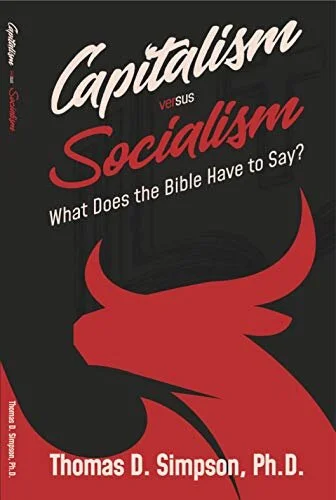
Capitalism Versus Socialism: What Does the Bible Have to Say?

 Photo by  Ivan Aleksic  on  Unsplash

Photo by Ivan Aleksic on Unsplash

by Thomas D. Simpson

Capitalism Versus Socialism: What Does the Bible Have to Say?

Are capitalist economies dominated by greed, exploitation, and inequality?
Is socialism the path to a better life and greater equality?
Does the Bible tell us that socialism is the right way for people to live?

The hot controversy over Bernie Sanders and AOC is testimony to the passion people have over the question of socialism or capitalism.

Click here to learn more

Preface

One of the more startling developments of recent years has been a renewed enthusiasm for socialism, especially among millennials and Generation Z. Indeed, opinion polls show that American millennials and Generation Zers have a highly favorable attitude toward socialism. Polls indicate that upwards of 70 percent of people in these age groups favor socialism. Th ey perceive that socialism provides more economic security, a greater sense of togetherness, and more equality of wealth and income. Adding to the popularity of socialism is an underlying notion that, under socialism, the things we want—college education, health care, and housing—would be free of charge. Th ere’s very little realization that these things require costly resources and must, at the end of the day, be paid for. In other words, to get these things for free, ultimately, we have to give up other things—indeed, a lot of these other things—that we also value.

Very seldom do you hear proponents of socialism addressing the other side of the coin: What the average person must give up to get these “freebies.” And how, in the end, it will be impossible to satisfy everybody’s wants. Invariably, there will be some type of unpopular rationing procedure to determine who the lucky ones are who get the scarce items being provided for free. Moreover, these rationing procedures inevitably pose an irresistible temptation for corruption. Those deciding who actually gets the scarce item can line their pockets with surreptitious payments from those most wanting it. It happens all the time.

Overlooked, too, is the tendency for such centrally directed economic systems to override personal freedom. When the government makes choices for us, we have ceded our right to make those choices ourselves. And the more choices that we’ve turned over to the government, the more our personal freedom has been curtailed.

Also playing a role is an attitude that has developed— aided by the media and Hollywood—that our market-based (capitalistic) system is based on greed, exploitation, and abuse. It’s a rigged system in which the average person doesn’t have a chance.

In addition to being unfair and drawing out the worst in people, inherent in capitalism are financial crises and major economic disruptions. Indeed, the financial crisis and Great Recession of 2008 and 2009 played an indisputable role in fostering these attitudes. Capitalism is portrayed as a dog-eatdog system in which only the fittest and craftiest survive. This can be pretty scary, especially for those who have always gotten a shiny trophy for participating in competitive events, regardless of where they finished. The popularity of Bernie Sanders and, more recently, Alexandria Ocasio-Cortez (AOC) epitomizes the attraction of millennials and Gen Z to socialism.

Meanwhile, Che Guevara, associated with Marxist revolutionary movements in the Western Hemisphere, is lionized as a champion of the downtrodden. Che is commonly found on tee shirts of the young. Lost in all of this is the historical record of the real Che. The real Che was ruthless in his dealings with anyone who opposed him. He was responsible for the murder of thousands and he fiercely beat thousands more.

The popularity of socialism seems ironic in light of the long trail of failures of socialism in its various forms, including pervasive corruption and brutal suppression of opponents. Moreover, we can watch a real-time example in Venezuela, which has been disintegrating before our very eyes—empty shelves, ongoing electrical blackouts, vanishing health care, historic hyperinflation, government repression, widespread corruption, and murders of families seeking to escape across its borders. Or contrast North and South Korea—the former a communist (socialist) system and the latter a capitalist (or market-based) system. The people who live in these countries share the same cultural heritage and inhabit the same corner of the earth. Yet one group perpetually lives at the edge of starvation and is subjugated by a vicious regime while the other—which may have produced your car, TV, or smart phone—thrives.

These examples reveal a huge chasm between the utopian ideals of socialist thinkers and actual performance. Interestingly, those countries that had been socialist in Eastern Europe have embraced market principles and have no desire to return. Nonetheless, Bernie’s views on the desirability of socialism have changed little over the decades, even in the face of the lengthy string of failures. The examples also reveal a widespread jaundiced view of the contributions of market (capitalist) systems, which have done more to raise standards of living around the world and lift people out of poverty than any other economic system in history.

This fascination with socialism by millennials and Gen Z is another example of the validity of George Santayana’s statement that “Those who don’t remember the past are condemned to repeat it.”

Yet many have argued that socialism is most consistent with biblical teachings. Frequently mentioned is the early church in Jerusalem described in Acts 2:42-47. Believers were selling their possessions and sharing with others, so that the needs of each member of that community were being met. Also, other biblical references to caring for the poor and the curse of being rich are viewed as supporting a system in which government performs the role of the leveler—redistributing wealth from the rich to the poor.

This book addresses the fundamental features of all major economic systems, including capitalist and socialist systems. Communism is a variety of a socialist system, and fascist systems—most notably those of Nazi Germany and Fascist Italy—have their origins in socialism. These are contrasted with the basic features of a capitalist or market-based system. The Bible doesn’t prescribe any specific economic system but is fairly clear about the underpinnings—or pillars—of these economic systems.

This book uses the term “market-based” system instead of “capitalist” system. The latter has more emotive content and is misleading. Karl Marx, author of the Communist Manifesto and Das Kapital, favored the term “capitalist,” and the term is widely used today by critics of market-based systems. Marx saw the population as divided into two opposing groups—workers and capitalists. Capitalists were the owners of the businesses that employed the workers and of the capital or machines used by workers in the production process. Marx described workeremployer relationships in the context of the manufacturing sector, in which employers were factory owners.

In his view, a highly adversarial relationship existed between workers and capitalists, one in which capitalists had the upper hand and routinely exploited their workers in their pursuit of greed. Capitalists expropriated for themselves some of the value created by workers during the production process—value that legitimately belonged to workers. Moreover, one’s economic and social position was passed along to the next generation; thus, your economic and social plight was determined by your birth. The offspring of capitalists became the next generation of owners and managers of factories while the offspring of workers became the next generation of exploited workers. For the workers, there were no avenues of upward mobility for their children—their children, too, were stuck in the misery foisted on them by greedy and uncaring capitalists. Furthermore, workers and capitalists formed the primary social classes, and tension between the two also represented a grave social clash.

This was a highly simplified characterization of economic reality, even in Marx’s day. It didn’t describe agricultural, retail, and other service workers who were around in large numbers at the time of Marx’s writings. In these sectors of the economy, family operations, sole proprietorships, and partnerships were common. In these situations, relationships between owners and those providing labor were typically much different.

Today, we live in an economy that’s largely a service economy, in which more than two-thirds of total output takes the form of services instead of manufactured, tangible goods. More importantly, modern employers—be they in the service sector or manufacturing—realize that satisfied employees are more productive and more valuable to the company than disgruntled workers. Furthermore, in a competitive labor market, discontented workers can leave and are prone to search for greener pastures. When this occurs, employers must undertake costly searches for replacements and costly training programs for new hires, not to mention disruptions to the production process while this is taking place. In response, we see employers luring new workers and seeking to retain existing workers by offering flex-hours, work-from-home, and other amenities that cater to changing lifestyles, along with competitive compensation. In these circumstances, workers in the private sector today see very little need for labor unions to represent them in dealing with conflicts with their employers, as witnessed by a paltry 6% of the private sector labor force being unionized.

Consequently, the differences between workers and employers have become blurred. Workers own corporations through their 401(k) plans and through their savings placed in mutual funds. In that sense, they’re capitalists. And managers of many successful businesses place their desks out with their employees, dress like them, and mingle with them throughout the working day. Business managers do have some ownership in the businesses they manage, but this typically is required by the board of directors chosen by the shareholders and to whom managers are accountable. The board wants its managers to have “skin in the game” to better align the managers’ interests with those of the other shareholders, so that their actions will be in the best interest of shareholders generally.

Moreover, those with the greatest holdings of wealth today haven’t acquired that wealth through inheritance. The wealthiest today are self-made entrepreneurs. In other words, the wealthiest Americans have created their own wealth and haven’t had it passed down to them. The top ten wealthiest Americans have names such as Gates, Zuckerberg, Bloomberg, Koch, and Brin—one of these is barely into his thirties. They’re all multi-billionaires. Some made their fortune by translating a novel idea into a product used widely around the globe, while others used keen judgment to find established businesses that were languishing and needed help to turn their fortunes around.

For these reasons, the term “market-based” is used instead of the term “capitalist” to refer to a system in which people—be they employees or employers, consumers or businesses—respond to market incentives as they pursue their self-interest. In this setting, economic outcomes result from the interactions of these numerous parties, each pursuing their self-interest—and not from central plans and direction. Property is privately owned, and large numbers of workers also have an ownership stake in corporate businesses, often indirectly through 401(k)s and other retirement plans. In the appendix, we’ll examine the conditions that are required for such an economic system to perform at a high level and get the most out of the resources available.

It’s worth noting that many of the proponents of socialism today appear to have a somewhat different version in mind than the types of socialism that have described the past. Under standard forms of socialism, property is owned collectively— and not privately. Production takes place through state- or collectively owned enterprises, not through private businesses. Socialists today focus more on using the state to redistribute income and wealth and to make widely available certain goods and services to the public, such as health care and higher education, at no out-of-pocket cost. Some see production being undertaken by government while others see a role for private suppliers. In any event, the government would be applying a heavy hand in regulating and controlling the economy, as in more traditional socialist and fascist systems. As a consequence, the scope for corruption and abuse is magnified, as in those other non-market systems.

In practice, most economies today are, in varying degrees, welfare states, relying on market forces for the bulk of the production of goods and services and the government to provide a safety net to those at the lower end of the income spectrum. The resources for the safety net come from disproportionately high taxes on those at the upper end. The United States has introduced a moderate welfare state, while Northern European countries have gone considerably further.

As noted, the Bible doesn’t specifically prescribe any of the economic systems addressed here, those that have characterized the past century. However, each of these systems is built on four pillars, and the Bible does have something to say on these. Perhaps, not too surprisingly, the Bible is most consistent with the system that the nation’s founders established, one based on freedom and individual choice.

This book is an outgrowth of an invitation that I received to speak on alternative economic systems—communism, socialism, and capitalism—including which is most compatible with biblical teachings at an annual Ratio Christi Symposium. As I researched the topic, it became clearer to me that marketbased systems are most consistent with the teachings of the Bible. 

Nonetheless, the Bible doesn’t condone excesses that can develop in a market economy (or any other economy), and each of us has a responsibility to care for those unable to care for themselves and to resist the temptation for wealth to become an obsession in our lives and stand above God.

By way of background, my appreciation for the basic workings of market-based economic systems has grown over a lifetime of being a student of economics and economic systems. I was raised the son of parents who struggled to make ends meet during the Depression of the 1930s, and who regarded government and labor unions to be a necessary protector of workers and consumers. Indeed, my father served as president of a labor union for a number of years. Needless to say, my parents were skeptical of free and open markets. Growing up, I also had the view that private business activity—working for businesses or buying from some businesses—was tainted. There was something morally questionable about doing so. Government and nonprofit organizations were more virtuous.

However, once I began studying economics in college, my views started to change. I began developing a realization that market-based systems are complex ecosystems that work in harmony to deliver impressive results. Also, I came to realize that people pursuing self-interest in the marketplace isn’t much different than pursuing self-interest by eating when feeling hungry. We are wired this way to preserve life by an intelligent designer. This appreciation for market systems grew as a Ph.D. student in economics at the University of Chicago. The contrast between economic performance under market-based and socialist and communist regimes took on new meaning during my career as a central banker at the Federal Reserve Board in Washington, D.C. In that capacity, I was privileged to be able to provide technical assistance to central banks in former socialist and communist systems. These nations had lived with the widespread shortcomings of centrally directed economies and wanted to emulate the performance of the United States and other market economies. Moreover, at the same time, most also were turning to democracy as a way of enabling their citizens to choose their political leaders and how they would be governed, in keeping with their new freedom to choose what to buy in the marketplace and where to work.

The vibrancy of economic life in well-functioning market systems is palpable. Moreover, these systems, perhaps ironically, treat individuals with more basic dignity, and are more compatible with democratic political systems than the others. They provide more transparency and less scope for corruption than other systems. But they’re not perfect and come with a list of well-known market failures. In those circumstances, they provide opportunities for humans to use their God-given abilities to develop public policy to achieve better outcomes, although it needs to be noted that the cure for the shortcomings can sometimes be worse than the disease. This is to say that all economic systems, including market-based systems, come short of delivering perfection—which is the human condition in a fallen world. It will continue to be the human condition until, as the Bible assures us, Christ returns.

This book is written for all persons interested in the issue of capitalism versus socialism and wanting an authoritative and even-handed treatment of the topic. It’s written for an audience having no background in economics. It’s especially of value to parents who want their children to be well informed on this critical issue. Indeed, each chapter has some questions to stimulate good discussion around the dinner table. They’re intended to launch a constructive back and forth discussion and not necessarily to come up with definitive answers.

A few biblical propositions underlie the arguments presented in this book:

  • The Bible from Genesis through Revelation is the revealed word of God and is to be relied upon and trusted in making decisions and forming judgments.

  • God created humans in His image, including giving us the ability to reason and the opportunity to make our own decisions (Genesis 2). This implies that all humans have immense value, and that no one person is any more important than any other. It also implies that individuals are competent to make important decisions.

  • In exercising our freedom to make decisions, we have repeatedly chosen to put our will ahead of God’s (Genesis 3—committed sin). The consequence has been a fallen (imperfect) world. A just God cannot tolerate sin and relegates all of us sinners to an eternity apart from Him—hell.

  • But God is also a loving God who has provided a plan for redemption, through His son, Jesus. Jesus ushered in a new era (kingdom of God) for those who accept Him and his sacrifice. He will return at some undisclosed time in the future to restore creation (Daniel and Revelation). Perfection won’t come until then. In the meantime, we’ll remain consigned to a fallen world, but one that we can and are obligated to make better.

Click here to purchase the book

Restoring Trust

by Christian Schnedler

The pandemic-stricken year of 2020 highlights the role trust plays in social interaction and community cohesion.  Specifically, 2020 illuminated the scarcity of trust in this broken world and the importance of trust in our personal walks with Christ. As Scripture states: “You will keep in perfect peace those whose minds are steadfast, because they trust in you. Trust in the Lord forever, for the Lord, the Lord himself, is the Rock eternal.” (New International Version, Isaiah 26:3-4) On a personal level, the events of 2020 deepened my understanding of this and similar passages and emboldened me to change directions and begin applying the hard-earned lessons I have learned as an entrepreneur and operator to my new position as a private equity investor. This new direction affords the opportunity to come alongside like-minded investors, entrepreneurs, and operators to cultivate glimpses of the trusted, transparent interactions God intends for us in commerce and social interaction.

From the outset of 2020, those of us living in America found ourselves amidst a crisis of trust in our institutions.  For more than three years, the media—representing both sides of the political spectrum—had sowed distrust in statements made by our political leaders and the institutions that regulated our way of life, and (in the wake of the confusion brought about by the COVID19 pandemic) this distrust extended to pillars of science and medicine. With the death of Breonna Taylor, George Floyd, and many other black Americans came the reminder of the deep-rooted distrust in law enforcement felt by black communities. By 2020’s conclusion, the bedrock of our democratic way of life—our electoral process—found itself distrusted by large swathes of the population as well.

On a professional level, I found this breakdown in trust particularly unnerving as I had spent the majority of my career building companies, developing technologies, and innovating methods that promote transparency and enable trusted interactions. While the pandemic raged and trust degraded, I continued my service as the head of strategy for a government contractor charged with enabling “individuals to establish their identity authoritatively and enable authorities to verify that identity indisputably.” I have long considered this God-inspired work as it offers a glimpse into our intended, original reality where “Adam and his wife were both naked, and they felt no shame.” (New International Version, Genesis 2:25) Yet the events of 2020 offered a stark reminder that sin acts at a much deeper level than mere individual shame, extending to cultural biases that permeate society and warp even the most well-intentioned social and commercial interaction.

By the end of the year, God called me to leave my role as an operator to make an outsized impact as an investor addressing this loss in genuine human interaction. The investment thesis of the practice area that I now lead summarizes the opportunity and hope I see for sincere interactions on the other side of the “great reset”: Infrastructure technology enabling a more just world by promoting trust and transparency in all of our dealings. This investment category runs the gamut of identification & authentication, secure communication, bias detection, and privacy protection. It is applied in more traditional eCommerce marketplaces and is increasingly relevant in emerging industries such as those employing cryptocurrencies and the blockchain. It seeks to address fundamental problems faced by government, commerce, education, religion, and individual stakeholders, with roots tracing back to the very first chapter of mankind’s story.

The recent zeitgeist around cryptocurrencies and the blockchain illustrates this point. In its purest form, the blockchain represents a technological reversion to Eden-like transparency where all transactions are immutable and publicly proclaimed. Certain adherents are quick to point out that many instantiations of the blockchain are also intended to ensure complete anonymity and privacy, with exchanges that disavow the need for Know-Your-Customer (KYC) processes and eschew regulatory oversight. These same currencies and exchanges quickly invite debates over use by organized crime and nation states to launder money and purchase illicit goods, citing sensational examples where Bitcoin and other cryptocurrencies have become the remuneration of choice by hackers. In this sense, the evolution of the blockchain serves as an analog to the evolution of human society where what was intended to be transparent and pure seeks cover in the face of its brokenness and shame, creating ideal conditions for sin to fester and distrust to sow.

And yet, conversation around a reimagined future from a Gospel-inspired perspective is largely absent from this and so many tangential debates. At the same time that protests are quashed in Hong Kong while the Black Lives Matter movement is protected by the government in the United States, there is very little debate in Christian circles around the appropriate use of surveillance technologies, predictive sentencing algorithms, etc. As cyber-attacks disrupt critical infrastructure and money is openly laundered through unregulated currencies, there is precious little consideration to how these are very natural second order effects of new technologies and new marketplaces being brought into existence by sin-marred mankind. As cryptocurrencies become mainstream and government authorities wrestle with regulatory policy, there are few devout industry leaders to call on for guidance around how to strike the balance between spurring innovation and curtailing corruption.

These are but a short list of the subcategories under trust and transparency that I look forward to coming together with fellow Christian investors, entrepreneurs, and dreamers to reimagine in light of the Gospel’s promise. They represent forums where Christian voices must be heard to ensure a balance is struck between what was intended and what is. Christians have a unique perspective rooted in our steadfast faith in Christ that allows us to apply “already, but not yet” theology to the regulation and policy reform necessitated by new technical realities. Moreover, Christian investors, entrepreneurs, and operators have the calling to foster marketplaces, technologies, and enterprises that can take root and thrive in secular industry by drawing upon the ultimate Source of truth and strength. As it is written:

“In fact, this is love for God: to keep his commands. And his commands are not burdensome, for everyone born of God overcomes the world. This is the victory that has overcome the world, even our faith. Who is it that overcomes the world? Only the one who believes that Jesus is the Son of God.”

(New International Version, 1 John 5:3-5)


Article originally hosted and shared with permission by The Christian Economic Forum, a global network of leaders who join together to collaborate and introduce strategic ideas for the spread of God’s economic principles and the goodness of Jesus Christ. This article was from a collection of White Papers compiled for attendees of the CEF’s Global Event.