Time Is Of The Essence

 Photo by  Elena Koycheva  on  Unsplash

Photo by Elena Koycheva on Unsplash

Article originally posted here by Access Ventures

by Access Ventures

Time. It is something we all have an equal measure of, but something we can often take for granted. Time, in moments of crisis as well, comes in short supply. Many have famously quipped about time.

“Better three hours too soon than a minute too late.” – William Shakespeare
“Lost time is never found again.” – Benjamin Franklin
“Time is the most valuable thing a man can spend.” – Theophrastus
“One cannot buy, rent, or hire more time.” – Peter Drucker

Every moment counts. We all have our go-to analogies and as a former Army officer, mine of course are military-related. It was captured quite well in Band of Brothers Episode 7, when LT Dike froze in the attack on the village of Foy and his men were pinned down. CPT Winters quickly assesses the situation and sends LT Spiers to relieve Dike and continue the attack. It’s in these moments, we begin to understand the true value of time and see how the effect of delay can be catastrophic to our collective success.

So too with this stimulus bill passed by Congress last Friday to help curve the critical effects of the current pandemic . As featured on our special episode of More Than Profit with John Lettieri, Co-Founder, President, and CEO of Economic Innovation Group (EIG), and Ross Baird, Founder of Blueprint Local, although the bill is a step in the right direction it would have been even better three weeks ago. The New Localism reported “many small businesses are living on the brink. The average small business has 27 days of cash flow and for many restaurants, it’s more like 16 days. For these businesses, shutting down operations for even a few days risk running out of cash. And, “when you run out of cash, as a small business you’re dead,” says Karen Mills, former Administrator of the SBA.”

With 16 days of cash and an SBA going into this pandemic staffed at 60% capacity, many of the businesses that will be needed for the economic snapback in order to rehire the workforce currently unemployed, may not be here.

Let’s embrace the moment, push aside fear and scarcity, and work collaboratively with others.

Which is why, we got to work late last week to put together a Small Business Continuity Loan Fund with some amazing community partners. We were able to catalyze and coordinate this new fund of almost $1 million dollars to help provide loans to small businesses of up to $25,000 at 0%. This fund is specifically designed to help support the most vulnerable businesses in our community. Across the country, communities like AtlantaBirminghamIndianapolis and Kansas City are doing the same thing. Local leaders recognize we need to step in, and even alongside what the SBA will be rolling out, in order to preserve the Main Street we all enjoy.

Additionally (and surprisingly), we have gotten several calls from manufacturers converting production to support the relief effort, but banks are simply too slow to help support their efforts. Last week I was connected to someone at our state economic development agency asking if I knew anyone that would do an expedited loan for a company with an approved purchase order from the state. They had a packaging company willing to make and package 50,000 gallons of hand sanitizer at-cost. 60% of the raw materials were donated, but this wasn’t their core business. They had a guarantee of payment but no cash to acquire the remaining inventory to fulfill the order. Access Ventures was able to provide a 0% loan of $250,000 against the purchase order (they were doing it at-cost given the circumstance) and we were able to get donated legal to draft the closing documents. We were able to sign the documents and wire the money by EOB Monday!

I tell this story not to simply highlight our recent efforts but to show how with a flexible mindset and a little creativity communities can come together to address some of the most critical needs of our local economies. I am greatly encouraged by the coordination I see in communities across the country to respond in moments like this. But it is important we do not delay. Let’s embrace the moment, push aside fear and scarcity, and work collaboratively with others. Choosing to believe in the abundance of compassion and resources if we truly work together in moments of crisis like this.

To Change the Culture, Tell Better Stories: Reviving Faith-Driven Influence in Media and Entertainment

Article originally hosted and shared with permission by The Christian Economic Forum, a global network of leaders who join together to collaborate and introduce strategic ideas for the spread of God’s economic principles and the goodness of Jesus Christ. This article was from a collection of White Papers compiled for attendees of the CEF’s Global Event.

by Ben Howard

More than two thousand years ago, Plato said, “He who tells the stories rules the culture.” 

For centuries of human history, a society’s ethics and values were shaped by oral tradition passed from one generation to the next, often within families. Perhaps the preeminent storyteller was Jesus of Nazareth, who used stories and parables to convey profound spiritual truths. Time and time again, Jesus told simple tales about farmers, wedding banquets, and athletes to reveal something eternal about the Kingdom of God. This isn’t because Jesus was folksy; it’s because He knew that stories change people. Change enough people, and you can change the entire culture.

It’s no surprise that during the Civil Rights Movement, there was a marked increase in television shows featuring minority families. The Jeffersons, All in the Family, and Good Times illustrated week after week that Black families faced the same daily joys and challenges as White families. Those programs paved the way for changes all throughout the culture, particularly in the South.

For a more recent example of this phenomenon, consider the LGBTQ+ movement. On September 21, 1998, a new sitcom premiered in primetime on NBC. The show focused on a single man, his female best friend, and the trials and tribulations of their sometimes glamorous, but always humorous, lives in New York City. Sound familiar? Take a guess. 

It wasn’t Friends. It wasn’t Seinfeld.

It was Will & Grace.

The only significant difference between Will & Grace and other sitcoms of the day was that Will & Grace featured two openly gay men playing openly gay characters. For decades, gay and lesbian cinema remained sequestered on platforms attracting only their most ardent supporters and did not get exposure in mainstream media. This began to change with shows like Will & Grace, where gay and lesbian characters were shown as ordinary people living their lives in relatable settings. 

In an essay for Huffington Post in 2014, author Jack Myers wrote, “Part of [Will & Grace’s] success was that … homosexuality is not the central theme of the show. While the two main leads are a gay man and his straight female friend, the show is not simply about being gay. Instead, it happens to have gay characters among its cast. This paved the way for shows that introduced gay issues and gay characters. Essentially, this lack of overall emphasis on being gay made homosexuality less of a loaded issue and pushed it toward the background.”

This show and others that came after it, such as Modern Family, have led the way for a cultural shift in America, and our laws and norms have followed suit. The same could be said for increasing public awareness and empathy for people with autism through shows like Parenthood, The Good Doctor, and Love on the Spectrum. Politics follows art, not the other way around. Artists and storytellers have long understood that if you want to change the culture, you must tell more and better stories.

So, what currently exists in the mainstream? In short, a plethora of dark, hopeless content. Listen to any dinnertime conversation, and you’ll hear Americans share their favorite shows, volleying titles back and forth like a rapid-fire tennis match. Thanks to digital production and delivery, more stories are now available to people than ever before. According to the Motion Picture Association’s 2021 THEME Report, the number of original online programs has doubled from 347 in 2019 to 693 in 2021 — a 100% increase in just two years.

Despite this explosion in quantity, the quality of content remains sadly predictable. Programs overflow with gratuitous sex and violence. In an essay for Newsweek entitled “Why Does America Crave Heartbreaking TV?” New York-based culture writer Anna Rahmanan writes, “From HBO’s Mare of Easttown (granted, a very good show), to the network’s The Undoing, Hulu’s Little Fires Everywhere and even ABC’s Big Sky, the vast majority of TV productions now premiering deal with heart-wrenching and downright depressing storylines that all seem to follow the same sort of formula: a mystery is solved by a strong woman, and on the way to semi-justice, the audience is shocked by revelations of infidelity, homicides, suicides, sexual predation, and other horrible tragedies.”

Award-winning dramas such as Succession and Yellowstone aim to depict real life but fail to offer audiences even a shred of hope that good will conqueror in the end. Characters are not just flawed — they are so depraved that they leave us no one to root for. Plotlines center on evil vs. evil. Like rubber-necking past one bad car wreck after the next, audiences binge their way through these series, leaving them feeling hollow and sad.

If that were it — if dark television and films merely left a bad taste in our cultural mouths — then we could just sit back and wait for better content to emerge. But unfortunately, art doesn’t exist in a vacuum; stories have cultural consequences. As is well-documented, rates of anxiety and depression have been on the rise. Authors Anne Case and Angus Deaton, in their New York Times bestseller Deaths of Despair, write, “In the past two decades, deaths of despair from suicide, drug overdose, and alcoholism have risen dramatically, and now claim hundreds of thousands of American lives each year—and they’re still rising.” While not causal in nature, the correlation is hard to ignore. We are a people drowning in depressing, hopeless stories. Is it any wonder that so many people are left feeling depressed and hopeless?

If and when a title breaks through all that negativity, the results can be seismic. In August 2020, an under-hyped show called Ted Lasso dropped its first episode on Apple TV. An earnest and unflappable eponymous American football coach found himself at the helm of a floundering English premier league soccer team. With genuine kindness and some strategic homemade shortbread, Ted Lasso won over America, leading to an October 2021 article in the Harvard Crimson student newspaper entitled “Ted Lasso and the Kindness Revolution.”

Of course, in a culture of negativity, even goodness demands critique. In a piece entitled “Ted Lasso Can’t Save Us” for the New Yorker, Doreen St. Felix writes, “The sports comedy, now in its second season, is almost alarmingly unsexy, and yet it’s expertly attuned to the romantic and the sentimental, as if engineered by Pixar. You don’t discuss what the show is about but, rather, how it feels to watch it, which is comforting, or, as one headline put it, like ‘a warm hug of nice.’” The New Yorker can nit-pick. But if the overnight success of Ted Lasso teaches us anything, it’s that hope and meaning can sell too.

Another series that made positive waves was The Chosen, a Christian epic chronicling the lives of Jesus and his twelve disciples. Funded independently and hosted on its own app before becoming a breakout sensation, The Chosen has received more than 300 million views in 190 countries. As the Washington Examiner reported in January 2022, the show is “supported by the most successful crowd-funding campaign in history (16,000 people invested $11 million for season one), [and] is still going strong, with producers now inviting fans to contribute to production costs and ‘pay it forward.’”

Programs like Ted Lasso and The Chosen prove that success is within reach for content with hope and meaning. And certainly, there are other shows and films worth mentioning. But unfortunately, the mainstream media is a profit-driven business. Investors are often risk-averse. Why invest in hopeful content when despair is a sure thing? And so the trend continues; content providers (networks, studios, streaming platforms) green light juicy dramas. Talented writers, filmmakers, and directors who want to bring stories of meaning, hope, and faith are left to fund their own way — or give up the dream. The current system will continue in this direction without direct and intentional intervention to the contrary.

To put it simply: faith-driven storytellers are under-funded and under-trained. There are hosts of jump-start programs for aspiring writers, filmmakers, and storytellers in the secular space. Ron Howard and Brian Grazer of Imagine Entertainment host a bi-annual fellowship called Impact for up-and-coming writers to polish and pitch their film and television projects. Reese Witherspoon recently launched LitUp, a writer’s fellowship for unpublished, underrepresented women. These established producers understand that young talent needs both financial and creative support in order to make their way in a complex industry.

So, where are the fellowships for writers of hope? Where are the pathways for the faith-connected storytellers of the future? It would be easy to throw up our hands and abandon changing Hollywood as a useless endeavor. But Jesus called His followers to be salt and light in our world, intentionally stepping into dark corners wherever they exist. Yes, Christians are free to make content on apps like YouTube or by crowd-sourcing like the Chosen. But compelling content that can reach broad non-believing audiences requires sustained financial backing by investors with the vision to impact America at large rather than preaching into the echo chamber of Christian culture. Like it or not, if we want to be salt and light in our world, we cannot abandon mainstream media.

Simply put, people of faith must invest more aggressively in the power of storytelling. Every day, Christians give their hard-earned dollars to support non-profits, para-church ministries, and social causes to great effect. In the same way, billions of dollars annually send missionaries and evangelists to domestic and international communities, bringing news of hope and peace. These efforts are valuable and ought to be continued. But there’s another way to love our neighbors —  and that’s by telling them a better, truer story than the one the world is telling. Not all is lost; hope really does win in the end. 

So, where do we begin? First, faith-driven people must make overt financial investments into the media space, supporting faith-connected storytellers and the development of their stories for mainstream media. Second, this effort must be strategic and not piecemeal. Media projects require sustained effort over long periods of time, and financial investment must follow suit; token giving will not suffice. Third, any investment must pursue two bottom lines: positive cultural impact and financial return. However, the expectations must have a long-term horizon. Our story culture did not get to a place of despair overnight, and we won’t turn back the darkness overnight either. In time, break-even investments will attain market-rate returns comparable with the rest of the media business.

In the end, media is and always will be a high-risk investment. And yet, without adequate funding and support, stories of hope and meaning will continue to lose out to secular programming that’s seen as a ‘sure thing’ but only brings our culture further into the depths of despair. That doesn’t have to be the case. We can start a movement within media and entertainment, refusing to abandon those spaces to hopelessness. With the right partners in place, faith-driven investors stand to make a marked impact, not only on media but also on the culture of America writ large. 

Now is the time to create great shows, films, documentaries, and other content that will impact people where they are and spread a message of hope. Now is the time for Christians to follow Jesus’ example and tell better stories.

Top 5 Lessons Students Learn Through the Beyond Angel Network at Cedarville University

 Photo by Eliott Reyna on Unsplash

Photo by Eliott Reyna on Unsplash

Recently, we were able to sit down with Dick Blanc to discuss how the Beyond Angel Network at Cedarville University is preparing future Faith Driven Investors and Entrepreneurs. Amanda Lawson captured their story below.

by Amanda Lawson

Would you be surprised to find out that some of Jesus’ disciples could’ve been as young as 13? So was I.

While we can’t completely confirm the exact age of the disciples, we know they were young. When you look at the responsibility Jesus gave them, it’s surprising to think about how modern society often neglects the insight and ideas of our youth due to their lack of experience on a resume. 

Jesus saw power, potential, and passion in the young men and women that surrounded Him. 

So, it shouldn’t be surprising that Christian universities across the country are taking Jesus’s discipleship model seriously—encouraging and enabling their students to participate in making world-changing decisions. Cedarville University is one of the newer schools to join this movement. Through the Beyond Angel Network, they are giving college undergraduates the power to influence major capital investment decisions and shape the real-world economy. 

After talking with the students, faculty, and leaders of this program, these five life lessons continued to arise in our conversations.

Education that Empowers is Education that Endures

Do not let anyone look down on you because you are young, but set an example for the believers in speech, in conduct, in love, in faith and in purity. 1 Timothy 4:12

Cedarville’s VCAT (Venture Capital Analyst Team) members are chosen after a rigorous application process. The eight students who are chosen are tasked with engaging in a deep dive of due diligence practices to evaluate a variety of companies seeking funding from their angel network. After substantial research and evaluation of the company, student teams narrow the pool of applicant companies to the top four which present to angels at an annual pitch competition. 

VCATs prepare lengthy executive summaries with their recommendations for the angels in preparation for the pitches. They maintain communication between the angels and the founders, serving as liaisons throughout the process. This hands-on experience not only gives students the practical skills of research and communication but empowers them to make recommendations to angels who are investing significant amounts of money based on the VCAT reports. The students become the experts and their wisdom results in lasting, real-world impact. 

Community and Mentorship Make a Difference

The things you have heard me say in the presence of many witnesses entrust to reliable people who will also be qualified to teach others. 2 Timothy 2:2

Scripture points to community as including peer and mentorship relationships. Beyond Angel Network does as well. The eight students on VCAT are divided into four separate two-person teams. Each team is intentionally paired to match an underclassman with a senior, therefore encouraging peer-to-peer work as well as a mentorship model within each partnership. Younger students learn from their senior partner and together, they are matched with an angel mentor from Beyond’s network, further extending the discipleship model. 

The goal of this structure is to bring encouragement and wisdom from senior students and angels who are able to speak to their own experience and history as Christian investors learning to navigate different situations that arise in faith-driven investing. This model provides students with leadership experience (in their second year) and invaluable wisdom and encouragement as they venture into their own careers at the end of their tenure as a Beyond Angel Network VCAT.

You Have to Measure What Matters

When Simon Peter saw this, he fell at Jesus’s knees and said, “Go away from me Lord, for I am a sinful man!” For he and all his companions were astonished at the catch of fish they had taken, and so were James and John, the sons of Zebedee, Simon’s partners. Then Jesus said to Simon, “Don’t be afraid; from now on you will fish for men.” Luke 5:8-10

Beyond VCATs have to prepare summaries for angels, recommending for or against making an investment, so having quality financial analysis is a necessity. But financials are not the only important measurement. Beyond teaches students to evaluate companies on a set of qualitative and “soft” quantitative measures that they explain are rooted in the Great Commission and/or the Great Commandment. 

This means that some measures are explicitly connected to the message of the gospel (gospel proclamation) while others more deeply emphasize the command to love God and others (action-driven). These may include how the company treats its employees, general conduct of the leadership, consistency across the words and actions of the company and its leadership, and/or if the company employs typically marginalized people. In this way, VCATs are trained to evaluate companies through both qualitative and quantitative, kingdom-focused, measurements. 

Opportunities Exist to be Seized

Then he said to his disciples, “The harvest is plentiful but the workers are few. Ask the Lord of the harvest, therefore, to send out workers into his harvest field.” Matthew 9:37-38

Cedarville University recognized the opportunity to involve students in real-world financial analysis and participate in the growing global movement of angel investing networks. The founders of the Beyond Angel Network recognized an opportunity to engage students in this space and teach them to recognize and evaluate opportunities of their own. 

While only four companies pitch at the annual event, that number is whittled down from twelve at the discretion of the student analysts. There is an abundance of funding-seeking ventures. The responsibility of the VCATs is to recognize the best ones and put those forward for funding. College students are the business leaders of the future, so training them in due diligence financial analysis and opportunity evaluation rooted in biblical principles is a crucial step toward developing a strong and successful entrepreneurial economy for years to come. 

Money-Making Can Create Ministry Opportunity

Brothers and sisters, choose seven men from among you who are known to be full of the Spirit and wisdom. We will turn this responsibility over to them and will give our attention to prayer and the ministry of the word. Acts 6:3-4

Everyone has unique and purposeful gifts and callings. Very few senior pastors could or should be financial analysts, arguably by design. But when there are investment dollars and entrepreneurial passions in the hands of Christians, sound biblical wisdom needs to be a part of the process. Beyond Angel Network provides that in every facet of its program: from assembling and developing VCAT students, to training them to recognize and evaluate important factors for investing, to offering recommendations to angels with humility and confidence. 

In doing so, these students are participating in marketplace ministry, incorporating their faith-driven values with real-world situations. At the pitch competition, students lead the Question and Answer sessions, facilitate presentations, and get to see the early fruits of their labor. As Christian funders come together with Christian founders—built on the efforts of eight college students—the market begins to change and the message of the gospel is furthered in industries that pastors often struggle to reach. Showing these young leaders that their efforts are valuable and can affect change for the gospel and the glory of God in the business world empowers them to pursue the giftings and callings God has given them, regardless of their industry. 

Taking Jesus’s model of discipleship and scripture encouraging young leaders, Cedarville’s Beyond Angel Network has, even in its infancy, developed a program that brings significant value to its students and angels for the sake of the gospel and the glory of God.

So, why would an undergraduate university engage their students in this kind of program? Because Jesus did.

Trading Capital for Equity

Article originally posted here by Dayton Business Journal

by Jacob Fisher with The Beyond Angel Network

The entrepreneurial arm of Greater Dayton’s second-largest private university is betting big on startups.

The Beyond Angel Network, the capital component of Cedarville University’s entrepreneurship ecosystem, recently invested more than $800,000 in exchange for equity interest in two startup companies: KiwiTech and Soteria Battery Innovation Group.

KiwiTech, an IT services and investment company, develops software for startups in exchange for cash and equity. Soteria, a technology development and licensing company, develops material architecture to improve the safety of lithium-ion batteries.

It’s the first-ever investment for the angel network, which launched in early 2020 and bills itself as the Midwest hub for faith-driven entrepreneurship and capital investment. Composed of 30 investors, the network invests in early-stage, Christian-led, for-profit companies that have scalable growth, a clear exit strategy and are post-revenue.

Preferred businesses include technology and platform business models, as well as those with a path to profitability of 18 months or less. The network invests in various industry sectors through preferred equity, convertible preferred debt and warrants.

“Our accredited network invests specifically in Christian entrepreneurs who are seeking to grow their businesses and live out their faith in the marketplace,” Sarah Jennings, assistant director of the Beyond Angel Network, said in a release.

KiwiTech and Soteria were selected from a pool of 20 startups screened by the network last year. Both were invited to virtually pitch their companies to investors at the network’s October 2020 pitch event.

Entrepreneurs interested in pitching to the Beyond Angel Network may apply online. A $100 application fee allows for two attempts at the network’s funding cycle.

The next pitch meeting is slated to take place at 9 a.m. on Jan. 29. Other quarterly pitch meetings are scheduled for April 16, July 16 and Oct. 15, 2021.

Augmenting the Beyond Angel Network is the Yellow Jacket Fund 1 — a sidecar fund capped at $5 million that aims to invest in 30 portfolio companies. It’s the first in a series of funds, and a new fund is slated to launch every three years.

The Beyond Angel Network is just one component of the university’s Beyond program, which plans to launch its newest segment — the Beyond Business Accelerator — in April 2021. Participants will receive scholarships to attend the 15-week virtual and onsite business accelerator, and each will receive a $50,000 investment upon completion of the program.

RECOMMENDED

TECHNOLOGY

Angel network aims to put Boerne on startup radar

TECHNOLOGY

Birmingham entrepreneur named CEO of Alabama Capital Network

EDUCATION

Wright State University lands two grants totaling nearly $500K

“We’re helping entrepreneurs launch their businesses and then we’re coming up a little bit later and helping them to fund their businesses and continue to grow,” Jennings said. “We’re doing both sides of the coin.”

Founded in 1887, Cedarville University is a private Baptist institution located 25 miles east of Dayton. It is one of the largest colleges in the region with 4,465 enrolled students and more than 600 workers, according to DBJ research.

KiwiTech, an IT services and investment company, develops software for startups in exchange for cash and equity. The business holds more than 250 portfolio companies across 15 industries, and it recently Graphite Financial — a New York-based finance and accounting firm that works with venture capital-backed startups.

Soteria Battery Innovation Group, a technology development and licensing company, develops material architecture to improve the safety of lithium-ion batteries. The company was founded in 2017 and is headquartered in Greenville, South Carolina.

Treasures in Heaven, Portfolios on Earth

Christians may agree with some tenets of ESG. But very little effort has been made to develop a uniquely faith-driven approach to investing.

Estimates indicate, for example, that while Christian individuals or institutions likely fund or control more than $30 trillion in investments (through 401(k)s, individual shareholdings, insurance general accounts, public pensions, foundations, and other sources), only around $260 billion is currently deployed in explicitly faith-aligned strategies, and that is principally through basic “negative screens,” which eliminate offensive products and services from portfolios.

In the rest of their investments, Christians tend to delegate the influence of their shares to mainstream firms that may or may not share their values.

The Christian faith has, at its best, always been more about what it is for than what it is against. And Christians have an opportunity to serve others through their investment dollars while shaping companies and culture in a way that reflects the good news of the gospel.

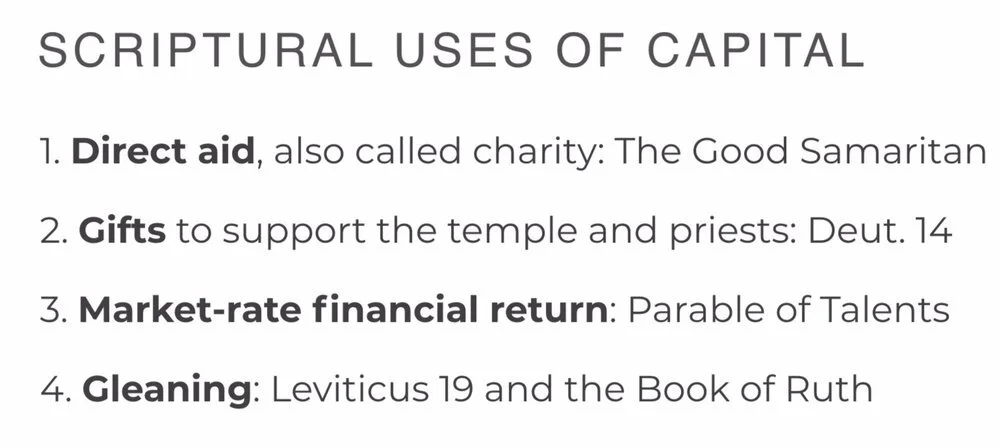
But how? There are a multitude of potential frameworks—each of which is incomplete in its own way. But I’d propose a very simple framework for Christian individuals and institutions who want to explore the alignment of their investing with their faith.


This piece originally appeared in
Christianity Today.

There’s No Debate: Good People Aren’t Good Enough

 Photo by  Tingey Injury Law Firm  on Unsplash

Photo by Tingey Injury Law Firm on Unsplash

We’re deeply grateful to Mike for sharing this timely piece with us! This article was originally published here on the author’s personal blog.

by Mike Asem

Last week I felt called to put my heart on digital paper in what became a post called “Racism won’t die in 2020”, and thanks to the encouragement and support of trusted friends and loved ones – I found the courage to publish it and be overwhelmed by the resounding response from thousands of people who took the time to read it and take it to heart. Those that know me know I’m also a man of faith, and it’s been put on my heart to step forward in faith again and share my thoughts with those willing and open to read… seeking to understand. 

It is because I am a man of faith, that I have included both scripture and history of Christianity in this piece.  I fully acknowledge that my faith has shaped the way that I process what is happening in the world.  And, while written from this viewpoint, I want to clearly and emphatically say I truly believe there’s real meat in this message for all who simply self-identify as good people. For good people reading this who are not Christians, I hope you can continue on and enjoy what I believe to be words of wisdom that also happen to be based in the Bible.

For far too long, good people just haven’t been good enough. While this is arguably already a “trending idea” in the public sphere, please indulge me just for a bit and walk down some of my own thought trails with me on the subject.

Open your mouth for those who cannot speak, and for the rights of those who are left without help. Open your mouth. Be right and fair in what you decide. Stand up for the rights of those who are suffering and in need. (Proverbs 31:8-9)

Years ago a man shared with me something I thought was phenomenally interesting about Christians in the earliest days of Christ’s movement. As he put it – original Christians were… savages. Not just good people… not just kind to others… not just thoughts and prayers… Christians were selfless savages for Christ, and therefore savage champions for justice and truth. These women and men ran straight into seemingly sure death by means of lion den, fiery furnace, and crucifixion for their beliefs. These aren’t just Bible tales. These are historically accurate events. Thousands of Christians died for their cause, and in the 300 years post-Christ’s crucifixion Roman emperors initiated no more than four general persecutions of Christians. “Mission work” wasn’t just a fun name people made up for philanthropically themed mini-vacations… these people went out to die for a message they believed in. 

Christian or not, as good people – who are we kidding when we quietly shrug and convince ourselves that just being a good person and not actively moving against evil is enough? To my fellow Christians out there yelling “All Lives Matter”… yes… they do. Sure… you can get extra credit for answering a question not on the test if you really want… but what do you think Proverbs 31 is saying about what we’re called to do when we’re in a better position to influence change than those being crushed by the knees of their oppressors? 

I’m an American, and proudly so. Christian, Muslim, Atheist or otherwise, many of you reading this can likely say the same. While I firmly stand behind and believe one of the most powerful tenants on which this nation is built on is religious freedom – I am a Christian. And, seemingly fortunate for me, for the entire history of this nation we’ve been predominantly Christian as well. Christian or not, though, I think all Americans can unanimously agree that we’re proud of our American values… which basically say we’re predominantly good people (please correct me if I’m wrong on that one). 

That being said… let’s talk brass tacks…

How is it that people have been marginalized, oppressed, and made to brutally suffer at the hands of others, en masse, in a nation where we’re predominantly… good? I’m not talking about one bully here or there, or a bad apple once in a blue moon. 

I’m talking about… slavery. Rapes. Murders. Beatings. Lynchings. Hundreds of years. Thousands, and thousands, and thousands of people.

Ironically enough, roughly 200 years and a month ago (really), founding father and 3rd President of the United States, Thomas Jefferson, said it best in one of his letters to John Holmes on the topic of the emancipation of slaves…

“We have the wolf by the ear, and we can neither hold him, nor safely let him go. 

Justice is in one scale, and self-preservation in the other.”

.

..

Good people.

Don’t miss this.

Justice… is in one scale, and self-preservation… is in the other.”

Self-preservation.

Growing up in Indiana, my school and community was predominantly white. As I mentioned in my last post, I have the honor and pleasure of calling many white people friends and loved ones… brothers and sisters. It used to come up all the time, whenever there was some new topical injustice against black people, how not all white people owned slaves. Not all white people were / are racist. “My ancestors never had a plantation or anything…” But as we hear the shouts of the anti-racist movement today, I want to call out here that… the fact alone that your ancestors didn’t own slaves, or weren’t actively racist, never. actually. helped. black. people. 

Here’s the deal.

The reason all these terrible things happen against minorities is that most Christians, most Americans, most good people have historically tipped their scales to self-preservation, over justice.

Today, all we can speak to and be responsible for is… well, us. And, what I think is fascinating to play with, is that self-preservation as an American is honestly kind of a ridiculous idea. Nearly all Americans fall in the top 10% of the world from a wealth perspective. On a global perspective, nearly 30% of the world’s wealth is held by Americans. When polled, most Americans thought the average annual earnings outside the U.S. were about $20,000… but in reality it’s more like $2,100. No worries, we’re just off by one zero.

So… when do you start asking yourself, just as one person in all this, “When do I hold myself to a standard of actively supporting, promoting, and voting for justice over self-preservation?”

Blessed are those who hunger and thirst for righteousness,

for they will be filled…

Blessed are the merciful,

for they will be shown mercy…

Blessed are the pure in heart,

for they will see God…

Blessed are the peacemakers,

for they will be called children of God…

Blessed are those who are persecuted because of righteousness,

for theirs is the kingdom of heaven. (Matthew 5:6-10)

Good people, defaulting to apathy, passiveness, self-preservation… isn’t good enough.

In closing – I’d like to briefly address what I know is a key discussion in today’s argument about justice. 

Our police. 

I want to stand firmly here and declare that we should be forever grateful for the women and men who’ve made it their life’s work to uphold the law and serve and protect us lawfully and fairly. I want to continue by acknowledging that it is true that a few bad cops don’t make all cops bad, in the same way a few black criminals don’t make all black people criminals. I want to make a clear distinction here, though, for those of us that think this is actually a fair comparison. 

No one hires us to be black.

No one fills out an application to get to be black.

No one goes through government approved training to be black.

No one sets standards, upholds them, and holds us accountable in order to continue to be black.

You can’t fire someone from being black.

Police on the other hand must apply, go through training that is deemed sufficient by those responsible for maintaining justice, must be held to a standard of excellence to continue to wear the badge, and when they’re behavior is unacceptable – should be given consequences just like (if not more than) any other person.

You can’t compare “a few bad cops” to “a few bad black people.”

And, just like good yet passive people aren’t good enough, good yet passive police officers – who can’t be counted on to hold their brothers and sisters in uniform accountable – aren’t good enough.

Do not conform to the pattern of this world, but be transformed by the renewing of your mind… (Romans 12:2)

We don’t need good people, we need champions for justice.

We don’t need good people, we need protectors of the oppressed.

We don’t need good police officers, we need accountability among our police.

Whether you’re white or black… police or bystander… history tells us there is no debate here. If you want to play a role in the end of systemic racism in America, just being a good person, isn’t good enough.

Stand for justice.

Speak for justice.

Vote for justice.

Maybe let self-preservation sit this one out…