The Faith Driven Investor movement stands on the shoulders of those who have come before us. John Siverling and the Christian Investment Forum are just one of the groups who have led this conversation, and we’re grateful to feature their contribution to the movement here.
This 2019 Survey of Financial Advisors is the 3rd edition to study the current state of awareness, knowledge and use of Faith Driven Investing. The first study was completed in 2013 and followed by the 2nd edition in 2016.
The 2019 survey, similarly to the 2013 and 2016 versions, focused on three areas beyond general demographic information. The first objective was to understand advisor Awareness of Faith Driven Investing – what were the critical components, and how they perceived it as credible. The second objective was to assess advisor Knowledge levels about Faith Driven Investing – did they feel reasonably informed and comfortable with the practice so that they could effectively communicate it to clients. The third objective was to understand actual Usage of Faith Driven Investing by advisors and their clients, including possible barriers to increased use.
There are various terms used to describe investing that is purposefully aligned with Christian faith. Some of the more commonly used are Biblically responsible investing (BRI), Values based investing, Faith-based investing, and Morally responsible investing. In this report, the term Faith Driven Investing is used most often, but other terms may be used interchangeably.
From that survey data, following are the key takeaways:
Key Takeaway #1
Within the respondent pool, which is more closely aligned and sympathetic to faith and investing concepts, the AWARENESS of Faith Driven Investing and what makes up FDI remains at nearly universal familiarity, but there remains a sizable gap between that awareness and a more detailed functional awareness of the breadth of currently available product and service offerings.
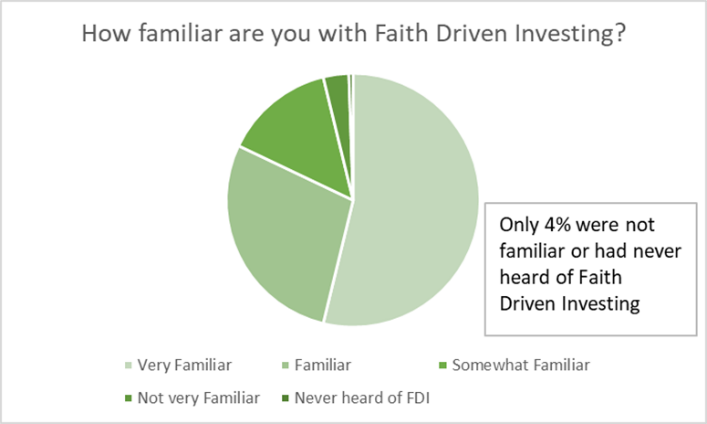
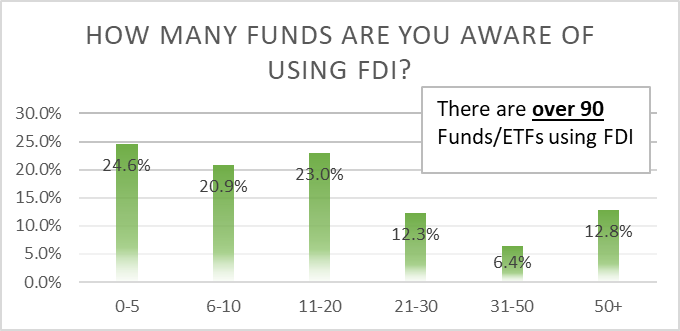
Seventy-eight percent (78%) of respondents are members of Kingdom Advisors, and are more likely to be supporters of faith and investing concepts. Fifty-four percent (54%) of respondents were very familiar with Faith Driven Investing (FDI), and ninety-six percent (96%) felt they were at least somewhat familiar with the investing concepts. The advisors identified the main components of a Faith Driven Investing approach, but a large majority of them (87%) were not able to accurately recognize the number of Faith Driven Investing fund and product offerings available.
Key Takeaway #2
The level of KNOWLEDGE in Faith Driven Investing, and belief in the credibility of FDI, is growing but has yet to reach a tipping point where more client conversations are regularly occurring.
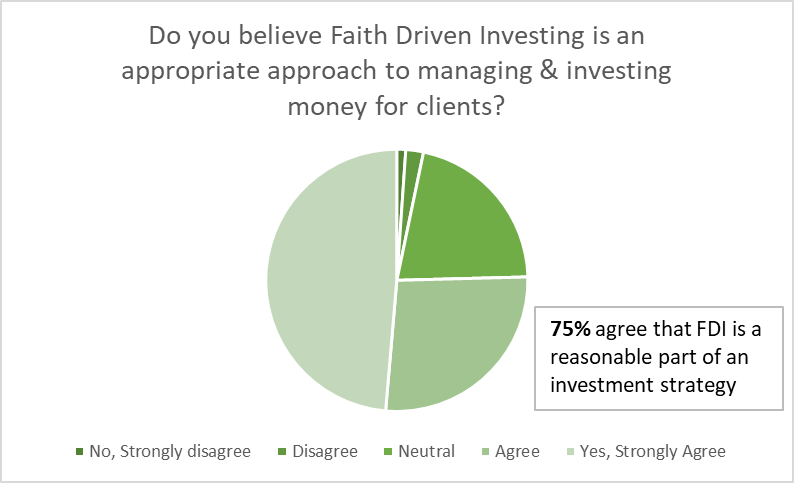
Just over half of the respondents (51%) felt well educated on Faith Driven Investing. Only three percent (3%) said they believe Faith Driven Investing is not a credible and appropriate way to manage client wealth, and ninety percent (90%) are interested in recommending investments that align with their clients’ faith and values.
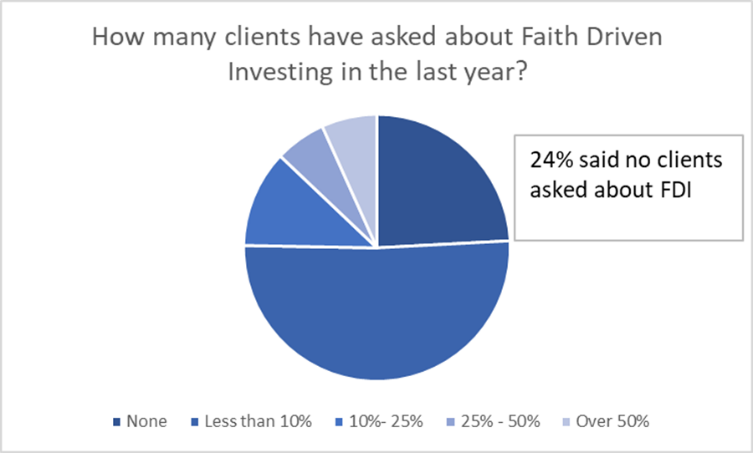
Yet when queried, seventy-five percent (75%) said that less than 10% of their clients had asked about Faith Driven Investing. Twenty-four percent (24%) had no client communication on Faith Driven Investing.
Key Takeaway #3
The Use of Faith Driven Investing is steadily increasing, with interest in recommending FDI to clients remaining well ahead of the usage patterns. This suggests that Faith Driven Investing could grow significantly with the continued development of resources and tools to overcome barriers.
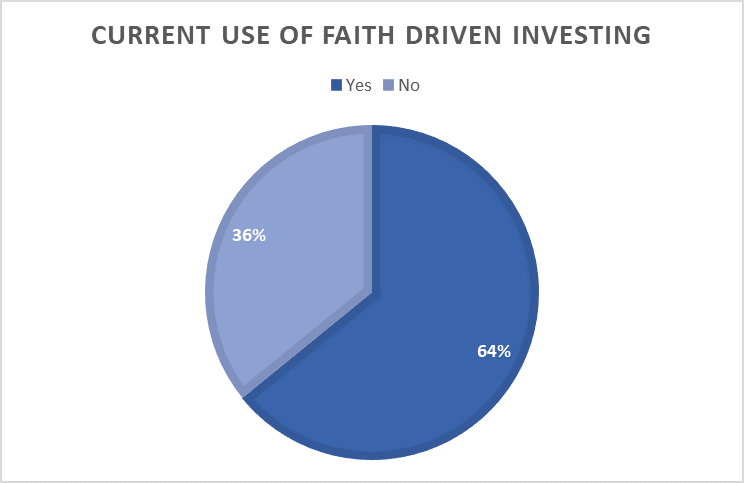
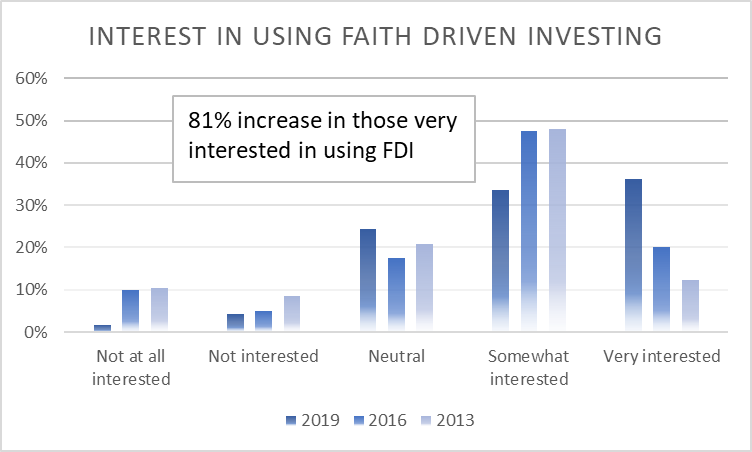
Sixty-four percent (64%) of respondents indicated they currently use Faith Driven Investing with their clients, but for most of them the allocations to FDI remain small. Of those not using Faith Driven Investing currently, thirty-six percent (36%) were very interested to begin using FDI and another thirty-four percent (34%) were interested.
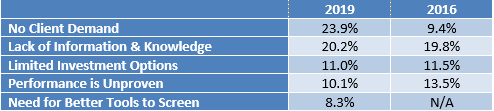
The top five reasons given for not using Faith Driven Investing were 1) No client demand, 2) Lack of information & knowledge, 3) Limited investment options, 4) Unproven performance, and 5) Need for better screening tools.
CONCLUSION
The results of this 2019 Survey of Financial Advisors on Faith Driven Investing Awareness and Use show continued, albeit slowing, improvements in all three areas – awareness, knowledge, and use. This slowing growth is relative to the last survey completed in 2016, which had shown more substantial improvements compared to 2013. In part this is due to a higher baseline, so sizable gains are more difficult to achieve.
To a large degree, the issues limiting the use of Faith Driven Investing remain the same since the initial study in 2013, though with some lessening in importance over the last 6 years with increased awareness and knowledge. There continue to be gaps in perception compared to reality on product availability and performance. Yet some further structural changes are needed – additional investment products that can more closely align with the different faith values of investors, increased acceptance of funds onto proprietary platforms, and additional research to support the already existing data on ESG, FDI, performance, and expenses.
The greatest opportunities to build momentum towards increasing the use of Faith Driven Investing are in helping encourage further education, and more importantly encourage conversations between advisors and investors. Both advisors and investors show high levels of interest in Faith Driven Investing, but neither advisors or investors are initiating a conversation or asking questions about FDI. More education on the topic of Faith Driven Investing can help to increase confidence for advisors to have the conversation. Similarly, more investor oriented information can help Christians recognize their role in asking questions of their financial advisor.
For those interested in supporting and growing Faith Driven Investing, there are strong reasons to be optimistic about the future growth in the use of FDI overall, and as a share of total assets under management. Data from this survey confirms previous research that a majority of investors and advisors alike have an interest in better aligning investments with the client’s personal faith and priorities. Macro trends in the market are showing investor interest in a more meaningful and integrated approach to investing in alignment with values. There are more organizations engaging in the conversation about FDI, and collaboration between them on messaging is improving. All of this helps to encourage others to understand they are not alone in desiring a more integrated approach to investing with their faith.
The Faith Driven Investor movement stands on the shoulders of those who have come before us. John Siverling and the Christian Investment Forum are just one of the groups who have led this conversation, and we’re grateful to feature their contribution to the movement here.
Review of Academic Studies
It is valuable to consider the wider literature on academic studies that exists related to research on the relationship between the broad Responsible Investing field and superior financial performance. This is important since there is widespread perceptions and opinions in the professional financial market that incorporating social or faith based values into investment decisions leads to inefficiency, higher risk, less diversification, and lower returns. This viewpoint is especially strong from those that espouse Modern Portfolio Theory and Shareholder Value Maximization as their beliefs of investing, and who do not view investing as ownership in the underlying assets but as an act entirely independent.
Four recent studies or reports are particularly helpful for this review. Each of these papers provides a composite analysis of an even larger set of papers on these topics.
The Journal of Investing Paper
A research paper in the Journal of Investing in Fall 2010 attempted to determine if, as is widely suggested by some in the financial industry, the incorporation of faith based values into the investment decision making process, leads to under-performance relative to the broad market or to the related SRI market. The paper reviewed prior research on this topic, and performed primary research based on an aggregate of existing faith based funds. The conclusions from both literature review and the primary research contrasted with the perceptions in the market. The authors conclude that the additional screens and criteria used by the faith-based funds does not hinder performance relative to the market. The authors also found in their research that faith-based funds did better than SRI funds in general.
“…the additional values-based screens used by these (faith-based) funds do not hinder their performance relative to the market overall. We also find that faith-based funds do better than SRI funds in general. From the findings, we can conclude that investors do not seem to sacrifice satisfactory economic returns by making ethically and socially responsible investing decisions based on their faith.”
In this study by Lyn and Zychowicz, the researchers did specifically look only at faith based funds. However, the study included all faith based funds, and did not specifically look at Christian faith based funds. Also, the study used composite performance data across all categories so may distort or hide category specific variances in relative performance and relationships.
Mercer Research Report
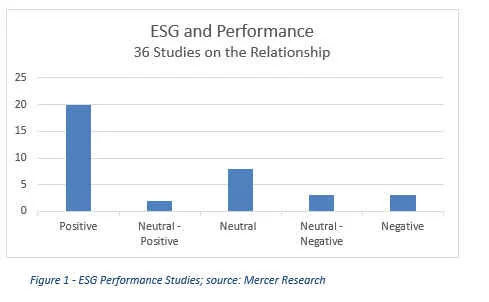
There are two research reports from Mercer that reviewed the relationship between financial performance and ESG criteria. The most recent report is cited here, as it includes information on both the current report and the earlier report. The current report reviewed 16 studies that sought to identify the relationship between financial performance (annualized returns) and the use of ESG criteria in a “Responsible Investing” approach. Their analysis and conclusions led to the following results: 10 (62.5%) of the studies found a positive relationship between Responsible Investing and financial performance, 4 (25%) of the studies were neutral, and 2 (12.5%) of the studies found a neutral-negative relationship. No recent studies found a strong negative relationship.
Mercer also went back to an earlier report they had prepared in 2007 that had additional studies on this topic. Between the current report and that prior one, they’ve reviewed 36 studies that looked at performance issues and Responsible Investing with the following results: 20 (55.6%) show a positive relationship between ESG screens and performance, 2 (5.6%) are neutral-positive, 8 (22.2%) are neutral, 3 (8.3%) are neutral-negative, and 3 (8.3%) show negative relationship.
In summary, the studies show clear support, and Mercer concluded the same, that social screening and ESG integration have either neutral or more likely positive effects on performance.
“We have shown that the results are leaning in favor of the value-added proposition of ESG integration, and we are encouraged to see more research considering the impacts across different asset classes (beyond equities) and the effects at the disaggregated level (such as sector impacts).”
Deutsche Bank Report
This report focused on what they describe as Sustainable Investing, first providing a history of the evolution in the approach from simple negative screens, to Socially Responsible Investing (SRI) which generally includes both negative and positive screens, and finally to what they describe as Responsible Investing (RI) which takes into account ESG factors in a more integrated fashion.
They reviewed primary and secondary research to determine correlation between ESG factors and positive financial performance (risk adjusted superior returns). What was interesting to note is they found correlation between ESG integration and superior risk adjusted returns, but more so at the individual company level, not in the funds that seek to invest in those same companies.
“We do indeed find positive correlation in a majority of securities studies, particularly those that look at securities that rate highly with regard to CSR (Corporate Social Responsibility) and/or ESG.”
MSCI Report
The MSCI report focused largely on testing and analyzing different enhanced index portfolio designs with the use of various Environmental, Social, and Governance (ESG) factors. They used their own proprietary Intangible Value Assessment (IVA) rating system to measure the relative performance of companies on ESG factors. Because this was designed to analyze different enhanced index strategies, the research focused on individual companies and index funds created specifically for this analysis. It did not compare to existing index funds, but only to industry benchmarks. The three strategies for an enhanced index design were 1) to exclude the companies with the worst ESG scores (“ESG Exclusion”), 2) to overweight those companies with the best ESG scores (“Simple ESG Tilt”), and 3) to overweight those companies with the greatest improvement in their ESG score over a period of time (“ESG Momentum”). The results of the research are summarized in the below highlight from the report:
“Proponents (of ESG Investing) argue that markets do not efficiently price ESG factors because they address long-term risks that have not been absorbed by the economy, and that alpha generation is possible as markets begin to recognize these undervalued influences. Academic studies and industry analyses have supported both sides of this argument, although on balance they find that investors employing ESG factors do not impose a significant performance penalty, that investors can achieve comparable risk-adjusted returns to non-ESG tilted strategies, and that investors may be able to enhance their returns through the use of certain ESG strategies.”
References:
Lyn, Esmeralda O.; Zychowicz, Edward J.; “The Impact of Faith-Based Screens on Investment Performance.” The Journal of Investing, Vol 19, No 3 (Fall 2010), pp 136-143
Adam (*1963) is an entrepreneur, investor, and philanthropist living in the Czech Republic. Along with his two brothers, Adam founded a pharmaceutical company named Walmark that grew to employ 900 people across nine countries. In 2010, the Walach brothers were awarded the ‘Ernst and Young Entrepreneur of the Year Czech Republic´.
After selling their company in 2015, the Walach brothers founded a family office called ATERNUS Family Office and also started a family foundation – 3W Foundation – where they have transferred a significant portion of their wealth. The foundation’s main focus is to support primarily European Great Commission ministries and projects with funding as well as with expertise and know-how.
To leverage the impact, Adam along with other like-minded Christian givers formed the European Great Commission Collaboration (EGCC), a relational network connecting global Christian funders, who collaborate to invest financially in strategic Christian ministries in Europe.
Adam holds a MSc in Mathematics from Olomouc University, Czech Republic. In 2013, Adam completed Halftime Institute in Dallas.
Adam enjoys skiing, mountain-biking and music. He and his wife, Grazyna, have three children.
As one of the fastest-growing workplace movements of the last decade, co-working enables people from diverse backgrounds to work together in a common space. The number of co-working spaces around the world has increased by nearly 700% since 2011. Globally, an estimated half a million people work in more than 7,800 shared workspaces today—a number which is expected to climb to 37,000 over the next two years.
This generation is beginning to see this alternative to traditional office space as the place for startups and entrepreneurs. While WeWork and many other national spaces continue to grow, our hope is that there would be a rise in co-working spaces that see themselves as more than hosts, but as friends, even partners that can consider things like Chaplaincy services and other unique ways to care for the leaders that spend most of their waking hours in their space. If you know of co-working groups that are looking to partner with investors and have an emphasis on Spiritual Integration please submit the form below to share with the community.
Know of Another Group that should be added to the List?
Submit it to our editorial team so we can consider adding it to the site.
We probably listen to a few too many podcasts around here, but in case you need a few, below are some of our favorites. Some come from a faith driven perspective and some are staples for any faith driven investor looking to integrate best practices to their work. We hope this list enlightens you, challenges you, and also inspires all of us to propel this conversation forward.
Note: For other great podcasts that come at more through the lens of an entrepreneur, you may find it helpful to check out the book list for Faith Driven Entrepreneurs.
Fine, we’re unavoidably biased. But if you’re new to the site and missed the link, Henry and William host a regular podcast. Faith Driven Investor is a growing movement of business leaders, fund managers, investors, and pastors that are driven by their faith and who believe that God owns it all and that he cares deeply about how we steward our investments. Our vision is for a world where Christ’s followers can pursue excellent investments that allow for financial returns and Gospel-centered transformation. This is becoming the place to talk about all different asset classes from direct deals, private equity, public, real estate and more.
with Henry Kaestner, William Norvell, and Rusty Rueff
Alright, we’re unavoidably biased one more time. But we think this podcast is great too! Henry, Rusty, and William host a weekly podcast, specifically dialed in for Faith Driven Entrepreneurs. We host leaders like Tim Keller, Chip Ingram, Andy Crouch, Nancy Duarte, Peter Greer and entrepreneurs like David Morken (Bandwidth), Steve Green (Hobby Lobby), Phil Vischer (Veggietales), Bryant Ambelang (Naturesweet)and many others.
Our mission is to tackle the pressing questions faith driven entrepreneurs wrestle with, so they can find the encouragement and support as they get ready to head back out on the journey.
Faith & Finance (formerly MoneyWise) is a daily radio and podcast ministry of FaithFi. Hosted by Rob West, the program offers a practical, biblical and good-natured approach to helping people become faithful stewards of God’s money.
Take control of your money once and for all. The Dave Ramsey Show offers up straight talk on life and money. Millions listen in as callers from all walks of life learn how to get out of debt and start building for the future. Check out Apple’s fourth most popular podcast! For more information, visit www.daveramsey.com.
While not coming at it from a Faith Driven perspective, there’s a lot we can all glean from some of the best practices of this favorite. In each episode they speak with the interesting stories. Their hope is they will help you better invest your time and your money, and teach you how to play with boundaries in your own life.
#6 The Twenty Minute VC
The Twenty Minute VC takes you inside the world of Venture Capital, Startup Funding and The Pitch.Listen to what some of most prominent investors are directly looking for in startups, providing easily actionable tips and tricks that can be put in place to increase your chances of getting funded. Although, you may not want to raise funding for a startup. The Twenty Minute VC also provides an instructional guide as to what it takes to get employed in the Venture Capital industry, with VCs giving specific advice on how to get noticed from the crowd and increasing your chances of employment.
The Social Responsibility of Business is to Increase Its Profits, a doctrine written by Milton Friedman, was published in the New York Times in 1970. In it he says that discussions that “business is not concerned ‘merely’ with profit but also with promoting desirable ‘social ends’” are “notable for their analytical looseness and lack of rigor. He argues that it is hard for “good” people to do “good.” In this worldview doing good and doing well are diametrically opposed, profits and purpose don’t mix, and making money is the only end goal. Is that really all it’s about though? Does it have to be so black and white? What if he was wrong?
In the 50 years since he wrote that article business women and men have challenged this narrative in ways that have snowballed into new movements ranging from conscious capitalism to benefit corporations to impact investing and everything in between.
At Access Ventures, we operate using a one-pocket mindset. We believe your values should be at the center of your strategy, and ultimately, at the center of everything you do, including business and investments. We believe you don’t have to sacrifice doing good or doing well in order to do either.
We think generosity is such a core piece of the heart posture of a Faith Driven Investor and why we think its key to be a part of the list. Check out some inspiring stories of Biblical Generosity is a podcast of the National Christian Foundation.
Really enjoying connecting with Ellis recently and encourage checking out his new podcast that he’s spinning up … “Are you a Christian who is bringing glory to God through excellence in your work or business? Are you looking for a community of like minded people who realize their work is actually a means of worship? Have you ever felt isolated from everyone as a christian entrepreneur? In this show, Ellis brings on amazing Christian entrepreneurs and business leaders to talk about godly ambition, what it takes to be successful in business, how to stay grounded in your faith, the kingdom of God, real estate investing, how to create wealth, financial education, and so much more!”
How do advisors go about integrating their faith into their investment practice — and at what cost? Tune in monthly to hear from GuideStone Funds® as we dive into a multitude of topics, discussing the upside of faith-based investing and myth-busting several concepts along the way. If you want to learn more about how your clients’ Christian values can be paired with traditional investment strategies without compromising their beliefs in order to invest their money wisely, then this is the podcast for you.
Chuck is a good friend of the Faith Driven Investor conversation. At Crown he put together some great podcast episodes in short segments. It is a great 2-minute Crown radio program packed full of practical financial tips.
> “A faith-based investment firm. We exist to operate profitable, operationally efficient, Kingdom Class companies that radically impact the lives of those we serve.”
Investment Approach
INVESTMENT THESIS
Our investment thesis is to help Christian business owners transition out of their business without losing their kingdom impact. Our goal is radically impact lives for Jesus through the businesses we operate. ADG’s wholistic focus is on People, Performance and Purpose, through our proprietary P3 process.
INVESTMENT OVERVIEW
ADG’s Kingdom Impact Fund acquires a controlling interest in lower middle market companies. We transition owner operated business to a next senior leader, develop culture driven performance, and/or reignite companies from growth plateaus. The businesses we purchase typically have annual revenues between $5–20 million, an EBITDA of at least $1M, are located in the US, and have been in existence for more than ten years. We “buy, hold and grow” so we can truly sustain our purpose and impact. Therefore we are placing permanent capital through an evergreen fund structure.
Investments to Date: Under 10
Focused Geographic Regions of Investment:
Is all of your activity in the US? Yes
What countries outside of the US are you active in? N/A
Focused Industries of Investment:
Manufacturing
Data, Software and Technology
Healthcare
Construction and Engineering
Consumer Services
Investment Example:
We Believe: Mission driven businesses are uniquely positioned to impact the world and solve problems like nothing else can. Healthy, missional cultures drive superior performance. A long-term strategy is essential for sustained growth and impact. Christian business owners’ hunger for aligned capital. Therefore we tracking spiritual KPIs. We promote, measure, and assess the impact of missional activates. These include but are not limited to: Bible studies, prayer times, chaplaincy programs, financial literacy courses and sending employees to marriage conferences. To achieve missional impact, we are descriptive versus prescriptive with our CEOs. Business leaders who own the mission, bring the highest level of creativity, passion and can contextualize the solutions. Since inception in June 2017 the portfolio companies we have a 18.85% dollar weighted ROI (updated Q3 2019). We pay a preferred 8% annual distribution on a quarterly basis. And essentially have a “2 and 20” fee structure.
Previous or Active Portfolio Companies:
Capital Raise Strategy
Total Assets Under Management: $7.2 Million
% of Capital from Top 3 Investors: 25-50%
Financial Reporting Frequency to Investors: Quarterly statements and annual valuations
Average Investment: Around $211,000. This is reflecting our lower minimum of $100k when we started. Our fund structure launched November 2019.
Minimum Amount: $500,000, but for $1M we offer legacy services to our investor families.
Setup to accept charitable capital through the National Christian Foundation or other listing platforms? Yes
Leadership Team
Cumulative Leadership Experience in Accredited Investing: 50+Years
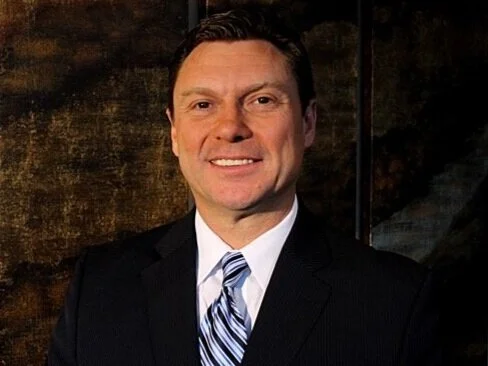
Steve’s primary role focuses on mission and vision: building operationally excellent companies that radically impact the lives of people. He leads all efforts to identify and recruit talented people to the ADG team. Steve’s career began with an electrical distributor. Through implementing operational efficiencies, he assisted in growing revenues by over 400%. By 24, he was promoted to president of the company. Subsequently, he has held key business development and management positions with companies in the small–medium sized business sectors. In 2001, he founded the corporate entertainment and hospitality company Concierge of Indianapolis. The company grew to serve national and international clientele. Recently, Steve served as National Director of Field Ministry. He also served on the management team at CBMC, which is a national ministry in the marketplace. At CBMC, Steve helped re-establish their national brand as well as implement a leadership development and training process. Both initiatives have been contributing factors to organizational expansion and the development of national leaders.
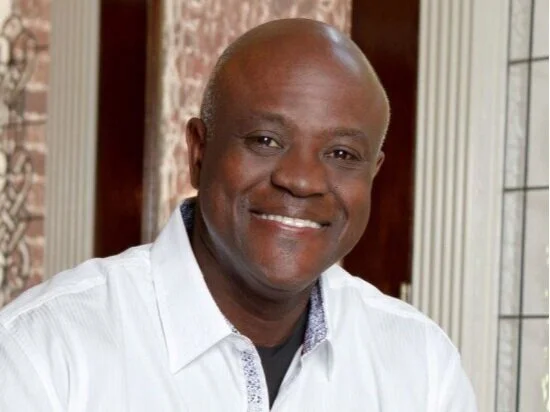
Ladell oversees the due diligence, investment selection process as well as the ongoing systemic growth process of our investments at ADG. Ladell and the ADG Management Team work alongside the portfolio company management to build and maximize the performance, profitability and marketable value of our investments. Ladell rose to the top of Wall Street as a manager of a $10.2 billion investment fund, which was the second largest in the country at the time. He then moved to Houston and co-founded Smith, Graham & Company Investment Advisors, L.P. – a premier fixed-income management company with over $2.5 billion of assets. Ladell served as president and chief investment officer of the company. His clients included the who’s who of the nation’s top corporations and municipalities. Ladell has been featured in numerous publications including The Wall Street Journal, Black Enterprise Magazine, Pensions and Investments Magazine and on the NBC special, Succeeding Against the Odds. He has received numerous awards and honors, including being listed in Who’s Who Worldwide.
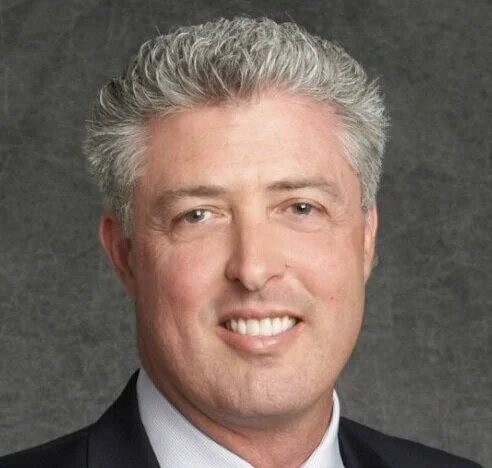
Jon applies broad experience, skills, and passions to lift the cultural and performance levels of the companies and individuals he serves. Jon leads the cultural assessment and developmental process of ADG’s pre and post-acquisition efforts. Working with company leadership, he helps identify key cultural and developmental needs and then advances strategies to drive performance improvement. This unique cultural focus provides significant value to the areas of due diligence, change management, strategic planning and people skills development.
Team and CULTURE
While not complete, one of the things investors have found helpful in the past is seeing how employees, customers have reviewed someone online. As of the date of completing this out …
Glass Door Rating: Not available
Facebook Review Rating: 5 Stars (1 Review)
Spiritual Integration and Impact:
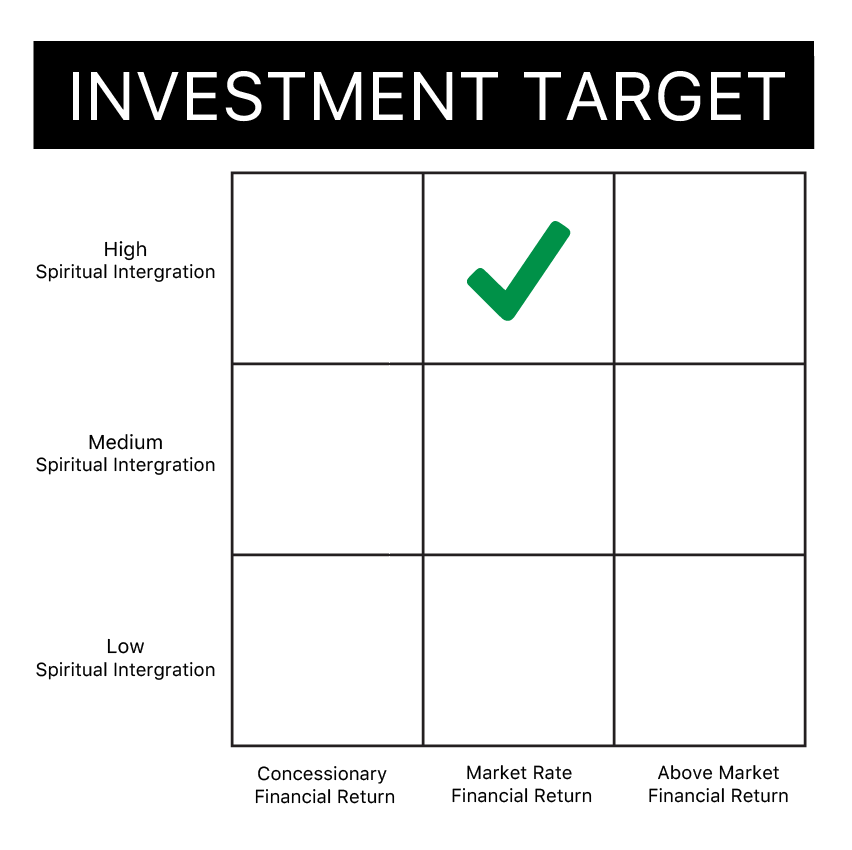
Faith Driven Investing can span a wide range from high yield to concessionary returns that have a higher level of spiritual integration. Having clear expectations of this philosophy is key for the movement. Each investment is unique and you might want to select multiples but if you had to choose one quadrant that best fits your groups spiritual integration and financial performance targets … What would it be?
We are growing in our spiritual KPIs and missional activities being tracked, reported and monitored in our portfolio companies. For performance, I say market is fair. We have seen an 18.85% portfolio return dollar weighted year over year since January 2017 (updated number for Q3 2019).
Describe the Spiritual Integration Activities of the Fund:
We track Spiritual KPIs in our portfolio companies. We promote, measure, and assess the impact of missional activates. These include but are not limited to: Bible studies, prayer times, chaplaincy programs, financial literacy courses and sending employees to marriage conferences. We are more descriptive versus prescriptive. We feel, Business leaders who own the mission, bring the highest level of creativity, passion and can contextualize the solutions.
Is Impact and Spiritual Integration Tracked?
The tools that are most useful to this effort are 1) Marketplace Chaplains reporting and 2) the Denison Organizational Culture survey. The former provides specific but discrete information regarding missional engagements with employees and family. The latter provides overall cultural assessment to insure that the companies are attentive to the holistic health of the organization. Employees beliefs and assumptions are keenly reflective of that reality. ADG’s missional metrics and measuring methodologies continue to be refined. We are adding a third assessment of missional activities that will track and measure the physical, emotional, and spiritual activities that are designed to show caring and impact on employees, families and communities.
Are you partnered with any other organizations?
Marketplace chaplains has been a partner since our first deal. Ron Blue Trust business services division helps in parts of our due diligence. ThreeTen Coalition and Christian Employers Alliance is a partner. Ron Blue Trust business services division helps in parts of our due diligence. ThreeTen Coalition is a partner. The Marketplace Ministry folks like C12, CBMC, Truth @ Work, Convene, etc. are friends in the movement.
A lot of Investing Conversations look at Social Impact related to the United Nations Sustainable Development Goals. Is there one of these that most resonates with your organization?
#8 “Decent work and economic growth” followed closely by #9 Industry, innovation and infrastructure
If you’re wildly successful how will the world be different?
> “We will radically impact for Jesus through the profitable businesses we operate. 100% of our portfolio company employees are in a role aligned to their God given gifts. 100% ADG leadership team in life on life mentoring and discipleship. 100% our investors will honor God with all of life including their money and live out their God-given purpose together. For stakeholders, we would have an impact on our employees, their families, business partners, customers and competition to sharpen, challenge and inspire. As we realize a successful future, this impact will grow outside of our companies walls to additional businesses, investors and high capacity families to impact the US, and the world for Christ.”
WHY The FAITH DRIVEN INVESTOR?
Why are you compelled to be certified and a part of the Faith Driven Investor Group? We love the community, developing partnerships, and Kingdom centered group forming here.