HOPE Global Investments: Moving Capital and Discipleship Around the World

  Image by     Kyle Glenn

Image by Kyle Glenn

by Josh Ruyle

HOPE International’s journey into deepened support for SME business owners across our network began in many ways with the Login family of Western Ukraine.  We had the privilege of watching as their microbusiness – a bike shop – blossomed into a platform for real impact in their home village, namely, helping adolescents with a tendency to turn their backs on family and fall into drugs and alcohol addiction in their teenage years.  As the business scaled, profits not invested back into the business went towards their tithe and deepening their impact on these youth – creating a youth bike club program, opening a free-to-use BMX grounds next to their shop, and organizing community biking competitions for families to connect with each other and the church.  And given they came to Christ just before they started the business, it’s not surprising to see them making their decisions with a Kingdom mindset – in their words, “when God gives, we are called to give back.”  We’re grateful to now offer spiritually-integrated SME lending and coaching services in five of HOPE’s nine microfinance institutions, and we’ve come to appreciate the enormous potential for Kingdom impact through continuing to invest in businesses like the Logins’.

Impact investing is a relatively new yet burgeoning industry, with the market growing to over $500 billion since the term was formally coined in 2007[1]. Likewise, the marketplace for faith-driven investments is nascent but growing, as investors seek to steward their resources in alignment with Biblical principles. This means there are many new and exciting offerings in the marketplace, from retail products like mutual funds and exchange-traded funds to private placements like venture capital, private equity, and direct investments. 

One area where there are relatively few Christ-centered offerings is low-interest debt. To be sure, there are many fixed-income-type products that have strong social and/or environmental impact, yet very few that also incorporate intentional discipleship and Kingdom impact into their model.  Given how microfinance institutions are traditionally financed – using debt capital to leverage equity and expand loan portfolios – we realized that an investment offering that would allow us to scale our SME portfolio while maintaining a values-aligned and spiritually-integrated approach to our work could fill a unique gap in the impact investing marketplace.

Earlier this year we launched HOPE Global Investments (HGI), a for-profit lending vehicle that enables accredited investors to provide debt financing to HOPE-network microfinance institutions around the world for follow-on lending to these local, small- and medium-sized enterprises.  We are particularly excited about this Kingdom opportunity as research has shown that SMEs in the developing world generate 58% of all new jobs and 67% of GDP/income growth, yet these businesses nearly always lack access to the full capital needed to realize their growth potential.  As business owners like the Logins have an opportunity to receive capital and be discipled towards faith and obedience to Christ, the potential to harness the latent power of the business for the expansion of God’s Kingdom is immeasurable.  HGI is the result of an increased demand from both current and potential borrowers in the field — many of whom have outgrown micro-loans and require larger capital infusions — and investors — who are seeking investment opportunities with a clear strategy for business growth, Gospel proclamation, and Kingdom impact.

 In addition to filling the market gap for faith-driven debt offerings, we believe HGI is unique for a few other reasons:

1.     It builds on HOPE’s 22-year foundation.  By God’s grace, HOPE International has been making microfinance loans since its founding in 1997, and now serves nearly 1,000,000 people across 16 countries. HGI is first-and-foremost built on HOPE’s long-term relationships with clients, a portion of whom have the capacity to make the transition from microenterprise to SME, scaling the business and employing staff beyond the immediate family.  Staff within HOPE network MFIs nurture client relationships, provide capacity-building support for borrowers and their businesses, and use a strong and standardized control structure for underwriting, securitization, and oversight of loan capital.  

  1. HOPE has a deep commitment to spiritual integration and spiritual impact. We celebrate the coming of God’s Kingdom as we witness material, social, and personal impact in the lives of SME business owners, their families, their employees, and their communities. Yet HOPE’s commitment to spiritual impact as an integrated part of our loan process — from initial contact, to underwriting, to loan visitation, training and support — is what makes us most unique. We track and report on spiritual integration metrics for the SME business owners we fund on a quarterly basis.

3.     HGI is simple in structure and provides options to investors. HGI is a simple, fixed term note structure that provides accredited investors a variety of options, including the country of investment, duration, target rate of return, and level of risk.  The investment vehicle was structured to allow for maximum simplicity and transparency on the usage of funds, to allow line of sight from investment to SME businesses funded. 

All of us at HOPE International and HGI are motivated by the great commission and the greatest commandment to love God, love our neighbor, and make disciples of all nations. As the faith-driven investing marketplace continues to mature and live out these mandates, we are excited to be along for the journey, and to see God’s Kingdom coming to the nations through the advancement of this movement. We dream of a day when more entrepreneurs like the Logins are able to grow their businesses, deepen their faith, and serve their communities.

If you’re interested in learning more, please email jruyle@hopeinternational.org.


Shareholder Advocacy: a Positive Use of Power

  Image by   Christopher Rusev

Image by Christopher Rusev

by Chris Meyer

Since adolescence, I’ve aspired to work toward a just and sustainable world. My motivation stems in part from feelings of dread and urgency about the trajectory of life on earth and in part from my desire to seek shalom, which I define as right relationships between humans, God, and the earth. Through influential authors and classes, as well as significant personal and spiritual reflection, my vision for change emerged during my college years. 

I was keen to learn about complex issues and determine the most productive path toward changing our systems. While I agreed with the merits of many causes and movements, protests weren’t my preferred method. I wanted to address root causes of problems, not just deal with effects. I felt called to know and understand the levers of power.

I determined that the greatest power – for good or for bad – seemed to rest in the financial world. And I wanted to maximize the amount of systemic change I could accomplish using my skillset within the economic system. 

I eventually learned of a job opportunity centered on shareholder advocacy at Praxis Mutual Funds®, a mutual fund family of Everence Financial®, a faith-based financial services company. Praxis practices shareholder advocacy – also known as corporate engagement – which means using the rights and privileges conferred by stock ownership to promote corporate change. It can take many forms, including letter writing, dialogue with company management, shareholder resolutions, and voting shares of stock.

I had learned about shareholder advocacy as a student from my now-colleague Mark Regier, who established Praxis’s stewardship investing program. I was intrigued with this use of power to promote sustainability from within our economic structure, and was excited to join Praxis.

Some may argue that trying to better an unjust system is a waste of time and that we need to be focused on creating a different one. I, too, have a vision for a harmonious way of life distinct from our current economic and political reality, and I had some reservations about the messy work of engaging the world’s largest corporations. While I support causes that are focused on developing an alternative paradigm, however, it is also a valid and faithful practice to ameliorate the system as it exists now, particularly because we are all connected to it.

Studies show that over half of Americans are invested in the stock market. The way most people invest is through mutual funds, whether in employer-based retirement plans or personal investment accounts.

If you’re invested in mutual funds, you’re a part-owner of hundreds of companies. What are you doing with that power?

Most people are unaware of this power, and they’re not invested in mutual funds that practice corporate engagement. The absence of active ownership through corporate engagement means defaulting to investing convention – the notion that investors are solely concerned with maximizing financial returns. 

Praxis is an investment manager for tens of thousands of people. Through corporate engagement, we harness the power of client investments for greater good.

Our shareholder advocacy work is concentrated on several priority issues. Our current themes are Promoting Creation Care, Working to End Modern Slavery, and Addressing Inequality. There are many sub-issues under each theme.

We don’t do this work alone but collaborate with many faith-based and values-aligned investors to engage corporations. We often lean on nongovernmental organizations to gain expertise in certain issue areas. We’re also members of organizations that seek to improve the environmental, social, and governance policy and practices of companies. Some of these organizations include the Interfaith Center on Corporate Responsibility (ICCR), Ceres, USSIF: The Forum for Sustainable and Responsible Investment and the Thirty Percent Coalition.

Partnering allows us to increase the breadth and depth of our advocacy reach. We lead some engagements and participate in others. We and our partners pursue trusting and mutually beneficial relationships with the companies we work with, while also pressing and challenging them relentlessly on issues where we believe they can do better. We represent both our core values and the investments that our clients have entrusted to us. We want the companies we engage to be financially successful in a way that’s beneficial to all stakeholders.

Much of our work occurs behind the scenes. For instance, most corporate dialogues are kept private to foster openness, and meeting summaries refer only to the general points covered. Positive outcomes from engagement are rarely attributed directly to shareholder advocates; companies want to be seen doing the right thing on their own. Combined with the fact that engagement with companies can be long and tedious work, one can see how critics might view shareholder advocacy as insufficient or unproductive. 

Nonetheless, shareholder advocacy has been able to move mountains. Shareholder advocates are often on the front lines of change, and I’m continually astounded at the power and influence we wield – especially considering our relative size. We have access to the people and rooms where decisions are made, and a small tweak to corporate policy can make a difference to millions of people. And along with many of our partners, it helps to be rooted in faith conviction that carries some moral authority.

In our role, Praxis has influenced companies to adopt human rights standards in supply chains, source fair trade ingredients, transition to a low carbon economy, end predatory lending practices, and honor the claims of residents affected by toxic pollution (among many other instances of progress). Here are a couple of recent examples …

 For the past two years, Praxis has led a shareholder engagement with NiSource focused on greenhouse gas emissions reductions, climate change scenario planning, and transition to renewable energy. In fall 2018, NiSource announced a plan to retire all its coal generation plants by 2028, reducing its carbon emissions by 90%. The capacity will be largely replaced with renewable energy, and the new wind and solar installations will effectively double Indiana’s renewable energy capacity. The changes will take place within the Northern Indiana Public Service Company (NIPSCO), NiSource’s electric subsidiary. NIPSCO serves nearly 500,000 customers in northern Indiana, including the Praxis and Everence corporate office.

Another example involves a large investor coalition of ICCR members who approached JPMorgan Chase (JPMC) about its financing of private prison companies, beginning in 2017. After a series of dialogues centered on human rights policies, JPMC announced in March that it would withdraw from private prison lending. Nearly all the largest U.S. banks have since followed JPMC’s lead and committed to ending their ties to the private prison industry, illustrating the effect that one company’s policy can have on an industry. Praxis did not lead the JPMC engagement, but we participated in the dialogues along with many colleagues—a testament to the power of collaboration.

From my experience, I’ve learned that real corporate change more often occurs from honest, respectful engagement with the company than from pitchforks at the gate, and that the most visible campaigns aren’t always the most effective. Shareholder advocacy seeks to make a difference, not just a statement.

Even after 13 years in this field, it feels strange to face criticism from people who share the same values that I do. Some may think we’re enabling an unjust system and that avoidance or divestment are the only ways forward. I can understand the impulse to pursue purity, but since all our hands are dirty as participants in the economy, I would rather seek the practical instead of the symbolic way of change.

I live on an off-the-grid homestead powered by solar panels in rural Ohio. I feel out of place walking the corporate halls of power. I’m self-conscious in the elite circles where I professionally operate. And I’m still not comfortable wearing suits. But I’m OK with that dichotomy. I’ve retained my identity and convictions without being consumed by structures of power. I’m also acutely aware of the privileged position I’m in to be able to wield this power on behalf of our faith-based investor community, and the responsibility that comes with it.

We are all part of society and tied to our economic and political systems. There are many ways to engage in transformative change, and an incredible amount of work can be done within the system to make it more just and sustainable. Shareholder advocacy offers an often-overlooked way to make use of power through collaborative, bridge-building interactions.


Chris is Manager of Stewardship Investing Advocacy and Research at Praxis Mutual Funds® and Everence® Financial.

A version of this story originally appeared in The Mennonite.

As of Sept. 31, 2019, the Praxis Value Index Fund has invested 0.09% of its assets in NiSource; 3.44% of its assets in JPMorgan Chase; the Praxis Growth Index Fund has invested 0.19% of its assets in JPMorgan Chase; and Praxis Impact Bond Fund has invested 0.82% of its assets in JPMorgan Chase. Fund holdings are subject to change. To obtain holdings as of the most previous quarter, visit praxismutualfunds.com. 

Consider the fund’s investment objectives, risks, charges and expenses carefully before you invest. The fund’s prospectus and summary prospectus contain this and other information. Call 800-977-2947 or visit praxismutualfunds.com for a prospectus, which you should read carefully before you invest. Praxis Mutual Funds are advised by Everence Capital Management and distributed through Foreside Financial Services, LLC, member FINRA. Investment products offered are not FDIC insured, may lose value, and have no bank guarantee.

Donor-Advised Funds Grow in Popularity as Tools for Impact Investing

  Image by   Chris Liverani

Image by Chris Liverani

This article was originally published here.

Check out The Chronicle of Philanthropy for other quality content!

by Alex Daniels

When the Nasdaq closing bell rang last Thursday, investors in Beyond Meat were jubilant. Trading in the plant-based food company had driven up the share price 163 percent during its first day on the exchange, making the Beyond Meat IPO one of the…

Read the full article at The Chronicle of Philanthropy.

Let’s Move Past “Can We?” – How to Measure Your Business’s Kingdom Impact

 Image by   Annie Spratt

Image by Annie Spratt

This article was originally presented at The Christian Economic Forum 2019.
Check out
CEF for other quality content!

The Christian Economic Forum hosts a world-class Global Event each year to connect the top industry leaders and experts from around the world with other individuals who are compelled to act upon the principles of God’s economy. The following paper was presented at CEF 2019.

by James Waters

Two years ago I quit my job to explore whether it was possible to measure the Kingdom of God coming through businesses and non-profits all over the world. My background was researching and helping the largest secular development organisations understand if they were being effective. I had seen how measuring complex aspects of human social and economic well-being, and organisations’ processes could move from “impossible,” to “doable.” And yet the concept of measuring “spiritual impact” remained elusive.

Two years later, after hundreds of conversations, dozens of metrics reviewed, organisations analysed, I am convinced this is not only possible, but critical. After all, in order to answer the question of this CEF theme, “How can we maximise our Kingdom impact through the allocation of resources?,” we need to know what Kingdom impact is! (I define “Kingdom impact” here as the social and spiritual impact that comes through the holistic operations of a company.) Likewise, we want to be good stewards of the resources God has entrusted to us.[i] In my opinion, that looks like knowing the impact of our organisations or investments, so we can: 1) help address the needs of those we are serving more accurately; 2) improve the processes of our organisations so we are more effective; and 3) celebrate what God is doing with all our stakeholders. (See our concept note for more on this.[ii])

But how can this be done? How can a Kingdom business leader move from anecdote (about their spiritual and social impact) to actual evidence? And how can we become leaders who truly understand our Kingdom impact?

The “How” of Kingdom Impact Measurement

There are obviously many ways this can be done, but there are three key principles we have learned from approaching this challenge to date.

1.     Think about your culture, your people, and your resources

Businesses tend to divide by function. There are the departments of production, purchasing, marketing, human resources, accounting, and research and development. But when we are considering the social and spiritual impact of a company, it is more useful to look at the areas through which the Kingdom of God may manifest.

 Jesus talked about and demonstrated the Kingdom in a number of different ways:

He clearly gave us guidance for how we should conduct ourselves—the qualities of the Kingdom of God. These include doing justly, loving mercy, and walking humbly (Micah 6:8); and the righteousness, peace, and joy that should be evident in an environment or “culture” that reflects the Kingdom (Romans 14:17).

Similarly, there are some clear principles for how we should treat our fellow man. We have a duty of care to those with whom we interact (Exodus 22:21; Leviticus 19:33); we are commanded to love one another (Romans 13:10), and to do good to those around us (Galatians 6:10). We are to “make disciples” (Matthew 28:19–20), as well as to protect the poor and vulnerable (Psalm 82:3–4; Isaiah 1:17; and nearly 100 other passages). Jesus came to give “life to the full” (John 10:10), and “shalom” to mankind[iii] that looks like flourishing materially, relationally, personally, and spiritually.

Meanwhile God commanded us to steward the assets we are given (Matthew 25). He gave us clear direction on generosity (Malachi 3:10–12; Acts 20:35) and commanded us to “tend and care” for creation, appointing us as stewards of it (Genesis 1:28).

Having considered the ways in which the Kingdom of God is described throughout Scripture, I reviewed over 25 different spiritual impact frameworks or tools. Combining these insights, I believe there are three key “dimensions” through which social and spiritual impact occurs in a company: its culture and governance, its people, and its resources.

 Practically, culture and governance includes a company’s vision and values, its governance processes, the working conditions, and operations. People includes the social and spiritual well-being of the CEO or founder, leadership team, employees, clients, and customers. And resources refers to the stewardship of financial, material, and environmental resources. To measure Kingdom impact, we need to think culture, people, and resources.

 2.     Ask the right people the right questions

Evidence has shown that the values a CEO holds are critical for the direction and success of a company—60% of a company’s market value is attributed to its reputation, and nearly half of that can be attributed to the CEO’s reputation.[iv]

 But companies are about more than just the CEO, and success is about more than profit. Companies influence many different types of people, from the leadership team to employees as well as external stakeholders such as suppliers, clients, customers, and/or local community. Each of these can be thought of as part of the “value chain” of potential positive and/or negative social and spiritual impact a company can have. What was the experience of the supplier as they engaged with your procurement team? How does the local community think about your management of waste? Do employees experience the values you espouse in your board room? Are employees growing not only in their engagement with work, but also in their personal sense of calling and character?

 All of these questions are answerable. We can measure different individuals’ social and spiritual well-being, or as we describe it, their love for God, love for self, and love for others. We can rely just on the opinion of the CEO, or we can dig a little deeper—gathering the perspectives of the supplier, the customer, and the entry-level employee. We believe these are all critical for understanding what God is doing through the whole company.

 And this is hard work! But measuring employee engagement used to be deemed so complex that it remained an academic argument. Now robust measures exist, such as the “Gallup 12,” that business people agree on and use to improve their businesses. Research based on 30 million employees has shown that companies with highly engaged workers outperform their peers by 147% in earnings per share.[v] What insights are we missing out on in terms of spiritual impact by not measuring the social, spiritual, and relational well-being of those in our companies?

 3.     Integrate into your strategic plan

“Data” is only useful when it’s used! So, a critical aspect of measuring Kingdom impact in a company or organisation is having a plan for how it will be integrated into company operations and management. From reviewing spiritual integration plans and practices of various organisations, we found three key aspects to this.

 First, the information needs to be useful and interesting to wider stakeholders. The CEO and board may be interested in financial performance and employee engagement, but what does your community impact mean to employees?

 Second, there needs to be a mechanism by which information can inform operations. This might be a theory of change through which the leadership understands how the company values will affect client satisfaction and exposure to the gospel. Or it might be a strategic plan that includes simple social and spiritual impact objectives, against which progress can be monitored. Either way, there are points of discussion where information on Kingdom impact can change the way operations are run, resources are allocated, or people are treated.

 Thirdly, we need to think about not just what we believe or what we do, but what the wider group of stakeholders experience. Just as it is not enough simply to think that taking care of the poor is important, we want to move from just thinking that the spiritual health of our employees is important, to actually measuring actions and their experiences. We call this the “values,” “actions,” and “fruit” of a company.

 There are some great examples where these principles have been applied. The Zappos company cultivated a culture of happiness through measuring and aiming for “profits, passion and purpose.” Non-profits like HOPE International use tools such as “Mission True” to ensure they are not deviating from their vision and mission. Meanwhile organizations like International Care Ministries (ICM) look into the spiritual health of not just their beneficiaries but also to staff by using their “Spiritual Temperature Assessment.” And organizations like IBEC help businesses to integrate a “Spiritual impact plan” into their daily operations. There are few examples where all these principles are applied holistically however, and changes are made to maximise impact, on the basis of solid measurement. This is a trend we hope to see change.

 In summary, I believe the faith-driven investment movement is at an exciting juncture—one that will be catalysed by some robust impact measurement. This measurement should “speak the language” of what already exists in this space (e.g., assessing governance processes or using validated measures for jobs created), whilst being distinctive to our Christ-centred approach (e.g., valuing prayer or understanding employees spiritual engagement). This Kingdom impact measurement is possible, and by considering the different dimensions of impact (culture, people, and resources), and having a plan to adjust to the findings, I believe we can truly maximise the impact of our resources.

[i] Matthew 25:14–30.

[ii] Kingdom Impact Framework (KIF) main proposal. https://www.eidoresearch.com/kif/

[iii] Partners Worldwide, “Seeking Shalom through stories and assessment” (2018). Also described here: https://businessasmission.com/business-shalom/.

[iv] K. Makovsky, “The Impact of the CEO” (2013). https://www.forbes.com/sites/kenmakovsky/2013/03/11/the-impact-of-the-ceo/#756f542151e7.

[v] Gallup, “The Engaged Workplace.” https://www.gallup.com/services/190118/engaged-workplace.aspx.

[1] Matthew 25:14–30.

[1] Kingdom Impact Framework (KIF) main proposal. https://www.eidoresearch.com/kif/

[1] Partners Worldwide, “Seeking Shalom through stories and assessment” (2018). Also described here: https://businessasmission.com/business-shalom/.

[1] K. Makovsky, “The Impact of the CEO” (2013). https://www.forbes.com/sites/kenmakovsky/2013/03/11/the-impact-of-the-ceo/#756f542151e7.

[1] Gallup, “The Engaged Workplace.” https://www.gallup.com/services/190118/engaged-workplace.aspx.

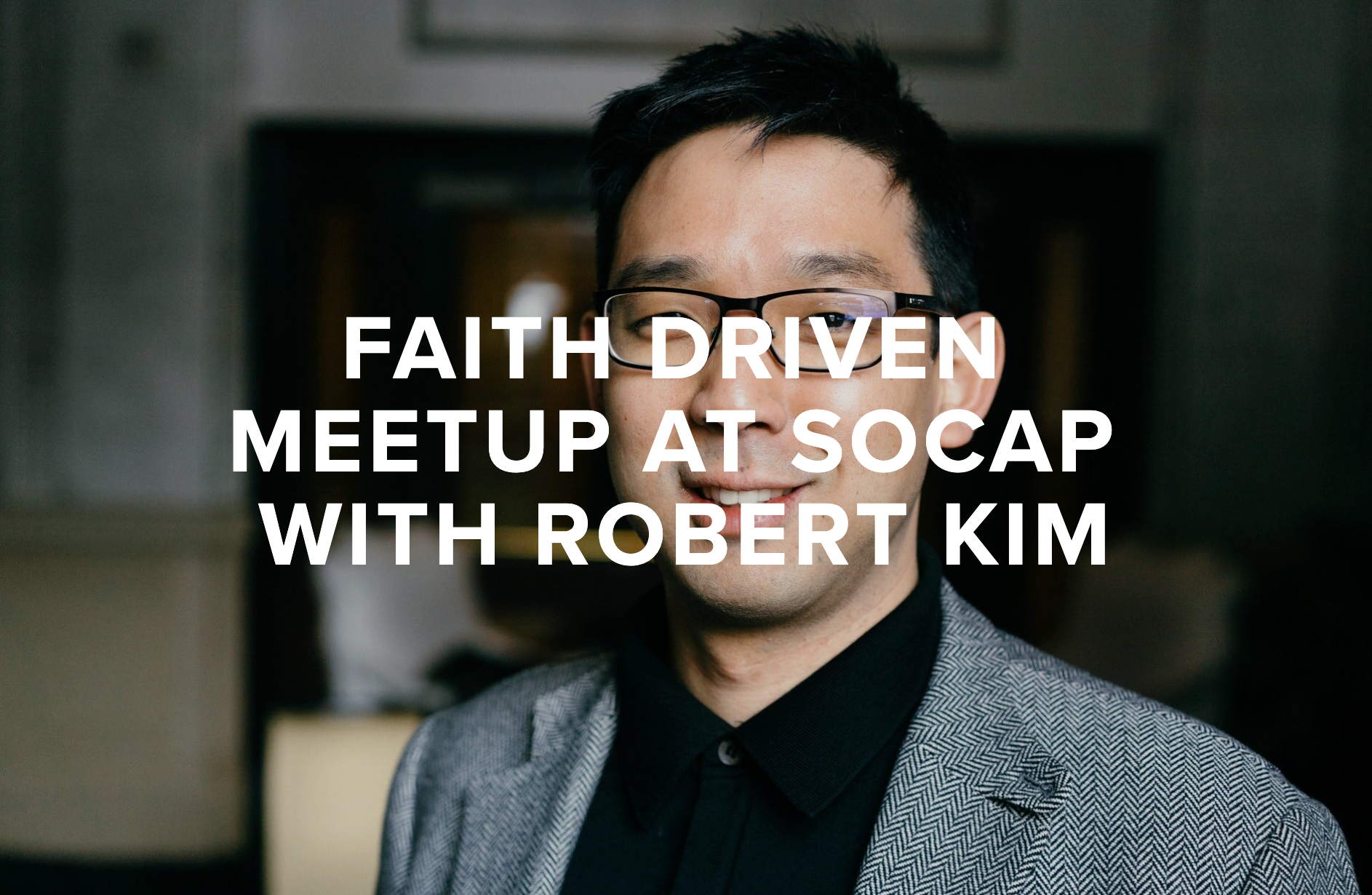
Faith Driven Meetup at SOCAP with Robert Kim

For our friends attending SOCAP, Robert Kim is coordinating a meetup for Faith Driven Entrepreneurs and Investors that we wanted to highlight. If you’re new to the conversation, here’s a quick scoop:

What is Faith-Driven Investing? Faith Driven Investing is a movement of an increasing number of asset owners, fund managers, and entrepreneurs that are driven by their faith. We all come around some unifying principles as a starting point and know that God owns all that we have and that we are called to faithfully steward our gifts – as investors, entrepreneurs, etc. We all have our unique parts in the broader Faith-Driven Investing ecosystem. 

At this event, the panelists will discuss the following three topics:

a) How Christian faith informs the way entrepreneurs lead and manage their own enterprises

b) How faith influences the way investors manage their assets

c) Practically speaking, how investors can align their assets in a faith-driven manner

Our hope is to discuss these three questions at a deeper level and create a dialogue to encourage one another to pursue our unique calling as investors, entrepreneurs, etc.

We are delighted to have amazing panelists, including Henry Kaestner (Sovereign’s Capital), Bryce Butler (Access Ventures), Jimmy Quach (Good Paper), Jonny Price (WeFunder), and more! In their own journey as investors and entrepreneurs, they have wrestled with these two questions deeply. We’re excited to hear their stories – both successes and failures – lessons learned, and practical next steps!

“One of the Best Investments”

This video was originally published here.

Check out Corporate Chaplains of America for other quality content!

Janet Ward Black has been practicing law for 30 years. Listen to how Corporate Chaplaincy has influenced her law firm.