Jesus vs. The Money Changers

  Image by   Kim Gorga

Image by Kim Gorga

This article was originally published here.

Check out Townhall Finance for other quality content!

by Jerry Bowyer

The confrontation with the moneychangers has been used to enlist Jesus into an ideological war against finance. There are many examples, but probably the best known of them is FDR’s inaugural address in which he extensively referenced this text.

“Practices of the unscrupulous money changers stand indicted in the court of public opinion, rejected by the hearts and minds of men.

True they have tried, but their efforts have been cast in the pattern of an outworn tradition. Faced by failure of credit they have proposed only the lending of more money. Stripped of the lure of profit by which to induce our people to follow their false leadership, they have resorted to exhortations, pleading tearfully for restored confidence. They know only the rules of a generation of self-seekers. They have no vision, and when there is no vision the people perish.

The money changers have fled from their high seats in the temple of our civilization. We may now restore that temple to the ancient truths.”

Is that really what this story means? Is it a general indictment of financial commerce? I don’t think so.

We’ve been tracing Jesus’ journey from Galilee down to Jericho into Judea and now to Jerusalem. The pattern has been that Jesus’ denunciations of wealth coincide with two circumstances: proximity to Jerusalem and proximity to the ruling class. Jesus is toughest on accumulations of riches when in Judea, least so when in Galilee. He’s tough on religious and political elites (often the same groups) who extract wealth, as opposed to those who create wealth through work, or even investment. That latter point – tolerance towards financial dealings – was counter-cultural in at least two ways. ‘Conservative,’ that is aristocratic, elites were tied to the land; the newly forming order of financial markets would have been somewhat alien to them.

David Fiensy makes this point in Christian Origins and the Ancient Economy,

The first thing we should say about the ancient economy of the Mediterranean and Middle Eastern regions is that it was agrarian. This observation is so common as to be beyond dispute.2 An agrarian economy was based on land ownership and farm production…the way to acquire wealth in an agrarian economy was to acquire more land. There was not much else a person could do with wealth but buy land. One could invest in trading and shipping, but it was risky. The culturally acceptable and economically less risky investment was land…

But Jesus tells several parables which involve finance, as opposed to agriculture. There is the Parable of the Unfaithful Steward, and the Parable of the Talents, both of which seem oriented towards a positive view of the investor. In fact, at least one, and probably both, of these parables put God in the role of the investor. This would be odd if Jesus thought of finance as an unrighteous profession.

Therefore, it is unlikely that Jesus’ confrontation with the money changers was simply because they dealt with finance.  Given Jesus’ criticism of the temple and its elites, it seems more likely that their location on temple grounds was at least one part of His objection. The account specifies that He confronted them when He entered the temple, therefore they were on temple grounds. He specifically criticizes their presence there, contrasting it with Solomon’s temple which was to be ‘a house of prayer for all nations’. Instead, it had been turned into a “robbers’ den” – a reference to Jeremiah who also criticized the temple elites of his time. The text makes clear that this activity taking place on temple grounds was an issue.

“And they came to Jerusalem. And He entered the temple and began to cast out those who were buying and selling in the temple, and overturned the tables of the moneychangers and the seats of those who were selling doves;

16 and He would not permit anyone to carry goods through the temple.

17 And He began to teach and say to them, “Is it not written, ‘My house shall be called a house of prayer for all the nations ‘? But you have made it a robbers‘ den.”

18 And the chief priests and the scribes heard this, and began seeking how to destroy Him; for they were afraid of Him, for all the multitude was astonished at His teaching.”

(Mk. 11:15-18 NAS)

Mathew21:12 And Jesus entered the temple and cast out all those who were buying and selling in the temple, and overturned the tables of the moneychangers and the seats of those who were selling doves.

13 And He said to them, “It is written, ‘My house shall be called a house of prayer’; but you are making it a robbers‘ den.”

(Matt. 21:12-13 NAS)

I’ve highlighted several phrases to draw attention to some points which might be missed otherwise. One of them, I’ve already discussed, is the fact that the moneychangers were confronted after Jesus entered the temple, therefore they were on temple ground. Also, please note the phrase ‘”robber’s den”. I’ve already mentioned that this is borrowed from Jeremiah. But it’s important to see how appropriate this designation was. Jesus calls this a robber’s den because they are robbers. The temple system was dishonest in numerous ways, which we can discuss in great detail elsewhere.

One matter which stands out is the dishonest nature of the currency transactions. According to Alfred Edersheim’s monumental tome, The Temple:

…But by far the largest sum was derived from the half-shekel of Temple tribute, which was incumbent on every male Israelite of age, including proselytes and even manumitted slaves. As the shekel of the sanctuary was double the ordinary, the half-shekel due to the Temple treasury amounted to about 1s. 4d. (two denarii or a didrachma). Hence, when Christ was challenged at Capernaum1 for this payment, He directed Peter to give the stater, or two didrachmas, for them both. This circumstance also enables us to fix the exact date of this event. For annually, on the 1st of Adar (the month before the Passover), proclamation was made throughout the country by messengers sent from Jerusalem of the approaching Temple tribute. On the 15th of Adar the money-changers opened stalls throughout the country to change the various coins, which Jewish residents at home or settlers abroad might bring, into the ancient money of Israel. For custom had it that nothing but the regular half-shekel of the sanctuary could be received at the treasury. On the 25th of Adar business was only transacted within the precincts of Jerusalem and of the Temple, and after that date those who had refused to pay the impost could be proceeded against at law, and their goods distrained,2 the only exception being in favour of priests, and that ‘for the sake of peace,’ that is, lest their office should come in disrepute…

So, the temple shekel was double weight, which no doubt had pious justifications about the glory – literally the heaviness – of the matters of God. But the bottom line is that worshippers had to pay twice the amount, due to dishonest weights and measures. And the mechanics of this financial abuse were carried out by the money changers. That is why Jesus calls them ‘robbers’.

You may notice that I highlighted phraseology which singles out the dove merchants as particular objects of Jesus’ ire. Matthew’s and Mark’s Gospels both mention the doves. Luke’s account is generally similar but doesn’t mention dove merchants.

John, however, focuses heavily on the dove sellers, so heavily that he portrays Jesus as speaking only to them.

15 And He made a scourge of cords, and drove them all out of the temple, with the sheep and the oxen; and He poured out the coins of the moneychangers, and overturned their tables;

16 and to those who were selling the doves He said, “Take these things away; stop making My Father’s house a house of merchandise.” (Jn. 2:15-16 NAS)

What is the significance of the doves? Under the Torah, the sacrifice of doves was a provision for the poor. Poor people bought doves. The whole system of money-changing was dishonest, but the dove sellers who charged double because of the dishonest shekel were specifically the group which was hurting the poor, such as were Joseph and Mary when they first started out.

“And when the days for their purification according to the law of Moses were completed, they brought Him up to Jerusalem to present Him to the Lord

23 (as it is written in the Law of the Lord, “Every first-born male that opens the womb shall be called holy to the Lord “),

24 and to offer a sacrifice according to what was said in the Law of the Lord, “A pair of turtledoves, or two young pigeons.””

(Lk. 2:22-24 NAS)

Luke doesn’t mention doves, probably because his intended gentile audience would not understand this detail of Torah.  But John has Jesus addressing only the dove-sellers. Why would John be particularly focused on the dove merchants? Remember John was probably the closest to Mary who, as we saw above, was herself exploited by this particular group. Jesus arranged for Mary to adopt John at the cross and according to early church historians, John and Mary stayed together, traveling to Ephesus.

This would also explain Jesus’ anger. His own mother had been exploited by this system. Jesus called out religious leaders for devouring widow’s houses. Perhaps He thought of his own, probably widowed mother. Jesus, on the other hand was not a devourer, but rather was Himself devoured by zeal for God and for the good of the people. That at least is how His disciples interpreted the confrontation with the dove merchants:

“and to those who were selling the doves He said, “Take these things away; stop making My Father’s house a house of merchandise.”

17 His disciples remembered that it was written, “Zeal for Thy house will consume me.””

(Jn. 2:16-17 NAS)

But Jesus was not the only one who was consumed. It was immediately after this incident that the chief priests and the scribes decided to destroy him.

“And the scribes and chief priests heard it, and sought how they might destroy him: for they feared him, because all the people was astonished at his doctrine.” (Mk. 11:18 KJV)

There were consumed with fear at His popularity among the people. Up until then they had merely been irked by Jesus because of His challenge to their religion, but now He was challenging their money, and for that, He had to be murdered.


New Study Says Focusing on Your Net Profit Could Actually Hurt Your Business. Here’s Why and What to Do Instead

  Image by   Stephen Dawson

Image by Stephen Dawson

This article was originally published here.

Check out Inc. for other quality content!

by Robbie Abed

I took a director-level position in a new company that had just gotten funded by a private equity firm. All the interviews went really well, since the company was focused on growth and increasing top-line revenue. But after I joined, the exact opposite happened.

The company decided to prioritize bottom-line revenue instead. The leaders grew obsessed with profit to the point that, instead of flourishing, we started to decline. We made cuts instead of investments. We focused on numbers instead of new ideas.

I’m OK with cutting the budget to be profitable, but this company also let go of our best talent because these people were “too expensive.” It turns out when you drain the company of its best resources, it starts to decline rapidly.

That’s not just my experience. A new study from Baylor University says focusing on the bottom line gets poorer financial results than investing in your team. Here’s what you can do about that.

Continue reading this article at Inc.

The Christian CEO is the Most Underserved U.S. Missionary Today

  Image by    Steven Houston

Image by Steven Houston

This article was originally presented at The Christian Economic Forum 2019.
Check out
CEF for other quality content!

The Christian Economic Forum hosts a world-class Global Event each year to connect the top industry leaders and experts from around the world with other individuals who are compelled to act upon the principles of God’s economy. The following paper was presented at CEF 2019.

by Chris Conant

It was June of 2017. I was at a Christian business conference when a pastor got up on stage and repented on behalf of the church-at-large. The apology was to God and all the Kingdom-minded CEOs and business owners in the room. The offense was: “treating business leaders like a second-class citizen, like you have one foot in the world and one foot in the church; for downplaying your assignment in the Kingdom; for not sharing you with others; and thinking that you are the source of our financial provision for ministry.”

He had the right words. And the offense depicted the treatment of a misunderstood Kingdom-minded CEO, owner, or managing director.

CEOs/owners are leaders with many talents. Much like Bezalel of Exodus 35—36, the Holy Spirit fills CEOs with wisdom, understanding, and knowledge. God made them multi-skilled to know how to carry out the work He commands.

As a former owner/CEO for 18 years and now Managing Director of Monmouth Society, I understand the life, challenges, and assignment of a Kingdom-minded owner. About five years ago the Lord revealed to me why we need to link Kingdom-minded investments to Christian leaders of companies.

When we compared the segments of the US population to Pew Research Center’s data indicating how many church-attending Christians there are in the US,[1] and then applied that metric against Gallup data on the number of small businesses in the country,[2] [3] [4]we identified there are approximately 459,000 Christian CEOs/owners/managing directors of companies in the USA with 10 or more employees.

Let me ask the reader: How many private investments do you have in these Kingdom-minded CEOs? If the answer is zero, you’re not alone. There are currently very few private equity companies taking capital from investors who were only Kingdom-minded for the purposes of supporting Christian CEOs and their companies. Second, the infrastructure in the Christian business sector is not yet mature for incubating mass deal flow from God-honoring companies, plus the due diligence is complex. Third, we noticed universally that the Christian community frets about the direction of America, yet continues to purchase public stock, thereby preferring to invest in secular companies that support values in opposition to theirs so the Christians can sustain provision for their family. That sentence just saddens me to write.

If a young Jewish entrepreneur today starts a business, the elders in the temple are likely to come around him and invest, and they very well could become his or her board of advisors. The Mormons do this well. Even the Muslims have a $1B Sharia fund. But where are the Christ-follower investors and why have we not taken care of our own or our culture? 

To answer this question we must examine a strong argument as to why we should invest in a Kingdom-minded CEO.

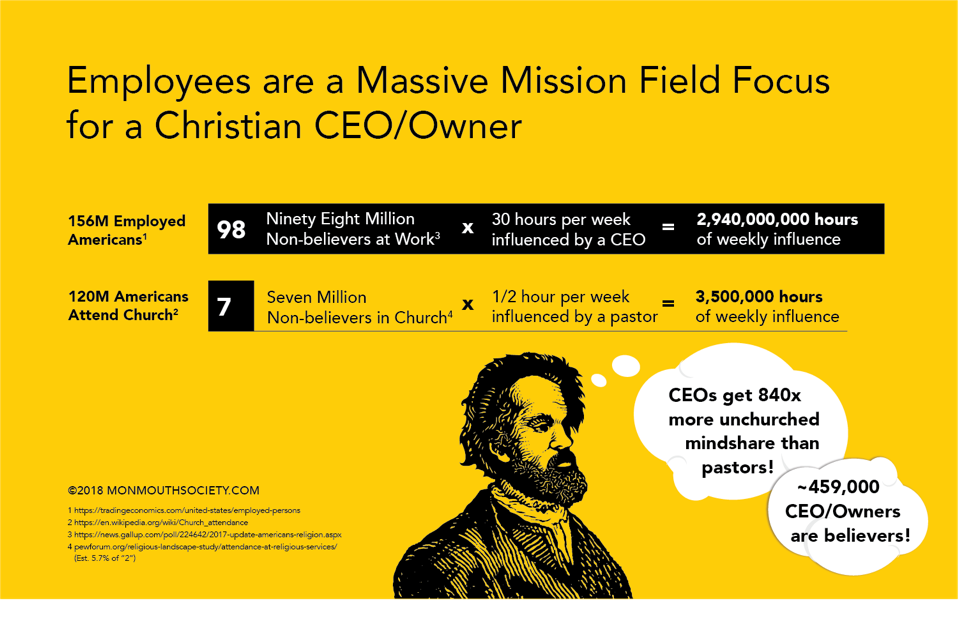
 The Monmouth Society compared the population of unbelievers in the workforce versus in the church on an average week. Approximately 98 million unchurched Americans are in the workplace for 30+ hours a week, versus an estimated 7 million in church for a 30+ minute service on a Sunday3. (See figure 1.) The results should compel us into this mission field.

 In the workplace, Kingdom-minded CEO/Owners get 2,940 million hours per week of “unbeliever mindshare” versus a pastor who would get about 3.5 million hours per week of “unbeliever mindshare.” At large, CEOs/Owners get 840 times more influence!

Imagine the shift inside corporate culture when Christian CEOs/owners are supported to steward their influence for Christ! Non-believers would speak highly of the amazing workplaces and their value on people. Customer satisfaction would shoot through the roof. Profit would follow. The Holy Spirit would be present in the organization: physical healings, answered prayer, marriages restored, and more. The gospel would be getting preached, and His kingdom would advance while He gets the glory!

These statistics made us realize that Christian CEOs and owners are perhaps the most underserved and misunderstood US missionary today. As I recall Billy Graham’s words, “the next great revival will be in the marketplace,” Kingdom-minded investors cannot solely expect financial ROI without understanding the value of very tangible outcomes from eternal ROI, when we support our own (like 1 Timothy 5:8).

Many investors are or have been CEOs or owners, so we, myself included, understand a Kingdom-minded CEO/Owner has to function in the role of both king and priest; balancing work and home, while always being “on” for crises, relationships, sales, vision, spiritual leadership, and the like. It can be lonely, exhausting, and isolating, sometimes unto sin.

Intercession, Peer Advisory, and Capital

These are the three investments CEOs have expressed they need in order to build godly cultures and fulfill their assignment.

“Intercession” means standing with the CEO to fellowship closely with God, but we use the word “intercession” to also encapsulate all chaplain efforts, journaling prayer, prophecy, and ministry to the CEOs (and their companies and families). Prayer gives us access to God, and we want the CEOs to experience Him daily.

“Peer advisory” means flourishing in a Christian CEO group and receiving counsel from peers because it is lonely at the top, and sometimes non-CEOs, including a senior pastor, can’t effectively counsel on business issues.  

“Capital” means being a resource to fund the vision, including using it to make critical hires, build inventory, and grow the Kingdom impact. 

The investor benefits here when an approved Kingdom-minded CEO/Owner builds an organization that hosts the presence of the Holy Spirit and models God’s love. We invest in Kingdom-minded CEO/owners/managing directors because they are our agents or carriers of ministry and evangelism. They lead the companies that steward the influence. In this regard, we are truly operating in a spiritual economy, by letting our fruit grow on someone else’s tree.

This eternal ROI is a great success even without an IPO. Sometimes an aging Christian CEO may want to sell his company, but not to a secular private equity firm. Instead he could seek out a Kingdom-minded private equity firm to do a fair deal (that honors all), and assures the spiritual equity inside the culture is maintained first and foremost.  

Speaking of going public, another challenge investors face is the allure of the “spirit of mammon.” As the Word of God clearly states, we cannot serve both God and mammon (the love of money, greed, putting ourselves first, the spirit of relying on self-provision instead of God).[5] And yet, sometimes we meet Christian investors who, within minutes of introduction, direct the conversation to what the financial returns are because “they are being good stewards.” If they are truly stewards of God’s money, then are they saying God wants financial returns first and foremost, at the expense of compassion, love, or salvation?

I wrote that rhetorical question only to provoke thought.

It’s not wrong to ask about financial ROI, but the timing of the question and the focus on money seems to suggest that mammon motivates that person. I will admit, we can all be influenced by mammon to some degree because we participate in the world economy, but, we are also a redeemed people, so it is important to recognize mammon and reject its influence.

If you’re a Kingdom-minded investor, may I propose that you seek the Holy Spirit and ask which investments matter to Him and where He wants you to invest His money. The parable of Luke 19:12–25 clearly tells us of a master who leaves his wealth in the hands of a faithful steward who figures out how to multiply his master’s money. The master was so pleased with the outcomes that he put the steward in charge of many cities. Why cities? Because if one can build a wealth ecosystem with someone else’s money, then that impressive act deserves a reward worthy of leading cities. Here on earth, our Master will return one day and we will be held accountable for where, how, in whom, and possibly even why we invested His money.

I still acknowledge that investors want to invest in something that will make a financial ROI, so they feel connected to stewardship, perpetuating giving to Kingdom work. Perhaps I can address financial ROI this way. The due diligence on a potential asset must be thorough and intelligent, management and company fully researched, investment committee advisors consulted, returns experienced should be excellent, and in most all regards, above market; but all this excellence is not to our credit. It is trusting God, by obeying His leading—that is what qualifies us for Kingdom work—obedience. It’s also what qualifies our CEOs and owners to perform well—spending time in prayer, listening to the Holy Spirit, and then doing what He says. Obeying His voice commands a blessing.[6]

 Our SEC attorney will tell a fund manager, “You have a fiduciary responsibility to your investors.” However, if you ask anyone at Monmouth Ventures (including the investors) who the number one responsibility is directed to, they will say, “the Kingdom-minded CEO/Owner.” When the focus is on hearing God in prayer, then Matthew 6:33 is at work (“Seek first the Kingdom of God and his righteousness, then all these things shall be added to you”). Plus, there are countless benefits and blessings fulfilled as we come into agreement with the promises of God.

One might ask, “Why not receive the wealth from unbelievers as investment into Christian CEOs?” To that I would answer, “That is not what we believe to be our assignment from the Lord,” and “Asking non-believer investors to give spiritual counsel to our Christian CEOs doesn’t work,” and “That would be off-mission for us.” Furthermore, I would add that receiving wealth from unbelievers does happen for us below the CEO level, since the company should be a light to the world, selling products and services that attract and minister God’s attributes to all customers.

With this Kingdom wealth ecosystem at work, the investor serves as steward of the Master’s money. ROI can be used for re-investment into more Kingdom-led companies or for funding Christian agendas. Just like the Parable of the Minas, the Kingdom investor puts the Master’s money to work. This same Master reaps where He hasn’t sown.[7] We understand that God’s ways and purposes are higher than ours, and He does abundantly more than we can ever ask or think, including causing increase where we haven’t strived.

By investing in Christian CEOs/owners for the primary purposes of reaching the lost and shifting culture, Kingdom-minded investors will feel fulfilled by participating in acts of redemptive stewardship and advancing the Kingdom of God.

Ultimately we want to see unbelievers in the workplace turning to Christ. It’s what matters most long after the company is gone. As the Christian CEO/Owner is empowered by intercession, peer advisory, and financial capital they can more effectively encounter God themselves, and then with the love of Christ they can reach the lost among their employees, their clients, their vendors, and their communities. There will be true culture change, and the Kingdom-minded investor and the CEO will both be rewarded (1 Corinthians 3:8).

Deuteronomy 8:17-18 states, You may say to yourself, ‘My power and the strength of my hands have produced this wealth for me.’ But remember the Lord your God, for it is He who gives you the ability to produce wealth, and so confirms His covenant, which He swore to your ancestors, as it is today.”


[1] pewforum.org/religious-landscape-study/attendance-at-religious-services/ (Est. 5.7% of “2”).

[2] https://tradingeconomics.com/united-states/employed-persons.

[3] https://en.wikipedia.org/wiki/Church_attendance.

[4] https://news.gallup.com/poll/224642/2017-update-americans-religion.aspx.

[5] Luke 16:9-11 (NKJV), “You cannot serve God and mammon.”

[6] Deuteronomy 28:1-2 (NIV), “If you fully obey the Lord your God . . .  All these blessings will come. . .”

[7] Matthew 25:26 (NKJV), “you knew that I reap where I have not sown.”

Where is the Business as Mission Investment Market Heading?

  Image by   Christine Roy

Image by Christine Roy

Pragma Advisors recently released The 2020 B4T Investment Market Study—a collection of interviews with more than a dozen of the funds and groups focused on investing in the BAM/B4T space, with faith-driven entrepreneurs at the helm. They were kind enough to sit down with us and answer a few questions about who they are, what this report is all about, and why it matters for the Faith Driven Investor.

FDI: What is Pragma Advisors all about? 

Pragma: We are startup advisors and investors who are committed to mobilizing skilled business men and women to get involved in the Great Commission using their talent, time & capital. We do that by providing research about the BAM & B4T space and places for our audience to collaborate around interesting companies and deals.

FDI: Who is your intended audience for the study and why?

Pragma: We wrote the study for Kingdom-minded investors because many just aren’t exposed to a broad picture of the BAM/B4T investing landscape. We wanted to highlight areas that need more support in the B4T ecosystem, in particular, thereby advancing the Gospel to the least-reached areas of the world through business.

FDI: What exactly is BAM/B4T and what are the differences between the two?

Pragma: The main difference is that Business for Transformation (B4T) companies are exclusive to least-reached areas, focused on two bottom lines, while Business as Mission (BAM) focuses on four bottom lines. On page four of the study, we show a nice side-by-side comparison to helps articulate the finer points.

FDI: What motivated you and your team to compile this research?

Pragma: I was looking to make investments in B4T funds when I quickly started realizing they all operate differently, with distinct focuses, and various ways to invest or give. After meeting with several, I got introductions to others that were not on my growing list. Finally, when I shared my initial analysis with leaders in the space, they encouraged me to share my findings more broadly. Thus, the market study was born.

FDI: We talk about Faith Driven Investing quite a bit, so what insights did you uncover about the role of faith in Business As Mission and Business For Transformation investments?

Pragma: In talking with seasoned investors, we uncovered war stories of great successes and great failures brought on by unstable economic and geopolitical climates. You find out really quickly what matters to you when things go south. There were also some great wins. Walking by faith doesn’t mean making bad investment decisions, but in BAM / B4T investing, it almost always means taking on much greater risk for the sake of bringing the Gospel to where few have gone before. We found that “Faith-Adjusted Returns” far outweigh the risk, from an eternal perspective. 

FDI: Based on your research, where does Pragma see the BAM/B4T investment market heading in the next year or two? Also, what do you see as areas needing improvement or growth?

Since the investment market is young, we see the market maturing the “norms” and “best practices” for the structure, diligence and follow-on support of these types of investments. With all the new funds coming on the scene, there will be a growing need for collaboration across funds and diligence processes. The support services space will also grow to meet the demand. As an industry, we need to do a better job of getting startups validated before they raise money and become more accountable to basic financial management post-investment.

 FDI: The report mentions that “all investors need to start by checking their heart-level motivation for investing.” Why was that important to your team and why do you think that matters? 

Pragma: As investors, our most present temptation is to protect the money we have as if we are its owner, to the point where we prioritize wealth preservation over Kingdom-advancement. Does that sound familiar? (hint: the one-talent servant who buried it in the ground, and later rebuked). Jesus said, “You cannot serve God and money.” It was important to mention heart-level motivation because we do not own this money we have, but God asks us to faithfully steward it. Checking our hearts allows us to invest wisely and boldly in the face of risk. Investing from a greedy or fearful heart will create agnst, stress and ultimately sin in our hearts.

FDI: During your research, did you find anything that surprised you?

Pragma: We were surprised by how many investors were coming into the space in the last 18 months and also how no one was even close to having the whole list of firms in the space. It underscored the need for such a study like ours to provide that industry-wide view of the funds focused on Business As Mission.

FDI: For people that aren’t aware of many BAM or B4T opportunities, where should they look to learn about them?

Pragma: Great question. Go to the BAM Conference or the B4T Expo to get familiar with the space first. Events are the best way to get exposed not just to deal flow but also to other investors (who you can co-invest with). The Lion’s Den Birmingham and Dallas are local, while the OPEN USA and BAM Global have pitch events along with the ACE Development Fund. Also on page 13 of our study you can find a list of resources hubs and startup training as well.

DOWNLOAD THE 2020 B4T INVESTMENT MARKET STUDY HERE

How Do You Make Wise Investing Decisions?

  Image by   Kyle Glenn

Image by Kyle Glenn

This article was originally published here.

Check out Eventide Investments for other quality content!

by Jason Myhre

All of us want to make wise investing decisions. For many today, that means focusing on profit. And while that may be the de facto understanding of wise investing, it isn’t wise.

What does wisdom mean?

Wisdom is an ancient word, of course, and we all know it – or think we do. Today, it means a kind of ‘street smarts’ or ‘knowledge applied skillfully.’ But this modern definition is only part of the word’s meaning. What I want to do is take brief look at the meaning of the word in different times and places, going back to ancient wisdom teachers for understanding.

Wisdom in western thought, c. 300BCE
Let’s go back in time to around 300BCE, to listen to western wisdom teachers, like Aristotle. At that time, the word for wisdom was phronēsis (or that’s how you would pronounce the Greek word, which looks like this: φρόνησι). Phronēsis translates to our English word ‘wisdom,’ or better ‘practical wisdom.’ But for western teachers, wisdom wasn’t just practical, like it’s understood today – it was ‘aimed at’ doing what’s right. It was a kind of ‘know-how’ that ‘knows why.’ For this reason, some say phronēsis should be read as ‘mindfulness.’1 Wisdom was knowing in a particular situation what to do in order to progress towards life’s highest ends. It was decision-making oriented towards doing what’s right. For western teachers, wisdom meant two things together:

  1. doing what’s smart

  2. aimed at what’s right.

We can talk about these two components of wisdom as analytically distinct, but in practice they were indistinguishable. Wisdom described one action that’s both smart and right.2

Wisdom in near eastern thought, c. 600BCE
Let’s go further back in time to around 600BCE to the near eastern wisdom teachers, like Solomon. At that time, the word for wisdom was hoekma (Hebrew: חָכְמָה). This word translates to wisdom in English. Again, we discover wisdom meant two things: 

  1. doing what’s smart and

  2. doing what’s right.

Leading scholar on the Jewish and Christian Old Testament wisdom books of Proverbs, Ecclesiastes, and Job, Craig Bartholomew of Redeemer University College, says, “Wisdom […] has a double advantage: it pleases God” (what’s right) “and enables one to negotiate life successfully” (what’s smart) (emphasis mine).3 Bartholomew writes that for the Hebrew wisdom teachers, what’s right and what’s smart were so bound up together that it would be impossible to dissociate the two concepts. In near eastern thought, the righteous (the person who does right) and wise are ‘co-referential’ terms that describe the same type of person.4 The wise person does what’s right and what’s smart and the fool does what’s wrong and what’s stupid or insane.

In both western and near eastern thought, wisdom meant one action that’s both smart and right. It’s only a recent, modern, and mostly western turn of events for wisdom to have the limited sense it has today, of only skill or technique. For most of human history and in most cultures, wisdom required both virtue and skill.

Returning to investing, we can see that focusing on profit only isn’t wise. Wise investing, must be as concerned with people as it is with profit. It would mean investing that prospers by serving well the needs of others. It would mean doing well, by doing good. 

Wise investing means paying attention to both profit and people. This not only satisfies a technical point about the criteria of wisdom – it’s also just a more satisfying way to invest. We’d love for you to experience it with us.


This article expresses the views of Eventide Asset Management, LLC (“Eventide”), an investment adviser, and there is no guarantee that any investment strategy will achieve its objectives, generate profits, or avoid losses. Readers should be aware that Eventide’s approach may not produce the desired results, and Eventide’s ethical values screening criteria could cause it to underperform other firms that do not have such screening criteria. The term “smart” is used for informational purposes only, and does not imply a certain level of skill or training by the Adviser. All investments involve risk, including the possible loss of principal.

Eventide is providing this information for informational purposes only. Eventide serves as investment adviser to mutual funds distributed through Northern Lights Distributors, LLC (“NLD”), member FINRA/SIPC. NLD and Eventide are not affiliated entities.

4643-NLD-6/1/2018

1. Thomas McEvilley, The Shape of Ancient Thought, 2002, p. 609

2. For Aristotle, what was most important was a life well lived, or a life worth living. When you hear people talk about ‘the good life,’ they got this from Aristotle. What’s required to live well is first to discern life’s highest ends – the most important things in life – the ‘precious things’ – and then to make all decisions in life such that you progress towards those ends. Establishing the life’s ‘destination’ required virtue, or good character, and ‘getting there’ required wisdom. “Virtue makes the goal right,” (doing what’s right) “phronēsis [practical wisdom] the things toward the goal” (doing what’s smart aimed at what’s right) (Eudemian Ethics/Nicomachean Ethics, 1144a7-9, translation by Jessica Moss).

3. Craig Bartholomew, Ecclesiastes (Baker Commentary on the Old Testament Wisdom and Psalms), 2009, p. 140

4. Christopher B. Ansberry, Be Wise, My Son, and Make My Heart Glad: An Exploration of the Courtly Nature of the Book of Proverbs, 2011, p. 77

The Landscape for Christian Investing

  Image by   Jeremy Bishop

Image by Jeremy Bishop

This article was originally presented at The Christian Economic Forum 2019.
Check out
CEF for other quality content!

The Christian Economic Forum hosts a world-class Global Event each year to connect the top industry leaders and experts from around the world with other individuals who are compelled to act upon the principles of God’s economy. The following paper was presented at CEF 2019.

by Endel Liias

[Note: This white paper is taken from a short report written first in March 2018 and then updated in February 2019 (online here)]

Socially responsible and impact investing is big business these days, representing more than 25% of all assets under management in the US.[1] Individuals and institutions are increasingly looking to align their financial portfolios with their values, and the same holds true for Christian investors.

However, while the mainstream marketplace has seen rapid growth, maturation, and classification, the Christian or “Kingdom” investment marketplace is less well-defined. Limited industry research and actionable information prevents existing stakeholders from connecting with each other and inhibits new participants from entering the market—reducing beneficial collaboration, capital flows, and the development of businesses and organizations that have both financial and Kingdom impact.

This paper is an effort to address this problem and bring greater clarity to the Christian investing marketplace by answering some basic questions and providing some practical resources:

•      What is socially responsible investing (SRI) and impact investing, and where do they fit in the broader investment spectrum?

•      What is Christian investing and how is it distinct from traditional SRI and impact investing?

•      What are the different types of Christian investing, what are some examples, and how are they accessed?

•      Who are the key stakeholders in the Christian investing marketplace, what roles do they play, and what are some examples of each?

•      Where is this industry heading and how can you get involved?

My hope is that this information will be useful to CEF conference attendees and will provide helpful context for discussions on “Christian Approaches to Investing.”


BACKGROUND

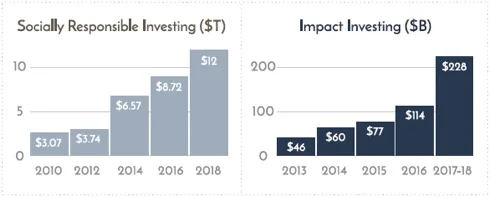
To understand the Christian investment marketplace, it is important first to define the broader world of socially responsible investing (SRI), of which Christian investing is one type. SRI is any investment strategy that considers both financial return and social impact. The most common form of SRI screens companies for their environmental, social, and governance (ESG) impacts, while other approaches avoid certain industries like tobacco or firearms (“negative screens”). Most SRI is in public markets through mutual funds and exchange-traded funds (ETFs), and accounts for $12 trillion (T) of the $46.6T in assets under management (AUM) in the US—25.7% of the market.[2]

Impact investing, a specific subset of SRI, is investment into companies, organizations, and funds with the intention of generating a financial return alongside a measurable social and environmental impact. Two key characteristics differentiate impact investing from SRI: intentionality and measurability. Impact investments are made with the expressed purpose of effecting a specific change, which must be measurable. SRIs, on the other hand, can be more general in their intent, and the non-financial impacts need not be measured. Impact investments are, therefore, made primarily into private companies and funds, where non-financial impacts can be more easily measured. The US impact investing market was $228 billion (B) in 2018[3]—the result of rapid growth in recent years but still only 1.9% of the total $12T SRI market.

The rapid growth of SRI and impact investing: Both SRI and impact investing have grown significantly in recent years. SRI grew from $3.07T in 2010 to $12 in 2018—a 391% increase—while impact investing grew 496% in the past five years, from $46B in 2013 to $228B in 2018. Impact investing market size data was not gathered prior to 2013.

Where do SRI and impact investing fit in the broader financial picture?

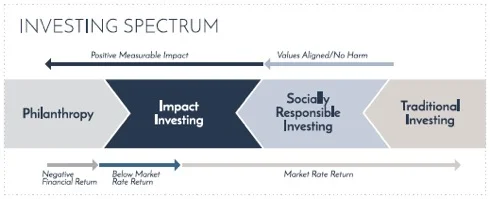
Historically, financial assets have been viewed as falling into one of two categories: (1) traditional investments, which have sought to maximize financial return; and (2) philanthropy, which is donated to charitable causes. SRI and impact investing bridge this gap along the financial spectrum, providing opportunities to invest capital that makes money and does good—both/and instead of either/or.

 The investing spectrum: Impact investing and SRI straddle the space between philanthropy and traditional investing. Impact investments always have a positive, measurable impact with returns ranging from below market rate to market rate. SRIs always target market rate returns, but do not necessarily have positive or measurable social impacts; they seek to align with investor values and at a minimum do no harm. The 2018 US market size for each category was: $410B in philanthropy,[4] $228B in impact investing, $12T in SRI, and $46.6T in traditional investing. 

Can an individual do SRI and impact investing? Yes, and it depends.

Yes. SRI can be done by any investor through a 401(k), IRA, brokerage account, or financial advisor. Because it is done via public markets through investment vehicles like mutual funds and ETFs, the options are abundant and easily accessible to the everyday “retail” investor. This ease-of-access is why SRI makes up more than a quarter of the entire US investment market. 

It depends. Impact investing is more difficult to access and is traditionally limited to high-net worth individuals (HNWIs) and accredited investors. This is because most impact investments are made into privately-held companies and private equity or venture capital funds, all of which have minimum investment amounts that typically preclude the everyday investor. This barrier to access is one of the primary challenges facing the impact investment sector. However, there are a few promising options that are emerging.

First, new equity crowdfunding platforms “democratize” access by enabling everyday investors to make impact investments in companies of their choosing for as little as $100. Second, impact investing can be done with charitable capital from a donor-advised fund (DAF), with any returns cycling back into the DAF for re-investment. The success of investment intermediaries like these will be key to the continued growth of impact investing.


CHRISTIAN INVESTING

Christian investing is essentially SRI or impact investing but with Christian values or outcomes as the non-financial impacts of a given investment. To illustrate this, let’s consider the Christian equivalents of SRI and impact investing.

Christian SRI is called Biblically Responsible Investing (BRI)

BRI is a strategy that considers an investment’s financial return as well as its alignment with Christian values and biblical principles. As with SRI, the vast majority of BRI is done via the public markets through mutual funds and ETFs. BRI has historically involved applying “negative screens” to filter out companies with unsavory practices, such as pornography, gambling, or abortion. However, today’s fund managers are increasingly applying “positive” screens to identify companies that proactively further biblical values, such as low-income financial services, family-friendly entertainment production, and safe water provision. Each BRI mutual fund or ETF has its own investment strategy and interpretation of what biblically-responsible means, providing a range of options for Christian investors along the ideological spectrum.

Christian impact investing

Christian impact investing, also called “Kingdom” impact investing, is investment into a company, organization, or fund with the expectation of receiving both a measurable financial return as well as a measurable “Christian” return.[5] This can take many different forms, from overt evangelism to the faith convictions of a company owner. And like traditional impact investing, nearly all Christian impact investments are made into private companies and funds that are better able to measure Christian impact. At present there are no industry standards for measuring these non-financial impacts; it is something each company and fund must determine on its own, often in discussions with investors.

 Market size

There are no formal statistics on the overall size of the BRI and Christian impact investing markets, but it is safe to say they comprise only a small percentage of the overall $12T SRI and impact investing markets. A high-level, informal analysis of the US Sustainable Investment Forum’s (SIF) 2018 SRI market report estimates that around 3% of the assets were Christian-oriented (BRI).[6] This would suggest that the current BRI market is approximately $360B. If we then consider that impact investing is 1.9% of all SRI, applying this same proportion to the $360B BRI figure would approximate the Christian impact investing market to be around $7B. Again, these figures are not scientific and are only meant to provide a high-level, broad sense of what the current market might be. Further in-depth research is required.

 Investor access

Accessibility to BRI and Christian impact investing also parallels their traditional market analogues: BRI is available to any investor through mutual funds and ETFs, whereas Christian impact investing is largely limited to HNWIs and accredited investors. However, new investment intermediaries like equity crowdfunding platforms and impact investing donor-advised funds (DAFs) are increasing access for everyday investors.

 What does the Christian investment landscape look like?

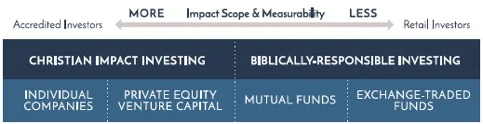
Below is a visual representation of the spectrum of Christian investing, from private companies and funds (impact investing) to mutual funds and ETFs (BRI). Impact scope and measurability is greater for impact investments than BRI, whereas BRI is more accessible to everyday retail investors.


CHRISTIAN IMPACT INVESTING

1.    Individual companies and organizations are the core of Christian impact investing. They operate across industries and geographies, range from seed-stage to mature, and can be both for-profit and non-profit (e.g. an enterprise charity is a non-profit that generates revenue to fund operations and, where applicable, provide returns to investors). Business as Mission, or BAM, is one well-known type of Christian impact business, with the distinguishing characteristics of being very intentional about Kingdom impact and explicitly concerned with the world’s poorest and least evangelized people.

2.    Private equity (PE) and venture capital (VC) funds are investment vehicles that contain a portfolio of private companies. Each fund has its own investment strategy (business sector and stage), return profile (financial, Christian, other), and minimum investment amount.


BIBLICALLY-RESPONSIBLE INVESTING

1.    Mutual funds contain a portfolio of public stocks, bonds, and other assets that are professionally managed and easily accessible to the everyday investor. Like PE and VC funds, they have different investment strategies, risk/return profiles, and fee structures.

2.    Exchange-traded funds (ETFs) are similar to mutual funds in that they are a professionally managed portfolio of public securities. However, they tend to have lower minimum buy-ins and fees, different tax treatment, niche offerings, and are traded throughout the day like stocks. At present there are only a few Christian ETFs on the market.


INDUSTRY STAKEHOLDERS AND ACTIVITIES

The previous section highlights examples of investment opportunities along the Christian investing spectrum. This section explores the wide range of other actors and activities that make up the broader ecosystem.

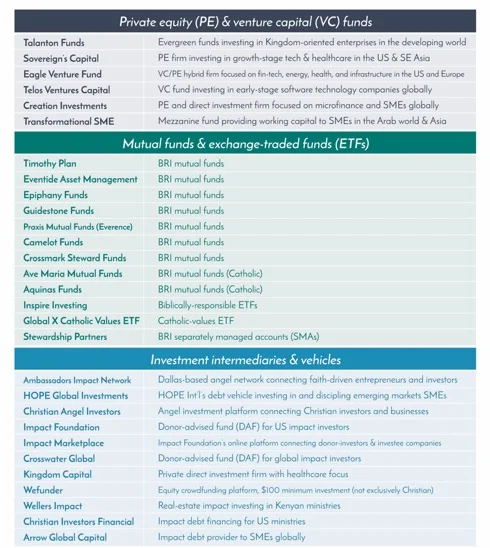
•      Investment intermediaries and vehicles facilitate BRI and Christian impact investment transactions and can take a variety of different structures. The most common are PE/VC funds, mutual funds, and ETFs, as outlined on the previous page. However, directly investing into an individual company or organization can be difficult, so several entities exist to facilitate these transactions, including impact investing donor-advised funds (DAFs), equity crowdfunding platforms, angel investing networks, loan syndicates, and private investment firms.

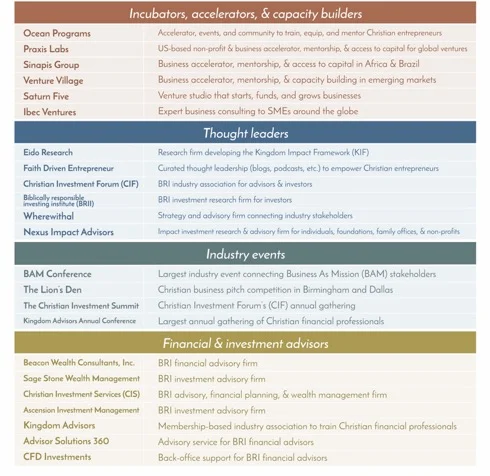
•      Business incubators, accelerators, and capacity builders play a critical role in training and equipping impact investment companies for success, from their early stages (incubators) to more mature phases (accelerators). Services include strategic planning, management and leadership training, mentoring, access to capital, and others.

•      Thought leaders provide research, information, and insights that empower Christian investing stakeholders and contribute to a flourishing ecosystem. Activities include producing industry research, organizing conferences, and hosting webinars and forums. There are currently a limited number of Christian investing thought leaders, and more are needed as the industry continues to grow.

•      Industry events are essential to the development of a robust Christian investment industry. There are currently several events catering to different segments of the market (BRI versus impact investing). These gatherings provide a forum for stakeholders across the industry to meet, build relationships, share knowledge, and grow the marketplace.

•      Financial and investment advisors help educate investors about the Christian investing marketplace, develop financial strategies that align with their goals, and deploy resources accordingly—whether toward BRI, Christian impact investing, or both. There are also advisory firms that specialize in training and equipping financial advisors to serve investor clients. The specific offerings and expertise of financial advisors vary from firm to firm.


TABLE: INDUSTRY STAKEHOLDERS AND ACTIVITIES

Below are some examples of key players and happenings in the industry. This list is not comprehensive.


FINAL THOUGHTS

The wide range of stakeholders and activities in biblically-responsible and Christian impact investing is evidence of a robust and burgeoning marketplace, and this growth is likely to continue apace in the coming years.

Over the next three decades, approximately $30T in assets will be passed from baby boomers to millennials—the largest intergenerational wealth transfer in history.[7] This will have major implications for the way money is invested, as younger generations increasingly look to spend and invest in accordance with their social, environmental, and moral convictions.

This presents particularly unique opportunities for the development of the Christian investing marketplace. As noted, informal analyses estimate the market size to be roughly $360B at present; however, internal research from the Christian Investment Forum (CIF) suggests that the potential market is much larger—on the order of $2.2–2.3T. Coupled with the forthcoming transfer of wealth, this could portend a significant increase in the demand for investment options that are financially profitable and biblically purposeful. Meeting this demand will require the skills, creativity, and hard work of stakeholders across the Christian investing industry, as well as the participation of new entrants.  


 [1] US SIF 2018 SRI Investing Trends Report, https://www.ussif.org/blog_home.asp?Display=118

[2] US SIF 2018 SRI Investing Trends Report, https://www.ussif.org/blog_home.asp?Display=118

[3] The Global Impact Investing Network (GIIN) Annual Impact Investor Survey 2018, https://thegiin.org/research/publication/annualsurvey2018

[4] Giving USA 2018: The Annual Report on Philanthropy, https://givingusa.org/

[5] Many different terms are used to describe the non-financial return of a Christian impact investment, including spiritual, missional, Kingdom-oriented, faith-based, and faith-driven, among others. Since no single term is consistently used across the industry, I’m using Christian to avoid confusion.

[6] Conducted by John Siverling, Executive Director of the Christian Investment Forum (CIF), and colleagues.

[7] The “Greater” Wealth Transfer: Capitalizing on the Intergenerational Shift in Wealth, Accenture Wealth and Asset Management Services,

https://www.accenture.com/us-en/~/media/Accenture/Conversion-Assets/DotCom/Documents/Global/PDF/Industries_5/Accenture-CM-AWAMS-Wealth-Transfer-Final-June2012-Web-Version.pdf