Creative Destruction and Work as Transformation

 Image by  Ricardo Viana

Image by Ricardo Viana

Article originally hosted and shared with permission by The Christian Economic Forum, a global network of leaders who join together to collaborate and introduce strategic ideas for the spread of God’s economic principles and the goodness of Jesus Christ. This article was from a collection of White Papers compiled for attendees of the CEF’s 2019 Global Event.

We share Luke’s White Paper as the first of many 2019 CEF White Papers to be shared here!

by Luke Roush

Joseph Schumpeter was a prominent economist in the mid-20th century, who devoted his life work to the study of capitalism. According to Schumpeter, the “gale of creative destruction” describes the “process of industrial mutation that incessantly revolutionizes the economic structure from within, incessantly destroying the old one, incessantly creating a new one”. 

We see this continuous evolution in the history of global business over the last 100 years, and the acceleration of its cadence has been the topic of much discussion. Xerox has experienced this in the realm of photocopying, Polaroid in the context of photography, traditional newspapers have given way to online-only publishers like Huffington Post, and in only fifty years we’ve gone from Vinyl to 8-Tracks to Cassettes to CDs to MP3’s to Cloud-based Streaming. Further to the product itself, the modes of distribution and purchase have been transformed multiple times, with e*commerce being a notable transformation. Industries like agriculture have been transformed as well, with biological engineering and mechanization creating new economies of scale that have transformed a number of industries. And, more examples continue to develop each year.

The work of Clay Christensen in The Innovator’s Dilemma does a great job of chronicling the difficulties that big companies face in their attempt to defend market share and maintain their leadership position. Successful innovation is, most often, a source of temporary market power, eroding the profits and position of incumbents, yet ultimately succumbing to the pressure of new inventions brought to market by the next generation of innovators. Schumpeter’s work is a powerful economic concept because it helps explain this cycle of industrial change — the transition from a competitive to a monopolistic market, and back again.

As Christians, when we observe this creative destruction, and the acceleration in its cycle time, how should we respond? What guidance does Scripture have for us? All the way back in Genesis 1:27-28, Jesus talks about our mission in the world:

“So God created mankind in his own image, in the image of God he created them;  male and female he created them. God blessed them and said to them, “Be fruitful and increase in number; fill the earth and subdue it. Rule over the fish in the sea and the birds in the sky and over every living creature that moves on the ground.” 

God has made man in His image, and as His image-bearer, we are equipped to mimic God in His creativity. To be clear, we are not intended to ‘become’ God, but instead to reflect God’s creativity, redemption, and restoration into the world. As we do this, we must do it in a manner that is consistent with the entirety of Scripture, led by the Spirit through prayer, and informed by Godly counsel from others. N.T. Wright builds on this intent in his book, Surprised by Hope:

“Earth – the renewed Earth – is where the reign will take place, which is why the New Testament regularly speaks not of our going to be where Jesus is but of his coming to where we are…And what he was promising for that future, and doing in that present, was not saving souls for a disembodied eternity but rescuing people from the corruption and decay of the way the world presently is so they could enjoy, already in the present, that renewal of creation which is God’s ultimate purpose – and so they could thus become colleagues and partners in that larger project.”

For fun reading on what this quote doesn’t look like, one can review the history of the Luddites, who were a secret oath-based organization of English textile workers in the 19th century. Within this group, a radical faction destroyed textile machinery as a form of protest. While most choose a more peaceful form of protest today, there are groups whose arguments against change and innovation are eerily similar to the Luddites of the 19th century. 

Are there new challenges that the Gig Economy has brought to light between management and labor? You bet. Are jobs going to be disrupted by robotics, artificial intelligence, autonomous vehicles, and a 3rd wave of internet and mobile-enabled services? For sure. But, disruption has always been the case, and will always be the case. It’s the by-product of creating new things. As the cadence of change has accelerated, the need for all of us to become lifelong learners who are continuously capable of building new skills has become urgent and mandatory.  

As we deliver this message to ourselves, our families, and our communities, we must do so with transparency and we must lead with love. We must listen and seek to understand before sharing our views. We must be prepared as citizens and as Christ-followers to help shoulder the burden for training and re-education of our colleagues. If we are going to equip individuals to provide for themselves and thrive as contributing members of society, we must be individually willing to engage in this mission. Federal, state, and local municipalities should not the primary drivers in this mission. Instead, this is a mission that we as Christ-followers should be leading and speaking into.

Thomas Cahill who authored Gifts of the Jews, provides a great historical context for where we’ve been, and where we’re headed:

 We normally think of history as one catastrophe after another, war followed by war, outrage by outrage–almost as if history were nothing more than all the narratives of human pain, assembled in sequence. And surely this is, often enough, an adequate description. But history is also the narratives of grace, the recountings of those blessed and inexplicable moments when someone did something for someone else, saved a life, bestowed a gift, gave something beyond what was required by circumstance… …This is also the story of the evolution of Western sensibility, a narration of how we became the people that we are and why we think and feel the way we do. And it is, finally, a recounting of those essential moments when everything was at stake, when the mighty stream that became Western history was in ultimate danger and might have divided into a hundred useless tributaries or frozen in death or evaporated altogether. But the great gift-givers, arriving in the moment of crisis, provided for transition, for transformation, and even for transfiguration, leaving us a world more varied and complex, more awesome and delightful, more beautiful and strong than the one they had found.

As we assemble here together at CEF 2019, let us imagine together how we might reflect these words, and inspire others in our various communities to do the same as we lean into the creativity and innovation given to us by our Creator. 

Announcing our 3 new Reading Plans for FDI!

 Image taken from  Alfons Morales

Image taken from Alfons Morales

THE BUSINESS OF LOVING THY NEIGHBOR

Pete Kelly and the team at Apartment Life have taken God’s command to love thy neighbor and turned it into an opportunity for both ministry and business. And they want you to do the same. If you work in real estate and want to see how God’s love can shine through your work, this reading plan is for you…

PRAYING FOR PEOPLE AROUND YOU

Everywhere we look, there are people in need. Few groups understand this dilemma better than Pete Kelly and the team at Apartment Life. They’re working to decrease suffering as they increase human flourishing, and they want to show you how to do the same. Join us on a journey of prayer as we bring the people around us before God.

SPIRITUAL DISCERNMENT AND PROPERTY MANAGEMENT

Managing and developing real estate comes with its own unique set of challenges. Thankfully, Pete Kelly and the team at Apartment Life have been thoughtful about this topic and have given us a framework for how to think, and really how to pray, through the heart posture and process of buying and selling property.


For more reading plans, visit our resources page here.

Begin Planning for Economic Recovery
 Image by  Dimitri Houtteman

Image by Dimitri Houtteman

by Joel Thomas

As a business leader, how should I interact with the uncertainty that COVID19 presents? 

In life, there are winners and losers…and it is not a static thing, but something that is constantly changing. COVID19 will certainly yield some winners and losers. My mom and seven relatives were on the Princess Cruise ship, and three of them contracted the virus, while the rest of them did not. I am in a unique position where on one hand I own a disaster & emergency management consultancy that is likely to “win” from COVID19, while on the other hand, I am President of a family-owned restaurant will likely “lose”, as we have been forced to close and furlough all employees, and the outlook is bleak. 

These bipolar realities have caused me to reflect on Ecclesiastes 9:11, “Again I saw that under the sun the race is not to the swift, nor the battle to the strong, nor bread to the wise, nor riches to the intelligent, nor favor to those with knowledge, but time and chance happen to them all.” 

Rewind 20 years, and I recall when I met and later married my wife, how we had very little (actually hundreds of dollars) to our names, yet the Lord provided and made a way when at times it seemed we had come to the end. I recall at one point relying on the generosity of others and government healthcare for a season, while my wife and I ate rice and beans most nights for dinner. I consider the opportunity I have had to travel and serve in more than 50 nations as a Christian missionary, humanitarian volunteer and business owner.  I remember also being tempted in those times of great scarcity to stop being generous, but choosing to be generous and share from what I had in my hands to give. I also recall taking a leap from a very comfortable employment situation to “risk it all” and launch my business just months after welcoming a fourth child into the world. I have also had the privilege of building a healthy small business, employing others, and caring for their families as well as our clients around the world. 

In my life, having had opportunities to work in contexts from the slums of East Africa to the White House, I have come to accept the seasons of uncertainty as normative, and that has been informed by experiencing what it means to have plenty and to be in want. And in every season, Christ has been the cornerstone of my life. The words of Paul resonate with me, when he said “I know what it is to be in need, and I know what it is to have plenty. I have learned the secret of being content in any and every situation, whether well fed or hungry, whether living in plenty or in want.” Philippians 4:12. 

The challenge humanity faces with this paradox is that we often hold too tightly to a particular vision of our lives, and become disillusioned when anything upsets that. Jesus is not interested in our comfort, but our “no strings attached” willingness to follow Him. That is going to be tested for many in this season, including entrepreneurs and small business owners. Some of our businesses will falter, others will fail, and some will do just fine. The moment of truth comes when we face the reality that our faith is oftentimes tied up in the success of our business.  

The secret of success in this moment is to look to Jesus’ calm in the midst of the storm. He is the one who invited me off the boat like Peter on the Sea of Galilee to walk in adventurous faith, and now even though the waters are turbulent, He is standing there looking at me. This Palm Sunday, let us reflect on the reality that in these uncertain and ever-changing times, there is only one Rock to cling to, and He is immovable, unshakeable, and ever-present in our time of need. Will my eyes be fixed on Him, or will I waiver in this moment. Just because I have heard His voice in the past does not mean that I am listening right now. Take heed and listen. 

What is the appropriate faith-driven community response to COVID19?
1. Safeguarding lives
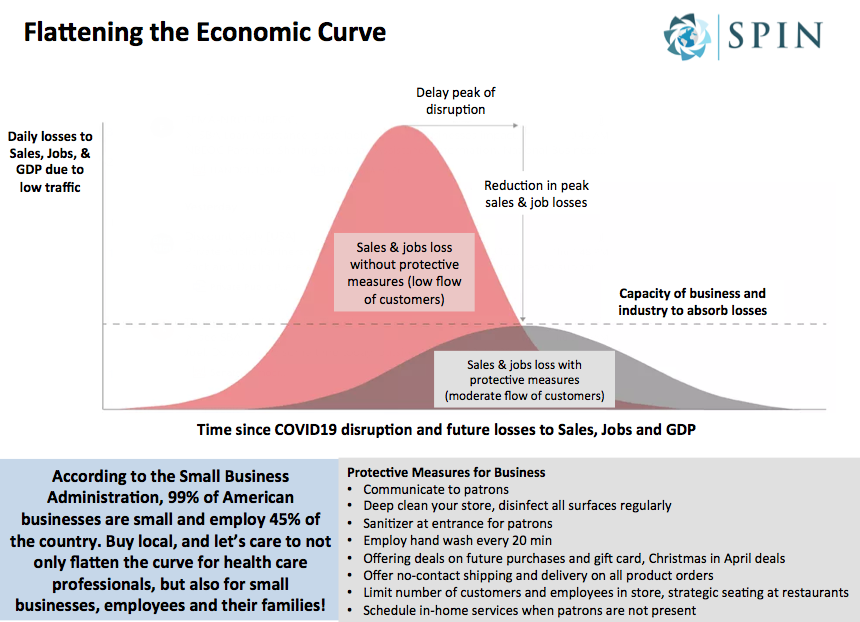
A few weeks ago much of humanity, including many churches and people of faith around the world, rallied behind the idea that “flattening the curve = love your neighbor” on the premise that Christians can help to save lives and reduce stress on the healthcare industry by sanitizing and isolating to slow the spread of COVID19. The global directives from health care experts and government officials have led to widespread declarations of emergency, lockdowns, closures, cancellations and stoppage of work in cities, states and nations alike. While we have yet to fully understand the consequences of these decisions, it is appropriate to do everything that we can to protect the health and save the lives of the most vulnerable, and follow the laws of the land and guidance provided by the authorities. I am not a health official and much has been written about this topic, so I will turn to point #2. 
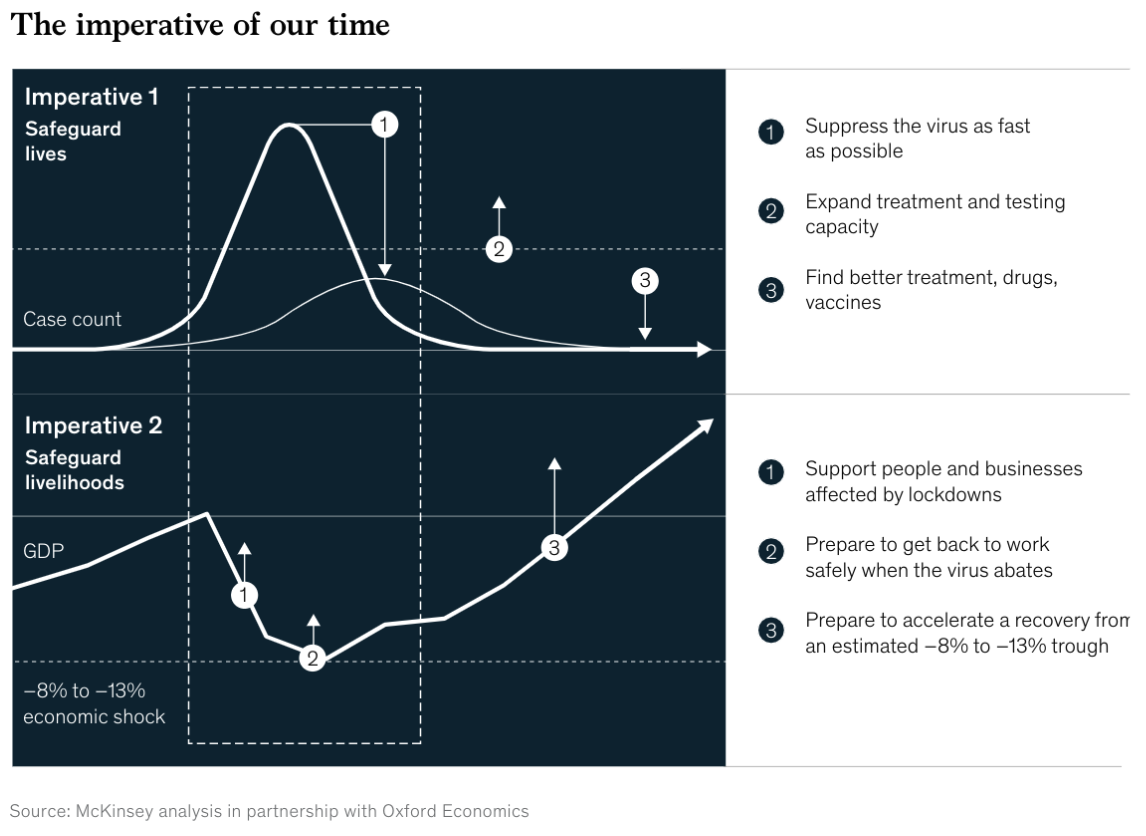
2. Safeguarding livelihoods
Inasmuch as people of faith were motivated out of sincere devotion to God to love their neighbors and protect their health, we should broaden the aperture to consider how we can help to save and sustain livelihoods and reduce long-term suffering by “flattening the economic curve” for businesses, their employees and families in a safe and responsible way. In other words, for faith-driven communities,  “flattening the economic curve = love your neighbor”, and is not mutually exclusive with flattening the health curve. Some may not think we can or should do anything to address economic hardships, or that government will figure it out as they have recently passed a few bills including a $2.2 trillion stimulus, but there are in fact many practical ways we can help our local businesses and the families they provide for in ways that will not exacerbate the health catastrophe. 

In my recent post “A Plan to Black Start the Economy”, I made the case that at a macro-level we need to have a national plan to get businesses and local economies back open as soon as possible in a safe and responsible way, and in the mean-time, we need to find creative and aggressive ways to patronize these businesses and keep cash flowing. Lives and livelihoods depend upon it, and mitigation is the key to success. Legislative and policy maneuvers can serve as temporary bandages, but only real-world commerce and trade will enable economies to heal. This particularly applies to the most vulnerable, including but not limited to small businesses, the 70% of those that cannot telecommute, and especially to 5 of 6 Hispanics and 4 of 5 African-Americans that are unable to telecommute according to the Bureau for Labor Statistics. Let us be mindful and care for one another, especially those in need during this time. 

Morgan Stanley predicts American Gross Domestic Product will drop 30% from April-June 2020. McKinsey just published nine economic scenarios including the definition of the “imperative of our time” which is to both safeguard lives and safeguard livelihoods.

At this time, nations have no plans to restart their economies, as the focus is on health and life safety. We need to begin planning for and contributing to economic recovery now at the policy level and the grassroots level, because without collective action, there will be unretractable losses that are avoidable and that will cause great suffering to many families. Therefore, I implore you to help mobilize your networks to flatten the economic curve for small businesses in your community in creative, safe and responsible ways. 
It is both a faith-driven and pragmatic response to our present reality.

FOR MORE INFORMATION ON COVID-19, PLEASE SEE OUR PAGE HIGHLIGHTING SOME OF THE BEST RESOURCES OUT THERE FOR FAITH DRIVEN INVESTORS & ENTREPRENEURS IN THIS SEASON.
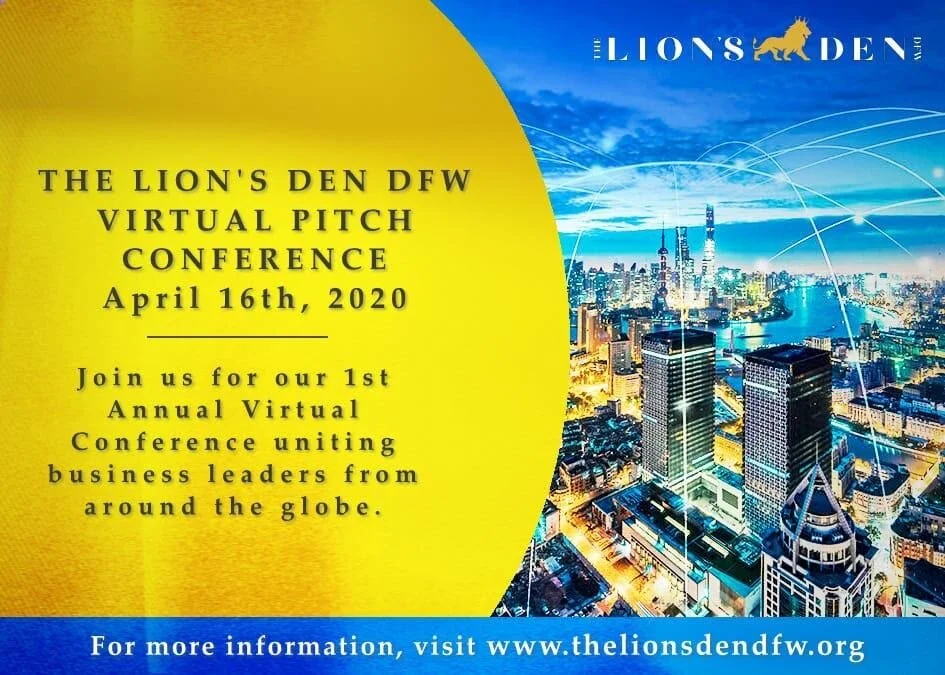
The Lion’s Den DFW Virtual Pitch Conference

by Vip VIpperman

At the heart of an entrepreneur is the curiosity and desire to find a solution where others see a problem.  We at The Lion’s Den DFW are entrepreneurs just like many of you.

Our purpose for the last 5 years has been to provide a platform so that real businesses can meet real investors to make real impact.  By all measures, we have achieved that goal through God’s grace, and we have many of you in our network to thank for that result.

Through God’s grace over the last 5 years, we have been building relationships with entrepreneurs, investors and accelerators globally.  

And in the next few years, we hope to grow our reach even more internationally as we have more investors and entrepreneurs from all over the world who are interested in being involved. Now with the coronavirus challenges for live engagement, we are accelerating that timeline and bringing to life a virtual Lion’s Den event so that the message of marketplace returns + kingdom impact can reach the ends of the earth. 

So, we are pushing the 5th annual live event to the Spring of 2021 and adding our first global virtual pitch event on April 16th.  

During this time of confusion and unrest, we hope to bring a message of hope to entrepreneurs and investors across the world and, through a virtual event, to reach more people in more countries.  

And we hope to get these incredible 10 companies, who were chosen earlier this year, funding so they can make their mark on the world
So, on the morning of April 16th, The Lion’s Den will continue to do what it has always done by uniting business leaders from all over the globe for a one day 3 hour virtual event. There will be live pitches from entrepreneurs who are actively looking for capital, a keynote message from a nationally known entrepreneur and investor who has weathered many storms, and TED style sessions covering inspiring and educational content relevant to this unique time in history and done by recognized leaders in Private Equity, Venture Capital and Family Offices. 

Session topics will include, but not be limited to, biotech and healthcare markets today, how companies have responded to and thrived in times of recession the last 100 years, how the cream will rise to the top in the venture capital markets, how to keep a strong Kingdom culture in your business during times of crisis, and what is on the heart of Christian family offices during this unique time of unrest. 

Join us on April 16th from 9am-12pm (CT) as we seek to inspire, educate and mobilize investors and entrepreneurs around the world.  Click to learn more and register today.

https://www.thelionsdendfw.org/ld-dfw-virtual-conference.html

So get out there and invite more people to be involved instead of worrying about how much TP you need in the cupboard.

C. S. Lewis on the Coronavirus

 Image taken from  Christianity Today

Image taken from Christianity Today

This article was originally published here by Christianity Today.

by Matt Smethurst

It’s now clear that COVID-19 is a deadly serious global pandemic, and all necessary precautions should be taken. Still, C. S. Lewis’s words—written 72 years ago—ring with some relevance for us. Just replace “atomic bomb” with “coronavirus.”

In one way we think a great deal too much of the atomic bomb. “How are we to live in an atomic age?” I am tempted to reply: “Why, as you would have lived in the sixteenth century when the plague visited London almost every year, or as you would have lived in a Viking age when raiders from Scandinavia might land and cut your throat any night; or indeed, as you are already living in an age of cancer, an age of syphilis, an age of paralysis, an age of air raids, an age of railway accidents, an age of motor accidents.”

In other words, do not let us begin by exaggerating the novelty of our situation. Believe me, dear sir or madam, you and all whom you love were already sentenced to death before the atomic bomb was invented: and quite a high percentage of us were going to die in unpleasant ways. We had, indeed, one very great advantage over our ancestors—anesthetics; but we have that still. It is perfectly ridiculous to go about whimpering and drawing long faces because the scientists have added one more chance of painful and premature death to a world which already bristled with such chances and in which death itself was not a chance at all, but a certainty.

Check out the rest of this article here!

FOR MORE INFORMATION ON COVID-19, PLEASE SEE OUR PAGE HIGHLIGHTING SOME OF THE BEST RESOURCES OUT THERE FOR FAITH DRIVEN INVESTORS & ENTREPRENEURS IN THIS SEASON.

Inter-Generational Generosity by Wendy Rogers

Wendy Rogers was one of the presenters at our recent event for Faith Driven Investors, and she was gracious enough to share a copy of her talk with us. Below is a transcript of her presentation about utilizing investment advisory firms and building alignment inter-generationally.

by Wendy Rogers

In Ted Style Talks, the experts say in order to drive your point home, you must divide your talk into three parts to be inspiring. Make your talk:

– Emotional

– Novel

– Memorable

Well, I must say the emotional part was the thought of me, a true southern woman, trying to bring home an effective point in under 5 minutes. In all seriousness, the topic of wealth management can get pretty emotional when families are not intentional around the vision of the wealth and the positive or negative disruption it can stir through the generations.

This is important stuff and it is not for the faint at heart. There is an expression from a Hermes Family Descendent that says, You do not inherit a family business, You borrow it from your grandchildren. And when I mention family business I am not just thinking about operating companies.

The Novel aspects of what I would like to share today would be the visual picture of what my grandmother taught me years ago. I grew up learning how to care for pecan groves and many times when we lost a tree due to disease, we had to be strategic in where we would plant a new tree. Ecologists taught us that a young tree grows better when planted in an area adjacent to the older, stronger trees. The roots of the young tree may actually graft themselves to one another creating an intricate, interdependent foundation. Let me provoke you a little—when you think in wealth and specifically in transferring any kind of wealth, what do you think is a healthy balance of independence and interdependence within a family or a family enterprise? 

Now to the memorable part. This picture here: I am a third generation family business owner stewarding wealth from a business my sweet grandfather started, my very determined father significantly grew, and then as a family we made a decision to sell to a Fortune 100 company. Here is a fun fact: I am one of three girls and we each have three girls, so there are, or will be, 13 women running the show.

The day after selling our operating company we knew we were in the family office business and we knew we had a great deal to learn about the preservation aspects of wealth, but we then had to get real focused on the growth aspects of those assets.   

We learned a lot about ourselves and also about our future need for surrounding ourselves with great strategic investment advisory partners.  

The transition from family business to business family is more about a mindset change. We, as family members, had to switch our mindset over to owners or stewards. We needed to learn a new industry…strategic investment management. 

In order to create, sustain and adapt family culture and values over generations, the family must be aligned, make fast and effective business decisions, and implement them. This just doesn’t happen overnight. Even to families who all love Jesus! 

The process by which the family owners collectively organize themselves to develop resilience in dealing with both the internal family affairs and the external business challenges is what many would call GOVERNANCE.

We had to learn to balance the many voices, then to translate this input into effective operations, clear decision practices and adaptive responses to new challenges.

Here again, we come back to independence and interdependence concept. I wish I would have understood those two words better 15 years ago.  

But before we could do all this, we had to revisit/collectively declare what we knew to be true about our family. How we were raised, what values defined us and held us together and the passions that pricked our hearts in making sure we clearly defined both our philanthropic and our investment vision and mission together. What was the purpose of this liquidity event and what did it mean to each of us? We sat around and discussed this at length. 

 We knew that inside our operating company we had values and an operating philosophy, a mission and guiding principles to guide how we worked and now as we set up new ownership structures we were going to need the same thing.

Family Enterprise Governance is the structure by which elements of the generative family alliance become aligned and integrated into practice. They need to listen to and balance the voices and perspectives of each group of stakeholders: Matriarch/Patriarch owners, young family owners to be, married in spouses and outside advisors. We knew we needed to work to create this framework and practice it and model it because we are now in the process and transition of on boarding new owners and the next generation, which as I mentioned are all female. 

We had to work hard to build this intergenerational alignment in investing, spending, giving and in living. This was not done overnight and we can never rest that it is complete. We instituted governance structures, shareholder agreements, management companies, estate plans and a family council. These were the fierce conversations to formalize and now we are living out our continuity plans. Picking partners and guiding these partners was a huge part of the process. The search, onboarding, and alignment of these partners is the role of family leadership.

We took the time to thoughtfully create and design an outside board of directors just like we did inside our operating company. This board is the core instrument for the family to build and sustain its distinctive culture and exercise faith -based oversight. This board upholds the legacy and values and defines the relationships among owners and across generations and is also open to anticipating and initiating change to take advantage of new possibilities  and respond to the expansion of the family. Mindset development is huge here as family members need to be tutored in ownership mindset. 

If we believe God owns it all, how do we live that out in our decisions about investing? In our decisions about spending? Bob Goff has said that all the rules change when you are flying under the banner of Jesus Christ. It changes everything…or it changes nothing.  It can’t just change a couple of things.” 

Many of these years proved to be like the old college science class of Lecture and Lab. We spent time and resources in the lecture section of this life -long class and we had to get clear as to the formal education we needed…we needed to invest in ourselves, but also trust our internal “knower” around who to align ourselves with. How to lead and yet learn from these partners. This is the lab part. We are doing this each day, each quarter as we listen to their advice and yet also find other outside, non -family  board members, partners in new private equity ventures and bring in thought -leaders to work with our family.  

Are we efficiently and intelligently using the resources God has granted us to generate returns but also generate human flourishing? This a recurring question we keep asking ourselves…the scorecard so to speak.

If we see ourselves as stewards and our Lord as the owner then we better get about the business of stewarding that well and that should never mean compromising or resting on our laurels to not cultivate growth and returns. We also had to act like geese and honk from behind in those leading us to stir bravery in each other, to live in faith and to continue to ignite purpose in our own lives but also in the lives of those around us.