Aligning Your Wealth with Your Values

 Photo by  Kat Yukawa  on  Unsplash

Photo by Kat Yukawa on Unsplash

by Dr. K. Shelette Stewart

Corporate social responsibility (CSR) is generally defined as the integration of business operations and values in such a way that the interests of all of a company’s stakeholders (e.g., investors, customers, employees, and the community) are reflected in the company’s policies and practices. Most of us are familiar with two common initiatives within CSR plans: corporate philanthropy and cause-related marketing (CRM), or cause marketing. 

Corporate philanthropy refers to charitable initiatives that help a company increase visibility, attract loyal customers, and offer employees the opportunity to band together in support of major social and civic concerns. A number of companies oversee corporate philanthropy vis-a-vis their corporate foundation, public relations, or external affairs department. 

Many studies from Harvard Business School, and other prominent researchers, have found that leading companies have discovered that there is a strong business case for corporate philanthropy and community involvement. Empirical research studies have shown that people looking to work for a particular company have actually admitted that they factor in whether or not they view the company as a good corporate citizen. Studies have also shown that employees feel good in knowing that their company is engaged in giving back to the community. 

In recent years, cause marketing has become more prevalent in business. Cause marketing is defined as a commercial activity by which businesses and charities form partnerships with each other to market an image, product, or service for mutual benefit. It’s an initiative for addressing social causes and issues by providing resources and funding while simultaneously addressing business objectives.

How do we, as God’s ambassadors in the marketplace, take corporate philanthropy to a Higher level?  How do we align our wealth with our values to the extent that we advance from building up our company to building up the kingdom of God?  How do we pursue kingdom philanthropy? 

Given rampant cases of terrorism, starvation, domestic violence, and health-related pandemics, there is certainly no scarcity of viable civic and social causes for any company interested in philanthropy. While many of these epidemics are at national and global levels, when it comes to addressing victims at the local grassroots community level, it’s usually up to the neighborhood churches and other civic organizations to support individual victims and their families.  Following are a few practical insights and pragmatic ways for aligning wealth and values

  • When we as Christian business leaders began to include formal support of God’s churches and Christian organizations within the context of our marketing plans and philanthropic outreach efforts, we will have begun the process of bringing corporate philanthropy and charitable giving to a Higher level. 

  • When you use your wealth and marketing influence to help advance worthy causes, the Lord will reward you (Matthew 19:17; Galatians 6:9).  Have the courage and fortitude to support churches and civic organizations in ways that are important and necessary, even if they are not always high profile and publicity generating. 

  • By pursuing kingdom philanthropy, your company will serve as a model corporate citizen for others in the community and a catalyst for drawing more attention to, and support for, important charitable initiatives. And for this, you and your organization will also be tremendously blessed by God. 

By aligning our wealth with our values and incorporating God’s kingdom principles, we become the magnificent trendsetters and market innovators God created us to be. Remember, God says we are the head and not the tail (Deuteronomy 28: 13). We should not be following the world; the world should be following us.

Alternative Recovery Scenarios: Henry Kaestner on the CEF Podcast

 Thanks to  Maël BALLAND  for the cover photo

Thanks to Maël BALLAND for the cover photo

This article was originally published here by The CEF Podcast.

Few people have been a consistent voice of wisdom than the Christian Economic Forum, and Chuck Bentley especially. If you’ve been following the website for a while, you’ve certainly seen multiple CEF whitepapers, which are a collection of innovative ideas from some of the world’s leading faith driven entrepreneurs and investors.

Recently, Chuck and his team at CEF had Henry Kaestner on their podcast to talk COVID-19, generosity in the midst of crisis, and alternative recovery scenarios.

Listen in to hear Henry share:

  • How his near-death experience last year has impacted his perspective on COVID-19

  • The 3-part strategy he recommends to entrepreneurs about running their businesses in this environment

  • Observations from Silicon Valley during the crisis

  • His response to 4 possible economic recovery scenarios

  • And stories of faith, hope, and love in the midst of hardship

FOR MORE INFORMATION ON COVID-19, PLEASE SEE OUR PAGE HIGHLIGHTING SOME OF THE BEST RESOURCES OUT THERE FOR FAITH DRIVEN INVESTORS & ENTREPRENEURS IN THIS SEASON.

An Inclusive & Creative Economy is Equitable

Article originally posted here by Access Ventures

by Bryce Butler

2020 will be a year to remember…or at least it should be. As many of us want to move past the moments of 2020, history and the circumstances of 2020, should stick with us and move us towards a better future in the most ideal of circumstances.

A global pandemic; economic justice, and Black Lives Matter protests; record swings in the stock market propped up by record-low interest rates; and, all amid the insanity of the election cycle still not fully realized until our new President is sworn in. Moreover, entire economic lockdowns and frighteningly high unemployment and business closures will have a lasting impact long after the pandemic is passed.

Related to the economy, we saw a recovery in the third quarter of 2020, expanding by 33.1%, although not enough to offset earlier losses from the initial closures, including the 5% decline in real GDP at an annual rate in the first quarter.

The March recession ended 128 months of expansion, the longest in U.S. history, and quarterly GDP had never experienced a drop greater than 10% since record-keeping began in 1947. And in April, the unemployment rate skyrocketed to 14.7% as companies furloughed workers. It remained in the double digits until August when it steadily declined. In the week ending December 12, though, claims rose sharply to 853,000, marking the largest increase in claims filed since mid-September.


For an economy to function at its best, it needs to be equitable, dynamic, and resilient.


With all of this in 2020, it’s hard to escape the simple fact that the economy is a significant factor in daily life. Millions of Americans have continued to struggle and are unable to fully participate in the various opportunities many of their fellow citizens have access to every day. And if we are being honest, many are fearful and have lost both trust in the system and hope for a better tomorrow for themselves and their families. For an economy to function at its best, it needs to be equitable, dynamic, and resilient. It is not just creating stability for some people but creating stability so that every person is free from worry about financial roadblocks or unforeseen issues. Therefore, for an economy to be a thriving economy, it must be an inclusive economy and when a system prioritizes people it will be more inclusive and creative.

We are facing a moral crisis in our economy with greater isolation and accelerating inequality. Poverty persists and economic mobility remains limited for many people. All, while there is increased sentiment that more and more people do not have a fair chance to succeed and that vulnerable groups, are excluded from the jobs, schools, and opportunities they need to move up – leaving them stuck in poverty for years or even for generations.


We are facing a moral crisis in our economy.


However, I doubt many of us want our communities to function in this way. We generally do not imagine communities deficient in opportunity. Instead, we desire to live in a society in which we care for one another. A society that fosters a sense of trust, belonging, and safety. A society where we have an individual and a collective sense that we can, as part of that community, influence our surroundings and our very future. Moreover, we do not simply imagine a community with just the basics present but a community that allows us to thriveIn this community, there is an investment in human knowledge and learning; where social trust, empathy, and solidarity are present; where beauty and creativity define a place and inspires us; where there is both natural and physical health; and where the economy is thriving through growth and innovation.

An equitable economy means there are more opportunities available to enable upward mobility for more people. All segments of society, especially the poor or socially disadvantaged groups, are able to take advantage of these opportunities. Inequality is declining, rather than increasing. And people have equal access to a more solid economic foundation.


An equitable economy means there are more opportunities available to enable upward mobility for more people.


Too many people have virtually no access to the economy. Of those who do have access, many face limitations on their ability to participate fully (they lack the economic autonomy to make decisions for themselves and freely move within the system). “This is more than economic inequality—it’s economic exclusion.” It is time we focus on expanding opportunities and limiting exploitation so that everyone wins, together.

That is why in our work at Access Ventures, whether it’s our direct initiatives, investments, or broader managed assets, we pursue people, companies, and funds aligned with this mission to improve equality and increase economic prosperity (agency). We look closely at things like geographic, gender, and racial equity in our managers and investments (i.e. things that support ownership) as well as things like income mobility and the creation and increase of wealth for under-represented people. Next week, I’ll explore a bit more at what a more dynamic economy looks like as we seek to further define our collective efforts at Access Ventures.

A Roadmap to Prospering “Communities” Worldwide

by Judah Musick

Intro

We are living in an unprecedented era where businesses around the world are seeking strategies and solutions that will allow them to “Do Well” by “Doing Good.” Companies are starting to realize that there are Economics of Mutuality1 in their value chains. This means that all stakeholders need to flourish to maximize financial returns and that they need to be positively impacting their employees, members, customers, and local communities to do so.

Look no further than the Business Roundtable which is made up of CEOs of America’s largest companies who, in August of 2019, formally redefined the purpose of a corporation to promote “An Economy That Serves All Americans” not just corporate shareholders.2

You may call this corporate social responsibility, social entrepreneurship, or impact investing; however, what they are describing is simply an example of how God’s Kingdom operates and the outcome of seeking Shalom in your community.

Jeremiah 29:7 gives us a glimpse into this reality when it says, “Seek the peace and prosperity of the city in which I have carried you into exile. Pray to the Lord for it, because if it prospers, you too will prosper.” Could this be the key to prospering communities worldwide? The reality is that businesses all over the world, regardless of their tax status, industry, or geographic location, have a mutually beneficial relationship with their communities to seek flourishing.

The Why

As believers, we all share the same “Why.” Jesus loved God and, in response, He also loved His neighbors well by searching for ways to meet their real and immediate needs—and He commanded us to do the same. When asked by an expert in the law in Matthew 22:36-40, “Teacher, what is the greatest commandment in the Law?” Jesus replied: “Love the Lord your God with all your heart and with all your soul and all your mind. This is the first and greatest commandment. And the second is like it: Love your neighbor as yourself. All the Law and the Prophets hang on these two commandments.” In other words, this is the purpose of life for every follower of Christ. We don’t need to question that. It’s pretty clear.

Jesus took it even further with the Parable of the Good Samaritan in Luke 10:29-37 when He explained not only that your neighbor is anyone that the Lord puts into your path but also exactly what it looks like to meet their needs. He went to extreme lengths in the story to model what He meant by “Love your neighbor.” It wasn’t saying, “I’m going to pray for you,” or “I hope you get well,” but instead, it was the transactional meeting of physical needs. First, he bandaged the wounds and poured oil and vinegar to help with a medical need. Then, he put the man on his donkey and helped with a transportation need. He brought him to an Inn and met a housing-related need. He cared for him with food and clothing, and if that wasn’t enough, he took out his wallet, paid the Innkeeper for any expenses, and then offered to follow up in 30 days to see if there was anything else he could do. Wow! What an example of what it looks like to love a neighbor.

It is the great commandment of loving neighbor and the example from Jesus of meeting the physical needs of people in a community that unlock the key for communities to prosper worldwide. What if businesses, nonprofits, government agencies, and churches all were motivated by a shared agenda to meet needs in their communities, just as the Good Samaritan did in the parable? This is possible but will require a clear understanding of the problem, the opportunity for enterprises to solve it, and the actionable tools that can help facilitate it.

Hidden Needs

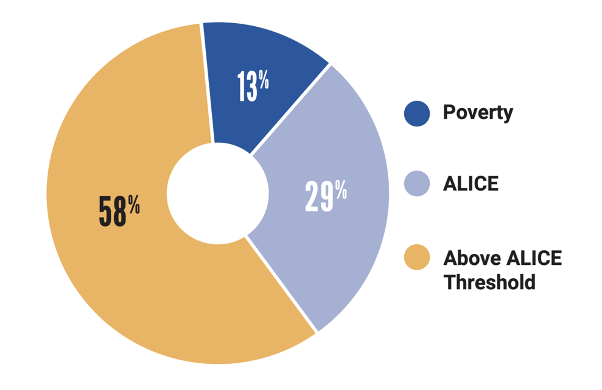
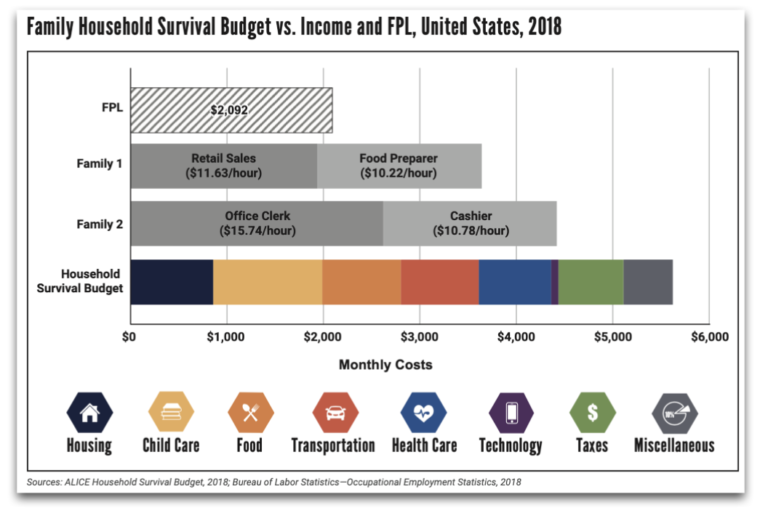
You can’t solve a problem that you don’t know exists. That is exactly the problem today with employers who are trying to impact their communities through social responsibility programs. They are only responding to causes or needs that they can see or hear about which are often related to helping families at or below the Federal Poverty Line (FPL). When most of us hear the word poverty, we are thinking of inner-city communities, and things like homeless shelters, rescue missions, and food banks come to mind. But in reality, the majority of households struggling financially with unmet needs are hiding in plain sight in the suburbs, and nobody knows about it. These families may not be labeled as living in “poverty” as the government would define the term, but they are nonetheless struggling financially just to survive. The term that best describes this demographic of families is based on research from the United Way and is called ALICE—an acronym that stands for “Asset Limited, Income Constrained, Employed.”3 These are hard-working American families who typically have dual incomes, are not frivolous with their money, and are living on a budget. However, while they are above the federal poverty line, they are falling behind financially each month. An ALICE household is likely living with a negative cash flow and falling further into debt every month, having less than $400 in emergency savings. They pay a quarter of their after-tax income to consumer debt payments, and half of them have nothing saved for retirement. As of the latest Census data in 2018, there were 121 million households in the U.S., and 16 million (13%) earned below the Federal Poverty Line (FPL), while another 35 million (29%)—more than twice as many—were ALICE Households. These are your neighbors, friends, family members, co-workers, and people you sit next to in church.

If you look around, you will find thousands of organizations picking one of these components of the household budget and working on solving for that specific “cause,” such as affordable housing, healthcare reform, or food insecurity. Unfortunately, these are often symptoms of a household budget that is broken. What households need the most is access to liquidity so that they can avoid fees, penalties, and high-interest loans and so they can bridge their income between paychecks. They then need to build up an emergency savings fund so that they can handle financial emergencies without tapping additional credit, and then, they need to work to aggressively eliminate all high-interest consumer debt to free up additional cash flow so that they can begin to save for the future. While this type of financial wellness education has been on the market for decades with organizations like Dave Ramsey’s Financial Peace University and Crown Ministries, we have not provided our community with easy, automated, and incentivized tools to help them practically overcome these financial challenges at scale.

The Gap

This is where employers come into play with the opportunity to maximize their community impact and to “Do Well” by “Doing Good.” You see, employers around the world face a significant crisis today. There is a massive gap between the benefits they offer and the real needs of their employees. The cost of this gap to the employer is tremendous—and it’s only getting worse.

While benefits are designed to help employees, the reality is that most employers are offering benefits that have been around for a very long time and are out of touch with the modern-day issues their employees are facing. Traditional benefit offerings include things like retirement plans, health insurance, paid time off, and sometimes some form of a corporate social responsibility program. While these benefits are important for the employer to be competitive, they do not meet the real and immediate needs of their employees. In general, employers have been very slow to adapt to the changing needs of today’s workforce.

Modern Benefits

For over 40 years, employers have been providing financial benefits that help people save for retirement. The vast majority of companies today have some form of retirement savings plans such as a 401k or 403b. However, we have already discussed the fact that 30% of employees are likely ALICE households and just struggling to get by. On the hierarchy of needs, they are dealing with survival and security, so the retirement savings plan has absolutely no value to them.

What if instead of helping employees only save for retirement, employers helped their employees save for emergencies? What if they help employees bridge their cash flow so that they could avoid late fees, overdraft fees, and high-interest payday loans? And what if employers help their employees get out of debt completely, all as a benefit to their employment with that company? Instead of just donating money to specific “causes” that will never go away or solve the root problem of the household budget, what if employers provided real solutions for employees to experience true financial freedom by breaking the bondage of debt, freeing up their household budget to be able to afford housing, transportation, and food once and for all. Now that is a solution to poverty that is aligned with God’s way of managing money.

Impact Loan

The solution that makes this possible is called an Impact Loan. It’s a 0% interest charitable loan with a flexible payback that builds emergency savings. The purpose is to help households bridge their cash flow and cover emergency expenses without accruing additional fees or high-interest debt. The loan is tech-enabled and can be applied for and distributed to the household instantaneously to meet needs. Repayment is set up automatically from the borrower’s bank account, and 10% of each payment will go to incentivize the building of an emergency savings account. The participant is encouraged to take as many loans as they need to cover cash flow and expenses as long as they can make the monthly payment and keep building savings. There is never a missed or late payment, and if the loan happens to default, it turns into a charitable donation.

The Impact Loan has all of the components to create sustainable behavior change in participants, similar to how retirement plans were designed to get families to save for the long term. The three key components are easy enrollment, automated payments, and a financial incentive or match to encourage savings. The only difference is that we are applying these behavior nudges to the household’s cash flow, emergency savings, and debt elimination, not just retirement savings.

Maximum Impact

When it comes to maximizing community impact, there is nothing more effective than lending at zero interest to your neighbors in need. This is exactly God’s model of helping the poor and is mentioned many times in the Old Testament.

“If you lend money to one of my people among you who is needy, do not treat it like a business deal. Charge no interest.” Exodus 22:25

“You will not lend them money at interest or sell them food at a profit.”  Leviticus 25:37

Do not charge a fellow Israelite interest, whether on money or food or anything else that may earn interest.”  Deuteronomy 23:19

One of the best cases for impact lending is in the book Toxic Charity: How the Church Hurts Those They Help and How to Reverse It by Robert Lupton who elegantly describes how we try to do good but often end up hurting the very people we are trying to help. He outlines what he calls the “Oath for Compassionate Service” which serves as a guide for how to help those in need. It reads:

  1. I will never do for others what they have (or could have) the capacity to do for themselves.

  2. I will limit one-way giving to emergencies.

    • Give once, and you elicit appreciation.

    • Give twice, and you create anticipation.

    • Give three times, and you create expectation.

    • Give four times, and it becomes an entitlement.

    • Give five times, and you establish dependency.

  1. I will seek ways to empower through employment, lending, and investing, using grants sparingly to reinforce achievements.

  2. I will put the interests of the poor above my own (or organization) self-interest, even when it means setting aside my own agenda.

  3. I will listen closely to those I seek to help, especially to what is not being said—unspoken feelings may contain essential clues to effective service.

  4. Above all, to the best of my ability, I will do no harm.

With impact lending, we can focus on a community’s strengths more than its needs. The model respects the gifts and talents of the poor and seeks to make an impact in the community with them rather than for them, thus protecting people’s dignity.

In addition to respecting the individual’s dignity and empowering them to “get well,” lending also maximizes charitable giving by using the repayment of the loan to not only sustain impact but to grow it.

Summary

The key to prospering communities is simply: employers around the world regardless of industry, geographic location, or tax status meeting the real and immediate needs of their employees, members, and community by giving them a hand up and not a handout. By lending to those in need without charging interest and using the repayment of the loan to build emergency savings to break the cycle of poverty, we can solve the issue at a root level instead of just addressing the symptoms. Employers have been doing similar things to drive savings behavior for decades, and yet for some reason, it has been limited in scope to just retirement savings. We need actionable tools that help our communities systematically break the bondage of their finances so that they can experience the life God has intended for them to live. In doing so, we will be unlocking the world’s wealth to meet the needs of people in the community just as we are instructed in the Great Commandment. It’s the act of loving a neighbor by meeting needs that allows God to begin to work in the lives of people who are lost but seeking. Our opportunity is to equip employers worldwide to join into a collective impact strategy that is based on God’s economy not our own—one that honors Him, unlocks resources for the Kingdom, and meets the needs of our neighbors.


 ——

https://eom.org/

https://opportunity.businessroundtable.org/ourcommitment/

https://www.unitedforalice.org/national-overview

——

Article originally hosted and shared with permission by The Christian Economic Forum, a global network of leaders who join together to collaborate and introduce strategic ideas for the spread of God’s economic principles and the goodness of Jesus Christ. This article was from a collection of White Papers compiled for attendees of the CEF’s Global Event.

A Solid Partnership: Cornerstone + Apartment Life

 Photo by  deborah cortelazzi  on  Unsplash

Photo by deborah cortelazzi on Unsplash

Cornerstone are a purpose-driven business that seeks opportunities to transform its city by developing property and building community. It does this alongside its investors by giving them great returns and an opportunity to partner in its mission. What Cornerstone is doing is pioneering, it has not been done before in our country and we need support to claim this ground. For more information see www.cornerstoneni.com

by Andrew Wallace

Cornerstone believe that ‘Life is better when you’re connected’ and have prioritised giving the residents in its buildings an opportunity to be part of a real community.

When we began looking into what this would look like we kept coming across an incredible organisation that was already doing something similar in North America. We made contact with Apartment Life and were blown away when their Chief Executive, Pete Kelly wanted to meet with us.

Basically the concept involves having a community coordinator that will act as a welcoming presence, coordinate community activities and provide pastoral care for the residents within the development.

Over the past 8 months we have been in regular contact with Pete Kelly who has also introduced us to members of his wider team. Lauren Jackson is leading on this relationship and she has jumped in at the deep end by completing the Apartment Life’s training plan to fully understand what it entails. Their experience and attention to detail are second to none and having delivered this programme in 1.3 million housing units to 3 million residents right across North America they know what they are talking about.

The relationship has now been formalised out of which we have created CommunityLife, our community programme. This programme is recognised as Apartment Life’s first move into Europe, with Belfast being the first city and we are excited to see how it progresses.

Cornerstone is proud to partner with Apartment Life and seeks opportunities to shine a light on what they are doing on this side of the Atlantic.

To read more about the partnership have a look here and to find out more about Apartment Life have a look on their website;


A Solution for the Lack of Collective Christian Capital (CCC)

 Photo by  Kelly Sikkema  on  Unsplash

Photo by Kelly Sikkema on Unsplash

This is one of the 2020 CEF Whitepapers. For more information on the Christian Economic Forum, please visit their website here.

by Johan du Preez

Note: Some of the introductory comments in this paper were taken from the CEF paper I wrote in 2016. 

Capital always has an agenda. Whether by design or default, explicit or subtle, positive or negative, the application of capital facilitates and drives a bigger agenda.

Furthermore, an agenda driven by an individual is limited in scope, effectiveness, and sustainability when compared to a collective one. The more resourceful and influential the individual, the bigger the agenda that he or she can drive, but it remains less impactful than a collective effort.

At the Tree of Life Foundation, we are advancing a God-inspired (and “God-owned”) solution to the lack of Collective Christian Capital in South Africa. Before I dive into that, allow me to first recap on how financial markets leverage collective capital. 

The Collective Nature of Financial Markets

Financial markets allow for the effective combination of individual capital pools to achieve what the individuals cannot achieve on their own. Examples include:

Life insurance: By collecting monthly insurance premiums from thousands of clients (policy holders), it is possible to make large lump sum payments to the family of deceased clients. From that perspective it can be argued that insurance is one of the godliest business models around – a large group of people contribute what they can and want as long as they are alive, and the benefit of these contributions are paid to those who need it most after their death (the family and dependents of deceased clients). It is an “automated Acts model” (compare Acts 4:35 where the apostles distributed contributed money to those in need).

Banking: By creating a facility where those with excess cash resources at any given time can store it at a central location, the bank could also create the ability to advance some of these as loans to people who have a lack of cash resources at any given time. Since those depositing the money receive interest, and those borrowing the money pay interest, both the person making the deposit and the one receiving the loan make a contribution and receive a benefit.

Asset managers: By creating products that allow individual entities to pool their capital into a central pool for defined investments purposes, asset managers have the ability to make sizable investments that would otherwise not be possible. Examples includes infrastructure funds that provide capital for roads, airports, and other infrastructure developments. 

The Solution We Are Advancing

Imagine a financial institution offering cutting edge investment, banking and insurance services whilst being explicit about its Christian worldview (the Chick-fil-A or the Hobby Lobby of financial services!). Imagine the shareholding of this institution being held by a Christian charity, so that any profits are available to fund the Kingdom. Imagine the size of this institution ultimately being such that it will have a comparable influence on the economy to the leading investment banks on Wall Street – enjoying a business relationship with the biggest public and private companies, being consulted by government on policy issues, influencing funding mechanisms and the way business is conducted. This is the vision we see in the distance, and this is the calling we have embraced.

If one wanted to do an experiment to see if the above can work, you could hardly find a better country to do so than South Africa.

  • 84.2% of the population is estimated to be Christian. (1)

  • Efficiency of financial markets, quality of banking system, and integrity of the financial services regulatory environment are reflective of a first world economy.

  • Entrepreneurial activity and regulatory arbitrage are reflective of a third world type of economy.

  • Small enough to do a meaningful experiment – only 55m people, but the second largest economy in Africa with significant influence and a key leadership role in the region. 

  • Big enough problems to make a meaningful difference – unemployment rate 29.1% (2), rising debt as percentage of GDP (projected to be 65.6% by Feb 2021) (3), several credit rating downgrades since 2012. 

  • Turnaround potential in economy subsequent to the ousting of a corrupt president in 2018 (Jacob Zuma who took office in 2009). He was replaced by a pragmatic and level-headed President (Cyril Ramaphosa – an accomplished businessman). 

Building a financial institution is no small task – especially if 100% of the shareholding thereof is to be set aside for God (in our case held by the Tree of Life Foundation – a Christian charity that provides funding to various charities in South Africa). To begin with, this ownership structure precludes us from raising private capital in exchange for shareholding in the financial institution. 

When God provides a larger-than-life vision, however, it is not for us to question it or to demand to see it all unfold in our lifetime. Similar to Abraham, to whom God promised that he would be the father of many nations (Genesis 17), our response should be to embrace it and live accordingly. 

Foundational Steps

In 2007 we formed the Tree of Life Foundation (TOL) as a Christian charity – in South Africa this is known as a Public Benefit Organization (PBO). All we had to begin with was equity in two private companies that two businessmen made available. 

For the first nine years of TOL’s existence, the team focused on investing the returns generated from these businesses wisely and was blessed to experience miraculous growth. During this period, no donations were solicited or received and TOL did not incur any debt.

As TOL’s balance sheet continued to grow through various investments, the trustees adopted a ‘progressive distribution policy’ in 2014, which in essence calls for a percentage of TOL’s Net Asset Value to be distributed to charities every year. 

Going Collective

Towards 2015 we felt the time was approaching for TOL to offer its expertise to others also wishing to participate in the sphere of donor capital, and we launched a project to see how we could move towards collective capital by using a Donor-Advised Fund (DAF) platform. This culminated in the launch of the Tree of Life Donor-Advised Fund (TOL DAF) in mid-2016.

This was a big step forward in becoming a financial institution. For TOL to become a major player in the deployment of capital, it needed to have clients entrusting us with capital. Although the vision is to offer these clients all types of financial services products, the pragmatic thing was to offer them various investment portfolios for the DAF money as a first step. In this sense it would be different compared to the conventional DAF platform in the US for instance – i.e. it also provides DAF clients with products through which they can collectively advance Christian investing. It was with excitement that we created and seeded the first three investment portfolios in 2016 (cash, listed equities, private equity), and added a fourth (Impact portfolio) in 2019. More detail on these portfolios is available at www.tol.org.za.  

Today we have many stories of businesses that we could serve due to the availability of Christian capital, thereby supporting the growth of Christian marketshare. Take Inovo Telecom, for instance: a very successful company providing call centre technology and optimization (www.inovo.co.za), founded in 2006. When one of the two founders wanted to retire, he had a dilemma – he wanted to sell his equity (>40% of the business) at a market related price to reap the just reward for his contribution, but he did not want to sell to a shareholder that would not appreciate and help foster the strong Christian culture he and his co-founder subscribe to. Due to the size of the business, the typical buyer would be institutional (rather than private), and as such, agnostic. Via the TOL DAF platform’s private equity portfolio, we acquired his shares and now find great joy in not only helping to shape the commercial strategy and execution, but also as a shareholder supporting biblical initiatives they undertake. (They recently became the first client of the newly launched Workplace Chaplains Africa, they developed a cutting edge mobile app for use by a charity at no charge, etc.). (see https://youtu.be/Mg3w60Sp0Hk)

Similarly, as an example of our Impact Investment portfolio, we recently backed two young entrepreneurs (both are Chartered Accountants) that created a marketplace for entry level jobs. In a country with an unemployment rate of 29% and many entry level job seekers having to overcome significant logistic issues to access the jobs that are available, Jobjack connects employers and job seekers via a platform that can be accessed by a mobile phone. The founders are devout Christians that believe they have a calling in this space. Based on financial metrics, this investment would not meet the stringent criteria of our private equity portfolio, but given the potential impact and a business model that will lead to financial sustainability, we were happy to invest from the Impact portfolio. If they had to approach an institutional impact investment fund, they would typically have to exclude the Christian aspect of their planned impact. (see https://youtu.be/SL1ZQ5ywCik)

Swiss Army Knife

The design philosophy of the TOL DAF is to address as many donor and societal needs as possible within one solution / structure. We want to be the Swiss Army knife of charitable giving, allowing the donor to use the features that are most important to him/her at the time, bearing in mind that these can change over time and will differ from donor to donor.

Features include normal DAF functionality with associated vetting of recipient charities, investment options that allow sustainable giving, tax-efficiency, low-cost cross-border granting, contributing to CCC while the money is on the platform, and maximizing impact via impact investment opportunities. 

We realize that contributing to CCC may not be the main aim of most donors and therefore aim to meet most donor needs. We allow donors to allocate as they see fit, but do try to encourage them to allocate a portion of their giving to CCC.

Limitations and Challenges

I have listed the factors that make South Africa an ideal place to launch a Collective Christian Capital venture such as the TOL DAF platform above. There are obviously challenges as well, notably limited tax incentives for charitable giving and scarcity of Christian donor capital compared to a country like the US. 

Due to South African tax legislation, almost all of the money from South African donors that flows into DAFs does not qualify the donor for a tax benefit. It goes without saying that the market of donors who are prepared to donate without a corresponding tax deduction is small. On the other hand, those South African donors who open DAFs with us are “hard core” and great clients to have!

The scarcity of donor capital needs a bit further context. The overwhelming need in South Africa has given rise to an increase in effective and strategic charities, and many donors support these. What we are talking about in this paper – collective capital – requires significant donor capital in excess of donations to fund the immediate charitable needs – i.e. capital that can be invested in a way that promotes the Kingdom whilst creating sustainable long-term funding.

International Giving and Trustbridge

We have been fortunate to participate in discussions on the topic of international giving conducted by a core group of thought leaders since 2012. It became obvious that the complexity of the tax systems in different countries and the restrictions on the flow of charitable money across borders in certain areas of the world were major impediments to international giving.

These discussions ultimately culminated in the establishment of Trustbridge Global Foundation (https://www.trustbridgeglobal.com/our-network), which today is a well-entrenched and successful movement that aspires to “make global giving easy”.

The benefit for the TOL DAF platform is that international (non-South African) donors using Trustbridge can open a DAF on the TOL platform in South Africa and still get their tax benefits locally. For example, a US tax resident can open a DAF with TOL and get a US tax deduction by working through the Trustbridge affiliate in the US (namely the National Christian Foundation).

Different countries have different strengths / competitive advantages. The beauty of the example above is that US donors with capital available for Christian investments (of whom there are arguably more in the US and who enjoy a purchasing power advantage due to the strong position of the US dollar internationally) can access Christian investment opportunities in a country with an abundance of Christian entrepreneurs but a lack of Christian capital, whilst benefiting from the generous tax dispensation in the US.

The Future

More and more Christians are not only aware of the importance of capital, but also want their capital to help drive the bigger agenda – even more than just a desire; there is an increased sense of urgency to do so. As such the limiting factor has shifted from apathy / ignorance / limited intentionality on the topic to lack of product. 

Those stewards of capital who are active investors themselves are less dependent on product. They can leverage the multiple networks and platforms that are available to get involved in Christian-based investing, and typically experience great joy from doing so. But those who are allocators of capital, rather than active managers, are more dependent on product.   

In both cases however, the scale benefit of collective capital is often not achieved. This is not to say that the individual Christian-based investments that family offices or informal investment networks do are wasted effort – definitely not – but simply that it cannot represent the total Christian capital strategy. We absolutely also need Collective Christian Capital initiatives with the economic engine and influence comparable to Wall Street investment banks in the US.

Ultimately there are only two competitors when it comes to the battle for market share: Light and Darkness. All market players that desire to represent the Kingdom in business are actively working to grow the market share of the Light, and therefore have the same Shareholder. They should actively be looking at ways to cooperate by pooling their resources and effort for maximum impact, and collective capital vehicles represent an integral part of such a strategy.

If you want to join the Collective Christian Capital party in South Africa, please let us know!

(1) Statistics South Africa: South African religious demography: The 2013 General Household Survey

(2) Statistics South Africa, Q3 2019

(3) Budget speech, Minister of Finance: Tito Mboweni, February 2020