How our Faith Affects the Way We Invest by Tim Macready

As Chief Investment Officer of a Christian pension fund, it occurs to me frequently that 25,000 Australians have entrusted their retirement savings to us. This is a substantial responsibility.

Our beneficiaries trust that we will work to the utmost of our abilities to ensure they are well-provided for so they can live a fruitful and purposeful retirement. In addition, they trust that how we invest their retirement savings between now and their retirement (and even, in many cases, during their retirement) will reflect our shared Christian faith and values. Both of these are complex issues.

Concerning the issue of how to invest a portfolio to generate strong risk-adjusted returns, there are myriad resources from which to draw. We have internal and external experts on asset allocation, manager selection, currency hedging, investment risk, and many other relevant matters. We can construct portfolios to give beneficiaries choice (Australia’s system has members bearing investment risk) to account for varying levels of risk and return appetite. These are all questions that have been and continue to be explored in detail by a wide range of people within the financial services industry.

The issue of applying Christian values to an investment portfolio, however, is not one that has been widely explored. What does it look like to invest, as a professional and fiduciary investor, in accordance with our faith?

Accordingly, we first seek to draw from biblical principles about the way we invest on behalf of those who have entrusted their money to us. This piece outlines some of our thoughts and conclusions.

THE CONTEXT OF INVESTING – CHRISTIAN STEWARDSHIP

We believe two things are foundational in understanding the context of investing.

First, we strive to apply a Christian worldview. If we believe that God created the world, that humanity sinned and thus corrupted the entire world, and that God will one day completely redeem His creation, then this must influence the way we look at the world in every sense. Since investing is part of the world, what does it look like to apply this Christian worldview to investments?

Second, we also need an understanding of Christian stewardship. As a pension fund, we are a steward of our beneficiaries’ retirement savings. But our beneficiaries are themselves stewards of assets God has entrusted to them, with the expectation that they will use these assets on His behalf. What does it mean to act on behalf of another? What does it mean to act, in some senses, on behalf of God as His ambassadors, representatives, and stewards?

THE GOAL OF INVESTING – CREATION CARE, HUMAN FLOURISHING, AND REDEMPTIVE INVESTING

To answer those questions, we thought about the role investing plays in the economy. In a transactional sense, investing is simply setting aside assets today so we can have more in the future. I believe there is a delayed gratification aspect of saving that is good for our souls. We learn to be patient and to look to the long term rather than being simply focussed on our immediate desires.

But in a much broader sense, investing is an opportunity to work out the mandate given to humanity in Genesis 1. Investing takes assets that would otherwise be unproductive (savings) and allocates them to parts of society that enable us to be productive.

We can provide capital to factories that produce goods, to enterprises that deliver valuable services like health and education, and to infrastructure such as roads and networks that enable the efficient transfer of goods and services. These enterprises form the backbone of the economy, creating jobs and playing an important role in exercising creation rule.

In this context, the mandate given to humanity to care for and cultivate creation becomes important, as we shall explore. As stewards, it’s important therefore to understand the way this investment activity interacts with God’s purposes and desires for His creation.

We can look at this in three ways. We seek to develop an understanding of our responsibilities in the area of Creation Care. “Fill the earth and subdue it” (Gen. 1:28) is an instruction to create and cultivate, but not a mandate to destroy. Creation is not just a source of beauty and a reflection of God’s character. It also represents God’s provision of the natural means to meet our present and future needs and desires, along with the needs and desires of generations to come. We use what God has provided to grow food, to make clothing and shelter, to develop medicine, and to create all sorts of goods for our enjoyment. The appropriate stewarding of creation will ensure our ongoing ability to meet these and other needs.

But there is a more important component of stewardship that reflects the importance of Human Flourishing. God’s desire is for His creation to enjoy peace—shalom in Hebrew and eirene in Greek—which reflects wellbeing, health, prosperity, strong relationships, and a deep sense of contentment. This is a holistic sense of wellbeing that encompasses not only personal security and economic sufficiency, but also values human relationships and spiritual reconciliation. Investing is not just an opportunity to grow our personal economic prosperity, but to contribute towards genuine human flourishing. As investors, we must recognize that investing can contribute to this in at least two ways.

At a personal level, investing represents an opportunity to provide for our future needs by setting aside money today and growing it for the future.

At a societal level, the assets we invest can be used for productive purposes—to support the creation of goods, services, and jobs that support human flourishing.

Finally, there is an opportunity to invest in ways that contribute to the deeper, spiritual needs of humanity. This idea of Redemptive Investing sees investing (and indeed business as well) as more than just as an opportunity to acquire more assets and to work out our Christian faith through creation care and human flourishing. In addition, it becomes an opportunity to reconcile relationships with each other and with God. This might happen through investments that specifically target positive social and environmental outcomes or through investment in faith-lead businesses that live out their Christian values in the marketplace.

PRACTICALITIES

So what does this look like practically? In applying the theological to the practical we recognize the messiness of our world. No enterprise is perfect; we are always working in a world that needs to be redeemed and seeking to play a part in shaping the world through the investments we make.

And practicalities dictate application. Do we have enough assets to command influence or even to be able to invest in those things we think are important? Do we have the professional capacity to evaluate redemptive investments in ways that are consistent with our fiduciary responsibilities?

For us, this application works itself out in four key ways. Negative Screening is how we ensure we do not invest our beneficiaries’ assets in ways that are inconsistent with their faith. It means identifying and avoiding those companies that are damaging creation and disrespecting life in ways that are fundamentally inconsistent with creation care and human flourishing.

ESG Integration is looking at our investment portfolio not only in terms of financial factors, but also related to the environmental, social, and governance factors that play into an investment’s long-term ability to deliver sustainable and responsible investment returns. Factors such as a company’s long-term track record in employee safety or their ability to reduce waste show not only social responsibility but also financial prudence.

Active Engagement is our response to the responsibility we have to engage with those companies and enterprises in which we invest. We encourage them further in the direction of creation care and human flourishing, and challenge them to cease practices that are damaging these areas.

Impact Investing is the intentional allocation of assets to companies that are making the world a better place while still generating a financial return. This includes investments in health, education, microfinance, renewable energy, and social enterprise. For us, this includes a specific allocation to faith-led businesses, where Christian entrepreneurs are living out their faith in the marketplace as a witness to Christ.

CONCLUSION

Over a decade into this faith-lead investment approach, we have been blessed with a growing membership and asset base, along with investment performance that compares favorably with our peers in the market. It is entirely possible to apply a faith-based approach to investing and deliver the investment outcomes our beneficiaries expect. We are still very much on the journey of applying God’s Word to the way we, as Christian professionals, invest our beneficiaries’ assets. This includes learning to be better stewards of creation, looking for ways to promote human flourishing, and seeking to be redemptive in all we do.

How to Turn Your Business Into a Ministry for God

Article originally posted here by Ronald Blue Trust

by Ronald Blue Trust

The following was written by Evan Longstreth, a Sr. Private Wealth Advisor in the Atlanta office of Ronald Blue Trust.

Do you feel a calling to ministry? Have you ever wondered how you can serve in fulltime ministry in your current work environment?

Leveraging your business for fulltime ministry takes intentionality and thought. Often business owners think they should leave ministry to the church, but we all play a unique role in fulfilling the Great Commission by building and supporting the Body of Christ. Most people think that you’re either in the ministry or you’re not, but perhaps your workplace could also be your ministry.

Think about this fact: the average size of a church in America is less than 200 people. Is that smaller than you thought? This statistic measures the number of people who attend church three out of four weekends each month in the U.S.

Now think of the number of people your business touches during a month: employees, customers, vendors, partners, or suppliers. When you add up all the key stakeholders, your business influences a significant number of people on a monthly basis. You could even be impacting as many people as your local congregation. Your business gives you an opportunity to share God’s love and grace with others.

Over the past two decades of serving small business owners along their stewardship journey, I have watched many of them evolve from a mindset focused solely on being a market leader to a mindset focused on becoming a marketplace steward. This spiritual business transformation has been fascinating and a blessing to watch.

Photo by Nicolas Hoizey on Unsplash

How to Use Factor Investing to Harvest Excess Portfolio Returns

Article originally posted here by Inspire

by Shane Enete

Factor Madness

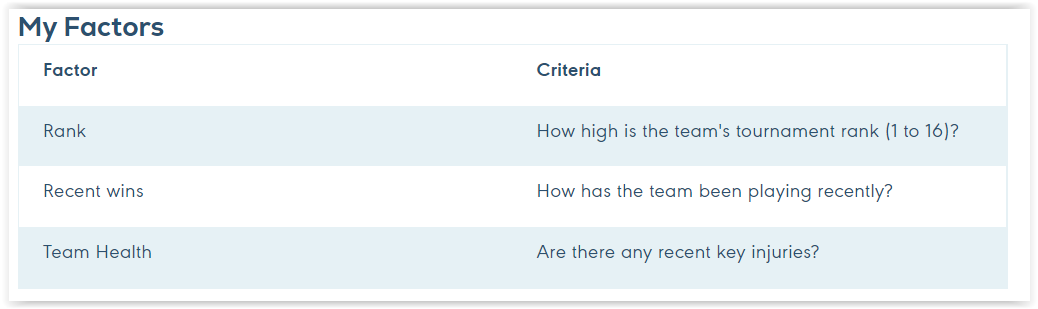
I recently lost my March Madness bracket to my wife for the second year in a row. When it comes to filling out my bracket, I use the following factors. 

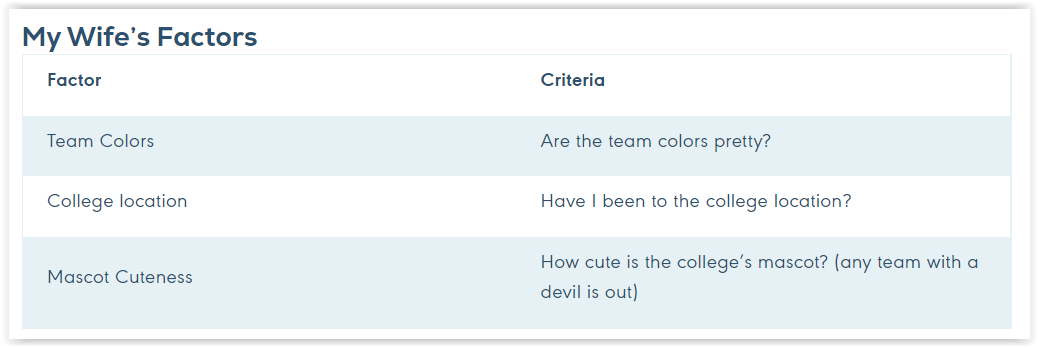
Given that I keep losing to my wife, my factors are not working well. For my wife, her key factors are less scientific.

Because my wife is from the west coast, her “location factor” created a bracket with a large West-coast bias, which worked out well for her this year since most of the final 16 teams were located west of the Mississippi.

Factor Genius

In the same way that there are a variety of different factors that a basketball fan can use to help them fill out a March Madness bracket, there are a variety of different factors that a portfolio manager can use when making stock portfolio decisions.

The foundation factor for a stock investor is the “Market” factor. Exposing your portfolio to this Market factor will allow your portfolio to earn a stock market return that reflects the overall risks of the stock market. As a general guideline, an investor who buys at least 40 companies (i.e., law of large numbers) will harvest the return associated with this Market factor.

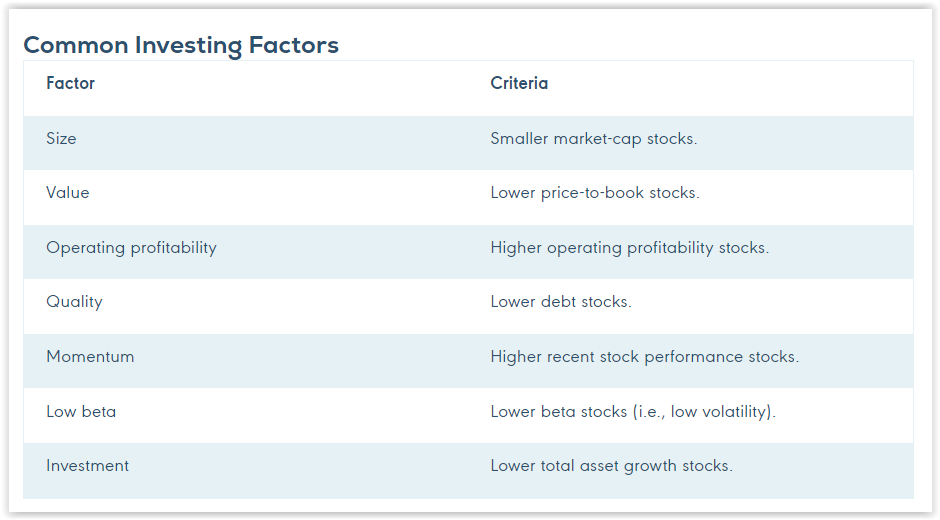
Outside of the Market factor, the next most common factor used by portfolio managers is the “Size” factor, which means focusing on smaller companies (i.e., lower market capitalizations) over larger companies. The Size factor (or small-cap tilt) is commonly used by investors because of a seminal 1992 study by Fama and French that showed that small-cap stocks outperformed large-cap stocks by +3% per year from 1927 to 1981.1 Many “efficient market hypothesis” advocates often argue that most investors who outperform the market are simply harvesting this small-cap premium through tilting their portfolio towards small-cap stocks.

A list of common factors that investors use is below.

Research Affiliates performed a study on the performance of these common factors and found that they did provide an additional performance above market returns.2 They also found that these factors performed differently depending on whether the stock market was up or down. For example, from 1963-2018, the Value factor provided a +1.8% return per month during down markets and provided a -0.8% return during up markets. The Size factor was the opposite, it provided a +0.8% return per month during up markets and a -1.6% return per month during down markets. 

Not A Slam Dunk

Harvesting factor premiums is not an exact science, and many of the factors that portfolio managers use may not harvest any premiums after all. For example, the Value factor can be defined in many different ways (price-to-earnings or price-to-book? if PE, which earnings value to use? If PB, which book value to use?). A study by 2 Sigma showed how the performance of the Value factor will vary greatly depending on how value is defined.3

Many studies show that tilting a portfolio towards higher momentum stocks (i.e., stocks that have a strong 3-month price performance) would allow it to harvest a momentum premium. However, the Momentum factor suffers greatly from asymmetric returns, which means that, while it performs great during up-markets, if there is a sharp downturn in prices, the actual, experienced momentum premium may not materialize for many investors who do not enter the market at the correct time.4

Factor ETFs

ETF products have commonly incorporated factors into their investment process given that

factors can be incorporated into a portfolio using relatively simple, passive criteria. For example, a Low Beta ETF can easily create a rule to overweight the lowest beta stocks among its investable universe.

The top three factor-based ETFs today:

  1. Vanguard Value ETF ($74 billion AUM; only buy low PE stocks).

  2. Vanguard Growth ETF ($72 billion AUM; only buy high PE stocks).

  3. iShares Russell 1000 Growth ETF ($65 billion AUM; only buy high PE stocks).

Other popular factor-based ETF products include Invesco’s S&P 500 Low Volatility ETF (SPLV), which seeks to take advantage of stocks with lower price swings (i.e., low Beta factor), and iShares’ Edge MSCI USA Momentum Factor ETF (MTUM), which only buys stocks that have gone up recently. There are also many multi-factor ETFs that seek to harvest multiple factors at once (e.g., Invesco FTSE RAFE US 1000 ETF (PRF)).

Many ETF providers equally-weight their portfolios, which is a natural way to take advantage of both the Size and Value factor since equally weighting a portfolio forces the portfolio to own a larger portion of smaller companies than a market-cap weighted portfolio (size factor), and, rebalances consistently towards companies with lower PE ratios (value factor).

ESG and BRI Factor Investing 

Many portfolio managers can add non-financial factors, such as Environmental, Social, and Governance (ESG) factors and Biblically Responsible Investing (BRI) factors. ESG factors include the carbon-footprint of a company, employee satisfaction, and diversity of the Board of Directors. BRI factors include whether a company is selling certain products or services that are contrary to Biblical values (e.g., pornography, tobacco, gambling) or using company money to actively change culture away from Biblical values (e.g., funding abortion clinics, LGBTQ activism).

Adding both ESG and BRI factors to a portfolio may help Christians invest in a way that is both fruitful and redemptive for our community. Current studies are mostly positive about the return implications of investing using ESG factors.5 Regarding the return implications of applying BRI factors, not much is currently known. Look for more Inspire white papers on the return implications of BRI factors once more BRI ETF products begin to have 5+ years of performance data starting next year.

Overall, it is considered “smart investing” to incorporate traditional factors, such as the Size and Value factors, into a passive portfolio management process. Investors who have used these factors, over long periods of time, have historically harvested excess returns without taking on the excess risks and fees that may occur from active portfolio management.

1 Fama, E.F. and K.R. French (1992) The Cross-section of Expected Stock Returns, Journal of Finance, 47, 427-486.

2 Arnott, R., Harvey, C. R., Kalesnik, V., & Linnainmaa, J. (2019). Alice’s adventures in factorland: Three blunders that plague factor investing. The Journal of Portfolio Management, 45(4), 18-36.

3 https://www.twosigma.com/wp-content/uploads/Thematic_Research_Risk_Premia_4_1.pdf

4 Fama, E.F. and K.R. French (1992) The Cross-section of Expected Stock Returns, Journal of Finance, 47, 427-486 (pgs. 16-17).

5 Madhavan, A., Sobczyk, A., & Ang, A. (2021). Toward ESG alpha: Analyzing ESG exposures through a factor lens. Financial Analysts Journal, 77(1), 69-88.


How we mirror God’s image when we invest our money.

 Photo by  Noah Buscher  on  Unsplash

Photo by Noah Buscher on Unsplash

Article originally posted here by The Faith First Advisor

by Eric Schrum

In the past investing has traditionally been viewed as a secular act. The expenditure of money, time, and talent in exchange for the expectation of suitable and appropriate profit. However, just as the most menial job transforms into the glorious work of worship when done for the glory of God, we too as investors have the opportunity to mirror the character and image of God in a unique and special way.

Throughout scripture we see an often overlooked attribute of God: God as an investor. In the beginning, we find God investing in creation through mankind, tasking his image bearers with the work of tending the earth and returning it filled and subdued. In Isaiah 55:11, we see that when God sends out his Word it does not return empty, but accomplishes His will and prospers wherever He sends it. In the famous Parable of the Talents, God reveals to us that He invests talents amongst his church expecting a yield above his principal investment, each according to what they were given. And, in the world’s greatest investment, we see God’s one and only son give everything in exchange for the joy that was set before Him. (Hebrews 12:2)

Just as God has invested in His creation, we too now have the opportunity to view our investing not as the simple act of gaining more material wealth in our 401Ks, IRAs, and Brokerage accounts, but as a way to partake in divine work alongside God. We find ourselves living out and fulfilling our commandment to fill the earth and subdue it. Investing Time, Talent, and Money to create value and bring about prosperity where there once was none.

Take the typical stock investment for example. When we invest our money into a company, we find ourselves fulfilling two commandments given to us in Scriptures. First, we are partaking in filling and subduing the Earth. Through our investment we have the reasonable expectation our dollars will be used in a productive way, creating value and human flourishing above what we have the ability to accomplish on our own. We can further raise our expectation of human flourishing if we choose companies who align with Biblically responsible values. Second, we find ourselves wisely using the monetary resources entrusted to us while avoiding the trap of idleness that the master’s servant fell victim to in the parable of the talents.

As Christians, when we engage in our work as a form of worship, our investing transforms from the neutral act of wisely allocating money to a divine act of partnering with God to bring “Thy kingdom come” to bear on our earth.

Hurt is Going to Happen: Acknowledging Our Ability to Create and Destroy

— by Justin Forman

Dallas Jenkins might be more admired in my home than Walt Disney.

Sure Walt has the whole Mickey and theme park thing going for him. But Dallas’s work on “The Chosen” has captured our family.

In one of the recent behind the scenes segments, they interviewed a test group of people who screened the series.

It gripped me as I listened to how each of the stories was filled with scars from the Church.

There was the painful rejection of a friend. The neglect of a professing parent. And the abuse or failure of a spiritual mentor or pastor. Heartbreaking account after heartbreaking account told how the hands and feet of Jesus went from ally to obstacle. 

These past 10 years, we have seen terrible failures of leadership in the Church. We’ve read countless articles and listened to in-depth podcast series about these crushing collapses. With a heavy dose of mixed emotions, we’ve seen these become some of the most popular catalysts of conversation. 

I’ve heard a friend describe them as “failure porn.” Just like one might imagine, it has been hard to look the other way. 

Recently, I’ve been pleading with God…”please don’t let all this work be in vain.” Please spare this movement of Faith Driven Entrepreneurs and Investors from being that same place of pain. 

I don’t want there to be people years from now talking about how their faith was rocked by some Faith Driven Entrepreneur who’s pride, false humility, or greed caused such deep hurt that they ran farther from and not closer to Jesus. 

Recently I was with a friend on a video shoot sharing about that fear. It took a few thousand airline miles to be reminded of the hard and inescapable truth: “Hurt is going to happen.”

With those five words, I was reminded once again of why we so separately need Jesus. We’re all going to fail. And sometimes, it’ll be big. And every time it will hurt.

Like the tendencies of an overprotective parent, I was hoping for a world that doesn’t exist. I realized my hopes are no different than those of Church leaders who have gone before us. It can be easy to head back to the bunker and try to avoid risk. But God has called us to risky places as entrepreneurs. 

So if leaders truly are lifelong learners, what can we better understand from all of this?

Leading With a Limp

Name an author, teacher, or hero of your faith you’ve looked up to who has fallen… I don’t need to mention the name of any recent pastor or spiritual leader. I’m sure one comes to mind. Think about the pain, uncertainty, and damage their failure caused. Think of the fallout and collateral damage. 

It’s painful. And disgusting. Because sin is painful and disgusting.

Why do we think King David, the Apostle Paul, or any of Jesus’ disciples were any different than the recent examples popping up on social media and headline news? 

Paul drummed up false charges on people leading to life sentences and death. One of Jesus’ closest friends and a faithful follower sold him out for an illicit gain. David destroyed a marriage and committed murder to pursue a sex scandal of biblical proportions. 

By God’s divine grace, there’s reconciliation even for those who fell hardest. But we have to stop drawing such unrealistic boxes for the people we follow and admire to fit in. Faith Driven Entrepreneurs and Investors included. 

We don’t get a free pass here. 

As Faith Driven Entrepreneurs and Investors, we can be the very instrument that allows, enables, and creates a false frame that leads to hurt and despair. Or we can be complicit in helping others build it. 

We are more than capable of destroying lives—ours as well. And we need to take a long hard look in the mirror before we go casting blame on others for their devastating choices and decisions. 

Yes, it’s difficult, if not dangerous, to lead when we have just as many opportunities to pile up brokenness as we do to revel in impressive achievements. But we must lead with a limp—a realistic frame where we recognize we will let others down. 

We will cause hurt. 

Admitting we’re capable of it and turning towards God when it happens are the only hope we have to surrender everything to the limitless forgiveness of Jesus. 

Free People Can Help Free People

We have a tendencty to focus only on the financial ruin, scandals of greed, or sexual brokenness. But if we swim upstream, we find the heart struggles that live in the shadows. 

That’s because the root cause of these failures started small and undetected. How often do we hear our heroes admit that they never started with plans of debauchery and deceit? 

Faith Driven Entrepreneurs and Investors are called to dangerous places. Oftentimes innovation, creativity, and the building process of a new venture has us surrounded by all the world’s trappings. 

It’s hard to admit, but you will hurt people. I will hurt people. Hurt people hurt people.

That truth, I think, is unavoidable. But once we humble ourselves and accept that certainty, I also believe that most of us would move to mitigate that risk. 

There’s no easy way to do it. And I don’t want to claim for one minute that I have the answer to it all. It’s the world we live in. Hurt is a byproduct of broken relationship with God and with one another.

But I also know that scripture calls us to be people of reconciliation. To do the hard work of pulling ourselves closer together rather than pushing ourselves further apart. For the Faith Driven Entrepreneur and Investor in particular, this can only happen when we put to death our desire to be a lone wolf.

Let others in. It’s not easy, but it just might be that simple.

By being vulnerable to share in our hurt and how we are wrestling with it will help us get ahead of these things. And as we push together through the difficult feelings and conversations, we find the freedom that Jesus has promised each one of us.

Each of us have our own unique perspectives and experiences that come with these ventures. But it also requires great vulnerability to reach out and ask for people to speak into you and your leadership.

I’m always hopeful when I see Faith Driven Entrepreneurs and Investors surrounding themselves with bands of brothers and sisters. The very people who will remind them of their strengths while gently and respectfully challenging their flaws. 

Seeing faithful followers of Jesus acknowledging the ability we have to both create and destroy (sometimes only a few words and sentences apart) gives me a renewed hope in how God is at work in the midst of our brokenness. And I am reminded that free people can help free people.

Related articles

If Foreign Aid were a Potluck, What Dish Should the Faith Driven Marketplace Bring?

by Dana Wichterman

Summary

Those of us in the faith driven marketplace are invited to have a seat at the foreign aid “table.” We should accept this invitation to ensure redemptive solutions are competitive within the aid ecosystem. A community of faith driven marketplace actors (FDMAs), rooted in a biblical theology, is primed to work more effectively in the aid sphere through Public Private Partnerships (PPPs).

Christians are often skeptical of the role governments can play in addressing global challenges in developing countries—and with good reason. My career was spent working for the U.S. Agency for International Development (USAID), and I know the dangers of government entanglement. Our tendency is to go it alone, avoiding the strings that can corrupt faith-based economic development. Certainly, there is an important role for purely private aid, but there’s also a place for Christians to partner with government. Like it or not, governments will continue to be major actors in addressing poverty, hunger, disease, conflict, and the like. At least some of us should work with governments to alleviate suffering and contribute to human flourishing within the foreign aid sphere.

As a philanthropist and impact investor in the developing world, I see the issue from many sides. I am convinced that to tackle global problems we should deploy not just philanthropic models but for-profit business approaches, as well. Profit shouldn’t be a dirty word when it comes to addressing global ills. When rooted in the biblical framework, it’s the goose that lays the golden eggs. For too long, Christians have relied principally on philanthropy to address global problems, and business has been viewed as merely a piggy bank to fund charities. But this worldview reduces business to a necessary evil—instead of the world-transforming and life-giving force it was intended to be.

Thankfully, there is a Spirit-led movement restoring business to its proper place in the Creation Mandate. Good stewardship is about multiplication, not addition. A faith-based business model holds the potential to powerfully upend a charity-dependent mindset. Despite the inherent challenges of working with the government, Christ-followers should deploy this transformative and biblical business model to reshape government foreign-assistance programs through Public Private Partnerships (PPPs). Without compromising our faith commitments, we must wisely engage the public sector on behalf of the poor, the powerless, and the oppressed worldwide. Business and finance will play a transformative role in the 21st century.

The nonprofit ministry Faith Driven Investor estimates that Christians manage $150 trillion—over half the world’s wealth. And that amount is over 200 times greater than annual charitable giving globally (faithdriveninvestor.org). This gift calls us to lean into a renewed vision, courage, and conviction for stewardship.

Charitable dollars and government dollars have limited capacity. They only self-generate (one through fundraising and one through taxation) when there is profit. Profit lies at the roots of wealth generation. Additionally, long-term dependency on charity (private or government) can diminish human dignity, something USAID has recognized with its long-term goal of moving foreign aid recipients towards self-reliance. Moreover, traditional development aid from public and philanthropic sources is not enough to realize the United Nations Sustainable Development Goals (SDGs), which face an annual $2.5 trillion funding gap.

To reimagine the marketplace, Christ-followers in the business ecosystem need to work with other stakeholders including government, the academy, and nonprofits. Redeeming the marketplace can be framed as seeking biblical shalom—with people made in the image of God—and stewarding God’s creation for human flourishing. Flourishing, this side of the Fall, includes communities advancing in proximate well-being, peace, and justice.

Many faith-driven movements are converging around a global vision of biblical shalom. Faith driven marketplace actors (FDMAs, including investors and entrepreneurs and their associated affiliates), are poised to have a greater impact in foreign aid. This includes believers active in:

  • the Economics of Mutuality (EoM) movement, making inroads into the non-Christian business world and the academy (led by Mars Corporation and Oxford University)

  • equipping organizations (e.g., Faith Driven Investor, Faith Driven Entrepreneur, Business as Mission, BAM); vocational stewardship advocates (e.g., Steve Garber, Amy Sherman); faith and work communities (e.g., Redeemer’s Faith and Work initiatives)

  • mentoring and accelerator groups (e.g., Praxis, Lion’s Den, OCEANS)

  • intermediaries (e.g., National Christian Foundation, Impact Foundation)

  • the generosity community (e.g., The Gathering, Generous Giving, Generosity/NY)

These movements are poised to foster learning, growth, and communal creation for the common good—aligning perfectly with God’s mandate to fix what is broken. Within Public Private Partnerships (any formal or informal collaboration between public actors like the federal government or UN and private actors), Christians have a vital role to play.

Two examples of PPPs include:

  • The United Nations Global Fund Coral Reef (GFCR) is a PPP investment vehicle funding innovative sustainable business models that increase resilience of coral reefs and the communities that depend on them. It is an alliance among UN agencies, financial institutions, and philanthropic actors in both the charitable and for-profit space.

  • Convergence is the world’s first platform blending private, public, and philanthropic capital to achieve global solutions to global problems. It was developed through an independent organization, spearheaded by Canada’s Department of Foreign Affairs, along with the Gates Foundation, the World Economic Forum, and others. It connects private, public, and philanthropic investors for blended finance opportunities in emerging and frontier markets.

In FY2020, USAID dispersed $15 billion in foreign aid to over 80 countries in a myriad of sectors including agriculture, health, education, human rights, and economic growth. Close to $10 billion of that aid was in grants to as many as 3,000 partners, including businesses, nonprofits, and universities. Congress has mandated that 12.5% of the funding has to go to small business—an opportunity for faith-based entrepreneurs. Governments acknowledge the essential role played by the private sector as the engine of economic growth and empowerment that can bring solutions to global problems. USAID, under previous administrations, pursued many ways to strengthen and catalyze PPPs. Under the Biden Administration, although there will be a shift in emphasis and programming, significant opportunities abound for advancing shalom if FDMAs partner with USAID to tackle global challenges.

PPPs are not easy, quick, or trouble-free. There are tedious government regulations, embedded players in the private sector who often have the inside track to contracts and grants, and temptations toward mission drift. Add to this the difficulties inherent in working within bureaucracies, legislative timelines, and the pace of government vs. business, and partnerships aren’t for everyone. But for those who are called to co-labor in this space, at a minimum, we need to:

  • Explore countries, services, products, or policy goals with which our network could best partner. For example, we might be well positioned to further USAID’s goal of food security in Africa through agribusiness innovation. Or at the top of the food chain, we could help shape US congressional funding targets towards market-based solutions.

  • Spell out the potential dangers and pitfalls in partnering with USAID, including challenges that faith-based entities face in the public sector.

  • Identify the key secular players in the “partnership” equation and discern how best to both collaborate and compete (e.g., Palladium, Development Alternatives).

  • Collaborate with faith-based nonprofits, such as World Vision, that are strategically engaged with USAID.

  • Participate in faith-based development forums, such as ACCORD Network, and secular forums, such as InterAction and Center for Global Development.

  • Put resources, talent, and time behind this effort, avoiding duplication.

Through USAID’s New Partnerships Initiative, the Agency is simplifying and opening access to new and underutilized partners, attempting to leverage the full marketplace of ideas and solutions by collaborating with partners from all sectors of society. One initiative under NPI is called “co-creation,” a process whereby all relevant stakeholders of a development activity (funders, implementers, governments, local actors, international government officials, and private sector) are involved in various aspects of co-designing the objectives and approaches. A seat at the table of this collaborative experience could produce a win/win outcome for both FDMAs and foreign aid recipients.

Our endgame could be as simple as a loosely affiliated cohort of like-minded people to share opportunities and build sub-contracting and grant opportunities. Or it could institutionalize into the creation of a single entity (for profit, nonprofit, or hybrid) that could act as a conduit for our community of FDMAs to engage with USAID. We have an opportunity to build bridges, play matchmaker for our community, and leverage government funding towards human flourishing.

Interesting models for engagement abound. USAID has leverage awards that provide 50% funding of partner initiatives that advance Agency goals. “Local Impact” is a PPP between USAID and the nonprofit Aga Khan Foundation, a multi-year, multi-sector, and multi-country partnership creating an innovative framework for sustained impact across Asia and Africa.

Another example for engagement is USAID’s CATALYZE, projected to mobilize $2 billion in blended finance with investors and financial institutions, small and large enterprises, a diversity of market intermediaries, and other key stakeholders to develop commercially viable business models that create jobs, expand sustainable social services, and optimize supply chains. CATALYZE is a contract managed by a private company tasked with bringing in new and underutilized marketplace partners.

Our community could work under a USAID Global Development Alliance (GDA), a partnership where USAID and the private sector work together to develop and implement market-based approaches to development challenges. Activities under GDA leverage assets and expertise to facilitate private sector-led development and drive sustained development impact.

We could also work with USAID INVEST, a contract managed by a private company that facilitates work between USAID and partners in the investment community. The projected value of mobilized capital is estimated at $1.6 billion.

Through PPPs, FDMAs stand to gain increased sophistication and access to government grant and contract funding, to develop new values-aligned partners, and to gain exposure to best practices in the private and nonprofit sector. Motivated by a quadruple bottom line (purpose, people, planet, profit), we have the patience and sustainable capital to navigate the complexities and headaches associated with such PPPs.

My hope is to see a collaborative group of faith driven investors, givers, and entrepreneurs to pursue funding opportunities via USAID, aligning with shared international economic goals of sustainable job creation, poverty prevention, food security, peace, and justice through rule of law initiatives, environmental stewardship, and more. Benefits would include funding for entrepreneurs, collaborative investment opportunities for investors, and a demonstration that faith-based initiatives are good for America and good for the world.

Governments are major players in attempting to solve global problems, for good or ill. Christians need to engage the public sector with grace and civility, knowing all actors have the image of God within them. We should assume the majority of those in the foreign aid ecosystem are striving to bring shalom in the best way they know how. Finally, we need to engage with excellence, truth, and courage, speaking truth (in love) to power on behalf of the voiceless and defenseless.

In the Parable of the Talents, the master lauded the wise servant who deployed his talents to multiply the capital entrusted to him. As Christ-followers, we are called to multiply our gifts on behalf of God and the world. For-profit business can foster human flourishing by providing sustainable and life-giving employment, preventing global problems from occurring in the first place. This powerful force should hold a central place among the Lord’s people, transforming private and public aid to the poor. We should be God’s entrepreneurs, leaning into profit-making, not to build our small kingdoms but to further His glorious and eternal Kingdom.

Through PPPs, believers can bring nutritious and creative “dishes” to the foreign aid table. Casserole, anyone?


——

Article originally hosted and shared with permission by The Christian Economic Forum, a global network of leaders who join together to collaborate and introduce strategic ideas for the spread of God’s economic principles and the goodness of Jesus Christ. This article was from a collection of White Papers compiled for attendees of the CEF’s Global Event.