Episode 130 – Discovering True Riches at Harvard Business School with John Cortines

Episode 130 – Discovering True Riches at Harvard Business School with John Cortines

Podcast episode

Episode 130 – Discovering True Riches at Harvard Business School with John Cortines

John Cortines had a plan to become a millionaire by age 30 and retire by age 40. He had all the spreadsheets and the “Big Oil” job to prove it. But while pursuing his MBA at Harvard Business School, John took the class “God and Money,” where he ended up writing a term paper that became a book—and it changed his life forever. He began studying God’s Word to answer the question “How much do we need to give?” John ended his exploration with the question flipped to “How much do we really need to keep?” In this Faith Driven Entrepreneur Podcast episode, we talk to John about the book that he co-authored, entitled, ‘God and Money: How We Discovered True Riches at Harvard Business School.’ Listen in as John shares practical tools for how Christ-following business leaders can give biblically and responsibly. 

All opinions expressed on this podcast, including the team and guests, are solely their opinions. Host and guests may maintain positions in the companies and securities discussed. This podcast is for informational purposes only and should not be relied upon as specific investment advice for any individual or organization.

Episode Transcript

Transcription is done by an AI software. While technology is an incredible tool to automate this process, there will be misspellings and typos that might accompany it. Please keep that in mind as you work through it.

Henry Kaestner: Welcome back to the Faith Driven Investor podcast and indeed welcome back. Today we’ve got a special guest that John and I have on the program, John Cortines. John has written a couple of books now, the one that you may already know about. If you’re listening to Faith Driven Investor podcast, it’s preaching to the choir here a little bit. God and Money. How he discovered true riches at Harvard Business School is a formative work in the space of an ambitious marketplace investor that’s wrestling with Where does God have them? As we before we get back and we get to the regularly scheduled program here, I wanted to set this up because the work that John has done and through the organization, he’s spent a tremendous amount of time with generous giving. And then the Maclellan Foundation has had such an impact in my life. At age 28, I came to faith. It changed everything. I had a career on Wall Street. I pursued all the things that an investor might pursue on Wall Street that does not yet know God. And then at age 38, as bandwidth was becoming more successful, I met Daryl Heald at the Maclellan Foundation and the co-founder of Generous Giving, the organization that John has spent a lot of time working with. And he asked me this simple question and I alluded to this a little bit in the outset when we talked about may we do this out of gratitude, of gratitude for the gift given us? Daryl asked me, Henry, why do you give? And I had no frame to think about the answer there. I probably mumbled through something theologically […]. I think at the time Kimberley and I were probably giving away 20% because God had really blessed bandwith and we thought we should do it. I may have even answered something like, I don’t know, I want to pay it forward. I hope it wasn’t something as corny as that, but it might have been. But through the next six months and God’s Word, God and Jesus and the and the teachings of the Bible helped me to see that so much of the Bible has something to do with money. In fact, it felt that every single one of those six months, every single one of the days in the six months, had something to do with money. And it changed my completely changed my walk with God. I credit Daryl and that time in Scripture with my born again again moment, I credit the whole season one in going from black and white Christianity to Technicolor. And John’s here to talk about that. John, thank you very much for being with us.

John Cortines: Thanks so much for having me on, Henry. It’s great to see you and John as well.

Henry Kaestner: So as we get started, give us a foundation. And I think this is really important and that is we have some certain assumptions that we make as a foundation in thinking about how we invest, investing for the glory of God. How do we think about that across different asset classes, stocks, bonds, real estate? We’ve recently had some folks in talking about investing in cinema and in culture, but there’s this underlying premise and belief that we as Christ followers, have a different way that we might think about money, but we really haven’t gotten into that that much on the podcast. So there’s the formative experience that each of us has that we can go through that then leads us to how do we invest our assets for the glory of God? John, speak to us a bit about your work. As we do with every guest, we like to start off with an autobiographical flyover. So do that, but then bring us right up to the work that you’re doing right now and help us to understand how you came, to understand how you might answer this question. They’re all asking, like, why do we give? Why do we invest?

John Cortines: Absolutely. Thanks, Henry. Well, you know, the quick flyover would be I grew up in North Dallas, grew up in a wonderful Christian home, so thankful for my parents. And I’m going to focus on the money element of this because this was transformative. I love how you called it Born Again Again. And I really point to that in my own journey. So I love Jesus from an early age, wanted to follow him with my whole life. And I also had imbibed this, you know, Christian money formula, which is something like work really hard, live frugally, save a lot, don’t have debt, and by the way, give 10%. Like there’s this obedience thing. And I thought, Hey, that’s cool. And I really started loving accumulating money, starting with mowing lawns in high school, socked away $10,000. I went to engineering school and had scholarships, and before I ever stepped foot into my first full time job, I had $100,000, you know, internships and scholarships and all of this. And so my plan was to be a millionaire by age 30 or retire by age 40. And I had all the spreadsheets to prove it. And giving for me was actually that annoying cell in my spreadsheets that I could toggle lower and I’d be able to retire sooner. But I knew that I had to keep a certain level of giving to be an obedient Christian. And I was kind of the way I thought about it. I even enjoyed some of the giving I was doing, but I just it wasn’t a source of life for me. And so fast forward in my journey, I was working in Big Oil. I wanted to pursue a career track with them and I ended up at Harvard Business School after having launched my career with Chevron, and I was going to go back as an expat after my MBA. And that’s a very lucrative opportunity for those who know about, you know, that kind of a deal. So very, very excited about that. My classmate and I, who are in the business school, found a class at the divinity school called God and Money, and it just piqued our interest. We said, this is so cool, you know, a theology class on money and God and we love God and we love money. So how can we not take this class? And long story short, the next few months we went Genesis to Revelation. We were digging into Scripture and we were meeting all kinds of extremely generous Christians who had been impacted and were living their lives in radical ways, ways that we’d never heard about, even growing up in the church in terms of the ambition and percentages and commas and zeros in their giving. And we thought, this is unbelievable. The most striking thing was that it wasn’t an act of obedience. It was an act of joy and gratitude, as you were just alluding to. And so that led us to write a term paper that became the book, God and money and really changed our lives forever. And so for the last seven years I’ve been working post MBA was called by God out of Big Oil. I let Chevron know, hey, I’m going to work for a small nonprofit in Florida called Generous Giving. And they didn’t even try to talk me out of it. I think they thought I’d lost my mind. You know, this guy’s a lost cause. So 60 to 70% lower pay than what I had thought I was going to be going into. But it’s been this rich adventure with the Lord and so on. My coauthor, Greg and I have had both sides of the adventure. He’s been in the corporate world and has been living and giving in a radical way. And now I’ve had the privilege of being on the ministry side of this and meeting hundreds, if not thousands of givers and talking to people about their journeys and getting to spread the joy, the message that this is a source of joy and intimacy with Christ rather than the way I used to view it. Right. Just obedience.

Henry Kaestner: The highest education I ever had was the University of Delaware. Some people call it the University of South Jersey. We did not have a class on God and money. It comes as a bit of a surprise to me that HBS had a class called God and Money, but maybe it shouldn’t have, because I know that much of John’s formation is through some really great Christ following men also at Harvard Business School. John, did you take the God and Money class?

John Coleman: Well, to be clear, I think it was at the divinity school, right, John? So I actually was aware of it while I was there. But I would say, you know, HBS was a much better Christian community than I had anticipated. And John, I don’t know if you had this experience, but there was a very active Christian fellowship on campus with small groups in the different sections. And so I found that my faith was actually able to grow during that time in groups with others. And John, I don’t know if you experienced the same thing, but it sounds like you you did, at least to some extent. What was that like for you?

John Cortines: Yeah, I’m really thankful for the Christian Fellowship. It’s such an awesome community, you know, it’s a small minority, but it’s very vibrant. And yeah, it was a Tuesday morning men’s Bible study that formed actually what has become lifelong community. So there’s a a text chain and some annual get togethers in this group that I’m a part of from my time there. And these guys have been a real catalyst for spiritual growth in my journey. So I really praise God for that.

John Coleman: That’s awesome. Now, you did make a very different decision than most HBS students do or HBS graduates do. First, I’d love to hear just what the reactions were when you came to this decision. First, when you gain this insight about giving and then came to the decision to enter the nonprofit world first, how did that conversation go with your wife? I know you were probably married at the time. And then secondly, how did your classmates react?

John Cortines: Sure You know, I want to answer on a personal level first, because God did this foundational work in my life and honestly, my coauthor, Greg’s life for both of us, where we talk about this and God and money, it flipped the question we were asking. We kind of came into this big project of studying God’s word to ask, how much do we need to give? Is that a 10% tithe? Is that something different? Is there another way to think about it? And we left that exploration asking how much do we really need to keep it just flipped it for us and God has abundantly provided for us. We had these educations, these careers, these salaries. And so to the extent we can define what enough looks like and live, you know, not this poverty lifestyle, but just live a nice life and be blessed and put a guardrail in place. The upside and the financial upside of our career gets allocated to God’s kingdom in a different way. So there’s this really freeing mindset shift. And then when the call to go into nonprofit arrived for me and for my wife, who is, I would say, more sensitive to the Lord and more able to make those pivots than I am. We had already reframed our lifestyle expectations around a finish line, so then it was like, okay, we may not have that upside we were thinking where we can give six figures every year, but we already recalibrated our lifestyle. And so it actually becomes more possible to move into the nonprofit sector and live on those kinds of salaries. That’s the personal side to it. And then how did people react? You know, certainly surprise. I mean, that’s the big thing, because you just I was surprised. Right. Is like I didn’t go to grad school to take on student loans to then go earn less money and work in a nonprofit that it just it’s an upside down formula. So all I can say is that God made his calling very clear. And that’s what we told people like, you know, I don’t know what your faith position is, but this is a call from God situation and all we can do is answer it.

John Coleman: That’s awesome and encouraging. Talk to us. I mean, if you don’t mind. For listeners who are unfamiliar with the book, talk to us about the thesis of the book and what you offer to people who are trying to consider the role that money plays in their life in God and Money. The book.

John Cortines: Sure. So the book grew out of our term paper. So those who have done business school will appreciate this. You know, we don’t really write papers. John, I don’t know if it was harder when you were there a few years before me, but not a lot of paper writing going on. And so then we when we were in the divinity school, the professor says, Hey, you have to write a 15 pages paper to conclude the semester. And we said, Wow. So we said, Can we write it together? And he said, Sure, just make it 30 pages. So we’re like, Oh, shoot. So we started a research paper. Honestly, we said, I want to investigate Scripture and interview experienced Christian givers. And try to build a framework around how do we think about money and giving and the Christian life. So that’s really the foundation of the project. And so it starts, you know, the whole first chapter is just a fly over Genesis to Revelation. What does it say about money? And it was funny, even the publisher saying, you know, people aren’t going to hang with you for a chapter one that’s just a Bible flyover. And you say, well, we got to anchor it on that. And what we do throughout the course of the book is try and build a framework for a higher income or a more financially successful business leader in the 21st century who’s wrestling with what do I do with this money that God has provided and how do I be faithful? And so we propose down to numbers and frameworks around what that looks like.

Henry Kaestner: So John, I want to get into something right off the bat that I think is really applicable to our audience. I think that some number of folks are coming to understand that actually there’s a great opportunity to understand that God owns it all and we can worship by giving to God what is already His, participate in the work that He’s doing. And there’s been a movement of biblical generosity that I think is really picking up steam in the church, which is to be celebrated. It’s not as clear that the concept of investing according to faith through this knowledge that God is at all is at the same level yet. I think it’s building toward that. But as you come at things from the foundational level, which I think is the most important level about God owning it all, do you have any reflections on how we might think about our investment portfolio in light of God and money?

John Cortines: Thanks, Henry. You know, one of the most compelling things I heard a few years ago, and I know these concepts are familiar for the listeners of this show and the work that you all are doing and advocating for. So I just I’m really thankful for your partnership in this space biblically to advocate for this perspective. But the thing that changed my perspective on this was when someone said, you know, if you think about all the giving that someone will ever do or all the giving that even Christians will ever do, in aggregate, it’s a small slice of the overall wealth. And if you think about the investment portfolios, the size is just radically, radically different. And, you know, we could even say in round numbers, you know, the giving is in, I don’t know, tens of billions probably. But the investment portfolio is in the multiple, multiple trillions, even the tens of trillions. And so how we allocate our giving dollars and the fact that we do give radically, generously as believers, that’s a that’s a mandate. That’s a call. That’s an invitation. But I think you’re right. There’s less of an awareness to say, hey, what does it look like to invest according to these principles? The one thing I’ll say and I love your reaction to this, too, as an expert here, we see this real push around ESG in the secular world. And depending on when people are listening to this podcast, you know, the FCC has even just come out and said they’re building frameworks around this for disclosures of publicly traded companies around ESG. And that’s coming from our, you know, the postmodern, confused ethical soup that we’re all swimming in as a broad society. So I think there’s a massive opportunity for believers to be out in front of that, which we honestly haven’t been, but to really articulate so many incredible faith driven business leaders who are running their companies by these principles, but probably haven’t written that down in a thoughtful way or publicly disclosed it necessarily. So I would love to see us be more forward and articulate in saying, here’s how we’re running our companies, here’s how we’re investing our money. Not necessarily in this same exact definition of ESG that the secular culture may create, but in a biblically anchored way, some of which is going to overlap and some of which is going to look a little bit different. I’d love to hear y’all’s reactions to that.

John Coleman: Yeah, John, I think this is such an important topic. You know, what’s ironic is that Christians and other believers, whether they be Muslims or Jews for a thousand years, have been at the forefront of this issue. You know, some of the earliest codes about how you should invest, what you should invest in, what you shouldn’t invest in, actually came out of the great monotheistic religions in particular. And yet if you look at the modern ESG movement, as you described, it’s largely been a mainstream or secular phenomenon for the last 20 or 30 years. And I think we had gotten to the space for many Christians you mentioned earlier had divided their life in two and said, I’m going to make money and then I’m going to give, which was kind of a false dichotomy. And I think that many business leaders and investors had also said the same thing that, you know, the corporation’s only duty is to its shareholders and the investors only duty is to make a profit or to maximize return and had segregated those two areas, living their values in one area and giving, but not really trying to impose those on the way in which they ran companies or gave. In the meantime, I think the mainstream world led by a lot of large international institutions. Decided that it had to enforce its values or they had to live their values through their investing. And so they started to require companies to meet certain criteria on climate or on governance, etc. And that’s grown now. I won’t go off on too much of a tangent here and to something like a $35-40 trillion segment of investment management is ESG now. And yet if you look at Faith Aligned Investment Management, it’s really between $50 and $100 billion right now. It’s a tiny sliver of the market. And so what we encourage people to do I think is to not draw a false dichotomy in their lives that if they truly believe in the values of their faith and how those can help people flourish, and how loving God and loving your neighbor can actually transform the world, that they try and exhibit those through their investing strategies and even through the ways that they lead companies, not necessarily as Christian companies, quote unquote, but really embracing the values of their faith and beginning to live those out in every sphere of their lives. And we kind of have a catch phrase for that, which is all investing is impact investing. It’s this idea that impact investing isn’t 2% of what you do when you’re feeling generous. It’s really 100% of your portfolio because that whole portfolio is having an impact. The question is whether you’re going to control that impact, whether you’re going to wield the influence that you have through that portfolio or yield it to others who have their own agenda to pursue. And so I’m seeing and Henry, I think you’d agree with this. I’m seeing a lot more people and institutions waking up to that. But it’s interesting to see how the faith aligned or Christian world actually fell behind after starting this whole movement, you know, hundreds of years ago and is only now waking up to what the mainstream world has been living for a couple of decades.

John Cortines: Yeah, and I so appreciate that. And the historical context is fascinating as I reflect on my own personal journey. You know, I’m very analytical and I anticipated building this nest egg. Hey, retire by 40. So what does that look like? And I kind of cut my teeth in the bobble head world, if that’s a familiar term. You know, the founder of Vanguard, and it’s this idea of index and forget about it and you’ll be okay. And even the idea that you’ll probably be a head of active investments anyways, net of fees, and even if you’re not, you haven’t spent any time thinking about it so you can sleep easy at night. You know, I think there are many believers who would fall into that camp. And so the argument needs to be, you know, regardless of what you think about what the return, you know, returns one way or the other. I love what you said, John. All investing is impact investing. So when you buy an index, you’re buying a lot of stuff you probably don’t want to buy. And so to set it and forget about it and just collect your returns for 30 or 40 years, I think we can start setting that aside in light of a broader picture of the kingdom and the impact that those funds are having.

Henry Kaestner: So, John, we do a segment here toward the end of every podcast called Lightning Round, and we’re not there yet. But I just want to prepare you just so you can start getting ready. We can up the tempo a little bit, but I want you to spend as long as you need to answer this question, because I think it’s really, really formative. We know from Scripture that God loves a cheerful giver not to give out of reluctance or compulsion. And I think that it’s fair for us to take that and extend it towards how we think about faith driven investing as well. He wants to have a joyful investor, one that doesn’t feel like they have to go ahead and invest in this fund or that fund, because otherwise they’re going to be beaten with many blows. Right. How is it that you are able to find joy in giving and joy in investing? And what are some of the things that you’ve seen others employ as well?

John Cortines: Yeah, thanks for that question, Henry. I would say that here’s the biggest thing about how to become a joyful and cheerful giver, and we can apply this to investing as well. You know, why do we give let me start from that. We start from the character of God. As Christians, we believe that God is the giver. He gave his only son. We have eternal life. We’ve received so much. And if we’re made in the image of God, we are made to be givers. And so if we start from the character of God and we recognize the priceless gift of the Gospel, then we move into a posture of gratitude. And so that is actually my answer of how do we maintain joy in our giving and in our overall stewardship of money is to wake up every day with a posture of gratitude for what we get to do and for what God has blessed us with. And I would argue we talk about this a little bit in the book. True Riches, that the opposite of gratitude when it comes to stewardship, the opposite of gratitude is pride. And those two words aren’t often put together in contrast to one another. But I believe financially it’s true, if you think about King Nebuchadnezzar in the Old Testament is the ultimate example of financial pride. He says, look at this, Babylon, the great city that I’ve built to display my power and my glory. And he’s struck down. You know, he’s a negative example for us spiritually. But if we start from that posture of gratitude and receiving all that we have. As a gift from God, it becomes so much easier to have open hands and to give or to have the freedom to do our very best in our investments. But know that we’re going to miss some. We’re not going to be perfect. We’re not going to pick the perfect fund, but we’re living in the freedom of gratitude for what God has given us. So that’d be my one tip on living with joy in our financial gifts and investments.

John Coleman: That’s awesome, John. What a great testimony. I want to pivot to some of your work at Maclellan here shortly, but before we jump off of the topic of God and money and how you started to investigate this, I was really fascinated that you went Genesis to Revelation through the Bible and then part of your term paper was studying people who were good at this or were living this out. I was wondering if you could make it real for us. Who are, you know, one or two or three people that inspired you on this front in the Bible? And then who are a couple of folks that really inspired you out in the world today on this topic of God and money and living generously?

John Cortines: Absolutely. You know, one thing I’ll highlight in scripture is this awesome contrast. Luke is the most financially oriented gospel writer. So the gospel of Luke has all these extra money stories we don’t get in the other gospels. And there’s a contrast between the rich young ruler who actually does appear in multiple gospels, and Zacchaeus who actually appears in the we don’t need to get all into biblical theology and interpretation here, but Zacchaeus appears at the apex of the journey into Jerusalem that Jesus is on. It’s a key story for Luke in writing his gospel and the rich young ruler comes to Jesus, has a bunch of money, can’t get over the hump of realizing that He’s called to give in a radical way. And he walks away, sad, and Zacchaeus is met with the grace of Jesus Christ and in his joy, he gives away half of his assets and beyond to do restitution for where he’s wronged people. And Jesus says today salvation has come to this house, you know, an acknowledgment of what Zacchaeus has done. So just kind of looking at that contrast like, man, I want to be a Zacchaeus, not a rich young ruler who has the money but walks away from God because of that. Yeah. Making it real in terms of some people. I’ll give one example. I’m a saver. I know many people listening that will have that saver mentality as well. And I met this guy. We spoke over the phone. He’s a hedge fund guy and shared quite openly, you know, hey I am blessed with like a $5 million plus kind of an income in the last few years. And and he said, but I don’t save money. And it was kind of on the phone. It’s like, come again, you know, tell me what that looks like. And he said, Well, you know, we have our house. Our house is paid off. We’ve got some money set aside for college, for the kids. I have really good life insurance and disability insurance. So, you know, my family’s covered. But, you know, as far as retirement, I’m not in a hurry. I’m in my forties, you know, why would I save up a big retirement nest egg? And so we make all this money. We live a decent lifestyle, and then we flush the rest. We give it to God’s kingdom every year. He said, I think I need maybe 3 million bucks to retire on, but I’m on a glide path to save that. I’m not in a hurry. And we just give whatever we make beyond what we live on, we give away. And I just was so floored. I think I probably hung up the phone and sat down on the floor of my living room, you know, just like I can’t believe what I’m hearing, because if I was him, you know, I’ve saved for six months and then call it quits. And I think just kind of hearing that kind of ambitious generosity was very transformative in my own journey.

John Coleman: And I’ll tell you, one of the most encouraging things for me, entering the faith driven investing world about a year ago was just the extraordinary number of examples of that, you know, whether it be people like Alan Barnhart or Casey Crawford or others who are so generous with their financial resources and live so radically differently. I wanted to pivot here quickly, John, to your work today. So you’ve joined the Maclellan Foundation in a role related to giving. Tell us a little bit more about Maclellan and about what you’re doing there.

John Cortines: Absolutely. Well, you know, it’s been such an honor to be a part of the Maclellan Foundation, who is the founder of Generous Giving, where I worked for five years, and I’ve been directly on their team for two years now, and the foundations existed for over 75 years. And so the family and this foundation has been passionate advocates for this perspective on biblical generosity for literally longer than I’ve been alive on this earth. And so I’m so grateful to benefit from that. And there was this key revelation for them that giving is not just a means to spiritual ends. You know, it’s not that we give in order to see people discipled and baptized and all these things. But giving actually is spiritual fruit in the life of a Christian believer. It is a component of our discipleship journey with the Lord. And in recognition of that, they started this organization generous giving that shares that message. Many people will have heard of a journey of generosity, retreat, or their celebration of generosity conference, which are these no pressure environments where people who have, you know, more resources than the average person. Come together with peers and explore the kind of conversation we’re having today and hear stories like we’re talking about today and just get fired up as givers and in that journey. And so through that, it was really impactful on my journey when I was kind of wrestling through these topics, watching some of their videos online and meeting people who got their start at these conferences. So yeah, it’s been a great joy to be a part of it. And I’ll just say that for anyone who’s thinking about stepping into those kind of environments, the beauty of it is the neutrality. It’s just this is not a fundraiser. This is not a conversation with a certain end in mind. This is a non prescriptive but prophetic environment to talk with people and say, Hey, what is God’s calling on my life as a giver given that He’s entrusted these resources to me? And how do I make the most of the opportunity I have?

Henry Kaestner: All right. That’s beautiful. I want to affirm that. I also want to encourage people that might be listening to this is that while traditionally generous giving and the work of Maclellan foundation have tended to help people who are struggling and trying to figure out how do they give well? It’s the biblical message of generosity is equally applicable for a college sophomore, somebody who’s in India. I remember one of the things that really brought me into the work that you all do out of Maclellan was Daryl going over to India and spending time with the Dalits, the Untouchables, and preaching to them about how rich they were. And that translator like, Dude you know who you’re talking to? And Daryl was like, No, no, just translate like that. And of course, he is preaching a second Corinthians 8:9 and just, you know, to that God who was rich, became poor so that we are poor and might become rich. And so they could understand the new view of riches through the biblical message of generosity. And there’s a beauty in there that’s really about heart transformation. And I think that that has so much overlap with Faith Driven Investor, because Faith Driven Investing at one level is yes, absolutely. How do we steward investment capital across? Yes, it could be patient concession return, but absolutely market based return as well. How do we think about doing that? Well, how do we respond into that? And I hope that listeners will get a good sense for that. But ultimately, all of this is about bringing us back to God and knowing God and how much He loves us. So much. So anybody who’s struggling with money at all, the spirit of Mammon, if you will being able to understand that biblical message of generosity that you all have espoused for so long, sets us free regardless of our financial background. And I think that that’s an important thing to mention. Okay, we are here at the end of our time together. Just so you know, this is how this is going to end. The question you’re going to get at the end. You are not going to get the questions early on because it takes away the fun of it. But the question you’re going to get at the end is what is God speaking to you about through his word? And maybe it’s today, maybe it’s over the course of last week, maybe sort of last month. That’s what we can end with. That’s when you know this is all going to be over. But John and I have a couple of Rapidfire questions we’re going to throw at you first. Okay. You ready?

John Cortines: I’m ready.

Henry Kaestner: Alright good Okay. Number one, we see the exercise equipment in the background. I also know you enough to know that you’re really fit. What’s your favorite thing to do to stay in shape?

John Cortines: It is lazy exercise, which I would say is fasting.

Henry Kaestner: I was not expecting that

John Cortines: Trick answer Once a week, 24 hour fast spiritual and physical benefits. So that’s my lazy exercise.

Henry Kaestner: Wow. Okay, so that’s the second podcast cast that we’ve had on today that’s talked about how important fasting is in their spiritual life. And so you’re not spending time on that exercise equipment. That’s for somebody else behind you. You do fasting.

John Cortines: It’s theoretically for me, but I’d be ashamed to tell you how often it’s used.

Henry Kaestner: Theoretically. Okay. All right. Number two, we’re talking about the biblical message of generosity so I am going to put you on a spot here and maybe you shouldn’t have a favorite in this. And no, I’m not asking you about your kids. I’m asking you about a charity, a ministry that you and your wife have given to over time, that there’s just something about them that’s really inspired you.

John Cortines: Oh, man, I have developed this beautiful relationship over the years with Compassion International. Everything they do is about Christ and children and working through the local church. Those are their three C’s and they are so I’ve known their executive leadership and I’ve talked to their volunteers through translators in the field, and they all speak the same language, so gospel centered. So I can’t say enough about them. They’ve been our number one allocation as a family.

John Coleman: That’s awesome. We love compassion in our house, too. One of the great things you can do if you have kids we found is that for each of the kids, we have a kid overseas who’s about their age that they’re a pen pal with now that we’re supporting. And it’s an easy way for any family to get into supporting others overseas. I have a slightly different question for you all. Preface this by saying, you know, John has written two books, God and Money and True Riches. Everyone should pick those up, I think. And we can be certain that any proceeds from those are going to good used, as you’ve heard today. So buy extra copies for your friends. But John, what are you reading right now or what have you read? Recently that you think would be helpful to people investigating these topics?

John Cortines: You know, I’ll give a very unique answer, something people haven’t heard of, but especially if somebody has read three or four books I’m giving and they’re kind of like, Hey, I wonder what’s out there. There is a guy named Saint Basil the Great, and he preached some sermons on money and giving 1600 years ago. He’s one of the church fathers. And so you can find a translation of several of his sermons that’s called On Social Justice by Basil the Great. Man. It is good stuff. He’s a little bit in-your-face. The church fathers were a little bit in-your-face. So if you can get past his aggressive style, it is convicting and inspiring sermons on money and generosity. So in centuries past, the message was the same as it is today.

John Coleman: It’s awesome. So maybe we’ll close it out. John, what do you think is God’s call in your life right now and what are you learning from him?

John Cortines: You know, it’s interesting that there’s this theme I found in the community of biblically generous people that God has allowed me to be a part of. Whereas you start giving your money away, you start giving your time and your life away. And then very often the call of God emerges to adopt or foster. It kind of comes inside the home. So Isaiah 58, beautiful passage. Bring the homeless poor into your house. The glory of the Lord will be your rear guard. And God has really spoken that into me in my wife’s life over the last few years. And so we have foster twins who we received from the NICU 5 pounds each and they’ve been with us since then. They’re now two years old and I’ll be in court tomorrow on their case. And we’re praying for an adoption this year. So I would just say that there’s all this professional stuff and flying around and conferences and that’s a great joy. But but the conviction and the challenge and the fellowship with Jesus and trying to live this out every day at home and in my wife, who’s a hero, doing that even more intensely than I am day in and day out. That’s been the real area of growth for us lately.

Henry Kaestner: That’s super motivating, very encouraging. John, I’m grateful for our friendship, our partnership in the movement and just the way that you challenge us all, challenged our listeners. So listeners, thank you for having dialed in. Thank you for the support and encouragement we’re getting from emails and suggestions on people we might have on the podcast. Yes, as you might imagine, if you think this might be a podcast that might be an inspiration or encouragement to others, please pass it along. We have a new Faith Driven Investor group study that we’ve rolled out that you might really enjoy. It’s six weeks study. You get together with your peers to talk about how you can process what God is saying about investing. It’s some great lessons from Tim Keller, Andy Crouch, Mark Sheard, Finny Kuruvilla, a whole bunch of others. It’s just really super motivating, encouraging. I think you enjoy that. Thank you for having tuned in and may God bless you as you endeavor to understand how to invest capital for God’s glory. Until next time.
Subscribe to the newsletter

Stay Connected to the Movement

We know that as an Entrepreneur, your most valuable asset is time. So each month we take the very best of the podcast, the blog and all the news, resources, and upcoming events happening across the space and bring it to you.

Episode 131 – Pastoring 120,000 in Public Markets with Pat Gelsinger

Episode 131 – Pastoring 120,000 in Public Markets with Pat Gelsinger

Podcast episode

Episode 131 – Pastoring 120,000 in Public Markets with Pat Gelsinger

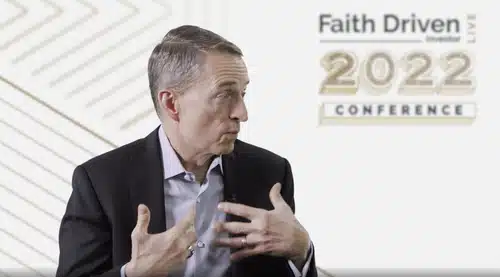
Intel CEO, Pat Gelsinger, has been a leader in the Faith and Work movement for decades. 

In this interview from the 2022 Faith Driven Investor Conference, Pat talks about some of the most important lessons he’s learned as he’s sought to bring his whole self into the workplace over the years. 

He also gives insight into how leaders can balance their work and family life, empower their communities, and love their employees, partners, and coworkers who come to work with different faith backgrounds. Let’s listen in. 

All opinions expressed on this podcast, including the team and guests, are solely their opinions. Host and guests may maintain positions in the companies and securities discussed. This podcast is for informational purposes only and should not be relied upon as specific investment advice for any individual or organization.

Episode Transcript

Transcription is done by an AI software. While technology is an incredible tool to automate this process, there will be misspellings and typos that might accompany it. Please keep that in mind as you work through it.

Henry Kaestner: Welcome, Faith driven entrepreneurs. It is an incredible honor to be here with Pat Gelsinger, CEO of Intel. And when we think his faith driven entrepreneurs about what it looks like to be a faith driven leader. A lot of us think, well, gosh, we can talk about our faith or be informed by our faith if maybe we’re running a small company in maybe the Bible Belt or something like that. But other than that, we just really have to buy into a secular spiritual divide and maybe leave our faith at home and maybe just look at it on weekends in a church. If there is a place in America, at least that people think is not very faith friendly, a lot of people think Silicon Valley or they might think of big, publicly traded company. But we’ve got a guy here who is the CEO of one of the very biggest publicly traded companies in the Bay Area who’s very serious about his faith. So, Pat, what an honor and privilege and a blessing for you to share some time with us. Thank you.

Pat Gelsinger: Hey, thanks, Henry. Appreciate what you do for the entrepreneurs. And a real pleasure to spend some time chatting today.

Henry Kaestner: Thank you. Thank you. So maybe we just start off with that, which is what does it look like to be driven by your faith and be a leader of a really big company?

Pat Gelsinger: Well, you know, it’s been a journey for me since early on. And in fact, maybe a little bit of the story of how I got here is funny, where I was very young in my faith. You know, I was working at Intel a few months and, you know, I felt compelled by God to go into ministry. And I’m a very young Christian and I’m, you know, at Intel, maybe eight months at this point, you know, had just become a Christian, maybe five, four months earlier. And God says, go into full time ministry. And I started arguing with God. I said, I don’t want to be a minister. I don’t want to be one of those pastor folks. I love this technology stuff while I’m doing it. You know, I’m wrestling with God for a while and okay, God, I give up, right? If this happens, I’ll go into full time ministry. And the answer from God was The workplace is your ministry. And Colossians three, 23 and 24 became my life verse work heartily. As for the Lord and not them, not from men. Knowing that you receive the reward of the inheritance, it is the Lord Christ whom you serve. And that’s always been saying, okay, you know, I’m in the workplace, but I’m a full time Christian, full time minister, you visible for my faith in those roles. And boy, that’s been the journey of almost 40 years now as a Christian, as a leader in the workplace. And to me it’s been occasionally challenging but extraordinarily rewarding, knowing that, yeah, I work for Intel no. I work for the Lord Jesus Christ on a daily basis.

Henry Kaestner: So how does that work out? A lot of people talk about Saint Francis of Assisi, and that’s the way to kind of inform what we do. And, you know, just preach the gospel, always use words when necessary. Of course, what’s missing in that is that he is also one of the most famous open air pastors of all time. Right. But you’ve navigated through deed and excellence and also sharing your faith. This is not the first time you’ve talked about your faith in front of a public audience. How do you navigate that tension?

Pat Gelsinger: And, you know, in many ways, I’ll say, you know, there’s a couple of key rules that I’ve learned over time to navigate that. Well, you know, one is I’d say, you know, first the thesis behind how you bring your faith into the workplace. And today there’s a lot of discussion on diversity and inclusion. And it turns out that for humanity, over 70% of all humans on the earth claim that faith is an or the most important thing in their lives. So if we’re going to talk about diversity and inclusion, but we’re not going to allow faith in the workplace, I’m telling 70% of humanity. No, the most important thing that you can’t come into the workplace. So, of course, diversity and inclusion means that faith needs to come into the workplace, it needs to be visible. Otherwise, I’m telling you, keep that at home. But other aspects of inclusion you’re able to bring into the workplace, you know, that doesn’t work, right? You know, diversity and inclusion is all about bringing your whole self into the workplace, your ethnic self, you know, your sexual orientation, your social and your faith. So I say I’m proud of bringing my faith into the workplace. And in fact, if I, as the CEO who’s the chief culture officer of Intel, can’t demonstrate my diversity in the workplace, then how can anybody? So, in fact, I need to be representing my faith, what’s most important to me or other aspects of my personality in the workplace. But then the second piece of it is, is I also then, as a Christian CEO, need to make it okay for everybody else to bring their faith perspectives into the workplace. And, oh, you’re a Sikh. Tell me about being a Sikh. Oh, what’s Ramadan? Yo, let’s go. Hey, you know, I just was talking to my board of directors was celebrating Ramadan. I said, next year, I’m going to celebrate it with you and I’m going to do the fasting with you next year as well. I want to know about your faith and your perspectives and so on. And for that, you know, people might say, well, you’re proselytizing if you talk about your faith. No, I’m bringing my whole self into the workplace. And I must make it okay for all other faith perspectives, including no faith. I hear someone say, you know, I’m an atheist. I don’t believe in any faith. Well, great, that’s your worldview. And I need to make that okay too when they’re part of my team, part of the workplace that we’re together [……].

Henry Kaestner: So presumably when you encourage that and allow someone to bring their whole selves to work, people feel more welcome and they stick around more. They do more excellent work and and probably even flow through to the bottom line.

Pat Gelsinger: Yeah. And in fact, you know, there’s lots of studies now that have shown that a more diverse, inclusive workspace brings better outcomes. You know, people, hey, if I’m able to, you know, bring my whole self into the workplace, I feel honored in my faith traditions or, you know, my cultural and ethnic predecent. Then I’m able to participate more effectively in work discussions as well. And I can bring those perspectives where, you know, I mean, the famous story of the first version of the Apple Watch, right, where it didn’t detect the women’s period because there was nobody on the design team who was a female. Oh, right. It’s sort of like you immediately just saw, hey, not having a gender diversity was a total design flaw in the product. Well, this is every aspect of bringing yourself into the workplace. And how will this product or this decision be seen by different ethnic groups, different social groups, different genders, etc.? And of course, as we said, faith has one of those.

Henry Kaestner: So that’s fascinating to me. I have a friend of mine named Chris Seipel, who is a big proponent for religious freedom, and he has a phrase that I really like, which is truth stands out in the marketplace of ideas, and that as faith driven leaders, we should welcome that and include that and encourage people to bring their whole selves work. So I think that’s really cool. And one of the things that will probably be a surprise to most of our listeners and most of our watchers is that the concept of faith driven employee resource groups really started out here right at Apple and then Facebook and then Google.

Pat Gelsinger: and in Intel.

Henry Kaestner: And of course at Intel. Of course at Intel. But that would be a surprise to a lot of folks to think that maybe they’re in Chicago right now are thinking, well, I don’t really know. I could yeah, maybe if I’m in Nashville, I could but can’t do it in Chicago actually out here that’s now accepted business. Right.

Pat Gelsinger: And we have over 30 different employee resource groups now with the company. And one of the earliest ones was the Intel Christian Bible Network that I helped to start, you know, many, many years ago.

Henry Kaestner: How long ago is that? So that’s a long time.

Pat Gelsinger: Over 30 years ago when we first did that. And in fact, you know, the first outline for the juggling act book was in preparation for my first speaking at the first Intel Christian Bible Network. You were talking about having a lunch time brown bag kind of event where people would show up and people sit Pat, Pat. You know, as a leader inside of the company, we really want you to, you know, be that Christian face as we kick off the Intel Christian Bible Network. And I said, Well, what should I talk about? Right. I don’t know. You know, maybe, you know, how do you make faith work and your family fit together? Oh, okay. And that became the outline for the book. And I’ve given that talk, of course, you know, now probably a thousand plus times or.

Henry Kaestner: 20 years ago, maybe, you.

Pat Gelsinger: Know, the first version of the book was over 20 years ago. The second version of the book was, I think nine years ago now. Right. The juggling act. And it was really born out of okay, I got to come up with some talk for our kickoff of the Intel Christian Bible Network. And now that whole theme of […] is really flourished inside of Intel. And we have, you know, different faith groups, different sexual orientation groups, different ethnic groups. You’re also, you know, different classes, you know, a black leadership group. We have a, you know, a veterans group as well for those coming out of the military into the workforce, you know, and of course, across some of the other regions of the world, you know, different slices that are important for them. And in fact, last year, we were recognized by the United Nations as one of the most faith friendly companies. And I and our head of HR were recognized for that as well. Right. It’s sort of like, wow, that’s came full circle, you know, 30 years ago and now being recognized by the United Nations, it was like, okay, this is pretty special.

Henry Kaestner: It is really special. Okay. So let’s go back to the juggling act a bit and this concept because all faith driven entrepreneurs wrestle with this, what does it look like? You’ve got four kids and they’re all at home when you’re writing the book. Talk to us about how you manage that. What was the juggling act about? Give our listeners a little bit of encouragement on that, please.

Pat Gelsinger: Sure. And it is you know, it’s sort of why the title is very fitting, right because you’re being stretched by work. And, you know, if you’re a good employee, how much do you want to work more? How much time does your family want more? How much time does your spouse want more? More. Right. So you’re just being stretched and, you know, how do you make that all work? And, you know, the juggling act was really my journey and how to make it all work. And, you know, some of the key themes that we developed in the book, one was a mission statement. Yeah, right. Where do you want to go? If you don’t have a plan of where you want to go, any path will get you there. So get very deliberate about your goals, your priorities, your values, and then systematically take things out of your life and consistent with those goals. Yeah, right. And allocate your time to those goals and then build clear your value driven priority and mechanisms to live that way. So set a mission statement. Another is to have mentors. Right? Okay. Henry, you are my mentor. Here’s my mission statement. Help me to live this way. Hold me accountable to what I said would be the case. Another is keeping score. And one of the things that people always get a kick out of is we had the at home chart, right, where, you know, you just sort of keep working a little bit later, a little bit later in the project and soon you’ve squashed the family hours in the evening. So we said, Hey, if I’m home by 6:15, that’s a point. If I’m home by 5:00, that’s 2.0. I like if I’m home after 6:15, that’s zero points. If I’m going weekend days, that’s a negative point. So that was the numerator. The denominator is the number of workdays and my secretary, an independent arbiter, would produce the at home chart on a monthly basis. So Linda would say, hey, you haven’t been home much lately. Yes, I have. No, you haven’t. Yeah, right. Well, now we have data, right? We look at the data and then she might say something like, Well, I felt like you haven’t been home much. Well, that’s different, right? The data says I have been home, but you haven’t felt that way. Oh, that’s totally different. But keeping score, keeping track. Are you living according.

Henry Kaestner: To talk about that though? So because one of the things I wrestle with a bit is kind of switching from my work life to coming home and I know so sometimes can really say like, I don’t know that you’re really kind of here, but I’m here. I mean, my independent arbitrator say you are absolutely home at 6:15, but I’m still thinking about customer acquisition or intellectual property or channels to market or whatever it is. Yeah. How do you have that discipline where you say, okay, now I’m focused on Linda and the kids. Yeah.

Pat Gelsinger: And I think, I think COVID has made this worse because now the day has no beginning and the day has no end. Yeah. So I think these matters in exactly this question have gotten harder in light of COVID work from anywhere, you know, hey, I’m four paces from my study to get started the work right here. So the day has no beginning. The day has no end, I can be, you know, in Europe in the morning and in Asia in the evening. I get you know, it’s pretty easy to have very long days that way. And it’s super important that, you know, you just develop the habits that allow you to disconnect, you know, become digitally naked, right? Turn off the devices, get them out of it so that you’re not in that immediate distraction mode. You know, listen, on purpose, go off and Linda will come back as as you really weren’t listen to me when I said I told you that yesterday. Yeah. Those should prick your soul when your spouse says things like that to you because you’re really not interested in their lives and priorities. Also say that particularly for entrepreneurs that might have kids at home, you know, they don’t care what time you get up in the morning. They don’t care what you do before breakfast. But they care an awful lot what you do between five and 8 p.m.. Yeah, yeah. Those are the Golden Family hours. And I’d say as a parent, you want to just like build fences around those, right? And really give those to your kids. And if you go back and work after 9 p.m., okay, that’s okay. But you know, really build fences around those evening hours, show up to their events, their sporting events, be all there. You know, sometimes I would take red eye flights just so I’d be home for, you know, a soccer game where my kid only got to play 5 minutes. Okay, but I’m going to be there. Yeah, right. That matters. Show up. Yeah.

Henry Kaestner: You mentioned mentorship as one of the things that you mentioned, of course, in the juggling act. And last time I saw you a couple of years ago, right before COVID, you’re talking about the fact that you’re still involved in mentorship. You know, I would imagine that the line of people want to be mentored by Pat Gelsinger, thousands long. But you still practice that. And do you still talk to a mentor?

Pat Gelsinger: I just spoke to Steve this morning. And, you know, last year was a very hard year on this subject for me because I had really five significant male influences that really influenced my life. You know, one was my dad. He passed away September 4th of last year. One was Andy Grove. You know, we just passed the sixth year of his passing. One was Luis Palau. Right. And, you know, he passed away just over a year ago. Another was Bryce Jessup from Texas.

Henry Kaestner: Of course.

Pat Gelsinger: He was another and he passed away a little bit over a year ago. So all of a sudden, you know, except for Steve, all of my yeah, he feels like I’m the old guy all of a sudden. And that was a rather startling experience. So my dad passed away last year and Steve was going through a major heart surgery and at the time, somewhat like yours and yours, all that’s happening, it’s sort of like, Wow, I’ve lost my mentors, but thank God, Steve still healthy and may I have to add one to my mentor list, but it’s really important, you know, and he’ll ask me hard questions regularly, you know, like, how is Linda doing? You know, how are you in her life? And are you continuing to be that person that is working with God to make her all that she was meant to be? And so holding me accountable to that, in addition to being a good advisor on some of my work trade offs. And, you know, that trusted voice, that speaking into your life. So, you know, I would be saying to all of the listeners here, if you don’t have good mentors, then you’re not serious about being everything that God intended you to be.

Henry Kaestner: So if I remember from our past conversation, it’s not just that you have these older people in your life that you occasionally talk to. There’s a discipline, a regimented discipline. Do it to How often do you speak to Steve and what would you recommend to folks that are establishing that relationship either with a mentee or with a mentor?

Pat Gelsinger: Yeah, Steve and I speak every Friday morning, 6 a.m. and obviously schedule and stuff like that. So we probably end up about twice a month, but we’ve been doing that for over 20 years.

Henry Kaestner: Wow. That’s awesome. Okay. You mentioned Bryce Jessop, and I want to switch conversation a little bit to philanthropy and giving and being actively involved in your community. So you’re CEO of Intel, you’ve got four kids, you’ve got eight grandkids. You get a lot of stuff going on. You would be forgiven if you just decided to just kind of write checks and be, you know, they’re going to get somebody else to do that. And yet you’ve gotten really, really involved in the community. So talk to us about TBC. Talk to us about this calling to an area and the leadership you provide not just to Intel, what you do so well, but the vision that you’ve provided to other Christian leaders in the Bay Area. Yeah.

Pat Gelsinger: Your overall backing up just slightly handling know Linda and I made a commitment very early in our marriage that we were going to give an increasing percentage of our gross income to philanthropy every year. Right. So that started with the tithe that 10%. And well, now we’re at about 50%, so about 50% of our gross income. So it started about 10% of nothing know now it’s 50% of a lot. Right, that we’re giving every year to charity. So, you know, first, I would challenge all the entrepreneurs, you know, build a lifestyle of generosity. Right. And hey, I am really excited about the cool things that we’re doing at Intel. But if you really want to hear me get passionate, let me talk to you about what’s going on at my philanthropies. Yeah, because those are really eternally life changing. And like one of them, Linda’s on the board of now. She’s going to Africa, to Kenya to invest in that. We have, you know, now the largest church planting organization that we helped start. So we’re the largest in the world with stadia. You know, we helped to start that, you know, been super involved with the Palau also forever. Yeah. We just had dinner with John Jackson, the president of William Jessup, this week with them. And, you know, these philanthropy investments can be the most fulfilling aspects of your life, and particularly as entrepreneurs, how you want to create success, you want to create wealth, but what do you want to do with that wealth? Right. If you start pouring it into ministries that truly become eternally shaping for humanity, okay. That can really release a lot of enthusiasm, energy, you know, passion. And ultimately, that’s what God would call us to do with our wealth and capabilities. Now with TBC, obviously, when we came back to the Bay area.

Henry Kaestner: Tell us about what TBC is.

Pat Gelsinger: Yeah. TBC transforming the bay with Christ and Melinda and I moved back to the bay. It was funny because she was not excited about coming back to the Bay Area. I say, you know, we’re living in Boston, enjoying ourself there with the […]. And she sort of scratched her claws across the nation. She came back to the Bay Area is like, I want to go back to the bay. Right. You know, there’s sort of crazy there. And then it was we came back, God brought one, two, three of our kids to the Bay Area and all eight of the grandkids, so were like, okay, he bless her decision to come back here. She’s thrilled now with that. But I also felt like when I became CEO of VMware that God was calling me to use this position of leadership in a much more influential way. And out of that came bringing together of business leaders that were Christians with the key faith leaders of the Bay Area to start a movement to truly transform the Bay Area with Christ. TBC And that now has been in operation for eight years now and really is about networking the churches of the Bay Area. It’s about, you know, helping them to be engaged in ministry in the Bay Area and ultimately multiplying the churches of the Bay Area. So we call it Unify, Amplify and multiply, right? The impact of Christ in the Bay Area and the Bay Area know, as I’ve said, it’s the richest area on earth, one of the most influential areas on Earth. It’s also one of the least philanthropic. Areas on earth and one of the least faith areas on Earth. Wow. That’s pretty hard soil. That’s my mission field. Right. You know, I get excited that, hey, you know, Christ shows up in the Bay Area. Yeah. He can show up anywhere physical, show up here in a powerful way, particularly coming off of COVID. I think the role of TBC in the Bay Area is maybe the most unique and impactful that it’s been since we started the effort eight years ago. The church is looking for, Hey, how do I get my footing again on the other side of COVID? So truly thrilling to see the momentum of it. It’s alive and well and the church in the Bay Area is alive and very well.

Henry Kaestner: Indeed it is. I can attest to that. So and encouragement that we’d have to all of you that are listening to this is what does it look like for you to be thoughtful and how God might have you love on folks where you’re planning, wherever the town, the village, the city, the region is, as it would, I think, encourage and challenge you as that. If you can do something like that in a kind of a bigger area like this with 54 different towns, you can think about doing it in your backyard as well as you bring together people in this network and say it again. It’s unify, amplify and multiply in your town. I’m so grateful for a time I can’t let you go before I just kind of throw out this kind of a grab bag one for you and you can answer any way you want to an audience of Faith driven entrepreneurs they’re trying to understand How do I know God more fully through my work? How do I do my work with excellence, how to lead my family? But gosh, how do I just make sure that I don’t lose my faith in the midst of this? All the things that are going on, anything that you have as an encouragement or a warning admonition, anything.

Pat Gelsinger: And you’re clearly your work can become so consuming. You’re, you know, in particularly you’re a couple of years into this entrepreneurial journey, you know, maybe you’re succeeding, maybe not, you know, you’re just pouring yourself into it because you’ve given so much of your life and passion to it. And I ask you all the question, are you still putting God on the throne every day? And, you know, if the answer to that is no, then what are you going to do to put God on the throne every single day? Every single morning? You know, where you in devotion, right? You know, are you really honoring him with the day? And, you know, some days, hey, he might stay on the throne till about 8:02. Okay, well, tomorrow we’re working on keeping God in the throne till 8:03, right? Yeah. I mean, stuff happens here, but are you putting him on the throne daily? Are you in fellowship with him or are you in regular worship in church? Do you have mentors who are keeping you accountable to the relationship and position that you would want God to have in your life? You know that iron sharpening iron. Okay, how is your devotion time going? However, you know people who are really to challenge, do each one of you have those kind of people that are challenging you and you’re going to screw up, you’re going to fail and so on. But then also seeing that the most important thing you do as a leader is to be a great leader, right? You know, make your company successful. You know, that is the most God honoring thing that you can do, right? You’re not doing work instead of faith. You’re doing faith through your work, right. In the workplace. And the most God honoring thing you can do is do that with excellence. And every day that you show up into the workplace, do it with absolute excellence. And then finally, it would be that as a leader and particularly now as a public company leader as well, I mean, I am thrilled that I get to speak through today 121,000 people at Intel. Right. You know, I get to make their lives better every day. You know, I get to help them create wealth for their families, improve the communities that they’re in, you know, demonstrate through, you know, our benefits, through our foundation and philanthropies that we do as a company, that I want to unleash their passions into their communities and to what’s most important to them. I want to create a workplace that they truly are thrilled with so I can be my full self when I show up at Intel and as a leader, as a CEO, that’s what you get to do each day. You know what could be more thrilling than to say I’m positively impacting 121,000 lives on a daily basis? Wow. You know, but then I also get to say through what we do at Intel, you know that we are here improving the lives of every human on the planet through the power of technology.

Henry Kaestner: I was going to suggest that if you didn’t. Yes.

Pat Gelsinger: You know, it’s just so cool. It’s just you know, and I you know, I helped to create USB, I helped to create wi fi. I helped to create the personal computer. I helped to create the cloud. Okay. You know, we’re now at 60% of humans are connected to the Internet. By 2030, that’ll be 90%. Wow. Yeah. I’m going to touch the lives of every human on the planet and make their lives better. Right. You know, we’re going to educate, right? And education, the best way to lift people out of extreme poverty is. Yeah, that’s the stuff we got to do because technology. And you’re impacting the world. And what can be more thrilling than a Christian to say, that’s right, I’m improving the lives of every human on the planet.

Henry Kaestner: It’s really awesome. It’s really awesome. Pat, I’m so grateful for your time, for your leadership, for your friendship, for your encouragement in the Bay Area and beyond. On behalf of our audience. Thank you very much.

Pat Gelsinger: Thank you, Henry.

Subscribe to the newsletter

Stay Connected to the Movement

We know that as an Entrepreneur, your most valuable asset is time. So each month we take the very best of the podcast, the blog and all the news, resources, and upcoming events happening across the space and bring it to you.

Episode 135 – Father, Son, and Faithful Investing

Episode 135 – Father, Son, and Faithful Investing

Podcast episode

Episode 135 – Father, Son, and Faithful Investing

“Dad, when are you going to get a real job?” 

Investors might find it hard to explain their careers to their kids, but that’s not the case in the Harris household. There, faith driven investing runs in the family. 

Britt is currently the President, CEO, and CIO at UTIMCO, the largest public endowment in America, and his son, Matt, previously served as Vice President of the Blackstone Group and is now on the investment team at Draper Associates. 

In this episode, we talk to both of them about being part of a family with shared faith and passion to impact culture through investments. Listen in as Matt and Britt discuss their intergenerational perspectives on the state of the market, ESG investment, and being a saint in the boardroom.

All opinions expressed on this podcast, including the team and guests, are solely their opinions. Host and guests may maintain positions in the companies and securities discussed. This podcast is for informational purposes only and should not be relied upon as specific investment advice for any individual or organization.

Episode Transcript

Transcription is done by an AI software. While technology is an incredible tool to automate this process, there will be misspellings and typos that might accompany it. Please keep that in mind as you work through it.

John Coleman: Welcome back to the Faith Driven Investor podcast. This is John Coleman and today I am privileged to be joined by two men who are legends in the investing industry in their own right. So Britt and Matt, thanks so much for joining us today and welcome.

Matt Harris: That’s great to be here. Good to see you.

Speaker 3: We’re excited.

John Coleman: Well. We’re excited, too. And I’m looking. I know that Britt and Matt are big Texas A&M advocates, and Matt managed to wear his Texas A&M’s shirt. They both got their rings on. So I suspect we’ll have some advocacy for A&M today.

Speaker 3: But we’re going to want to talk about this year’s recruiting. But that’s probably after The Good Stuff.

John Coleman: Yeah, the recruiting class was pretty strong this year, I think, after you saw Florida State’s coach. So not bad.

Speaker 3: I think that was the that was free. He did that of his own volition.

John Coleman: Well, as we get started here, Britt and Matt, maybe Britt will start with you. Just give us a little bit of background in brief bio. You’ve been in the investing industry for many years now, Britt, and have had such an interesting journey through investing. Talk us through that a bit and let us know how you came to that and what your journey has been like.

Britt Harris: Well, you know, I was looking up what the S&P was the day I came out. Take a guess. What was the S&P in 1980?

John Coleman: Oh, gosh. 500. Am I going to sound ridiculous?

Britt Harris: 100.

John Coleman: Oh, my gosh.

Britt Harris: Yes, it was 100. You know, so at least for this cycle, you know, I’ve seen it all. But, you know, to help, I think everybody understands it really, for me to have understood my own journey. You know, I want to take you back for just a second. And I want to talk about two things that I learned growing up. One of them is it’s very important that you are 100% on God’s plan, not 90% on God’s plan, 100% on God’s plan. And that the second one is you have no idea what God can do with you. You know, you have no idea what God can do with you. None of the things that have happened to me, what I have ever imagined, you know, that’s not false humility. It is just the way it is. So on the first point, you know, my father was the youngest executive that mogul had ever had. This is the sixties we’re talking about. And at that time, Mobil Oil was in New York, and so we lived in Connecticut. And at the same time, you know, he was traveling all the time, but I don’t remember he’s absentee father at all. You know, he was a very involved father, a good dad. You know, he and my mom helped bring churches up and they brought missionaries into Ankara, Turkey where we lived for a while. And so he was an amazing man. But he’s out there at a Little League baseball game. I’m pitching, you know, nine. And so they don’t have an umpire. So you have to know my dad. So I’ll do the umpire. Okay, fine. No mask like dad. You put a guy like dad, put a mask on. No, don’t need a mask. That fastball hits him in the head, sent him in the hospital. In the hospital, he says to the doctor, You know what? There’s my back. You know while I’m here. Can you take a look at it? And two days later, my dad was in the terminal condition where he didn’t want to live for another. The doctor said, I don’t know if you can live for another five days. And I’m nine at this point. And as I learned his story, he had told his dad, my grandfather, when he was in 17 or 18, he felt like God was calling into the ministry. And, you know, his dad said something is very logical. It doesn’t make sense to me, like you’re loaded up with math skills and all these business skills. Now, what? Preacher needs to know how to do math, and it made sense as logical. And so dad went on and he got a degree in petroleum engineering and he got in the business and he was really good. I mean, he really did a lot. He and my mom did a lot of great things, but he was only 90% on God’s plan. So when he got this terminal diagnosis, you know, when the doctor left, he called up Southwestern Baptist Seminary and enrolled for the next semester. So all of a sudden, you know, I’m nine. You know, I left Fairfield, kind of Connecticut, a mansion, and went to Fort Worth, Texas, in a track house. And my dad went from being head of global sales to selling insurance door to door. My brother and I would actually go and tie the brochure on the door and he would come by the next day. And what that did is just I didn’t have to learn that money was not the most important thing. You know, I’m nine years old at that time. I was on a baseball team in Connecticut. I’m on a baseball team down here. I have my family there. I have my docs in here, you know, whatever it is. And so early on, I think God showed me that money is not something that should control your life and it’s not something you should obsess over. It’s better to have enough, but, you know, it’s a means to an end. It’s a resource that’s used. It’s not something that’s meant to control you.

John Coleman: And your dad ended up surviving that cancer.

Britt Harris: Yes, he did survive for another 20 years and ended up dying at 53, there was a miraculous recovery there, which is a whole another story. But so I have this background where I had a dad who was a preacher and a business guy and somebody say, I’m kind of half of both. And then so the stories I get out of them, this is very early. I mean, you guys cannot imagine how early this was and there wasn’t even a computer. I remember when they brought the first computer out and they showed us like, here’s a Suzy and here’s the numbers. That first cell, you put a one in there you could punch. And I was like, black magic. This wouldn’t go at 1985. And I was at Texas Utilities, which is not where you go. Normally, it’s become a you know what I’ve had a chance to become. But I did work with some great guys, and all of a sudden they decided to merge five subsidiaries into one. And each one of those little subsidiaries had a little pension fund. And all of a sudden I remember $330 million. And you got to understand, this is big enough that somebody needs to look at it, but not big enough. Is somebody important needs to look at. So I’m like 26 or 27. The boss says, you take a look at and people ask me like, How did you learn this? And the truth is, I learned it on the bus. Everybody who’s in any business, you know, it’s kind of like how much you learn in a day. So all of a sudden, I don’t know anything about venture capital, but I have a venture capital guy. Come in and talk to me. I ride the bus and I’m studying venture. Oh, that’s what venture capital is. He tells me how it works. You know, you’re faking till you make it right. And then I review it all the way home for three years, and I walk into the office one day. And. friend says congratulations. Britt. And I said, thank you very much. I have no idea what we’re talking about. And I have been given the award, being on the top 25 investors in America, and I was only 28. Wow. Yes. It’s a wow until you realize there’s absolutely no competition. I only 29, you know, involved. You know, you get something like that on your resume. Well, actually, what the company did was they said, no, this is out of control. You know, we want you to be executive in this company, not an investor. I went to a service centers. The first person that they ever going to use in that kind of is senior management track. And I got seven offers, which I didn’t surprise me and I didn’t have this and this I was in with meter readers telephone. I didn’t have any typewriter. I didn’t have any. So how do I respond to these letters? I had a pencil and a piece of paper. I wrote out my resume and pencil.

John Coleman: So that’s not great advice for students entering the field today. I would imagine.

Britt Harris: It was unique, I guess using that at.

Matt Harris: Least.

Britt Harris: You know, and that was, you know, you can’t lose bank because you got to race things, you know, and the next thing I know, Jerry and I are up in Connecticut Mass one and then I just ran the gantlet up there where first comes chemical combustion engineering and I got there and combustion engine was gone bankrupt. I looked into. A little more. They got acquired by coming out of stay around Bloomberg and I started first of all I was getting I had I think six different plans overseas. And they were very purchased combustion engineering, and they only kept two people. They kept me and they kept the head of HR. And there was a day that time when I was going to a party for all the people who were going to be let go because the company hadn’t been running well enough to keep it going. And as I was walking out the office, they said, just before you go sign a check, and I signed a very big check for the CEO of the company who had not managed the company well enough to keep it out of this position as I was going to have a party for the people. And so along the way and there’s other stories I learned that management is a sacred relationship with the people that you’re overseeing. It’s a sacred relationship for the people you’re overseeing. It’s about them. It’s not about you. Then a guy named John Carroll came. He was one of the really programs of this business. And at that time, they were the most respected pension fund in America. And he was asking me to come and run their equity division. And we had lunch and Rob Nice and he said, sent me your resume. And I just took it as perfunctory. I thought he had no idea how young I am and I didn’t send it to him did not because I didn’t want to. Just didn’t take it seriously. Third time around, you know, I sent it to him and ended up offered me the job and I called three people who knew him and knew me. And I said, John Carroll just offered me this position as the head of equity for DG, which is now for everybody split but Verizon and should I take it? And they said, no, wait a minute, guys, this is a rhetorical question. This is a big one and why not? And I said, because we know John and we know you, and he’s a bull and verbal and you can’t have the proverbial two bulls in the same place. And oh, by the way, you’ll be the little bull. And so I went back to John. I said, John, it’s a great offer, but our mutual friends have told me that we’re just going to make each other miserable. So I don’t think I should take it. And he said, Look, everything says correct. And when he didn’t say, Is my dad, I’m 61, he was 56, that I am ready to stop running the company. So you can’t you run a company and I run the board, step out on faith. And the minute I have the elevator. I ran that company and John ran the board. So I’m in my early thirties, so I got to watch a master at board level and I ran the company. So I was able also to bar his credibility for some crazy ideas I had. I once had the CFO of our company take my proposal, stand up and throw it in the trash. In the trash. And I don’t know how I did it, but I got up and I got out the trash and I took it back and I said, Mr. Tristano, this is what we need to do, sir. And he looked over John Jack, it knows what he’s done and wow. So that’s credibility. And then John retired and I became the number one guy that was right in right into the heart of the tech and telecom crisis. And I was there. And then all of a sudden General Motors was asking me to come and run their fund and this was their public. And I was using Bridgewater as my reference. And Bob Prince and Ray Dalio are really good friends. But the Princess and the Harrises vacationed together.

John Coleman: For reference for listeners who might not know, Bridgewater is now the largest hedge fund in the world, I believe still and has been successful for many years now.

Britt Harris: It’s the most successful private investment public investment operation. I mean, central banks rely on Bridgewater. And so I get this phone call. I’m in California, said they need to talk to you urgently. I call them. And I thought, oh, my gosh, what has gone wrong? Said, if you’re going to actually go now we want you to come and be our CEO. So I did that and it was fantastic. I was literally on top of the world as far as the industry goes. And then I was struck with depression just out of the blue, on top of everything. And when it first happened, you look at what in the world happened here and you just just start going down and writing about who loved me and I love them. Don’t quit. Don’t we know you’re. And that was loving advice, that terrible. So I did. And I went into a year of recovery. And I’ll tell you.

John Coleman: What’s this new for you? Or had you ever had a bout with depression before? They had a brand new.

Britt Harris: Brand new. And I found out later that my father had had a change, that maybe it’s earlier, but I’ll tell you that when I came out of it, I was more spiritually aware. Than I have ever been in my life. I mean, just. Everything was just alive. You actually knew? Kind of broke both sides. And that loss really a deeper faith. And there are certain things, you know, everything that God does or everything happens to you. God is going to use it to make you the person He wants you to be. And I don’t think there’s ways that I could have gone from who I was to who I became without that suffering. You know, towards the end of it, I walk on the balcony. We’re baseball guys. And we knew that we would lose in the Little League world and a little process the third week of July, we always get knocked out. So we had a vacation the final week long, the whole this year we don’t get knocked out. So all the family know leaves and Brother Will and I stay 6:00 in the morning. I want everybody to listen to this. 6:00 in the morning. I had been able to read the Bible, hadn’t been able to pray. Really was kind of hard to focus on anything. And I’m there in Connecticut and my wife my wife has every translation of the Bible it’s ever been created in her kitchen. What is it? And so I just grabbed one and I went out on the balcony by myself. Remember, this is Ridgefield, Connecticut. I’m looking over this beautiful forest early in the morning. And I just opened the Bible. And, you know, God does just amazing things at the end of Matthew Chapter nine. And help everybody understand what that was. That’s the one that ends with the fields are waiting to harvest but the workers are few. Pray for the workers to come to the harvest. But right above that, it says Jesus saw all the people and he has compassion on them, for they were helpless and harassed like sheep without a shepherd. You saw all the people. You had compassion on them because they were helpless and harassed, like sheep without a shepherd. And look, I can honestly say it’s ridiculous. Like, I had never thought that I myself needed compassion. I thought, maybe I’ll give you compassion. It’s 50/50. But now I’ve been through this situation. I can’t deny I’m desperate, need compassion. And it says all everybody is. And because we’re all helpless and harassed and the only difference in people’s whether they have a shepherd or don’t have a shepherd. And so that lost a whole new spiritual wave in my life and I’ll just finished quickly. So I left Bridgewater. I came out. If there’s a concept called suggested significance, we should mind that layer. But I was able to come to Texas teachers where I could serve 1.4 million teachers. And then I had a group with me and they got mature. And now I’ve moved over to Tameka, which manages my four University of Texas, Texas A&M and then V.A. Hospital, which is the second largest university in the country, the sixth largest university in the country, and the top cancer research facility in the world. And this is all happened over four years. We’ll get to the markets in a little while because they’re very different. And along the way, everybody’s listening. Thank you know, I’m a nobody. Well, yes, that’s correct. Does it matter? Does it matter? God’s going to do what he what he wants to do. So I’m from Arlington, Texas, 25,000. You know, we sell citrus. My job in high school was to sweep up the cotton grain. Jen, how in the world does that guy become one of the top 25 investors in America? Become an adviser to the president himself. Become an adviser to the New York Stock Exchange. Adviser to the New York Federal Reserve and the Dallas Fed. And have been named one of the top five people in my field. It just doesn’t make sense. It does not make sense to me. But you know what? That first lesson. I want to be exactly in God’s plan. I do not want to be 90% off. God has used that, and I’ve been places that nobody ever gets to go and God puts his men and women where he is.

John Coleman: Well, one of the things you see consistently in the Bible and even in the modern world is that people do have to go through periods of experiencing failure in humility, often before God will put them in positions of authority so that they do know they need compassion. I was talking with a friend the other day about one of the things that’s lost when you’re extraordinarily young often, and it’s the almost the temperance that comes with age, the understanding that you yourself are fallible, that you do need compassion, and the understanding that everyone else does too, that everyone you might have sat in judgment over is trying and sometimes failing, just like you have. And there’s a real transition of wisdom there that has to happen, I think, before you’re equipped to take real positions of responsibility and before often you can be trusted with those. Right. And I think that’s partially what you’re describing.

Britt Harris: It is. And what happens when you realize that you need compassion and so does everybody else. Fear goes away.

John Coleman: That’s right.

Britt Harris: Fear goes away. No, there’s a United States. Oh, my gosh. The guy needs compassion. You know, there’s the schoolteacher. Oh, my goodness. She needs compassion just like me. And you give up the pretense that you don’t, which takes a huge, you know, everything about developing a competitive advantage to align yourself with what’s true and not being adverse. It kind of ran counter to what’s true. And so for me to sit there and say, well, you know, I’ve got this, I got that, I don’t need compassion, which is a false narrative. And to give that up in the language truth, you know, freed me up to be a better decision maker.

John Coleman: That’s fantastic. Matt, I want to spend a little bit of time with you, if you don’t mind. So you moved to Connecticut, 21 years old, and obviously you’re growing up around this. Your dad’s making a lot of interesting transitions. Tell me a little bit about your childhood, and particularly when it clicked for you that investment might be in your future.

Matt Harris: Yeah, I mean, I had a great childhood, really couldn’t have been better. And I honestly think that’s what made investing interesting to me. Right. Like I was fortunate to get to grow up with a lot of really successful people in the industry because we lived in Connecticut for I think when I was three months old, actually know 30 something. And then they surprised me and moved to Texas after I went to college in Texas, which is a different.

Britt Harris: House of rent still.

Matt Harris: I love Connecticut and Texas. I honestly was I was thinking about it like what really drove me in this direction. And it was really that childhood experience with those people, you know, just getting to be around people like the princes and like a son of Beschloss, as is were very close and several others. Flip flip is not in the investment business, but it just these people that I never would have had a chance to know that I got to be really close with because of who my dad was. And you get close to them and they’re just fantastic, hardworking, honest people. So it’s really my experience with the people growing up that maybe they’d be like, Yeah, I want what they have.

John Coleman: You know, in all of this. When did you actually start investing? Like, one of the things we think about with our kids, for example, is when to kind of expose them to the concepts of investing, even just in their personal life. Do you recall kind of when you actually got into it and did you ever consider seriously another career or was this very clear from the outset?

Matt Harris: I mean, I think just to riff off the story my dad just told in terms of like when I started investing and caring about it, like all this stuff was rising up really fast and being CEO of Bridgewater and all this stuff, like we had no idea that any of this was happening. Right? Like, I think my little brother story about the ice cream truck really drives that home. And so, like, I remember he tried to take me out to dinner one time in high school, explained markets to me, and I just was not interested at all.

Britt Harris: Really?

Matt Harris: Yeah. And so this stuff wasn’t on my radar at all until really like second half of college when you start getting a job. And even then for me it was at that time it was more just about the people that I knew I would be exposed to. And, and, you know, so like 12 years in in the industry, it’s been totally true.

John Coleman: Well, one of the things I’ve noted over the course of my life is that beside maybe every successful man is also a successful woman in relationships like this. Matt and I were texting earlier and he mentioned just how influential his mom had been. And so, you know, we’re talking about father son. But maybe I mean, Matt if you don’t mind telling me just a bit about your mom and the influence that she had and then Britt, perhaps your wife and the influence that she’s had on you.

Matt Harris: I mean, I think a lot of things come to mind. You know, I think growing up, my dad was very strict and we did. And we still fight pretty much all the time. I mean, it doesn’t really affect our relationship very much because we’re both fine with conflict. But he was the strict one. He was the one grounding me, you know, all that stuff and being more the disciplinarian. And then my mom was kind of the softer side, and so they were a very good team in that sense.

Britt Harris: So when you look at couples, there’s power couples and balance couples. And my gifts are administration teaching, giving. I’m very extroverted. You know, my other ones are compassion, you know, service, all that kind of stuff. And I married almost the exact opposite of me. So you can come to the Harrises for whatever you need and you’re going to get help. But it’s one of us is going to help you, not both of us, but we also merged into when you marry, you create a third thing. It’s, you know, each person is individual person that you create a third thing, you know, what is your couple gift? And our couple gift happens to be giving because it’s her third and my third. And so it rises to be our first together. So I think Matt got to see a lot of hospitality. But, you know, Jerry was the person making everything happened in the back and I was the person making everything happen in the front.

Matt Harris: And I think my mom, I think she saw early on that my dad had surprisingly developed this amazing platform to help a lot of people. And so she made, you know, and still makes the decision every day to have her life be about that.

Britt Harris: And so let’s just talk about ladies for a second. Joy, it was called to stay at home. In fact, we never made a decision. She just she worked up to the day she had our first son and she just stayed home. Other women are called to go back to work. And so what I think is important is that the woman has the choice to do it. And so what I mean by that is you have your financial house in order because. Most people are not going to know what they really want to do until that child’s their. And some are called a stay home and some are called to go back to work. But do not put your wife in a situation where she doesn’t have a choice because you’ve set up your financial circumstances where if she doesn’t go back to work, you have to sell your house or, you know, two cars and something like that. Give her the financial freedom to make that decision so she can make the money that God’s dying her to. I’ve got lots of amazing ladies up here, and I’m so thankful that they’re called to work. But in this case, she was calling home. Where is your cockles? Is that question.

John Coleman: One that will pivot in a moment, if you guys don’t mind, to the markets. But I will say there are about three things that make me choke up in life. And one would be talking about my mom. One is probably my kids and one might be a really good steak. So I guess you are in good stead. I want to circle back to some of these deeper kind of theological topics related to investing a bit later in part two of the podcast. Before we do that, though, you two are incredible craftspeople in the investing industry. You know a lot about what you do. Matt Your expertize these days is in venture, although I know you have deep expertize part from that. And Britt, you have more of a macro perspective on the industry. We’re obviously living through a very unique period of time right now on the economy and in markets, and I was hoping we could spend just a few minutes with you all commenting on what you’re seeing and particularly where do you think we are right now in markets and help us place this particular period of volatility in historical context?

Britt Harris: I think the first thing that people need to understand is that there are these short term business cycles, you know, and then there’s a very long, long term cycle. And so we have just finished 40 years of the same cycle actually, I think was last week or earlier this week. Right around now, you know, we’re getting to the 40 year mark. Remember, the S&P was 100, now is at 4200. You know, I hope when we actually play this is the same level in interest rates. When I came into the market discount rate was at 20% know went down to zero. The inflation rate was 13%. You know, it got under one, you know, Treasury bonds were 14%, you know, got under one. What had happened was the prior era, you know, ended in the latter part of the 1970s as inflation started to stoke and stoke and stoke. And I want you to just imagine a train this climb up a mountain and all of a sudden people act. We can’t stop this thing and people start to jump off the train. And that’s when you see gold start to outperform commodities, just by the way, because people are getting out of the system, that this is going over the top, this is the end of the world. And then Paul Volcker came in and all of a sudden stop the train. I think it was the ski slope. We were at a 14,000 foot high ski slope. The multiple in the market was like eight times. We’re talking about the treasury markets are 14%. Just think about how much as interest rates go down, how much discount rate factor you’re going to get from a 14% reduction. And so in 1980, also, we were talking about energy finally enough. And our big problem then was we are not energy independent. We have got to get ourselves and we’re dependent on foreigners for our energy source, which means they can cut us off at any time. And our debt to GDP was 30% of GDP. And so here comes the interest rate down. Inflation is going down. You know, the bonds are going down. By the way, bonds are playing a really terrific part in diversification because, yeah, if you have a longer term bond, your stock market goes down in 2020, 36%. You’re bottom up 21. Yeah, it’s great diversification and this is a 40 year period. So in the ski slope analogy, we skate around, we’re now at the bottom of the ski slope and so we’re going to have to go sideways for a while or this is a better outcome. We’re going to have to replace multiple expansion for everybody who’s out there. You know, the price of the stock going up relative to its earnings because the interest rates changing, we’ve got to replace that with actual earnings, not just our interest rates. I think we can do that. But so people are very confused right now because a 40 year period in the past is overlapping with the four year period going forward. And so we’re getting statistics every day. They’re baffling people. Yes, my father followed 12 economists religiously and these guys are pretty good. Every one of these guys in the first quarter and the second quarter, not just got the degree wrong, they got the direction wrong. People criticize the Federal Reserve. The Federal Reserve has been given some very bad numbers and they’ve acted on those numbers. And you know, so and then on top of it, of course, we have the Russian situation comes out of the blue. We have China who has moved into their third phase, first phase with industrialization. Second phase is becoming an industrial country. The third phase is taking over the world. And so now we have this monstrous competitor over there, and that’s a completely new factor. We’ve got this whole climate change, which I know you want to talk about. And so if this overlapping, you know, these these circumstances, we just can’t get the day right now and everybody thought the market was don’t go down right now. It’s gone up. Our models just say, you know, we have a very slow trigger for a bear market and our models did not signal a bear market. And when it pierced the bear market, that, oh, no, you know, our models are wrong. Well, that lasts about five days and came right back down again. So, you know, we can play anything else that you want. But the main thing is, you know, we have two years overlapping plus these extraneous factors of the war, plus these long term factors are going to be for a while with the energy transition and so on.

John Coleman: Yeah, I think that’s one of the most confounding things. I was speaking with our team just yesterday and it’s so difficult to predict what the next 6 to 12 months will look like, right? You’ve got incredibly tight labor markets. There’s a question about whether the economy is in recession or will go in recession, although that has seemed less likely recently, financial markets took a steep dove over the last 8 to 12 months before kind of recovering, at least in public markets. And there are just all these conflicting variables. And you mentioned some of them supply chain tightness, military activity overseas that make it quite challenging, I think, to really predict with any certainty what the next six or 12 months will look like and are proving to be quite different than the late 1970s, which I think was an analogy that some folks were turning to for the period that we’re in now.

Britt Harris: Yeah. So what we do is we have a series of pre described economic regimes. And we know exactly how many times we’ve been in that regime over 50 years. We know what happens in that regime. We know where it’s historically gone when it changes regimes. None of this. There’s no physics in here. There’s no sanctions of gravity. Like the apple must fall from the tree so that we can go up and go sideways. But at least we know what’s happened in the past. And so we’ve had this model for 15 years, and it’s never once pierced into the inflation region, never once over 15 years. And last, I think it was October or November. All of a sudden it pierced into the inflation area, but it was high inflation and high growth. So inflation doesn’t have a huge effect if you have enough growth to offset the higher inflation. It does lower your real return, but it’s not a big hit to your pocketbook. And we stayed in there and then we flipped over to high inflation but low growth. And in that scenario, just to your point, we bump back like when did this happen before? Was 1975. 1979 and 1981. Now just the exact same times we’re having a problem with oil. And of course, 1991 was the Gulf War. So I was actually pretty comforted by the fact that the markets are operating normally. This is the same scenario we had then. The markets are doing the same thing. What we have to have is we’ve got to get inflation lowered and have a super low, just got to be lower and we got to have enough growth. If we get into this period where there’s relatively high inflation and not enough growth and the Fed felt focus on stopping inflation instead of stimulating the growth, then, you know, we can have problem for a while. I mean, these are all things are all for a period of time.

John Coleman: Matt, let’s let’s turn to you for sure, because probably the area that’s been hit the hardest is growth equity in public markets. Growth oriented securities. And then late stage venture growth. Equity on the private side, I think was the earliest area to get hit and one of the hardest hit. You’re spending every day in venture markets. What are you seeing right now and how are you thinking about the next six or 12 months in venture?

Matt Harris: Yeah, it’s been interesting. One of the interesting things is because I spent the first ten years of my career in oil and gas between 2010 and 2020. I’ve actually been through several of these cycles and I would say so far this doesn’t even count as one, to be honest. Like it’s not even close. I think my, my, my experience in those ten years is that these things get way worse than you could ever imagine. And we’re not even close to that. It’s a good time to ask the question, because normally my role on the team is sourcing and doing diligence in negotiating the investments that are making. And I don’t necessarily zoom out every day, but I do write our quarterly letter to our investors, which I actually just finished this morning, which has a market update. And it is really interesting. You know, on the one hand, as of a week and a half ago, when I when I wrote this part of the letter, the Nasdaq was down, I think was the mid-twenties. And we looked at the Goldman Sachs non-profitable technology index also as a proxy in that that had gone peak to trough 54% down, and it was 40% at the time. And so that was a little bit of the dissonance that makes for some, you know, you wouldn’t expect early stage entrepreneurs to be dialed into the markets, but like they were looking at, you know, S&P and the Dow Jones and just living their life and thinking like things don’t seem like they’ve changed very much. But when you look at specifically at the companies that you mentioned, you know, the small high growth public technology companies, they just gotten destroyed. So that’s like one part of the equation. But then, you know, in Ventures, our firm is Pre-Seed Seed and Series A, so we’re pretty much as early as you go for an institution. And so far the data mostly from Pitchbook shows no change. I mean, the trend is down off of 2021, but 2021 was kind of a wild year. And so I don’t think people count that as a trend yet because it’s still way, way higher than historically. But in terms of, you know, funds raised and the number of deals done and valuation, you know, at everything except the very latest stages of venture, you basically haven’t seen a change. So there’s this weird tension between I think we’re on track to do like 15% of the IPOs we had and 2021, which you would think at some point that’s going to feed back into the system and slow everything down. But also we have three years of dry powder. It’s done the last 12 months investment pace. And so it is a really interesting time. I mean, from like a blocking and tackling perspective, you know, what am I seeing in the market? Like, things have definitely cooled off a lot. Like I’ve had two companies call me in the last week. We make a lot of investments in our funds doing really well. But I’ve had two companies call me in the last couple of weeks saying, you know, we can’t raise money and we’re out, and so we’re going to try to sell it and salvage what we can. That was not happening six months ago. And you’re starting to see just a lot of stuff like that happen, a lot more investor friendly environment for the moment. But then at the same time, you’ve got I we were just talking on the way here. The main indices like the Dow and S&P are down like 8% now, peak to trough, which is like a bad day. And so it’s a really interesting time and absorption to see how it plays out in the next the back half of the year.

John Coleman: Go ahead. I was just going to say, my colleagues and I, you know, we think a lot about early stage venture as well, Matt there is this tension where you would think the challenges that have taken place in public markets, particularly the lack of an IPO market, would begin to filter down. But there’s been so much capital raised by these mega funds that deal in late stage venture. There’s a real question about whether early stage venture companies won’t find a source of capital because of all that dry powder. And I think that’s one of the things that’s more opaque about the industry. It’s harder to see then public markets that might support earlier stage ventures. You’re describing where that money has to be put to work somewhere, and an early stage venture doesn’t seem to have taken quite the hit that later stage venture growth equity has taken.

Britt Harris: So our portfolio, I think we’re the fifth largest venture capital portfolio in America. So in 2021, we and everybody who had a really good venture capital strategy that we’re all up 100%, and that just in that one year now, you know, venture capital kind of laid fallow for quite a while. But venture capital has changed because at this point, companies are staying private longer. You know, companies that would have gone IPO maybe two or three years earlier staying private. Longer for a whole bunch of reasons. And so there are more mature companies. You know, when they actually do come out for an IPO, I’ll just give you kind of a fun and terrible story. Now, we had bought Coinbase and we had $1.9 million in Coinbase. Which we sold for 740 million. Yes, but one other thing is changes. You don’t really get your stock distributed. You know, it’s just terrible because these leaks out forever. Coinbase attributed all their shares before they took it public. And so we had the opportunity to sell everything, which you did on the first day, which a lot of people do when they’re you know, we’ve been here for 12 years to get to this point. And so we you know, our guys sold it things like 374 or something like that. And, you know, the stock today is what.

Matt Harris: Is it, 90 now. It came back after the blackout.

Britt Harris: Got down to below 50. But this industry which I’m at, this is a digitization of America. It’s also a, you know, an alternative form of doing business. You know, it’s not going to go away. And I guess the last thing is it’s interesting, small cap stocks in the public market. I struggle in part on what people are using as an explanation has these seed companies. Now you get public is not all right. My main product is already obsolete because there’s a seed company out here chasing my market and so they go public and kind of, I don’t care about you anymore. I’m going back down to the guy who’s got the next new thing. Is innovation getting faster and faster for listeners?

John Coleman: I didn’t do the math here formally, but I think a 30,000% return on investment is pretty solid for a venture investment Matt could check my understanding, get the industry.

Britt Harris: Okay, it’s okay.

John Coleman: It’s not bad. Yeah, just fascinating, guys. But I do want to check in on one other topic that I know our listeners are quite interested in, which is ESG and values investing. You know, one of the things that we focus on a lot is faith driven investing, obviously, like the name of the podcast. And Christian’s thinking about whether and how they should try and express their values through their investment portfolios, something obviously the mainstream world has been very aggressive about over the last 30 years with the development of ESG in various types of impact investing. Just a brief question for you all is how do you think about ESG and values investing broadly right now and how do you think Christians should be thinking about it?

Matt Harris: Oh, I’m going first on this one. Okay. I mean, I guess I’ll just say, like the obvious thing that I’m not the right person to go first on this one. But I think what I found is where I work at Draper Associates, I found really strong alignment with faith and with ESG. And what I mean by that is I think the venture model creates the best alignment with customers. I’m only going to do really, really well if our customers do really, really well. There’s not sort of the really big base, really big bonus every year structure. It’s all in the area. But I think that creates really good alignment and really good opportunity to just serve customers as well as you can. You know, our organization in particular is is actually very mission focused alongside generating those returns for our customers, that mission being proliferating freedom all over the world. You know, I think our view and what my boss, Tim Draper, has been big on his whole career is that, you know, entrepreneurship is the engine for protecting and promoting freedom all over the world. And I find great alignment with that in my faith just because I think it says right out of the gate, you know, we’re meant to be free, we’re meant to have a choice. But there are consequences to the choice that we make both on Earth and eternally. So I think those two things, you know, the the freedom orientation is very aligned with faith and the compensation structure. I found it to be really good for things like social and governance, right? Like if I see color in my job, I’m not going to make money because I’m very incentivized just to pick the best entrepreneurs, regardless of who they are or what they are, where they are. And to do otherwise would be to work against myself because of the way the compensation structure is set up in early stage venture where the funds are smaller. I mean, on the energy stuff, I personally think that any conversation on energy first needs to start with the thank you to the hydrocarbon industry. You know, the population of the world has grown, I think, between three and four times since I think 1960. You know, the poverty has gone way down and wealth has gone way up. And it’s I would say that’s because of democracy and capitalism and hydrocarbons. And I don’t know how you could argue otherwise. And so before we get into like where the industry is going, we should thank these brilliant engineers for what they’ve done. And, you know, I’m excited about being a millennial. I’m excited about how we’re going to be the generation to make this sustainable and make this into something that can last forever and not force us to have to move to Mars or whatever it might be. And I work on quite often in my job, actually, but I think it’s, you know, it’s important to be realistic, right? Like I forget the number, but it’s something like I worked in energy for ten years and I’m still being educated on all this stuff. It’s very difficult to be fully educated on energy. But for example, you know, I think something like 80 to 90% of primary energy demand is still from hydrocarbons and there’s really no replacing 80%. Yeah, there’s really no replacement for it in things like ammonia, which is like basically the reason that we’ve been able to feed this population growth from the fertilizer, you know, plastics, cement and steel. There’s really not a replacement for hydrocarbons in these things. And so I think it’s important to be realistic about what we can do with energy. I’m all for making it sustainable. I do think we have a problem, but we need to go about it in a way that makes sense. And I think there’s an education side, like some basic stuff to overlay. It seems like the general public may not be aware of is that, you know, oil and gas wells, the climate, right? Then I’ll just come online and stay at the same production rate for the rest of their life, especially in the U.S., where it’s mostly shale wells. Like these wells are coming off 50 to 80% of their first year in the US. I don’t know the latest numbers, but, you know, 10% of global production. And so if we shut off oil and gas production from the US, then this is a very inelastic market and you’re seeing that now out in the real world. And so anyway, that’s a lot like I’m excited to be part of the generation that’s going to make this work and make it be sustainable. But I think we need to be a little more thoughtful about it and I think. Most people would agree now that we’re seeing it come through at the pump, basically.

Britt Harris: That’s good. So now from the other generation, first of all, you talked about this values on investing. It is true that, you know, millennials, you know, they want their money to do more than just make money. Now, they’re not willing and they shouldn’t be willing to make less money, you know, to express their values. Now, that’s not something, unfortunately, the human condition is ever going to support in general. So initially, a lot of them said, you know, we can make more money, you know, with the same risk. And there’s really not any real evidence for that. But what they found out is like we can make the same money and take out the oil or take out the whatever cigarets or no kind of whatever’s that you want. This idea is new and it started in Europe. About 70% of the funding of all the climate change money is coming from out of Europe. The annual flows. Europe is, number one believing that China is number two. We’re number three. But with even with that said, one third of all capital flows for the last three or four or five years have gone into some kind of renewable structure. And people are on the one hand, millennials want to express their values. On the other hand, this is becoming law all over the world. You know, it’s not like just suggesting that you lower hydrocarbons is now a law and it’s kind of out of the gate. And the UN plan, I mean, they’re doing the best they can, but they haven’t. Unsolvable problem. How would you like to negotiate with 178 countries all at the same time and it’s just impossible problem. But if you sort of boil it down, the U.N. plan is marketed by politicians, you know, supported by European scientists and created by activists. And so what that comes down to is the plan is a utopian plan. It’s not a plan you can actually implement. You know, not people have ever had to create energy in any way. For the most part. They said, well, we can just do this. And it’s a utopian plan. And what’s happened is even for them, you know, the Russia situation, California, Germany, the U.K., they were so far over their skis because they were trying to lead this too fast into the future and they’re all using coal. Yeah. So the second thing is. The word existential risks. I want everybody to hear what the reports actually say. And you know, when you do a report, you know, it’s a scientist or a researcher and they’re trying to decide something and they come up with a best case scenario, a worse than base case, a better than base case. Or they come up with this distribution, you know, 1 to 100, the population can happen. So when people say scientists say it’s actually centuries, that is actually true. But what it implies is, is the base case and it’s not the base case. If we have a worst case scenario, it could be existential risk in some places. So there’s this kind of deception that’s going on because I’m going to get the money. How much do you think McKinsey has said this energy transition is going to cost the world having any idea?

John Coleman: It’s tens of trillions. I know, but I don’t know exactly how many.

Britt Harris: 275 three.

John Coleman: 275 trillion. Holy smokes.

Britt Harris: Yeah. The Earth’s entire economic value today is about 100 trillion. We’re almost three times the value of the earth that’s going to be going to this situation. And so it’s going to be about $10 trillion a year. And people are trying to make it sound like a small number. So it’s only three victory knowledge incremental where, you know, what, three or $4 trillion is to create a new Japan or Germany every year, every year for 30 years, you create a new Japan or new Germany. You know, it’s just it’s so big that people have no idea how difficult this is. Now, what San Jacinto is going to talk about is, you know, we don’t need a utopian plan. We need a practical plan that we can actually implement and be successful in that plan rather than starting out with the rich people. Now, you start with the poor people. You know, when they’re talking about doing something immediately, you know, if they don’t get a huge carbon tax, then anyone who’s poor or living anywhere near the poverty line, 70% of the world is is going to be sunk. And so we think we should start with compassion and we should say no. What can we do to make sure that these folks who there’s a billion people in the world who have no energy access whatsoever. It’s things we can’t even conceive.

John Coleman: Yep.

Britt Harris: And so we want to start with compassion. We want to be pragmatic, and we want to be affordable. And here’s the other thing. This is super important. Everybody, when you’re talking about the planet we’re on right now, there’s nothing about human flourishing in that plan. Absolutely nothing about human flourishing. And the match point, if you look at your history, how long you think the world’s been? Around 5 minutes or 50 billion years. Whatever time you think it was around, there was absolutely no growth. Absolutely no growth for all that time. The way you grew is you captured something, read the castle and took their castle. There was no growth when hydrocarbons was discovered. You know, of course, they just thought it was going to be a lamp. But hydrocarbons are critical to our food supply. They’re critical to our medical industry. They’re critical to our ability to transact business. They’re just critical to the whole operation. Now, one down here. So there is a limit. You know, a good thing can come a bad thing, you know? So there’s a limit to how many hydrocarbons we can get in our atmosphere without having some effects. And so, you know, when you’re talking about 1900, we’re so far from the limit. But you know, what happens is Europe goes out first. Europe’s emissions have been going down since 1985. U.S. goes out. Second, U.S. two nations have been going down since 1995. Hmm. Down now. They’re still too high. They need to go down more. But they’ve been going down. If you ask a typical person on a street what direction our nations are going. They think you’re all going out. They’re not even going to do that. Now, that’s why you listen to this podcast. And, you know, this is a global thing, like this has to work. Everybody has to be in here, because if any major country doesn’t do it, it undermines everything else everybody else did.

John Coleman: So Britt and Matt, I now want to talk a little bit more about some theological topics or some integration of faith and work topics. The first I know that you both have is this idea of work as worship, and that work itself can be a mode of worship. Would you talk to us about what you mean by that and what work is worship looks like in the investment industry?

Matt Harris: For me, I think it means I think everyone on Earth is not only made in the image of God, but also has any gifts and talents. I think one of our key sort of tasks is to figure out what those are and then put them to at least one of the best use cases that’s out there. And so for me, I mean, I think there’s a couple of places in scripture where it talks about, you know, spiritual gifts and giftedness and it gives you a good list. So going off that, I mean, I think my gifts are business administration, which is fairly common in our industry. Maybe the less common one for me is a gift of encouragement. What I like doing it. I’ve always been that kind of person. And I think venture capital is a great place to encourage people when you consider, you know, what these businesses end up being and how hard it is and how many kind of lows there are for these entrepreneurs. And so for me, you know, other than kind of stuff I talked about earlier where I was, you know, being aligned with our customer, but it’s also, you know, figure out what your [….] is, which is the story my dad can tell you what you’re meant to do, what you’re built for, how God made you, and then try to find the cleanest expression of that as you can. And for me, that’s a lot of why I pivoted over to venture capital, to start to realize, you know, not only do I love encouraging people, I love startups. I’m also like a wildly optimistic person. Just just I mean, I’ve learned to be very inquisitive, but I see the upside. I see the vision. I believe you. I think you can change. You know, I do all of the things that maybe other asset classes shouldn’t do, but at the preceding seed stage of what we should do. And so that’s what it means to me.

Britt Harris: Every time I go into a new company and this is my seventh one, the first thing I say is what kind of culture deal don I want to have? Because every great company has to define culture that’s extreme. Every great company has to define culture. That’s extreme. I’d say that’s about 10% of companies maximum. And so I say, you know, what kind of company, what kind of culture do you guys want to have? And every single time, as you can imagine, the top vote is work life balance every single time. You know, and so, I mean, I want work life balance, too. I’ve got lots of interests […] with my son, my granddaughters know I’ve got teaching. I got lots of things that I’d like to do, but I have to go and say to them, look, there are people in century, they’re working 24 seven and. If we think we’re in front and working 8 to 5 then, we’re either very naive or very arrogant. So we got to come up with a floor here that we can take advantage of in their plan. And I you know, I’ve run some of those teams. And it’s not actually 24 seven, but it’s close enough to them. It feels like 24 seven. And I also know these are the least efficient operations known to mankind. And it’s not that the work is super hard. It’s just super inefficient and it’s super slow. And, you know, Matt talked about if you know about what Scripture says, it says every one of us has got some set of spiritual gifts. I call it personal genius. And there like Goldman Sachs was a fine company. This is a typical example. You know, they’re doing everything by brute force. And like, you’re smart. We pay you a lot. You go over there and make it happen. And they’re not really you know, they’re getting better with not too concerned about what your stage of life is and what you really understand. They don’t do a lot of time optimizing like, what are you really good at? And so the way that we try to compete is we find out what everybody’s that. And you know, we don’t call them spiritual gifts, but through personal Jesus example, it all from God. By the way, I’m not sure everybody knows that Myers-Briggs, one of the two of them, was a Christian. And that whole yeah, the whole thing. There’s probably an enrollment which says gifts offering and it lifts all the gifts which one ever was read that scripture and thought, I wonder how we can make this, you know, more mechanical. And so let’s just say that work 10 hours a day, 10 hours a day, but they are in the area of personal genius and it feels like 5 to 10. But they get 20 into productivity. Because they’re in the flow with what God designed to do.

John Coleman: I’ve heard you touch on this before, this idea of giftedness. And in a related idea, I think about the narrow path. And you’ve talked about how Joseph demonstrates that so well.

Britt Harris: So there’s a scripture, the end of the Sermon on the Mount where Jesus is closing down and he says, Enter by the narrow gate. For wide the way and broad the path that leads to destruction, and most take it, but narrows the way and narrows the path that leads to life. And few find it. And so in both these college classes and with the people I’ve yet to develop, I just say, we’re trying to make you narrow path here. We are trying to make you narrow pathway. We need leaders who lead or led to life, lead their families to life, lead their communities to life, lead their companies to life and in some case their country to life. And if you say, well, no, there’s more people doing that than they’re doing this. Yeah, that’s exactly what Bob says. Yeah. Most leading to destruction, because they’re operating in the way the world works. There’s also a companion verse in Matthew Chapter nine, which is the battle chapter, Jesus say, not ready now. And there’s a verse where Jesus says, His disciples. You are sheep among wolves be as shrewd a serpent and as innocent as dove. This sounds what you are. A sheep. A sheep among wolves. Is Jesus telling us like you’re just going to go to slaughter here. No, he’s given a battle plan. He said, look how we’re going to defeat the wolves. Be as shrewd as serpent. And as innocent as dove. So. If go back to the fall, think about Truman’s nurses. They weren’t together, were they? There were shrewdness in the snake that were innocent to people, the shrewdness of the world defeat the innocence of people. Mm hmm. Is that the. Hey? Huh? You guys need to be shrewd as well. Not shrewd in the way the world, shrewd in God’s ways. That’s the story of Joseph. So the shrewdness of God [….] the shrewdness of the world. That doesn’t mean you totally ignore it. Like, if your football team is playing the national championship, you don’t just say, I don’t want to know anything about that other team. And then you get failed that linebackers all-American of they’re super aggressive but they got a really quick defensive back. But the guys are only five seven. And you say, all right, we’re going to run a lot of counter plays to offset their aggressiveness. I’m going to put three people on that linebacker and we’ve got a six foot seven guy to put on that five foot seven guy. And you’re using this as the example, of course, you know, using God’s wisdom, which will overcome the world’s wisdom and you conduct yourself blamelessly and you conduct yourself blamelessly. So shrewdness of God plus blameless dialog equals victory in a secular world. So the reason I want to talk about Joseph is there are several examples in the Bible of a CEO. Several Daniel, on your address but for me, Joseph is the best one. That was a great do, but I just want to see how God works. If you go read the scripture we meet, Joseph, when he’s 17 years old and here is Scripture, he is entitled, is lazy, is arrogant, is rude. His brothers hate him. His brothers hate him. And, you know, he even tells his parents to a dream like I’m better than you. Makes everybody furious. But his dad, at the end of that work says that knew about his dream. He kept that in mind. And I want you to listen to Joseph’s life, because we know that Joseph is going to be the second most important person in Egypt in 13 years time. We know that’s what could happen because we know the end of the story. And so just stand back and just let’s watch what happens. Joseph has three problems. His character is really low, he’s not in the right spot. And he has no experience whatsoever. So the first thing that happens to Joseph in the pit. In the pit. Guys and gals. I’m sure Joseph wasn’t completely transforming in that pit, but he was in process. There was no more arrogance. There was no more entitlement. There was no more laziness. God was changing his character, because he need to be changed for what God wanted him to do. And when he is being sold into slavery as a good option. You know when you’re going to get killed with other option. So it’s elements of slavery. Just I want to think about Joseph. And your essence is point just for rise up, Joe. Love, are you in God’s plan? Joseph. Joseph, are you on God’s plan? I gotcha. I I’m trying to be a man of faith, but I can’t.

John Coleman: He seems pretty off plan when you’re in the pit or when you’re being sold into slavery. Yeah.

Britt Harris: Yeah. But that’s where they go in. They’re going to Egypt, God has put him in position. And so the last thing is he needs to have managerial experience, not just he needs to have it, but needs to experience it. And that’s where we find out that this guy is a CEO. He’s loaded up with business. And this is a good thing for people like how can, you know, Christian can’t be successful in business because business is secular thing. That is the biggest myth and probably the single most terrible thing that gets Christians on the sidelines. There’s a think out to become a saint. You become of your true self. We can come back to that if you want to, but you become your false self because you think that’s going to make you successful and you’re going to crash and burn. You got to stay with your true self, which is God. And so we read the scripture, number one says, and God was with him, talk about Joseph, he’s in captivity. God was with him. And listen to this, he says, and he bless Potiphar’s house because of Joseph. God was with Joseph the whole time and he bless Potiphar’s house because of Joseph, and he goes to jail again. In Pharaoh’s Palace. Got his file. You’ve got your character, right? You’re in Egypt. You’ve got to manage your train. I’m going to put you right into position. And again, says, God is with him, this is what we got to remember. God is with you and God blesses other people because you’re there. And he interprets somebody’s dream. And the guy gets the job back under Pharaoh. And he says remember me. And he doesn’t. And there comes a day. When Pharaoh has a dream. It is a great time back in and I want everybody to realize he has the smartest guys in the world available to him. Who apparently had been able to interpret dreams before. And he turned to them Oxford, Stanford, Yale, Harvard. Guys what is this move? And they’re kind of like, we don’t get this when we don’t know. The world’s wisdom is incredible. It’s not super high, but it’s limited. And all of a sudden, this guy said, Oh, I remember there’s a guy back in the jail who interpreted my dream, and I want everybody to put themselves mentally into this spot. Joseph has been in captivity for 13 years. He did two things. This is what my message is for myself. Joseph did only two things. He continued to worship the Lord and he brought all of his gifts every day out into the world. He didn’t withhold his gifts and he didn’t capitulates to the world. He worship God and he brought his gifts. That is all he did that we know about. And he’s sitting over there, has no idea what’s happening. And I would imagine that Pharaoh dispatches a group of soldiers to go get him. And all of a sudden, you know, they ram down the doors and they like, who is Joseph? Everybody’s going. Because they think they’re all in trouble. Probably. Joseph looks at he is stunned. Come with us. Describe a very scary moment. And we don’t know the time. But let’s say 60 minutes later, he’s going to be standing in front of Pharaoh. Like you, 60 minutes from now. Wherever you are, you’re going to be standing in front of presiden Biden. You don’t know about. Didn’t know about till just now he’s filthy. They gotta clean him up, get him a new robe. He gets there. And Pharaoh says, I heard you interpret dreams. And what he says next blows my mind. Pharaoh says, I heard you interpret dreams. You know, he says, No, I can’t interpret dreams. And he must’ve been stunned. But then he says, But God can and he will interpert through me, that’s all this happening. God does things, you know, if we’re lucky, God does it through us and the nations in hell. And so Pharaoh gave him the whole dream. And I think what happened was. He knows the answer. I’m sure he looked over at these guys like. Really? No, I don’t want to. No answer. That’s not the answer. Here’s a little sidelight. Go ahead. You guys don’t get this one because Joseph is operating on a totally different level. He’s operating on God level. They’re up and out in the world. And it’s very easy to interpret the dream. Now, when that happens. What’s he supposed to do? Go stand by the wall. Stop talking. Salesmen may stop talking. Go stand by the wall. But he is loaded up with the gift of ministration. He is a business guy. He is a CEO, and I can almost see him there and will say anything until he can’t stand it. So this is what he got to do. You got to bring things into the barn. You got to have a security system. He lays out a strategic plan right there. Remember, he’s the only godly man maybe in the country, certainly anywhere in that room. And he’s just professed God and he’s just told them what to do. You are like, Oh, did not know, he’s a godly man, so they’re going to want him. Get rid of him. Christians who are operating with God’s plan are super viable, super viable. And Pharaoh says this is why he’s managing them. Okay, I get that part. What happens is what’s supposed to happen with these squirrely guys over here, the Harvard and Yale? There’s one thing. Just a second. Joseph. Pharaoh, could we talk to you for a minute? This guy just got here.

John Coleman: Yeah.

Britt Harris: Maybe we’re going a little too fast. Let’s make him an analyst. No. You know, even they say yes. This guy’s the wisest guy in the country. And they know he’s a man of God, right? They know it and they don’t care. They just know he’s fantastic and they want him on the team. And then Pharaoh says, you know, the most amazing thing, you know, it gives all ring, all that kind of stuff. And everybody saying, like, how can I influence my company? How can I change the culture in my department? Well, there’s no what Pharaoh says, owing to the only godly person. That we know about in the entire country, other than my word. From this day forward, this man’s word is law. This man’s word is law. The only guy persevering after he’d given up his true self. If he decided, you know, God’s treat me poorly. And I’m sure he had no idea what God was doing. But whatever is happening to us, God is not necessarily causing it. But he will use it for something that’s going to make you a totally different person and be ready for something in your future. And the world needs narrow path people. Christians, we’re never going to be in the majority. We’re not going to be a majority. We are the defense. You know, we’re the defense. We’re holding back with God, the evil that’s in the world. And so I kind of like this role of defender. Especially if I know Jesus is in front.

John Coleman: What a great word, Britt. And also reflects the lesson we talked about earlier where, you know, sometimes you have to have a humbling experience to know that you need compassion, that you need help to bring it to what we talked about earlier. You know, we are coming to the end of our time today. One of the things we like to ask folks as we close is just what they’re learning from God through scripture right now. And we just had a great example of some of that from Britt. Although after deep reflection, Matt, I was wondering if we could turn to you to close us out. What are you learning from God through His Scripture right now that you’d want to share with our audience?

Matt Harris: I mean, I think James is probably my favorite book in the Bible. And so, like, I’ve got three kids and one’s three months old. So the trials come to mind not only for that, but also, you know, we are in a tough time in the venture cycle and I’m having to have a lot of hard conversations with really good friends. And so these are trials that, you know, we’ll get through together and we’ll all be better off for. And another thing that I’ve been thinking a lot about is, you know, I’ve always thought there was kind of a controversy around what James says very bluntly, which is faith without works, is dead what I’ve been more focused on recently is that that’s actually a very prevalent theme in pretty much every book in the New Testament. And it’s not saying that you can earn your way into heaven. You know, he’s very clear that there’s an order to things. But I’ve just been thinking a lot about how, you know, I feel like I’m bursting at the seams faith wise, and I’m just kind of praying and looking for where else that’s going to come out and works. I’m focused on that.

Britt Harris: Just one thing I want to pass along I’ll be very short it’s that it’s been in my life and it’s just had a huge positive effect. And we have a deep culture here. And about a year ago, I was convicted to write in a new phrase, and the phrase I wrote in was, Speak the truth with love, to speak the truth with love. And I thought, you know, we got some great people here. And I don’t know how people to feel about this. This right out of the Bible. Well, it’s been the best thing we put in there because it really resonates with people because it’s three things. Do you speak? A lot of us don’t speak. So we may be able to tell the truth and we could do with love, but it doesn’t matter because we never speak. And we have to learn how to speak. And we have to allow them to speak. Now, the people, you know, like most of us, we speak all the time, but we don’t necessarily hold ourselves accountable for truth. That’s our problem. Or, you know, we speak the horrors of a camp where truth, but we do it in such an unloving way that nobody wants to hear. So every one of us has a problem. And one of these three areas. And like my company, we’re the second biggest endowment in country. So this is not a little bitty place. Everybody here is not a Christian. They’re all great people. This is God’s word, and it resonates. And believe it or not, I gave this instruction to the 100 scientists for this conference on climate change. So we’re going to operate on these principles. We’re going to speak the truth with love in whatever you believe. We’re going to get a chance to speak. But when you get up, don’t tell us it’s a fact if it’s not a fact. You tell us your story or it’s a fact. In almost all this story is. SMITH It’s kind of like this. They’ve done a lot of work, not home. And we’re going to speak with love. And at the end of this conference, we put in God’s word, five words, speak the truth with love into a totally secular, high IQ, high intelligence audience. I didn’t see this coming when I closed the conference and just started to walk off. There was a standing ovation from the entire crowd.

John Coleman: Wow.

Britt Harris: Innovation from the entire crowd. And you know why? It was because we had a conference where they spoke the truth with love.

John Coleman: That’s powerful. Matt Britt This has been wonderful. It’s been great to get to know you all, to hear your perspective on markets and certainly to hear your perspective about the integration of faith and work and how faith can manifest in investing. We are grateful for your time and hope we can have you back to the Faith Driven Investor podcast sometime. Thank you very much.

Britt Harris: We’d love it. Thank you.

Subscribe to the newsletter

Stay Connected to the Movement

We know that as an Entrepreneur, your most valuable asset is time. So each month we take the very best of the podcast, the blog and all the news, resources, and upcoming events happening across the space and bring it to you.

Episode 141 – How Edtech Investing Empowers Flourishing

Episode 141 – How Edtech Investing Empowers Flourishing

Podcast episode

Episode 141 – How Edtech Investing Empowers Flourishing

Education is a fundamental part of thriving societies, and technology has brought about more learning opportunities for all people.

That’s why Christian investors like Evan Baehr and James Tieng see the space as a way to promote human flourishing across various communities.

The two also discuss the unique opportunities available in education, their thoughts on less-traditional forms of learning, and who they listened to most on Spotify in 2022. It’s a light-hearted and insightful episode that you won’t want to miss..

All opinions expressed on this podcast, including the team and guests, are solely their opinions. Host and guests may maintain positions in the companies and securities discussed. This podcast is for informational purposes only and should not be relied upon as specific investment advice for any individual or organization.

Episode Transcript

Transcription is done by an AI software. While technology is an incredible tool to automate this process, there will be misspellings and typos that might accompany it. Please keep that in mind as you work through it.

John Coleman: Welcome back to the Faith Driven Investor podcast. This is John Coleman and I am here with my colleague Luke Roush. Luke, how are you doing today?

Luke Roush: I’m doing great. I’ve got a couple of great guests and fired up.

John Coleman: It is a couple of great guests today. We can say that very authentically. Always great guests on the Faith Driven Investor podcast. But particularly today, we welcome two very close friends of ours and extraordinary investors and influencers in the venture capital and growth equity space. Evan Baehr and James Tieng. Evan is the managing partner of Learn an education oriented venture capital firm. Evan has had a long and storied history, all that he and James talk about, but they actually were undergraduates at Princeton together and then graduate students at HBS together. And Evan has worked in a variety of capacities. James has been a venture investor for most of his professional career, at least recently, and has been a real leader in the education investing space across a number of different firms. I know he has a deep heart for education and then co-founded the firm Lumos with his partner Victor, just a couple of years ago. And now they’re a leader in growth equity, education, investing. And so we’re very excited to talk to both of them about investing in education, about venture capital and growth equity, and just about why they do what they do. James and Evan, welcome.

James Tieng: Thanks, John.

Evan Baehr: Good to be here, John.

John Coleman: Awesome. Well, I’m going to kick us off, guys, and I just want to just set the ball upfront. What does it mean to invest in education and what types of businesses are you looking at? When we talk about investing in education and maybe, James, you could kick us off.

James Tieng: Thanks, John. For us, and I think it is true for learn as well, it’s really about investing in companies across the full age spectrum of learning. So that covers early education into K-12, into traditional higher education and workforce development, which touches on things like upskilling, reskilling and even corporate learning and to invest in education for us and I believe for learn as well. It’s about driving outcomes from an academic standpoint for employment standpoint, broadening access and equity as it relates to everything that really is the ingredient for human flourishing through building the skills across the entire age spectrum could be a B-to-B company, a B to C company, domestic and or global. But that’s the catch all across a sector for us.

Evan Baehr: Agree with everything that James laid out. One misconception we hear a lot is that when you hear education, people think that you’re selling into K-12 schools. Really only about 20% of our companies, which is about 180 in total, actually directly provide services to K-12 schools. So obviously something like upskilling or corporate workforce training happens outside of the classroom. But we’re really into thinking about and recognizing that a lot of education happens not inside the walls of the classroom. And it doesn’t only happen when you’re young, so that means you get up in different places and different ages. A phrase that our firm co-founder Rob Hutter, uses. He says that we’re focused on investing in companies that innovate, in delivering payload to the brain. That’s a really unique definition of education, but will use sort of the space X analogy, right? So their amazing innovation is lowering the cost, cutting payload into outer space so you can ship all kinds of new things to outer space satellites, etc.. So if you imagine whatever payload we’re talking about, traditional, you might think of it as physics or math or the ability to build a welder or social emotional, whatever it is, we’re really interested in the innovative approaches of how you take whatever that core subject area or area of expertise is and how do you actually impart it on the brain. And so that explains why we might be in a medical device company that puts a helmet on your brain and spins tiny magnets that recalibrate your alpha brainwaves. Because if your brainwaves are not coordinated correctly, you’re not able to process information and impart it on your brain. And so when we step back and say it’s basically the case with the Internet that nearly all information in the world, all skills, all facts, anything you could possibly need is on the Internet right now for free, and almost no one does anything with it. So how do you wrestle through that, that it’s out there for free everywhere, but people are not soaking it up, learning it, and sort of changing their lives as a result.

John Coleman: That’s awesome, guys. And maybe just to dig into that really quickly. One step further, Evan, you mentioned a couple of specific applications there. We’d love to hear from both of you. Just examples. So give us a deeper understanding of this space. What are examples of a couple of the innovative companies you’re investing with or that you’ve seen in what they do so that listeners can kind of understand the breadth of that innovation more deeply?

Evan Baehr: So we’re invested and really involved in a company called Sharpen. They have secured the patent on a genetic test for dyslexia. So to a three year old child, you can do a mouth swab combined with family history and have a 90% accuracy of predicting if they will have developed dyslexia. So if they test positive at the age of three, the second half of what the company does is they acquired the most successful and largest off line reading intervention program and built an app to be able to deliver it digitally. So a trial that is screening to be likely dyslexic is essentially taught to read in a different way. And so you can imagine that from sort of a public health perspective, our society wide perspective, if you can screen and understand, I think early major driver of kids finding it difficult to read and to learn generally and then do the intervention, the intervention is far less expensive and far more effective when done at an earlier level. So, you know, when you think about genetic testing, you don’t normally think of, you know, an education company. But for us, it sort of helps stitch some of those concepts together.

James Tieng: One example I would have for you, John, is Transfer VR company that some of your investors have seen through some of the videos we’ve done with you. But it’s company that provides simulations delivered currently through VR headsets and related accessories that allows for a few different things. One is career discovery. So for kids and learners and aspiring workers to really touch and feel and experience, what is it like to work in the automotive plants, an aerospace manufacturing facility, even in a health care setting, etc. and to then to bring to bear real skills building and proficiencies that are demonstrable, that are accessible, such that when somebody gets through a program and realizes they have the interest in that specific field, they also have competencies that allow them to be more hirable once they step foot in that setting. And so an example would be working with an automotive manufacturer in Huntsville, Alabama, connecting the dots between K-12 community college and also workforce development boards to bring that talent to an employer.

Luke Roush: Those are great examples. You know, and I think actually some of our work around diagnosis, being able to diagnose either vision disorders or hearing disorders or dyslexia and then being able to intervene early allows people to become learners where they otherwise might be misdiagnosed as slow or some other form of special needs. I want to go back to just Simon Sinek and start with the why. Why did each of you guys wade into this space? Why is innovation in education important as you kind of vision here? What the next 20 or 30 years looks like? Maybe just speak a little bit about the impact that you believe educational innovation can have.

James Tieng: For me, it’s an accumulation or it’s an evolution that goes back prior to even attending business school, sitting down, you know, 15 plus years ago, thinking about life, think about which sectors gave me excitement and mission around where I can spend my time as an investor. And this was a bit more of a hypothesis, but this was what I articulated going into business school. And I remember having one transformative experience in business school, taking a course at HBC, taught by a woman named Stacy Childress around innovation in the sector. But this is going back many years ago. And so what is innovation, what does innovation look like? Back then it meant a palm pilot to assess literacy competencies. So innovation was very different, but that wasn’t lost on me in terms of the opportunity being just massive, in terms of the pain points that exist and had existed across every part of that learning spectrum that I mentioned and wanting to be a part of something that could really start to move the needle. And I know it’s hard work, but that also ties in eventually to why we’re all here today, which is our faith intersects so much with our work and our professional calling. And over time it just kept and pull me forward and forward up to the point of actually co-founding Lumos with another Faith Driven Investor. And so it’s really this evolution that has spanned nearly two decades now.

Evan Baehr: I am tiny in the relative scheme of giants on this call. Also, James has been doing this for decades. I’m newer directly into the education space. Joining this firm, we’re in capital. It ties in to a lot of the themes that I’ve been really interested in, which are both around venture building, but specifically around building venture backed tech enabled businesses that solve big public problems that tie in to really critical global macro issues. There’s a wonderful chart, I think Marc Andreessen called it the chart of the century, and it looks at essentially inflation across different bundles of goods over the last 20 years. And his great line is essentially the three components of the American dream are essentially up 100 to 200% in terms of inflation and the growth of the prices. The number one is hospital services, which is up 220%. But the two just below that are college tuition and fees and college textbooks. And so if you were to really ask the question, on one hand, there’s this sort of political economic side, which is like, what is the greatest existential threat to the United States as a nation state or Western nations in general to continue to drive their competition? Certainly our ability to educate not just higher ed, but K-12 would certainly be a huge one. So I find it very interesting from a geopolitical component, if we do not figure out how to und bankrupt, how we fund education and how we improve our education. We will absolutely no longer be a leading nation. We need to spend on the education side. The United States is number four in the world behind Luxembourg, Austria and Norway, and we’re ranked number 31. So something is really broken with how we spend money and how we produce results on more personal and sort of spiritual level. Rob as well, these great lines. And he said the following. You said, Why is it that we know more about the minerals under the ground of a tiny town in West Texas than we do about an African-American boy on the south side of Chicago in second grade. And it was this really cool tape to just say, gosh, the human person is this amazing, beautiful creature that has all this potential. But many of them, especially low income ones, the United States, we know so little about. And so that contrast of how we put all this brainpower or anything of stewarding a resource of crude oil into the ground relative to how we think about the children, you know, in our own family or in our own backyards was a really powerful one for me.

James Tieng: I’ll just add on to that. I mean, I mean, I think that’s a great example because it just showcases, you know, we’re all children of God and the often said talent being evenly distributed, but opportunity not. I think that is common amongst all of us, right. And to really just driving us forward to solve these very pressing issues you mentioned Evan.

John Coleman: Yeah. Let’s continue to dig into that because you touched on a couple of really important topics. I think there one is the power of the private sector to really solve public policy problems or social problems. And then secondly is a component of that impact. You know, and that dovetails with what we’re hearing a lot in the news today about ESG investing and values based investing, impact investing. What I hear you all talking about is not what I consider standard ESG principles, but rather aligned with your Christian faith, human flourishing, and really investing in people and the impact that you can have on those individual lives in the way in which they can further impact the world. Talk to me about how you think about impact in the context of your portfolio. And James, I know you have a formal screen on this or way of looking at this, so I’d love maybe to start with you, but how do you think about impact and how does that fit with the way that Christian investors should think about the impact of their capital?

James Tieng: It’s a great question, John. It is something that we thought about from the beginning and still think about regularly in terms of refining. What is the approach and sort of what is the level of accountability and reporting and where is this all going. But fundamentally, it started with three pillars that Victor and the whole team aligned with, which is each and every one of our companies, we want to really align with at least one, if not two. And all three would be kind of magical. But number one, again, I said outcomes. So do we have sufficiency of proof that whatever company we’re backing really does improve the status quo as it relates to academic and or employment outcomes? You can measure that with tests, grades, progression up to competencies, completion, graduation, employment rates, etc.. Number two, are we doing something about access that allows more people to capture those opportunities to get the skills they need to be successful during K-12 and higher ed, but more importantly to the ultimate job as well? And that’s not just about costs bringing down the cost for all the reasons Evan has just mentioned, but also the modality, because we all sit in different parts of the world. And this pandemic taught us very clearly that you don’t have to be somewhere necessarily to be productive and get to where you need to get to. And so allowing people from all different sort of walks of life wherever they are to get access to high quality education, and then somebody really think about equity from a couple of different lenses. But it really just. Is there a gap that systemically just exists today that need to be addressed and broken and reimagined? And are our companies really in service of that as well, whether it’s target populations or how we build out of those organizations to serve more and more people? So those are the three dimensions that we then had to create frameworks around, then create sort of systems internally and externally to allow us to do that. But it really comes down to those three pillars.

Evan Baehr: Yeah, just to pick up on the ESG frame. So we are very much in the conversation. A number of our LPs are coming from an impact perspective, and we have had a dedicated impact partner who only works on these topics from screening to supporting to reporting. So we take it really seriously and talk to LP prospects a lot about this attention that I’ve found in the sort of global conversation on ESG, maybe, I may, illustrated in the following example. So let’s say that a standard approach from a capital allocator to drive an ESG agenda would involve a survey asking about various factors of one of the companies we invest in. And those kinds of questions would be things like, you know, number or percentage of representatives of members of you know how many women, how many racial minorities, how many members of [….]. They would ask about the carbon production of the company itself. Does this startup of 12 people have solar panels on the roof? And I think there’s a little bit of something lost in translation here where if you’re coming at ESG from a sort of Fortune 1000 perspective, where the agent of attack is really changing the operating business, to say to Ford, you’ve got to put up solar panels like that, moves the needle to say to a startup, you’ve got to put up solar panels. It really annoys the founder and they probably go out of business. And so the way I like to think about it is let’s get to some of the underlying fundamental areas of human languishing, the opposite of human flourishing. Let’s expose what those are and let’s invite our best and brightest founders to build venture backed tech enabled companies to run after those problems. And so if your concern is carbon, your attack vector is not, does the company at all have solar panels? It is. Are they building a startup, which is this engine that combines a culture with talent, with risk capital, with a set of advisers around it that has the ability to scale solutions and deliver results like no corporate entity has ever in history. So we have opinions on it, and we get a lot of these survey questions and where we can try to nudge people to say, Hey, let’s start from first principles here. What are areas of human languishing and are we organizing the brightest minds and the best capital like a laser beam on those problems we all agree we want to solve?

Luke Roush: And so, I mean, one of the things you’re getting at is just this risk of scope creep where you start to the end. And and I think it’s layered on early stage companies in a way that may be distracting from their core primary mission. One of the things that I want to touch on, because both of you guys have been hinting around and we talked about primary education, secondary education, higher ed, skilled trades. I want to dig in on that last bucket of like skilled trades just sort of where we are. When you think about trying to correlate outcomes in preparing people for jobs, good paying jobs that also maybe circumvent the student debt trap that a lot of students find themselves in in higher ed. How are you guys thinking about skilled trades as investors in that space, whether it’s skilling or reskilling?

James Tieng: I would say we think a lot about sort of what is the ROI of education. And I think when you just look at the data, it’s clear that ROI is lacking in many of the traditional pathways. And so the opportunity for data and technology and innovation to drive forward to have a better matching system, you know, has been true for many years and sits in front of us right now. Still, the massive opportunity, right? You look at student loan debt as one indicator of the problems of how most people have kind of gone through called this the traditional pathways or you look at the for profit post-secondary world that crashed a bit when it got overextended in terms of what it looked like. But ultimately, what are we all trying to do? We’re trying to find the right pathways for the right people to embark on that career journey that does create that sustainable life ahead. Right? Because we all know that, you know, depending where you sit in the US right now, being a lineman might be a transformative career for you relative to where you are now. You have kind of direct exposure to that and we respect that work deeply. But that is true in so many different professions that, you know, blue collar, white collar, whatever it is. So you got to guide people the right way. And that does start in K-12, right? It starts because you need exposure to these professions that you’re not entering that decision point of, do I go to college or not? You know, not understanding what you’re actually trying to get to, Right. And then once you get to college, you need further guidance to get to the right place so that it is a fulfilling career, but also a sustainable one where you can meet all the ambitions you might have in terms of raising a family and providing for a family and whatnot. And there are so many complexities of what that looks like. And I think that is something that we all have to be aware of as investors and backing these entrepreneurs, because it can’t be a concentrated bet on something that only serves the person that will ultimately be a web developer, for example. That is certainly a need that has been felt over the years. But many of these other professions have been under med health care, included blue collar jobs that touch on electrician work. In fact, all these things that we’ve seen this part of the country. So I think you just need to have that broader lens of what that all means.

Evan Baehr: My friend Wyatt Smith has built a business called up Smith right in this space has taught me a lot about this. And just a glaring stat that he points out is that for every one skilled tradesman that enters the workforce in the United States, four are retiring. And the way he phrases that I think is really amazing. He thinks that the United States, when you think about higher ed in STEM, remains definitely in the top five of producing credentials to preserve the United States as a designer nation. We are able to design things. We can generate intellectual property. We are already falling behind and are at risk of losing our ability to be a maker nation and especially set against a backdrop of repatriation of whether it’s ingredients for pharmaceuticals or semiconductors or other things that we now see greater geopolitical realm. That is a huge challenge. And the stats, as I dug more into it, NCIS did a survey and suggest that 23% of American adults, about one in four, are functionally illiterate. So the state of education among America’s workforce is pretty appalling. So when you think our scores on a PISA, for example, have us at 37, that’s been around for 20, 30 years, meaning 30 years, a 50 year old who graduated ranked number 37 is functioning, literate, is not able to contribute to workforce in a practical way that generates economic outcome, in a way that produces a work and an income that gives them dignity. So there’s a lot to be figured out here.

John Coleman: Yeah. And I love that you tied in the global perspective, too. And James touched on this. I do love the phrase talent is universal, opportunity is not. And a lot of this discussion is, you know, the college market or the four year college market is such an incredibly small portion of the global education framework. Right. And whether in the U.S. or abroad, the opportunity to reach people for the critical needs in their communities around the world with differentiated learning programs that can be lower cost, that are lower time intensity, I think is just a remarkable way to move the needle on giving more people opportunity globally and also meeting the critical infrastructure needs from a public policy perspective. Evan as you mentioned of countries around the world. I might pivot just a moment here. So both of you are in venture and in growth equity right now. Obviously, it’s a relatively tumultuous time in markets. We’ve seen changes in valuation in that space. We’ve seen some concerns about the space, the potential that we’re headed into a recessionary period here in 2023. How do you think about the reset that you’ve seen in venture and growth equity this year? And why do you think this is still an important place to play?

James Tieng: I think even a more holistic approach, by the way. And so, you know, we set out as a private equity firm that would invest at the growth stage. And that one distinction allows us to have the flexibility to do growth recapitalizations, if not buyouts as well. And so I do think that as the world normalizes for all the reasons that you described in terms of the stock market valuations and also just what’s happening on a lagged basis with many of the venture back in growth backed businesses as well. There’s going to be ripeness for doing very interesting deals at valuations that frankly will feel more sane versus the froth of several years ago. And so as an entry point sort of time period, this should be quite good. And you can look at obviously every sort of recessionary period that we’ve seen in decades, and there’s always been good vintages of private equity and other investing that emerge. And so I think that is one thing that’s going to happen or has been happening through this year and certainly into next year that will benefit LPs. It’ll benefit us in terms of be able to create value over time. But you do need a long term mindset in that right there. Think about one, two, three year windows. It’s hard to time the market, but I think all of us here, we have a long term mindset. We have a capital base that allows us to kind of spread across different cycles. And so we are seeing that correction and believe that there will be a net benefit in this kind of coming few years.

Evan Baehr: And look, times of recession, capital scarcity, having to trim and think about capital efficiency, there’s history for really amazing companies emerging out of downturns in the 2008 nine recession at WhatsApp, Instagram, Groupon, Uber, Slack, Square, Venmo like pretty epic market capital by companies that were developed during that time. They’re probably the most extreme example is obviously the massive firings, layoffs, resignations, whatever you want to say at Twitter. And it’s like, wow, they seem to be shipping more product improvements more quickly than they did before with five times the people. So might be a little extreme, but there are ways to do heroic things in times of cuts.

John Coleman: Well, and you know, I used to work with a great venture investor named Evan Dar and Evan pointed out on the ground what happens during periods like this where valuations come down and where there are layoffs at tech companies, etc., is that creates the framework for people to leave and start companies? Because the problem, when values are rising and you’ve got options is you got golden handcuffs at the big tech companies, right? In a period where the stock prices have collapsed and those options are no longer valuable or they’re indeed doing layoffs, a number of really good people then have the freedom to leave and go start their own thing with less risk or leaving less money on the table. And so it does enable this cycle where in periods like the late nineties, early 2000, during the great financial crisis and potentially now you see this burst of innovation of new company founding, a really intelligent people, leaving big corporate jobs to go do something interesting. And I’m interested to see if all these waves of people leaving Meta or Twitter or others or the folks who are leaving voluntarily because their options aren’t worth something are going to spur a similar wave of innovation now.

James Tieng: And I will say, I mean, it may not be as quite epic as the floods and, you know, Noah’s Ark and whatnot, but I mean, there is kind of back to faith for a moment. I mean, God humbling all of our hearts at this moment. Right. Is an important correction that just everybody needs more and more. And it just you know, you look around sort of the past few years and there was just such unbridled behavior, unconstrained behaviors that, you know, when it’s too good, you lose sight of certain things, whether it’s like cash flow management or sustainable business building or whatnot. But I think having that humility, reintroducing the system, at least for those of us that are accepting of it, I think that is a critical time to. Really just reflect and retool and continue in this kind of path forward.

Luke Roush: I want to hear just each of you is really serious about your Christian faith, and I’m sure that is reflected in how you shepherd capital. Love to just understand kind of why that is important to you and how that influences and shapes your role as a capital allocator and ultimately as a counselor to many of the companies that you’re investing.

Evan Baehr: There’s a line from a mentor across Praxis, which many of us are tied into, and they do really great work helping me and others think more deeply about this. And this investor likes to ask the question, Will your business exist in heaven? Now, that’s probably not a question that most investors should ask. It’s not when I ask. There’s all sorts of reasons you may not want to do that, but it’s an interesting thought exercise to think about if a version of heaven is heaven on earth. It is people with work and in marriages and going places and doing stuff and making stuff. What would this company look like in an Edenic state if heaven came back to earth? How would this company exist? I don’t use that as an investment criteria, but I do like that. It draws us to what are the garden look like? What were the conditions of it? How did humanity flourish when it was in the garden? And I want to believe that when you find a company that truly in the long term drives the human flourishing of its employees, its investors and its users, probably the largest base. I believe that in a long arc of capitalism will reward that company in market cap. The short term it may not, but in long term I think it will. So I think even as an investment criteria, does this company drive the flourishing of the users? Are they operating and living in a way that they were intended to live? If there were a handbook, a playbook, a user’s manual for the human person? Does this help them live more as they were made? Tim Keller line of work is definition of work is following, he says quotation definition of work is rearranging the raw material of God’s creation in such a way that it helps the world in general and people in particular thrive and flourish. So our work as investors rearranging the raw material God, we’re taking various forms of capital, financial capital, human capital, spiritual capital, rearranging them in ways and kneedings and encouragement and high fives. And I can’t believe your company died. Hey, I kill your company soul so that they flourish. Gives me excited to bring these conversations into the context of how we allocate capital.

John Coleman: man Evan Baehr dropping some deeply philosophic truth bombs here on the FDI podcast.

Evan Baehr: John on that one. Question would the FDI podcast exist in heaven?

John Coleman: I think the FDI podcast would exist, but it probably wouldn’t be hosted by me. Would that be? I think they could do better. I have a feeling there are some great people up there. So we’re going to close in just a debt asking you guys what you’re learning through scripture. Before we do that, we’re going to do something fun we call Lightning Round, and we’re going to ask you guys simple questions and look for kind of short answers in 60 seconds or less. Some of these may be serious, some of them maybe less serious. I’ll start us on a semi-serious one, which is, as you look around education right now, what is the innovation you’re most excited about over the next 2 to 3 years? James, we’ll start with you.

James Tieng: It’s a really tough question. I am excited by apprenticeships applied more broadly than they have been globally, but certainly in the US, and that’s not a bleeding edge sort of, you know, metaverse type thing. It’s really just the idea that we have so much more to do to my earlier points around bridging education to employment and so practical skills training and even on a paid basis, allowing people to really get their hands on the meat and substance of work will just be transformative. And we can embrace that globally, but certainly just in the US right now. And so I realize that’s not really a tech forward. I mean, there’s a lot of tech ways to bring that to bear, but that’s a simple concept that I think is very disruptive still.

Evan Baehr: We are at the beginning of a massive change of public opinion and public policy in the United States that will radically change to make it so that money follows child. When that happened to the form of charter voucher […] Or other policy instruments, it invites entrepreneurs to create all kinds of solutions that we can’t even imagine today. And what used to be more of a partizan issue is in really amazing ways, because we know when parents have more control and educators have to compete. Results dramatically grow. So that’s sort of the meta issue I’m really excited about. I think invites more founders into the space on the backside of massive […] voucher, charter, etc.. I think we need a whole new generation of entrepreneurs who want to build schools. There’s a challenge of people that come in to build schools. They’re often from a nonprofit background that are often teachers. If you’re a teacher, it doesn’t mean you can’t be an entrepreneur. It’s just very different skill sets. And so we learn, spend a lot of time thinking about on the back end of a massive wave of millions of parents getting to choose where the kids go to school. How are we going to build the supply chain to generate all kinds of new school concepts that are scalable and kept most aggressive year? They built three schools. One of our companies, New Globe, which powers of micro schools across Africa, has a contract provider for the government. So Kip’s biggest year of preschool last year, new globe built 3800 schools for profit venture backed companies have the ability to scale. And that’s really what we need to talk about mass education, especially of low income people, obviously in their states, but certainly 10-20 x that around the world.

John Coleman: An extraordinary answer in greater than 60 seconds. So I’m giving that round to James over to you Luke.

Evan Baehr: Hey, your podcast will not exist in heaven. John will never.

Luke Roush: Be so one example in 30 seconds or less for each of a benefit in a risk of remote or virtual education.

James Tieng: Benefits clearly is just you can be anywhere at any time. Risk is that people element. I mean in K 12, we understand to be like that high quality teacher that transforms lives and I guess just gets played out across all of education. So losing that in-person element is the biggest risk for my perspective.

Evan Baehr: I just air on the risk side, McKinsey report out suggests that the extended COVID school lockdowns and alleged Zoom classroom from home has an estimated about an additional 1.6 million students dropping out from high school because of learning loss.

John Coleman: Unreal.

Evan Baehr: Take that one John.

Luke Roush: Man you made up for the long answer the first time Evan, I’ve got one more.

John Coleman: It is very concise. Go ahead, Luke.

Luke Roush: So about this time of the year, every year Spotify comes out with kind of the rap. It’s sort of like your year rap. Who showed up more in your playlist, Justin Bieber or Taylor Swift, please. James, to you first.

James Tieng: Neither because my top ten were all Lauren Daigle songs. So you could go, Oh.

Luke Roush: Okay.

Evan Baehr: Lauren Daigle. Really? That’s right. Well, all of my top ones were Michael W Smith and just kidding just kidding. Okay. Mine’s definitely. Taylor Swift. My son is a big Taylor Swift fan. I spend about 6 hours during the great Ticketmaster controversy waiting in the ticketmaster line to get the tickets. And we did secure tickets. We’re going in a few months. And I only had to sell my third child to afford them.

John Coleman: And Luke, this is a fundamentally silly question. I mean, in a year when Taylor Swift releases a banger like Midnight 3 a.m. Edition, I think there’s only one appropriate response to that. Question. I know you’ve been doing your Turnstyle with the Bee Gees on repeat for the entire holiday. Well, we are going to wrap up now. That was great Lightning round. Before we leave, we like to ask every guest just to share with listeners something that they’re learning through Scripture right now in their faith that they’d like to share with others. And Evan, maybe we’ll start with you and end with James.

Evan Baehr: I’ll just offer this contrast to a good friend of mine. Joel Bryce has been preaching and thinking a lot about human flourishing and the nature of work and where those concepts emerge in Scripture. And he taught me the following two definitions, which I’ll just leave with you guys. And so there’s two notions of work translated versus agathos. And this version of work is that many people sort of set our hearts to this. It is good work, it is good natured, is well-intentioned, and even can do good in the world, is a different kind of work from the word kalos, and that is work only possible after the gospel message has transformed the human heart. And this kind of good work it is a beautiful work. It’s work that creates beauty on the outside after a transformation has happened to make the inside beautiful as well.

James Tieng: Mm hmm. For me, you know, it’s been a year where I think my heart has been closer to Scripture than many years. I lost a parent this year, and that kind of put a lot of weight to sort through kind of of those questions of aging and end of life. This one isn’t specifically about that. But as I shift through kind of many of the different passages I reflect on this year, one is from the Billy Graham Center on that hike that I think I saw you jogging on John back in February, but it’s from Psalm 145. The Lord is near to all who call on him to all that call on him in truth. And this year has been just complex because of all that going on. And I’ve had to distill it into the simplest way to pray when it’s the hardest to pray. Right? And it’s simple for me because I boil it down to simple statements that I can say both in my heart and out loud. I am listening. I surrender to you, Lord, and I need you. And I boil it down to that because we need to call on God to be present our lives. You know, we can sit back and be passive Christians or we can actually call on him. And that is such a powerful way to approach prayer.

Luke Roush: On that note, we are grateful, Evan and James, for you being able to participate with us on this podcast. You know, our view is that almost any business can be creative or redemptive or restorative, but there are certain types of businesses that have unique potential to really impact the world and humanity and what human flourishing looks like. And certainly businesses in the educational sector fall in that category. So we’re grateful for you and appreciate you taking the time to be with us.

James Tieng: Thank you both.

Evan Baehr: Thanks, guys.

Subscribe to the newsletter

Stay Connected to the Movement

We know that as an Entrepreneur, your most valuable asset is time. So each month we take the very best of the podcast, the blog and all the news, resources, and upcoming events happening across the space and bring it to you.

Episode 142 – Pursuing Righteous Capital with Kola Aina

Episode 142 – Pursuing Righteous Capital with Kola Aina

Podcast episode

Episode 142 – Pursuing Righteous Capital with Kola Aina

As both an entrepreneur and an investor, Kola Aina has a unique perspective on Africa’s market. These days he spends most of his time building and investing in ecosystems that help communities flourish. He joins Henry and Ndidi to talk about the makings of a good deal and to inspire listeners with a vision for righteous capital.

All opinions expressed on this podcast, including the team and guests, are solely their opinions. Host and guests may maintain positions in the companies and securities discussed. This podcast is for informational purposes only and should not be relied upon as specific investment advice for any individual or organization.

Episode Transcript

Transcription is done by an AI software. While technology is an incredible tool to automate this process, there will be misspellings and typos that might accompany it. Please keep that in mind as you work through it.

Jacktone: Welcome back to the Faith Driven Entrepreneur Africa podcast. We are committed to spotlighting the voices of entrepreneurs and innovators shaping the marketplace in our countries across this vast continent. This week we’re featuring Kola Aina. Kola is the founding partner at Ventures platform and early stage discovery venture capital funding championing the next generation of African entrepreneurs. He’s a leading executive and board director who combines a powerful mix of entrepreneurial investment and technical experience across diverse industries, including technology, finance, media, agriculture, infrastructure and real estate. As a venture capitalist, Kola identifies and invests in early stage technology companies focused on the disruption of financial services, healthcare, education, agriculture and enterprise software. He has built a strong investment portfolio of best in class high growth companies. We are excited to talk to Kola about the makings of a good deal and how good work contributes to more flourishing communities.

Henry Kaestner: Welcome back to the Faith Driven Entrepreneur Africa podcast. We are in the early days here and I’m with as always with my co host Ndidi, Ndidi. Good morning. Even though it’s not morning.

Ndidi Nwuneli: Good afternoon. Good evening.

Henry Kaestner: Exactly. Ndidi, when we talk last, you and Reuben, who joined us on our first podcast, it encouraged me to listen to some more African music. And we had talked about so many folks in the United States, in the West think of getting involved in Africa through the lens of Bob Geldof and U2. And the challenge was, for me, the upserper on this podcast that’s coming from the West, but has a great passion and great love for Africa to be able to be brought up to speed more of my music. And so I listened to Burna Boy, and I think I need to keep on listening because it’s not exactly my type of music, but I need to get broadened out beyond, I guess, Lady Black and Bozo and Shot. A I know that there are lots of things that I and so much of our audience need to learn about African music. But this is also a good time to mention the fact that this podcast is primarily while we expect that a lot of folks will come over from our Faith Driven Entrepreneur, our Podcasts and our Faith Driven Investor podcast, which are, to be clear, global listen to in 130 countries, it does kind of skew to the West. So we anticipate that some folks from our audience that are interested in Africa will come over, but it’s primarily for African entrepreneurs, so they might see what God is doing in the marketplace, be encouraged by their brothers and sisters in Africa. And there’s no better way to do that, no better leader to lead us through that than you Ndidi, Ndidi, thank you very much for being with us again.

Ndidi Nwuneli: My pleasure, Henry. And thank you for this wonderful opportunity.

Henry Kaestner: We’ve got a great guest today. We’ve got a guy that really embodies so much of the spirit of what God has done through this movement that we have Faith Driven Entrepreneur Faith Driven Investor. And for those of you who are coming in new into the family, Faith Driven Entrepreneur and Faith Driven Investor are these decentralized movements that involve lots of great organizations and ministries from around the world. We have, I don’t know, maybe a dozen or so great ministries just in Africa alone that have all coalesced around this concept in the spirit of a shared cultural DNA of Christian business owners and entrepreneurs around the world, which include things like the identity in Christ, our call to create and daring to be faithful versus willful, etc. But we’ve got a great opportunity to be able to shed light on what’s going on in the continent through a person who is an entrepreneur and an investor. And so, Kola, welcome to the program.

Kola Aina: Thank you for having me. Henry Delighted to be here and to share and learn, but really just happy to get the chat going and share some of what God is doing on this end.

Henry Kaestner: Excellent. Ndidi is going to lead us through a lot of that. But before we get started, one of the things we like to do with all of our guests is get a biographical flyover. Who are you? Where do you come from? How has faith been brought into your life with time? And then we’ll get into meet of that. But give us a flyover, please.

Kola Aina: Yeah, sure. Kola is my name, Nigerian citizen. I was born in Lagos, but my family very quickly, like most like lots of families, moved to the northern part of Nigeria, precisely Kano in the first instance and then Kaduna. My father worked serving as a corporate salesman and then very quickly became a bottling entrepreneur. I like to say I grew up in a start up family because I would watch my dad go from business to business, and at some point he would have three different enterprises run at the same time. And so my life as a kid was between so watching my parents start businesses and turning in those businesses and going to church. It was very much a regulated upbringing that I went through. Very quickly because I’m the first of five kids, my dad ensured I got really involved in family business. I went to boarding school and my mom will always tell me, remember the son of whom you are, you know? And if you know anything about the you’re about culture, you know, there’s a huge responsibility on the first child to not sully the family name. Hmm. Very quickly as well. I grew up, you know, one of my dad’s most repeated sayings is a phrase I like very much. And it goes like this My father, God takes care of me in grand style. And, you know, because he was swinging so far out, taking so much risk both in businesses and extremely leveraged himself, he would always sort of declare this extreme levels of faith in God and what God was doing, you know, in his new businesses, that very quickly, I begun to see a direct correlation between my faith and the work that I did. And so that was sort of my upbringing. You know, growing up in Kaduna I went up to engineering school in the U.S. I went to business school, walked in, you know, corporate. But I always had this nagging desire to come back to Nigeria to be a part of, you know, how my country got better. And in 2009, I finally made that bold move, move back to Nigeria. I met my wife shortly after I got married. And as I say, the rest is history while I was in school certainly got carried away at some point as well as most young men do. But, you know, God bless my mother. She had put in so much work and instilling the fear of God in us as kids that even when we sort of, you know, got carried away, we always had a center. Right. And my mom would send us devotionals all the way from Kaduna to wherever we were in the world. You know, I definitely invested a great deal in my Christian journey once I gave my life to Christ in my teens. And so I’ll pause there. Happy to sort of continue the conversation all the way to where I am today.

Henry Kaestner: I think that’d be great. Yeah. So the question on my mind and I’m trying to place your accent, did you go to school in the States?

Kola Aina: I did, yes. I went to school in a small town called Savannah, Georgia.

Henry Kaestner: Yeah.

Kola Aina: And that’s because, you know, my my mom and I were plotting how I would go to school in the U.S. and my dad didn’t know about it. I got admitted, got a scholarship to study graphic design at a school in Savannah, a leading design school. And my dad, my dad kicked against that and said, no way. My son went to study design. And so I ended up it had to be in Savannah because we had family in Savannah, Georgia. And so I ended up at Savannah State University in Savannah, where I went for engineering school and moved out west to Bowling Green State, Ohio for my master’s. And yeah, my accent is a mix of different twangs. Very, very nice.

Henry Kaestner: Do you say y’all. Can you do that?

Kola Aina: I do. I do. I I’m quite the Southern boy, you know.

Henry Kaestner: That’s great. Okay, so you’re back to Nigeria and you said 2009.

Kola Aina: Yes.

Henry Kaestner: And then you started your own career. Give us flyover of your career and what you’ve done professionally till now.

Kola Aina: Yeah. So, no, I didn’t quite start my career right off the back. My first move back to Nigeria was my dad had asked me to he was looking to retire and in a move back to help run the family business, you know, until we worked together for a year and a half. But, you know, I had invested quite a bit of time in trying to understand the purpose of my life and what I was for. And, you know, I was one of those obsessive, purpose driven Life readers. The book by Rick Warren. Yeah. You know, the time I probably read it like five times. You know, I’d read the journal, I read all the versions of the book, you know, and I’d come to a clear realization what the purpose of my life was at the time I called it the way I coined it was the purpose of my life is to build platforms to enable other people. You know, it was pretty crystal clear. You know, most people are not that fortunate to have that level of clarity. I’m grateful to God for that insight that I had. And so I spent a year and a half working in my family. Business was a large publishing concern, but I always felt this hollow in my heart, you know? And I wasn’t doing what I really wanted to do. And so I left the family business a year and a half. And that’s always a difficult thing to do. As you can imagine, leaving the family business been the first born child and I initially relocated back to the U.S. when my family had a really rough patch, you know, a bit of a dry spell trying to figure out what next. And was in that time actually at a church program? At a church event? In DC that I met my co-founder. A gentleman by the name Chuka Esei Nigerian American. And we decided we were going to start a technology business that would build open source software for midsize businesses and, you know, development agencies and governments in Africa. At the time, you either were dealing with, you know, the large the Microsoft Oracles of this world or you were dealing with some random, small or random guy, you know, with a backpack to build your technology. And that had low risk with it. And so, you know, we decided we’ll start this open source technology company. He wasn’t going to move back. I decided to move back to Nigeria, started the company called Emerging Platforms and back to my idea of building platforms. And we had a really basic idea. We were going to build a platform to enable people and ideas emerge. It sounds kind of silly now thinking about it, you know, and came back.

Henry Kaestner: What sounds silly about it?

Henry Kaestner: It sounds awesome.

Kola Aina: Well, yeah. I mean, the logo as well had a line in the middle emerging was on top and platforms was beneath. I mean it was quite literal until we came back and you know, we started looking at different sectors. The education sector was one sector we focused on. And for instance, in education, we would walk to universities to take their courses online, enable them collect payments, ease the process for students to apply and get admitted. This was all manual, right before the time we started doing this. And, you know, God blessed our efforts. It was really tough. We didn’t have any funding. I couldn’t go back to my family for funding because I had been a a bit of a rebel, but I was convinced this was what God wanted me to do. I was convinced I was pursuing the purpose of my life. My mom was sort of in alignment. My dad eventually came around and, you know, it was a really slow process. I mean, fast forward today, it’s so easy to raise venture capital. At the time we started, there was no venture capital for the kind of business I was running. I was a software business right in Nigeria until was essentially funded the business off of customers, which is the way businesses traditionally are built, one customer after the other. And then in 2013, I really started getting curious about the role technology could play in making Nigeria a better country, you know, and a much more prosperous country. And that led me to start sort of angel investing in other sectors I was interested in, but didn’t feel I could personally pursue ideas in. And that, you know, very quickly, my angel portfolio grew to, you know, initially about 15 companies or so. And then I felt I needed a proper structure to manage those companies. And that really was what inspired venture platform being formed in 2016. Today we are one of the most prolific early stage funds in the region. We play a discovery role. Essentially, we’re discovery fund. We identify high potential companies early that we believe can be transformational. And I can talk a little bit more about thesis down the road, but we backed them early on. We help them scale. And this is with a Pan-African mandate with the goal that these entrepreneurs would, one, create new markets that ultimately allows the vast majority of Africans who are generally low income access the goods and services they need. By so doing, we can start to increase prosperity on the continent. But more importantly, when those founders themselves exit and make a success of their businesses, we start to unlock what I like to call righteous capital, right capital that is disconnected from the legacy wealth in Nigeria and in Africa. That really starts to impact the kind of change we need. Until I can impact that as a whole. But that’s the ultimate goal for why we invest and why invest now.

Ndidi Nwuneli: I love that Kola, really inspiring and I love how you’ve evolved through your story and one experience has built on the next that’s very inspiring. You know, when you talk about Nigeria, you made a bet on Nigeria, you made a bet on Africa. Your co-founder didn’t want to come back, but you did. What excites you about Africa? Why do you see what others don’t see and what opportunities have you seen that have kept you motivated and going?

Kola Aina: I think at the time in the early 2000, you know, when I moved back, what excited me was more the possibility what was yet undone. Right. You know, using my family business as an example, my family had this large printing business. And if you wanted to print anything, you. You would have to travel all the way to the press in Kaduna physically. But in the US we had the Kinko’s stores everywhere. And you come in, we could drive and you could produce it, you know? And I would tell my dad, I, look, I think the future of printing is going to be real time. Like literally everyone will print all over the, you know, and so being in the US gave me an opportunity and because I kept in touch with Africa, I was very much aware of the gaps that existed and I had a burning desire to try to bridge some of those gaps. And you can say that perspective was based off of my youth and sort of my desire to create nicer things on the continent. Today, it’s a more urgent mission. You know, Africa has one of the fastest growing populations, a largely youthful population and, you know, the largest concentration of poverty in the world. And ultimately, we have to create prosperity at scale, you know, because that’s how you solve for insecurity. That’s how you solve for terrorism. It’s all connected. And so for me, I see a real opportunity to utilize innovation and capital to create new markets that enable more people, gain access to the goods and services they need. You know, and when people have access, they gain agency, right? They become citizens that have agency and then they start to hold governments accountable, right? And then they become more empowered. And so this is as much as it’s, you know, venture capital strategy, the ultimate goal is to empower people and really build prosperity on the continent.

Ndidi Nwuneli: That’s really excellent. You know, when you think about catalytic capital and I love the term righteous capital, we would love to unpack that some more. But you mentioned innovation. You know, and innovation is critical in landscapes where there are still evolving sectors and growth sectors. So when you think about innovation, what does it mean to you and how have you built that culture within your own company and the companies you’ve invested in?

Kola Aina: Yeah, I think the topic of innovation is a super interesting one and it took us a while to, like I said in the early days, I was very excited about the shiny things that you find in the West at the time you couldn’t quite find in Nigeria or in Africa. I mean, I was shocked you to know that until 2016, when we invested in Paystack and Paystack launched a payment company, it was really hard to set up online payments for any business. But today our thinking around innovation has evolved to where we are interested in a particular kind of innovation. You know, it’s described as a market creating innovation, right? Because that kind of innovation essentially creates a new market that is more accessible. So it’s really not about enhancing the products. For instance, every time a new version of Henry’s mic that’s recording this podcast gets released or like an iPhone, you know, you get millions of people buying it. While the majority of the folks here on the continent don’t need a new iPhone, they just need a phone right to communicate on to find out the price of wheat in the market. And so for us, it’s really about investing in the kinds of innovation that allow the vast majority of people on the continent gain access to healthcare, to education, to, you know, to housing. And that’s why we are very specific thesis is very specific about the kinds of innovations that we like to support. And another way to put it is we are looking to back painkillers and not vitamins. And we think by backing those types of companies, we can not only make an impact here on the continent, but also create the outcomes around righteous capital that we talked about early.

Ndidi Nwuneli: At least I love that you’re addressing painkillers and vitamins I would like to dig into that a bit more because there’s a lot of temptation in the sector that you’re in VC to back those vitamins and the shiny new things. And, you know, Paystack has been extremely successful. Right. So how do you stick to that frame and stay grounded and rooted in your vision?

Kola Aina: Well, again, I guess it’s ultimately why I started, right. And for me, I consider the work I do in college, you know, because I could do this. I often tell there’s so many simpler ways to earn a living. Venture is actually really hard, you know? But it is a way that I feel a sense of responsibility. You know, and I like to think about careers as spheres of influence. I feel like God’s kingdom needs to be viewed as different spheres. And we get put in those spheres to dominate and to influence. And so my role and our role as Ventures platform is to do venture in a kind of way and venture that produces a kind of outcome.

Henry Kaestner: But you hit on something there that’s worth just just looking in a little bit more. You don’t hear that a lot from Christ followers talking about domination. You know, you’re getting something that’s very much from Genesis. It’s the creation mandate as to take dominion over all things and to claim it in the name of God and do it for the advancement of his kingdom, for his power under his for his glory. But when you talk about the creative process in innovation and maybe this is part of your design base, but lean into it a little bit more because we don’t hear that much. What do you mean about dominate? I like that.

Kola Aina: Yeah, I think as Christians, we are meant to dominate our sphere of influence as long as we’re dominating for the right reasons. Right. You know, my role is to try to establish the kingdom of God through the work that I do right here on Earth by dominating for the right reasons. Not necessarily. I mean, how much can I possibly need? how much do I possibly need. Right. But we have to minister to people through like when a jobless, young Nigerian is finally able to launch her online store because of paystack or flutterwave. That is impact right on. You know, I think as we spread the gospel, as we inspire people to give their lives to Christ, we also have to sort of reduce poverty and then show people, you know, can live a decent, modest life. And so that’s the way I view dominating, and connecting that to sort of genesis, which was an expressed sort of desire of God. Where I struggle with it is when the domination is for the wrong reasons, for personal gain and whatnot. And so and I learned that early because, growing up my dad had this library was full of books, autobiographies and lots of Christian books. And I remember once picking a book from his library called the Bible MBA, you know, and I quickly realized that there’s the way the world does business and that’s the way we do business. Right. And, you know, I think it sort of permeates the company culture, the policies and sort of how we operate in the market. So, for instance, when we launched our fund, we were very keen on being transparent and giving a fair deal because we felt, yeah, we may not necessarily insist that we would only fund Christians, right? But if our terms are fair and transparent and we don’t try to invest with any funny terms and play any games, that’s one way to let our light shine, right? And people get closer to us and they want to know who we are, why we believe, what we believe. That’s one way that we minister and the work that we do.

Henry Kaestner: I think that’s beautiful. I want to come back into the concept of righteous capital and building and taking dominion over all things for the support of building about an ecosystem that points to God. And I get a sense that you do some of that with the foundation that you have. Can you talk to us about the foundation? You don’t see a lot of foundations associated with relatively new venture capital funds. You see it maybe with Andreessen Horowitz or Bessemer or U.S.V.P or Battery, you know, when they’ve got billions and billions of dollars under management. But I get a sense that you have this philanthropic mindset in investing back into the ecosystem, and that was around since the beginning. Talk to us about that.

Kola Aina: Yeah. That’s great. Yeah, it’s counter-intuitive, right? I mean, who stocks foundation for a fund off of the first fund where you barely have any fees. But again, we came to this, our first few investments were all proprietary capital, right? So it was I had the technology business that had done really well and we decided we carved out a part of capital to invest. And very quickly we realized that there was so much ecosystem development that needed to be done if we would invest successfully in companies. You know, 2016, where we started, you would struggle to find high quality deal flow as we now have. And so in the early days, the mandate of our foundation was to invest in entrepreneurs that were not yet investment ready. Right? How could we help them sort of scale up their ideas? And in parts of the country, not Lagos, you know, for instance, I grew up in Kaduna, so I always had a heart for that. I’ve always had a heart for that part of the country, which, as you may know, is northern and mostly Muslim. Right. And again, this is part of letting our light shine. And so we set up there and we were doing campus outreach, helping campus students with their ideas, you know, teaching them how to start a startup and whatnot. Today, the ecosystem has changed significantly, and obviously we started funding the foundation off of our very meager fees. And I initially did a grant to the foundation to a set of grants very quickly. We had all the partners sort of chip in to support the work the foundation was doing. And today that work has come upstream as the market has matured. So most recently we’ve been working the foundation has been playing a lead role in getting a parliament passed called the Nigeria Startup Bill, which is an act of parliament that is meant to support the startup ecosystem and protect companies and galvanize a set of incentives for the ecosystem. And so it’s been an incredible journey, really working to build pipeline and create an enabling environment so that we can actually fund companies and the companies can go on to be very successful.

Henry Kaestner: I’d love for you to walk us through some of the stories that you’ve invested in and what is it that they make? I mean, I think about Paystack and Flutterwave. I mean, these are become very, very successful unicorns. I mean, I think in the case of Flutterwave, maybe even $1,000,000,000 valuation, 1,000,000,000 USD valuation. So achieving great scale. Talk to us about some of the companies that you invest in, what they do. And then also, what does it look like in the personal relationships that you have with some of these founders?

Kola Aina: Oh, yes. I mean, I’ll tell the Paystack story. For instance, you know, when I met Shola, the founder of Paystack, I had been dealing with the issue of just not being able to turn on payments on any website or any platforms we built. We will build for customers in my enterprise business. And here was this young guy who said he had built this outlet that you can set up an online payment checkout system in less than 30 minutes. And you could be live, you know, It sounded incredible, right? Because it just seemed impossible to do it locally in Nigeria at the time. And this was just as recent as 2016. It’s incredible, you know, so we invested early today. Paystack supports over 100,000 merchants. And these merchants range from, you know, the college graduate who’s not been able to get a job and decides to start making crafts and selling them online all the way to airlines. That process hundreds of thousands of tickets every month and really proud to say six years after making that investment, Shola is now an investor in our new fund, so it feels like full circle. And you know, when I talk about righteous capital, righteous capital as well can be deployed in the various spheres of society until paystack were sold to Stripe in 2020. And, you know, Shola had a nice exit. We did an exit on that one as well. And now he’s investing in community soccer. He set up a football team in Lagos in Surulere and identifying talent in the community. Surulere is, I guess could be considered mainland Lagos, probably not the best part of Lagos. Right. And, you know, they have players and they’re going to scout this place and help them build their careers internationally. And that, in my mind, is how you build a better country, right, in sports in in the church, in government. And I think that’s only possible when you start to unlock new sources of philanthropic and investment capital, which is why my definition of righteous capital is quite broad, ultimately, is capital that is not tether to legacy to the. Legacy that has cost Nigeria to underperform. And that is really interesting in building a better country and a better future in different sphere of influence. So Shola is a great story, and it’s one that I consider have come full circle. Another great example I like to give is a company called Reliance HMO. It’s one of the fastest growing health insurance providers in Nigeria. They’re digital insurance. We invested in the company in 2017. At the time, you know, they went to Y Combinator and they do a pitch in the telemedicine app. That product really struggled to scale. But I was super impressed with the resilience of the founders. They did the pivots and identified that the traditional insurance companies in the region were run very manual systems, and so they really couldn’t price their products as effectively as they should. Well, if you use technology, you could price the risk a little better. You could serve your customers a lot better. And today, they recently just closed a series B, led by General Atlantic Company, scaling really fast. And I’m super proud of what the founders have built. And so, you know, we’ve backed companies and fintech and Healthtech and Agtech across various verticals. And the majority of the stories of 0 to 1 where we meet the founders at the earliest stages of their development. Before now, we would just write one check and support them in every way we can. You know, as they scale and help them raise full on capital. But in December of last year, we closed on the fund and we’re super excited to be able to be a long term capital partner to these entrepreneurs, to not only invest at the Pre-Seed stage, but to follow on investment at Seed and Series A and hope that we can influence the founders both professionally and personally as well.

Ndidi Nwuneli: I love that and well done. Those are great stories and the righteous capital theme, you know, good money from great sources following good projects that also results in good money coming back into the communities. I just it’s really phenomenal. And, you know, you are building on this issue of how you follow these founders and how you coach and mentor them. How does your faith show up in these relationships? Are you actively discipling young men and women who are looking for meaning and purpose? I don’t know if Shola is a Christian, but I’m just curious with those examples and others, how does your faith show up?

Kola Aina: Great question. I mean, I think, first of all, you know, like minds sometimes flock together. And so, of course, your team, we have members who are, you know, lovers of Christ. And I think over the years, some of my team members, my partner, for instance, has been on the team since 2016. What you see is that our faith sort of shines through our strategy, our policies and our culture. And that for us is probably one of the first pieces. I mean, you see folks sometimes who profess to be Christians and children of God and, you know, you look at their businesses and it’s a contrast. Right. And so we think the way we treat our employees, the way we treat our investees, the way we engage in partnerships itself is a reflection of our faith. Right. And when people interact with us, they should actually wonder, what is it about this guy or this people that’s so different? So that’s one. Secondly, yes, I very much play a mentorship role where lots of the founders entrepreneurship is hard stuff, and so you often find people burning out wondering if they’re doing the right thing, you know? And that often presents a great opportunity to sort of minister to these founders, because there’s no other moment when a founder is open then at that point. And so I guess first off, we want to ensure that how we deal and how we interact reflects God’s grace and God’s love. But then also we take our mentorship responsibility very seriously.

Ndidi Nwuneli: Terrific. And I wanted to push on this issue a bits around, you know, great success stories. Have you had some failures? And how did you deal with those from a place of faith and a place of grace?

Kola Aina: Great point. Really proud to say we have two founders in our portfolio whose companies failed and we back together. And that for me is somewhat reflective of how Christ, you know, we stumble as long as we, you know, we confess our sins and we ask forgiveness. God is gracious and kind to always forgive us. Right. And so in these cases, for instance, it was obvious to us that the founders gave it their all the companies failed, not because they didn’t try enough. I think it speaks to the kind of company that we invest in we are back in people. Right. We’re ultimately trying to make a judgment on the quality of the human being. You know, in some cases, you know, founders have conflict or the time is too early. But we would always back the right founder again and again. And I think we’ve had you know, we’ve had a few cases where companies have just haven’t worked out. Like I said, two cases where we’ve backed the founders again.

Ndidi Nwuneli: That’s phenomenal. I have to say, this is the first time I’m hearing that you back people who fail. Usually we try to run as far away from them as possible. So you are walking reflection of Christ, my brother. Well done. And one last question for me before I pass it back to Henry. You know, as we look at our landscape, it’s a difficult time, right? It’s a difficult time in Nigeria’s history. It’s a difficult time to stay optimistic and excited. We’re losing quite a few strong, talented people being poached all over the world in your sector. What keeps you excited and grounded and how do you keep your founders motivated? Thinking about the future?

Kola Aina: Yeah, that’s a tough one, right? Because particularly today, you know, I’m not sure if this is unscripted, but there’s a power crisis in Nigeria partly connected to what’s happening in Ukraine. And I mean, we had a meeting today and some of my folks are working remote, some are working in the office. And there’s no power. There’s no power, there’s no diesel. It’s really frustrating. Right. And so we decided to buy new power packs and battery packs wherever you want. And so it is tough, you know, but I think starting with our team, you know, everyone on the team is very missional, right? And we’re also very aligned in terms of our faith. You know, I’m not judging anyone, but I think the vast majority of our team members are Christ loving Christians. And so there’s a bigger purpose to the work that we do. And that does help, you know, I mean, kind of it’s reminiscent of the question I like to ask founders, what is your why? Why are you build in this business? In my case, why am I doing venture capital? You know, and it’s a purpose. I believe it’s what God wants me to do, what God has called me to do. And so that’s certainly keeps one going. But I have to say that it’s not all fluff. In the last few years, we have seen incredible successes. You know, our portfolio is up 12 X in aggregate today while multiples on investor capital.

Henry Kaestner: I am an investor and I’m grateful through what God has done through our track record, but it a12x that’s really impressive.

Kola Aina: We’re early stage. We’re early stage, right? So we come into this deals really early as a discovery fund and we’ve been really fortunate with the selection. We’ve recently started to experience liquidity events for some of our early investments and so there is an encouraging tailwind. But I think in terms of stepping out of venture start for my my team and our track record, I think the ecosystem is genuinely excited about some of the exits that have happened as well as the increase in valuations. Right. And so things like ESOPs are really starting to be meaningful when the company issues your stock. Oh, now, it does mean something. A couple of years ago it meant nothing. And so I think there’s a lot to look up to. But yes, the struggle is real for talent. Wages are rising because engineers are sought after all over the world. And so it’s the best of times. It’s also probably one of the most difficult times as well.

Henry Kaestner: Call it. This has been great. I’m grateful for you to be able to paint a picture of what the entrepreneurial ecosystem looks like in Africa and what investments look like. And one of the things we want to be able to do through this program is to change the narrative. In fact, Ndidi has an entire initiative on changing the narrative for Africa, and I can’t think of a better example that’s advance that agenda and that objective than this interview. So thank you very much for that. Thank you for talking about your faith and how that’s informed what you’ve done and what you’re doing. On that note, as we close out, we like to do this across all of our programs that we do have faith driven. Is there something that you’re hearing from God through his word? We believe that God continues to speak to us, and he absolutely does that through prayer and fasting, but very, very much so through his word, through the Bible. And it doesn’t necessarily mean it need to be something this morning, though. It could, of course be, but something recently where you feel like, you know, that’s something in scripture that really just speaks to me where I am and as God just continuing to point me along his path.

Kola Aina: Yeah. Recently I have been meditating on a scripture from Matthew 11. I think it’s Matthew 11 28-30 and it’s a beautiful portion of Scripture that describes the unforced rhythm of grace. And for me, in the world we live in today, which, you know, I’m not sure if we’re still in the pandemic or we are out of it. We’re all zooming from meeting to meeting. Yeah, it’s been. The number of emails I receive has quadrupled. But, you know, we also just closed the fund and are doing a final closed. You know, that scripture says, Are you tired? Are you worn out? Are you burnt out of religion? Come to me. You know, at the feet of Christ’s there is rest, there is grace. And that whole notion of the unforced freedom of grace, I think, is something that we all need to aspire to learn that world where, you know what? Frustrated about what’s happening in Ukraine and I’m frustrated with what’s happening with power in Nigeria and and the regulators. God’s grace is present. Right. And in that we can find rest, we can find calm. And that, for me is super reassuring, just knowing that in Christ it is rest.

Henry Kaestner: Amen. That’s a great encouragement to me. And thank you for sharing that with our audience, and thank you for sharing your time in your life. And may God bless you in the relationships you have with your entrepreneurs and in the community through your foundation. And may you continue to shine that light back in the region where you’re from in the north and through the capital city. And I’m just grateful to have spent time with you. And I know that our audience is as well.

Subscribe to the newsletter

Stay Connected to the Movement

We know that as an Entrepreneur, your most valuable asset is time. So each month we take the very best of the podcast, the blog and all the news, resources, and upcoming events happening across the space and bring it to you.