
A New Cure for Anemic Investment in Emerging Economies

This article was originally presented at The Christian Economic Forum 2019.
Check out CEF for other quality content!
The Christian Economic Forum hosts a world-class Global Event each year to connect the top industry leaders and experts from around the world with other individuals who are compelled to act upon the principles of God’s economy. The following paper was presented at CEF 2019.
— by David Simms
Christians know God cares deeply about His children who are trapped in poverty. The Bible has more than 300 verses on the topic of poverty and social justice. Jesus quoted these words from Isaiah 61:1-2 at the start of His earthly ministry:
“The Spirit of the LORD is upon Me, because He appointed Me to preach the gospel to the poor. He has sent Me to proclaim release to the captives, and recovery of sight to the blind, to set free those who are downtrodden, to proclaim the favorable year of the LORD . . . Today this Scripture has been fulfilled in your hearing.” Luke 4:16-21
As Christ’s disciples, we are called to emulate Him. If His heart is with the poor than our mandate to love and serve them is crystal clear. But while the call is clear, how we are to respond is less clear and is varied.
What does “poverty” mean? Where is poverty the greatest? Recent studies show almost two billion people live on less than $3 per day—that’s over a fourth of the world’s population. While this statistic may be accurate, it does not communicate the depth of what this means to those currently trapped at this level of subsistence. People living below $3 per day, in general, do not consistently have three meals per day, access to good housing, potable water, sanitation, and health care, the ability to enroll their children to school, and most importantly, hope that things can be better in the future. Most of the families living in poverty live in Sub Saharan Africa, India, China, Southeast Asia, and parts of Latin Ameria.
Many attributes define poor families, but one common thread runs through them all—a lack of steady jobs. Where good jobs exist, people can gain employment to feed and educate their families, provide adequate housing, water, sanitation, and gain access to medical care. Without a good job, all these elements that can lead to a flourishing life are likely to be missing.
Let’s then turn to understand the nature of anemic investing by capital providers into emerging economies and how it subjects millions of people to lives of deep poverty by denying them the steady jobs necessary to work their way out of despair and poverty.
1. Why is investing in emerging economies anemic and why is that important?
The chart below shows what is meant by the “missing middle.” In the developing world, it is a huge gap in funding for “small and medium enterprises” (SMEs). SMEs are companies that employ between 10–250 people with sales under $60M. This is the cohort that makes up the bulk of businesses in high-income counties. They are important because SMEs are the backbone of almost every economy; according to the World Bank they account for more than 50% of jobs and contribute more than 35% of Gross Domestic Product in most emerging markets. Studies show that SMEs create as many as 80% of all new jobs in a developing economy.[1]
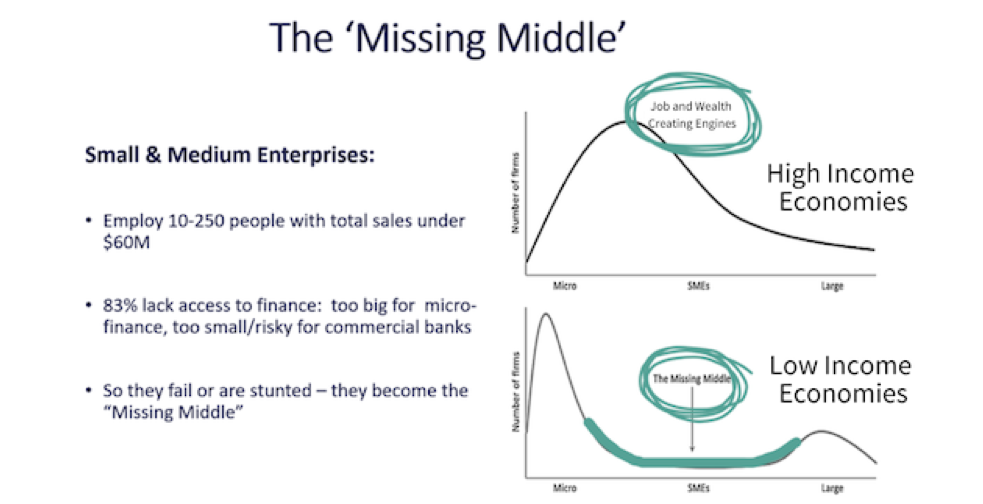
Despite all these benefits, SMEs remain significantly under-funded and underserved by financial institutions in developing nations. SMEs are too big to be served by microfinance and too small or too risky to be served by the commercial banking sector or most private equity firms. Research indicates that the credit gap confronting formal SMEs is about one trillion dollars. If we include informal enterprises that gap more than doubles to over two trillion dollars.[2]
2. Why does this “missing middle” exist?
At an economic level, there are several reasons for this funding gap. At the core is that capital markets allocate capital on a market-rate, risk-adjusted return basis. This is a sound approach to investing. Less risky companies have access to capital and at lower rates than do riskier companies. The capital markets perceive that investments into SMEs in developing nations are risky, and hence are attractive only if the company can pay a high return commensurate with the perceived risk level.
While there are high growth tech/other companies that might shine through to overcome these risks and access funding by providing high returns to investors (companies referred to as gazelles), the truth is that most SMEs in the developing world don’t fall into this type of high-growth gazelle category. The bulk of SMEs frequently are referred to as oxen—slower, steady growth companies that don’t readily attract commercial capital given the range of risks they must overcome.[3]
Thus, because this large segment of SMEs can’t access funding to grow and create good jobs, we end up with anemic investing in these emerging economies and the missing middle funding gap.
3. The consequences of anemic investing and the missing middle
A key reason why we as Christians should be concerned about anemic investing and the size of the missing middle is the inherent evils they lead to and the impact on “the least of these” from Jesus’ Parable of the Sheep and the Goats in Matthew 25. Good jobs prevent desperate actions such as prostitution, theft, civil strife, refugee flight, or terrorism. Jim Clifton, president of The Gallup organization, commented on this as a result of some significant research his organization has done: “What the whole world wants is a good job.”[4]
With increased income from steady employment, households experience security—feeding their families, educating their children, gaining access to potable water, electricity, sanitation, and medical care. As stated above, with up to 80% of formal jobs being created by SMEs in emerging economies, the way to address poverty is by helping those SMEs grow and act as the job creation engines they are designed to be.[5]
The World Bank tells us that the global economy needs to generate 600 million jobs between now and 2030, just to absorb the growing workforce and begin to tackle some of the high unemployment fallout.[6] While the job growth “solution” is clear, in over 70 percent of countries, SMEs cite access to finance as the single biggest obstacle to them doing business. Being disconnected from capital is a greater concern than tax rates, political instability, or access to electricity.[7]
4. How should Christians respond?
We at Talanton know that investing in redemptive businesses can play a key role. If we maximize holistic impact—economic, social, and spiritual returns—we can mobilize funding to support job-creating enterprises that are positioned to free the poor. Good investment disciplines can achieve this result, including identifying companies with strong faith-based leaders capable of scaling, supporting those enterprises with management and technical support, plus ongoing mentoring and performance monitoring.
But in addition to these field-focused disciplines, we need a movement of financial investors—true Kingdom-minded stewards—willing to look at maximizing impact beyond the uni-dimensional financial return of a traditional ROI. If we judge all investment decisions on a single bottom line of market rate, risk-adjusted return, then emerging economies will continue to suffer from anemic investing thereby entrapping hundreds of millions more people in desperate poverty.
Dallas Willard’s book, Called to Business, describes God’s way to loving people through business and the professions. Dallas Willard Ministries summarizes his teaching to say,
Surely, we as stewards for the Master can focus some of His resources on caring for “the least of these” whom He has called us to love and serve. Maximizing our “returns” should include the impact we can have on people’s economic, social, and spiritual lives. We believe this is the road that leads to the chance to hear, “well done good and faithful servant. You have been faithful over a little; I will set you over much. Enter into the joy of your master” (Matthew 25:21).
[1] “What’s Happening in the Missing Middle? : Lessons from Financing SMEs,” World Bank Group Working Paper, Published 3-29-2017 (https://openknowledge.worldbank.org/handle/10986/26324).
[2] Ibid.
[3] “The SME finance gap in Kenya: how are investors missing the ‘missing middle’?” (https://www.ids.ac.uk/opinions/the-sme-finance-gap-in-kenya-how-are-investors-missing-the-missing-middle/).
[4] Jim Clifton, “The Coming Jobs War”
[5] Op. cit., “What’s Happening in the Missing Middle?”
[6] Jieun Choi, “The Future of Jobs and the Fourth Industrial Revolution: Business as Usual for Unusual Business,” World Bank IBRD-IDA blog post (7-17-2017) https://blogs.worldbank.org/psd/future-jobs-and-fourth-industrial-revolution-business-usual-unusual-business
[7] Investment Climate Surveys of the World Bank (https://www.worldbank.org/en/topic/investment-climate)