

Why Do We Worry?

Editor’s Note: This article was originally published on the Sound Financial Strategies Group website by Chris McAlpine. To read the original article vist: https://www.soundfsg.com/resources/articles/worry/

by Chris McAlpine

Worry: wor·ry | ˈwər-ē , ˈwə-rē: noun; (a): mental distress or agitation resulting from concern usually for something impending or anticipated: ANXIETY (b): an instance or occurrence of such distress or agitation.

Why do we worry? What do we worry about? Granted, the world seems in chaos, our country seems to be wrecked, and only the politicians are selling hope but we don’t trust them. Isn’t it conceivable that some of our worries are worth considering? Yet, is it even more conceivable that the vast majority of our worries are not? Adrian Rogers once said that 90% of the things that we worry about never come to pass. Of the 10% left, you may consider that half are in your control and half are not. Of the 5% that is in your control, half has happened and a half has not. Therefore, you should decide how to react to 2.5% of your worries, make plans for the other 2.5%, and stop worrying about 95%.

I realize that is easier said than done, but it is doable. Retirees worry about their money running out, the world their grandchildren are growing up in, and what this nation is becoming. All of these are extremely valid concerns, but using these for example, let’s break these down. Can you make high-quality plans and be disciplined to follow these to improve your chances for retirement success? Yes, so you should do this. Stick to your plan and move forward. Yes, life still happens, but you adjust your plans and adapt. What about the world that your grandchildren are growing up in? Certainly, this is a valid concern. My teenage daughter recently said that because of the way the world is going that Christians should grow stronger in their faith. Wow, I was proud and grateful to the Lord as a Dad. But I also see the wisdom in this. God will not lose any battles between good and evil, in fact it is not an even fight. This leads us to worry about what our nation is becoming. I have not met anyone that likes what they see on the news at night. But let’s remember that “blood sells.” Therefore, the news channels are showcasing the worst of the worst stories, because that’s what we watch. Daniel predicted over 3000 years ago that “many would go back and forth, and knowledge will increase.” (Daniel 12:4) We see this happening today; information and news being pushed out for all to see without context nor the full story.

When it comes to worrying and life’s concerns, we very often overreact, overestimate, and miscalculate. We can all be guilty of this. But God is good, all-powerful, and He loves you. Yes, in this life there will be troubles, many of those we will not understand. But God says, “Behold, I am the Lord, the God of all flesh, is anything too difficult for Me?” (Jeremiah 32:27) Therefore, our response can be “let us set aside every weight and sin which clings so closely…looking to Jesus the founder and perfecter of our faith…” (Hebrews 12:1-2)


About the author

Chris McAlpin | Managing Partner and CEO

With over a decade and a half of helping clients manage their finances and move from a life of work to retirement, Chris has helped his clients align their purpose with their profit in their financial plans. Chris has a Master of Business Administration from Mississippi College and a Bachelor of Accountancy degree from the University of Mississippi.

Why Good Intentions Aren’t Enough

Article originally posted here by The Chalmers Center

by The Chalmers Center

Caring for the materially poor is not an optional aspect of the Christian life, but there is no “one-size-fits-all” recipe for how each Christian should respond to this biblical mandate.

Some are called to pursue poverty alleviation as a career, while others are called to do so as volunteers. Some are called to engage in hands-on, relational ministry, while others are better suited to support frontline workers through financial donations, prayer, and other types of support. Some Christians are called to work at a government level, seeking to promote justice for the poor through public policy. Others are called to work in the business world where they can provide job opportunities for the unemployed. Many Christians work with churches or parachurch ministries, allowing them to communicate openly the love of Jesus Christ through both words and deeds. And some Christians simply minister as individuals, walking across the street to help a neighbor in need. Each Christian has a unique set of gifts, callings, and responsibilities that influence the scope and manner in which to fulfill the call to help the poor.

We praise God for this diversity of gifts and resources in His church, but we also want to say as loudly and as clearly as we can: GET MOVING!

We believe that the coexistence of agonizing poverty and unprecedented wealth—even just within the household of faith—is an affront to the gospel. You see, what is at stake is not just the well-being of poor people—as important as that is—but rather the very authenticity of the church’s witness to the transforming power of the kingdom of God. Hence, the North American church should have a profound sense of urgency to spend ourselves “in behalf of the hungry and satisfy the needs of the oppressed” (Isa. 58:10).

What’s the Problem?

That having been said, good intentions are not enough. It is possible to hurt poor people, and ourselves, in the process of trying to help them.

You see, how we diagnose the problem of poverty directly impacts how we will seek to address it, and many of us have not thought through the complexity of material poverty to make a good diagnosis.

We’ve asked many people over the years how they would define poverty. In the vast majority of cases, middle-to-upper-class Westerners describe poverty differently than the materially poor in lower-income communities or countries do. While people who are poor mention having a lack of material things, they tend to describe their condition in far more psychological and social terms than our North American audiences. Poor people typically talk in terms of shame, inferiority, powerlessness, humiliation, fear, hopelessness, depression, social isolation, and voicelessness. Wealthier individuals tend to emphasize a lack of material things such as food, money, clean water, medicine, housing, etc. This mismatch between many outsiders’ perceptions of poverty and the perceptions of poor people themselves can have devastating consequences for poverty alleviation efforts.

While there is a material dimension to poverty there is also a loss of meaning, purpose, and hope that plays a major role in poverty. The problem goes well beyond the material dimension, so the solutions must go beyond the material as well.

Defining poverty is not simply an academic exercise, for the way we define poverty—either implicitly or explicitly—plays a major role in determining the solutions we use in our attempts to alleviate that poverty.

Think of this example: When a sick person goes to the doctor, the doctor could make two crucial mistakes:

Treating symptoms instead of the underlying illness;

Misdiagnosing the underlying illness and prescribing the wrong medicine.

Either one of these mistakes will result in the patient not getting better and possibly getting worse.

The same is true when working to alleviate poverty. If we treat only the symptoms or if we misdiagnose the underlying problem, we will not improve the situation, and we might actually make the lives of the materially poor worse in the long run.

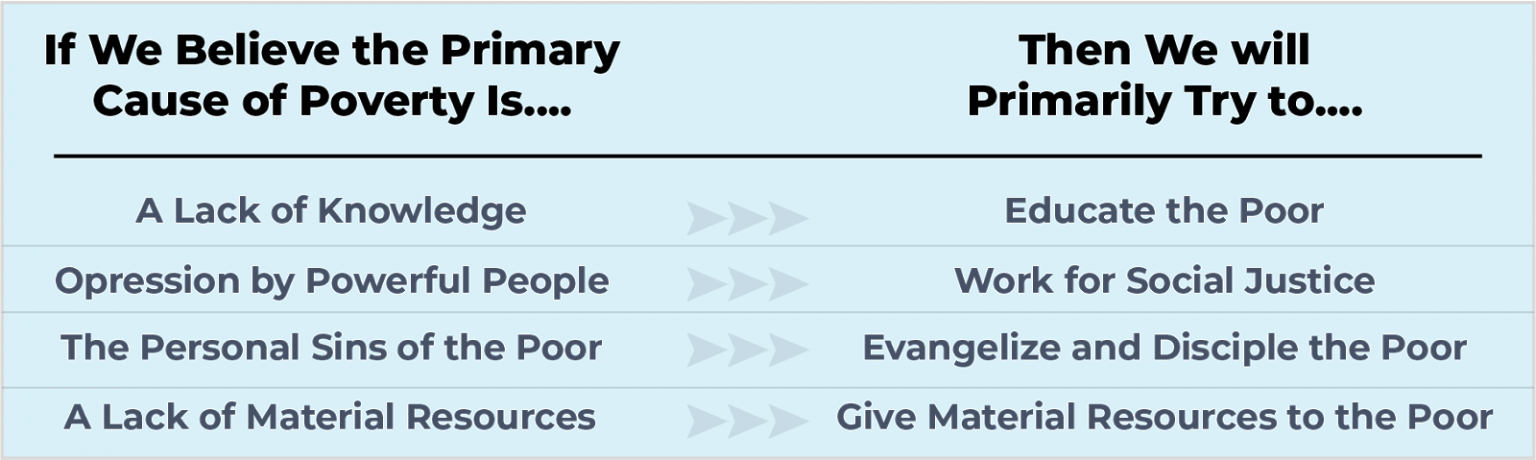
What we believe about the causes of poverty determines the solutions we will use to alleviate poverty.

A sound diagnosis is absolutely critical for helping poor people without hurting them. But how can we diagnose such a complex disease? Divine wisdom is necessary. The Chalmers Center roots our understanding of poverty and its alleviation in God’s big story of creation, fall, redemption, and consummation. Although the Bible is not a textbook on poverty alleviation, it does give us valuable insights into the nature of human beings, of history, of culture, and of God to point us in the right direction.

Helping without Hurting

Consider the example of a person who comes to your church asking for help with paying an electric bill. On the surface, it appears that this person’s problem is the last row of the table above, a lack of material resources, and many churches respond by giving this person enough money to pay the electric bill. But what if this person’s fundamental problem is a mental health issue or the effects of trauma that prevent him from keeping a stable job? What if he’s been kept out of the workforce by a lack of self-discipline or the soft skills necessary to work with others? Simply giving this person money is treating the symptoms rather than the underlying disease and will enable him to continue struggling along without long-term transformation.

In this case, the gift of the money does more harm than good, and it might be better not to do anything at all than to give this handout. Really! Instead, a better—and far more costly—solution would be for your church to develop a relationship with this person, a relationship that says, “We are here to walk with you and to help you use your gifts and abilities to avoid finding yourself in this situation in the future. Let us into your life and let us work with you to determine the reason you are in this predicament.”

While the symptoms of poor people largely look the same around the world: they do not have sufficient material things (according to the varying standards we hold of what is “sufficient”), the underlying diseases behind those symptoms are not always very apparent and can differ from person to person. A trial-and-error process may be necessary before a proper diagnosis can be reached. Like all of us, poor people are not fully aware of all that is affecting their lives, and like all of us, poor people are not always completely honest with themselves or with others. And even after a sound diagnosis is made, it may take years to help people to overcome their problems.

There will likely be lots of ups and downs in the relationship. It all sounds very time-consuming, and it is. “Spending yourself in behalf of the poor” often involves much more than giving a handout to a poor person, a handout that may very well do more harm than good.

Our efforts to help the poor can hurt both them and ourselves. Often churches and nonprofits in middle-to-upper class contexts find themselves locked into the following equation:

The Fundamental Equation for Helping that Hurts

Taking the Next Steps

What can be done to break out of this equation?

Changing the first term in this equation requires a revised understanding of the nature of poverty. Many Christians need to overcome the materialism of Western culture and learn to see poverty in more relational terms.

Changing the second term in this equation requires ongoing repentance. It requires North American Christians to understand our brokenness and to embrace the message of the cross in deep and profound ways, saying to ourselves every day: “I am not okay; and you are not okay; but Jesus can fix us both.”

And as we do this, God can use us to change the third term in this equation. By showing low-income people through our words, our actions, and most importantly our ears that they are people with unique gifts and abilities, we can be part of helping them to recover their sense of dignity, even as we recover from our sense of pride.

But do not let these truths paralyze you. Study. Learn. Pray. Repent. Try to do something. Evaluate, and then repent again. And then trust that a sovereign God is more than able to take our feeble acts and turn them into something that He can use for His glory. We would love for every Christian to quadruple their efforts to help the poor and do so immediately. But maybe we should also consider doing things differently than we have in the past. This is exactly what the Chalmers Center’s resources and training are designed for. We’re here for you. Let’s go!

Why “How much equity is fair?” Is the Wrong Question

 Photo by  Cytonn Photography  on  Unsplash

Article originally posted by Paparelli

by Charlie Paparelli

“I need a technical co-founder!” Ted exclaimed.

Ted has deep industry knowledge. He knows how the industry works. He knows the industry language. He gets the industry culture. He knows the players. He identified the problem that needs solving. He realizes he needs to build a technology solution to solve this problem.

He is stuck.

He knows how to use technology but not how to build technology. He needs a technical co-founder to get this business off the ground.

Ted worked with a couple of developers to build an alpha product. His goal was to prove a solution can be built and that his market would use it. This first cut at the product was put together with duct tape and baling wire, but it did work. More importantly, his market responded with a “Let’s build it!”

Here’s the problem.

Every talented developer already has his own company. At a minimum, it is a contract programming business. And being a good small business person, he is in search of revenue. The business founder, however, wants a real partner, an honest-to-God co-founder. He doesn’t want a partnership or joint venture with this talented developer. He wants a real partner.

The question Ted asked me was this, “How much equity is fair?”

If you are looking to get some programming done and you have no money, then this is the right question. If you are looking for a real partner, then this question is premature.

The question isn’t equity. The question is mission alignment.

Getting a talented tech developer to join you as a co-founder is really a business merger. The developer already has a business. And the developer’s business has a vision, mission, market, and product just like yours. You are asking him or her to drop their mission and adopt your mission.

How hard is this?

Real partners are on the same mission. They are thinking about accomplishing their mission 24/7. It is all they think about and talk about. It is hard to birth a business. Really hard. You are creating something real and financially sustainable from an idea. And this is why it takes absolute alignment between founders in order to have a chance at being successful.

Maybe it is just transactional.

If the developer is not captured by your mission, then the relationship will forever be transactional. He wants to help you with your mission but only as a part of his business’s mission. He is excited about his business and mission and will not give it up.

This results in a client-vendor relationship. You are not partners. In this case, work to get the economics right for both companies. If this is not possible given your personal cash and equity constraints, move on. Find another developer who will work with you.

The buy-in.

When I explained this to Ted, he said, “That will never happen. The developer I am working with will never give up his mission for my mission.” Ted threw his hands in the air and said, “I’ll never find a talented developer to be my co-founder.”

I said, “I agree. It is impossible. But all things are possible with God.”

Finding a partner is like finding a spouse. There is the initial attraction. You take your time and go on dates. You get to know each other better with each encounter. You get more involved with each other’s lives. You share your dreams. And if the attraction continues, you go deeper. You come to a shared vision, a shared mission. Then you get married.

I was talking to a Christian businessman yesterday who helps build startups in developing nations. The startups always have included in their mission, “To help build the local economy by creating jobs and sharing the Gospel of Jesus Christ.” His fiancé knew what she was getting herself into. She gave him a wedding band with this inscription: “Where you go I will go, and where you stay I will stay. Your people will be my people and your God my God.” Ruth 1:16

I have to tell you, I was blown away by this level of love, trust, and alignment. But this is what it takes to come together at the start of a marriage. And this is what it takes to come together as co-founders of a new enterprise.

Take your time.

Like dating, it all starts with sweat equity. No guarantees, just trust.

Your potential co-founder will go one of two ways as you begin working together.

  1. They will either show continually increasing commitment and engagement to you and your mission.

  2. You will see and feel them losing their enthusiasm and beginning to distance themselves.

In either case, you will know if this is your co-founder.

This is the one!

Once you know this is your co-founder, it is time to formalize the equity deal.

Here are a few criteria to consider:

  1. How far along is the company?

  2. What did you bring to this company?

  3. What is your relevant business experience?

  4. What does your co-founder bring to this company?

  5. What is the business experience of the co-founder?

These questions prompt tough conversations. And this topic is just the beginning of tough conversations. This relationship, like marriage, will continue for a very long time. And no relationship is easy.

Why I Always Have 2 Jobs

 Photo by  Carl Heyerdahl  on  Unsplash

by Jewel Burks

Since I’ve been able to work, I’ve worked multiple jobs. During summers growing up, I worked in the businesses started by my grandparents in Mobile, AL and passed down to my father and his siblings. You could find me doing everything from working the register at their BP gas station to preparing sandwiches in my father’s Subway. When I went to college, despite having a full ride academic scholarship at Howard University, I took full advantage of work study opportunities — working “security” in the evenings at the School of Business and working in the afternoons as a part-time instructor at MS², Howard’s on campus Middle School for Math and Science. Even as I worked my first full time job at Google, I moonlighted as a fashion model, signed to the now defunct, San Francisco based, City Model Management, and doing runway shows and local advertisements on the evenings and weekends to bring in an extra thousand dollars per month. Fear of being stuck in a generational cycle of debt and financial insecurity or not having enough money to pursue my dreams has always been a driving force in my life and decisions.

Click here to read the full article, originally by Jewel Burks

Why My Grandma Struck the Church out of Her Will (and Replaced It with a For-Profit Company)

Article originally hosted and shared with permission by The Christian Economic Forum, a global network of leaders who join together to collaborate and introduce strategic ideas for the spread of God’s economic principles and the goodness of Jesus Christ. This article was from a collection of White Papers compiled for attendees of the CEF Global Event.

by Matt Elsberry

At CEF, we’re blessed to be a part of a community that challenges the status quo. This paper is significantly different than my two previous efforts.

This paper and my grandma’s decision prompt a critical question: Are churches and non-profit ministries the only way money can be used to build the kingdom of God? I chose a provocative title, but I am at least attempting to write with humility. There is much incredible kingdom work happening through traditional churches and traditional ministries that are worthy of capital. This paper and my grandmother’s decision are less about diminishing these forms of kingdom building and more about promoting an alternative route, one that is being increasingly represented by incredible members and businesses in the CEF community. Perhaps many of these are also worthy homes for kingdom-building capital. My grandmother certainly believed so, and in her final days, she put her treasure where she wanted her heart to be also, with the kingdom builders.

Here’s my tribute I shared at her funeral. [Elaine Elsberry]

How do you measure the value of a life well-lived?

In my grandmother’s obituary, one word stood out to me more than any other word…curiosity. Certain words have immense power and require thousands of others to explain. “Curious” is certainly one. Like Grandma, it brings a host of descriptors to mind. She was a tiny giant, open to learning something new for every one of her 35,000+ days. She had this uncanny, erudite way of using her curiosity to inspire and draw out your own.

Words hold no respect for the strong and mighty; her tiny, 90-pound frame could break down walls and destroy kingdoms. Words could transport her mind far beyond the stamina of her body. She could teleport with her mind as effortlessly as she could turn the next page of her book.

In a word, she was curious. And her tenacious curiosity made her a tireless force for good—yes, for worship. In ancient Jewish culture, the highest form of worship was knowledge. What more respect/honor could you give someone other than to learn everything about them? And if this is indeed God’s world, and each author ever to have put pen to paper is His child, then each word is a holy utterance—a fragment of a clue in the cosmic story God is constantly unveiling about Himself.

And Grandma drank deeply from this well.

She was insatiable—and darned if not more contagious than Covid.

I was one of the lucky ones to have caught her curiosity. Many others did, too.

Countless times she would throw out a thought, “What do you think God means by…” or, “Why do you suppose God allows….” I ache to remember those questions, to be surprised by the unveiling of a cosmic record with constant availability of those precious, finite, fleeting moments, made even more valuable by their expiration.

If you had the privilege of having one of those conversations with my grandma, you’d know that after careful reflection on the ensuing discussion, she would usually lean forward and say: “Well I suppose…” before delivering a powerful truth.

I guess I always knew it in my heart, but it took her death for me to realize that she was one of my favorite people in the world with whom to have a chat.

God, I wish for just one more of those conversations. Like a spoiled child, I took for granted the delicacies that I could have called upon at any moment, and yet too often did not.

I chose my words carefully around Grandma—not out of fear but out of respect. Each word holds meaning, and I could count on her to contemplate each one and assign value to it.

She upped my game. Her curiosity would often expose weak logic or unchiseled thoughts. Sometimes while talking with her, I would find myself outside of myself, examining my own thoughts, questioning their merit. I often would concede, “I guess I’m not sure,” after conversations with Grandma.

And it’s for this reason I suppose curiosity usually precedes humility. It’s hard not to be humble when you are constantly learning.

I threw some crazy ideas at her these last few years:

  1. That God doesn’t only build His kingdom through church as we currently define it but wants to use business as well.

  2. That 99% of our available wealth is invested in companies that care nothing for the kingdom of God, while we put what equates to a fraction of a penny into “the kingdom” through charitable investments.

  3. That we largely let the US government dictate what constitutes a “kingdom-building” gift through its tax legislation.

And she was remarkably unfazed. She even cheered me on as I sought to help build a for-profit company that was committed to building the kingdom of God, showing up week after week after week to our company prayer time. And as an affront to the status quo, one last cannonball of curiosity, she did something many would consider scandalous. She struck out the traditional church from her will and penned in our for-profit company—one last big hug and encouragement from even beyond the grave. “I approve grandson. And I’m proud of you. Use that tenacious curiosity of your own to challenge the giants in front of you.”

This was an overwhelming thought to me. The most curious person I knew had dropped a fat stamp of approval on my own curiosity. These ideas my curiosity had led me to were more than ideas, they were worth the money she had reserved for the kingdom of God. And in her final days, she decided that LivFul (our company) was a better bet for growing the kingdom of God than her traditional church was.

This is no small thing, and while I tremble at the weight of the implication, I’m also glad for shoulders larger than mine who carry it (and us along with it).

I love you Grandma, and thanks to you, I have renewed strength to persist. You will forever be a part of me and my calling to demonstrate the building of the kingdom of God through business.

You are forever part of LivFul, and our legacy is surely yours as well.

I suppose my grandma threw down a bit of a gauntlet here. If you’re a business leader, the challenge is to make your business a worthy place for housing kingdom capital. Would you feel comfortable receiving a donation in lieu of it going to a church? If not, why not? I can assure you that there is no difference in how God views money entrusted to either…it’s clearly all His.

At LivFul, we don’t take this gift lightly. My grandma believed we could steward the money better than her church, and that’s quite the bar to live up to.

At the end of the parable of the talents, the man who had turned five into ten tried to give the money back to the master. “Thanks, but no thanks,” he said. “Please keep managing it for me.”

May we endeavor to build the kind of businesses that are so exemplary of the Kingdom of God that, when we try to hand the money back to God, He says the same. “You’re doing well! Keep stewarding this for me.”