Episode 11 – A Founding Father of the Faith Driven Investor Movement: Ron Blue

subscribe to the podcast

It’s not every day you get to have a conversation with someone who is widely considered to be a founding father, but that’s exactly where we found ourselves with Ron Blue. If you’ve been around the Faith Driven Investing conversation at all, you’ve no doubt heard the name, which is why we’re so excited he agreed to sit down with us.

When it comes to time with Ron, it’s like sitting in front of a firehose. His extensive experience lends to the profound insight and wisdom he has about the current state of Faith Driven Investing and what’s to come. You won’t regret tuning in to hear the half-hour he shared with us.

Whether you’re new to Faith Driven Investing, or whether you’ve been involved in this movement your entire professional career, you’ll love this conversation with Ron Blue. As always, thanks for listening.

Useful Links:

Master Your Money

Thinking Right About Your Money

What’s Your Why? The Ron Blue Story

Principles-Based Investing: The Ron Blue Investment Framework

Episode 10 – Why We Should Invest in Sinners with Tim Macready

subscribe to the podcast

Today’s episode finds us all the way down under—in Australia with our guest Tim Macready. Tim is Chief Investment Officer at Christian Super. He has been responsible for the development of the Fund’s Responsible Investment Approach, which is applied across the entire portfolio and now incorporates Negative Screening and Impact Investing. 

What we think you’ll love most about this episode is hearing Tim talk about how he set out to create the “perfect, faith-driven fund”. But then he realized…We’re all sinners. He’s a sinner, every company is led by sinners, and every customer is a sinner.

He talks openly about how that shifted his perspective, some of the tough decisions it led him to, and how he stewards that calling today. As always, thanks for listening.


Useful Links:

How Our Faith Affects the Way We Invest

Where Are the Christian Investors?

Why I Invest in Sinners

Why Context Matters for Early-Stage Investing in Africa

by Tony Chen

After spending 3 years living in Kenya, we returned to the States in 2018. I had invested as an angel investor and built a portfolio of 15 Kenyan companies, and I felt convicted in my prayers: “Tony, what you had started doing in Kenya, go deeper.”

This gave me new clarity and compelled me on a journey to better understand the funding models for Africa and to launch a new fund. I also became instantly curious about how funds launch, and more importantly, how funds pivot and iterate over time. How do funds change course to better achieve product-market fit?

As a 5-time tech entrepreneur, I love the process of pivoting and iterating the next version of a potential product in 5-week sprints. We code like crazy, let adventurous beta-customers try it out, get feedback, and then based on that feedback, rinse and repeat every 5 weeks. I received some great advice from a friend who’d transitioned from tech entrepreneurship into tech VC, “Yes, you can iterate on funds. But instead of 5 weeks, it might take 5 years to get your first data points. The worst thing you could do is deploy all this capital today, and in 5 years, you’d be very wise, and very broke.”

How do I squeeze 15 years of wisdom into 15 months? That motivated me to learn from experienced investors who’ve iterated. We asked them: What drives outcomes in early-stage ventures in Africa, and how have you changed your approach? I partnered with two African thought leaders, and together, we interviewed 100+ Africa-centric entrepreneurs, investors, and LPs, took 900+ pages of notes, coded our findings into 15 key themes, and synthesized our findings. We published the resulting report this past January entitled Chasing Outliers: Why Context Matters for Early-Stage Investing in Africa (free access at kinyungu.com/chasingoutliers).

We learned a ton. First, the obvious.

Silicon Valley venture capital is largely a mismatch for most African ventures. The VC model works when the context has these critical ingredients: huge markets, high lifetime value of customers, efficient infrastructure to capture and retain customers cheaply, and plentiful investors at every stage of the business lifecycle. In most African markets (and actually in most markets globally), none of those ingredients are present. Context matters.

Another important contextual element is time horizon. Things often take longer in Africa (and many emerging markets). Exogenous shocks — a shaky transition of power, a drought, a new head-scratcher regulation — are frequent. Relationships and trust take time to build. Also, an entrepreneur trying to solve problem A realizes she can’t unless she also solves problems B & C. How do you create the “Amazon of Africa” if there aren’t addresses? How do you loan money if there isn’t such a thing as credit scores? These foundational problems — reframed — are massive opportunities. Investors willing to look deeper into the context will be rewarded. But most overestimate what can be done in 1 year and underestimate what can be done in 10.

Venture capital is like a race car. With smooth, straight roads, good weather, and a pit crew, you can get places fast. It’s a beautiful vehicle designed for a very specific purpose under very specific circumstances. But too often, too many have copy-and-pasted it into other arenas too widely. Why aren’t we talking more about 4-wheel off-roaders built for versatility or even little motorbikes designed for agility?

Now to a non-obvious lesson.

One of my personal take-aways from the research was that these $50-500k checks into early-stage African tech companies are crucially strategic, still represent jaw-dropping opportunities, and yet are almost impossible to pull off as a stand-alone fund using typical investment structures. I found 4 groups who had tried launching $20M early-stage tech funds who all failed. I looked at the ~30 groups that were writing $50k checks in Kenya, and every single one had other revenue streams: donor capital and/or a parallel business (usually advisory or intelligence). To be honest, this was hard to accept. I thought I was being faithful by “going deeper” into launching the fund.

So, what do you do when the exact thing you thought you were called to do isn’t feasible?

Ironically, one of the crucial things I look for in investable entrepreneurs is their pivoting ability. The best entrepreneurs are the best pivot-ers. It reveals a certain curiosity and humility that they can learn from the market. It also reveals that they haven’t fallen in love with their solution. No, they’ve fallen in love with solving a problem. Looks like I needed to follow my advice.

I began exploring alternative structures with longer-term focus and niche investment strategies. I became quite encouraged by the entrepreneurs and investors who are pivoting within these realities. One fund’s primary investment thesis was companies that solve those “problems B & C” — reducing the friction of doing business. Some are innovating around fund structure and instruments used. A group within the Faith-Driven Investor community is innovating how due diligence “lite” can be done so that smaller $50-500k checks can be written in more sustainable ways. Some agri entrepreneurs are pursuing end-to-end vertical integration to build unique moats. I’m excited to see more and more notable CEF members like Verdant Frontiers, Talanton, and Saad Capital (and other Faith-Driven Investors like Future Africa). All four are working in Africa, executing unique niche strategies, utilizing non-traditional structures, respecting the local context, and gaining great traction.

In the midst of this exploration, in God’s timing, an opportunity came up, and I joined one of those innovators — Verdant Frontiers — as a Partner.

Verdant will also acquire my firm Kinyungu Ventures and the existing tech portfolio.  Together, we’ll bring a long-term value creation approach in the African tech sector. I’m excited to be able to continue investing in African tech companies, while also being part of a broader entrepreneurial team passionate about building large-scale businesses across the African continent.

I’m excited for a new season that is dawning. There’s no doubt in my mind:

Africa’s moment has arrived.

Opportunities abound, and redemptive entrepreneurs and investors have pivoted to capture this opportunity by building great teams, executing with resilience, respecting the local context, and thinking long-term.

Article originally hosted and shared with permission by The Christian Economic Forum, a global network of leaders who join together to collaborate and introduce strategic ideas for the spread of God’s economic principles and the goodness of Jesus Christ. This article was from a collection of White Papers compiled for attendees of the CEF’s Global Event.


Why Do Christians Give?

by John Cortines

Why Do Christians Give?

“Keep your life free from love of money.” (1)

 “Sell all that you have and distribute to the poor.” (2)

“Do good… be rich in good works… be generous and ready to share.” (3)

Christians consider the Bible to be our source of truth in matters of faith.  And the Bible says more about money than it does about heaven and hell combined.  Jesus says more about money than heaven, hell, or prayer, and there are over 2,300 verses pertaining to money in the Bible.  Clearly, it occupies an important place in what we consider to be God’s inspired word.  So, what does it say?

In short, three things:

  1. All of our wealth originates from and belongs to God. (4)

  2. In light of this, our wealth should be used for God’s purposes. (5)

  3. God’s purpose is to restore the world to wholeness.   This occurs spiritually through salvation in Jesus Christ, and physically through our service and giving to serve the poor, needy, and weak. (6)

Implicit in these three statements is the idea that our wealth is not our own.  As followers of Jesus we believe that we have been bought with a price – when He died for us, we were purchased into His eternal family, accepted and redeemed. (7)  In light of what He’s done for us, nothing but radical and total submission to His purposes would be reasonable.  (8)

Thus, our wealth is not to be used for our own goals, but rather subsumed into the greater purposes of God.  Since we believe it is God who enables us to get wealth in the first place, and that we are the recipients of His great grace in our lives, our natural and joyful response is to engage in radical generosity on behalf of the Christian church and the poor.

This gets expressed in a variety of ways, but a few real-life examples might paint a picture of what 21st-century Christian giving looks like in its highest and best form.  (All are true stories!)

  • Mark and Megan, in their late 20’s, are so thankful for Mark’s $50,000 bonus he earned at his law firm.  Joyfully and with a great sense of purpose, they give the entire amount away toward international justice efforts for the poor, and a Christian camp they admire.  They rank the opportunity to give to God’s work more highly than their own potential enjoyment of this money, including their imminent need for a home down-payment.

  • Tom and Bree relocate to a poor neighborhood, despite Tom’s very high income.  They read about God’s heart for the poor in the Bible, and they want to know God’s heart.  They lead a Bible study for the community, and eventually welcome a family in need to stay in their home for a while, while they get back on their feet.  They give a huge fraction of their income away, raising their family on the median family income out of a desire to serve the world around them.

  • Greg and Alison are home shopping.  They buy a house that costs less than half of what they can afford, because they want to embrace contentment and to give generously to spread the Christian message of hope.  The house is less than what they’d like to have or what their peers may own, but they’re thankful God has given them the opportunity to give generously.

Paul’s Goodbye

The Apostle Paul stands second only to Jesus in his influence on the Christian faith.  In his final goodbye to the Christian community around him, he gave them this charge:

“And now I commend you to God and to the word of his grace, which is able to build you up and to give you the inheritance among all those who are sanctified. I coveted no one’s silver or gold or apparel. You yourselves know that these hands ministered to my necessities and to those who were with me. In all things I have shown you that by working hard in this way we must help the weak and remember the words of the Lord Jesus, how he himself said, ‘It is more blessed to give than to receive.’”

He commends them to the word of God’s grace – i.e. the Christian message of spiritual salvation.  And then, he tells them that he never coveted money, and goes on to charge them to help the weak and remember that it is more blessed to give than to receive.   (9)

Why is Paul mixing up money behaviors with the spiritual message of God’s grace?  Consistent with the rest of the Bible, Paul didn’t see money and spiritual life as separable.  His life, free of covetousness and fully generous, was evidence of God’s grace acting in his heart.  As the well-known Christian Pastor Tim Keller says, reflecting on this passage,

“To the degree you understand the Gospel of grace, you will live a radically generous life!  If you truly have a spiritual inheritance, you are going to be promiscuously generous with your earthly inheritance.”

Christian giving springs from our view of God.  Because we believe he emptied himself and gave everything for us, (10) we have no proper response but to turn around, face the world around us, and give ourselves away.

John Cortines is the co-author of two books including God and Money: How We Discovered True Riches at Harvard Business School.  He serves with the Maclellan Foundation, where he oversees efforts to catalyze a global movement of generosity among all believers.  John lives in Orlando with his wife Megan, their five children, and a flock of chickens.

Footnotes:

1 – Hebrews 13:5
2 – Luke 18:22
3 – 1 Timothy 6:17-19
4 – Deuteronomy 8:18, 1 Chronicles 29:11-14, Colossians 1:16
5 – Luke 12: 42-43, Matthew 25: 31-46
6 – Luke 4:18-19, 2 Corinthians 5:18, Matthew 28: 19-20, Jeremiah 22: 13-16, Proverbs 19:17
7 – 1 Corinthians 6:20
8 – Matthew 16:24, Luke 14:33
9 – Acts 20: 32-35, bolding added
10 – Philippians 2: 5-8

Why Do We Worry?

Editor’s Note: This article was originally published on the Sound Financial Strategies Group website by Chris McAlpine. To read the original article vist: https://www.soundfsg.com/resources/articles/worry/

by Chris McAlpine

Worry: wor·ry | ˈwər-ē , ˈwə-rē: noun; (a): mental distress or agitation resulting from concern usually for something impending or anticipated: ANXIETY (b): an instance or occurrence of such distress or agitation.

Why do we worry? What do we worry about? Granted, the world seems in chaos, our country seems to be wrecked, and only the politicians are selling hope but we don’t trust them. Isn’t it conceivable that some of our worries are worth considering? Yet, is it even more conceivable that the vast majority of our worries are not? Adrian Rogers once said that 90% of the things that we worry about never come to pass. Of the 10% left, you may consider that half are in your control and half are not. Of the 5% that is in your control, half has happened and a half has not. Therefore, you should decide how to react to 2.5% of your worries, make plans for the other 2.5%, and stop worrying about 95%.

I realize that is easier said than done, but it is doable. Retirees worry about their money running out, the world their grandchildren are growing up in, and what this nation is becoming. All of these are extremely valid concerns, but using these for example, let’s break these down. Can you make high-quality plans and be disciplined to follow these to improve your chances for retirement success? Yes, so you should do this. Stick to your plan and move forward. Yes, life still happens, but you adjust your plans and adapt. What about the world that your grandchildren are growing up in? Certainly, this is a valid concern. My teenage daughter recently said that because of the way the world is going that Christians should grow stronger in their faith. Wow, I was proud and grateful to the Lord as a Dad. But I also see the wisdom in this. God will not lose any battles between good and evil, in fact it is not an even fight. This leads us to worry about what our nation is becoming. I have not met anyone that likes what they see on the news at night. But let’s remember that “blood sells.” Therefore, the news channels are showcasing the worst of the worst stories, because that’s what we watch. Daniel predicted over 3000 years ago that “many would go back and forth, and knowledge will increase.” (Daniel 12:4) We see this happening today; information and news being pushed out for all to see without context nor the full story.

When it comes to worrying and life’s concerns, we very often overreact, overestimate, and miscalculate. We can all be guilty of this. But God is good, all-powerful, and He loves you. Yes, in this life there will be troubles, many of those we will not understand. But God says, “Behold, I am the Lord, the God of all flesh, is anything too difficult for Me?” (Jeremiah 32:27) Therefore, our response can be “let us set aside every weight and sin which clings so closely…looking to Jesus the founder and perfecter of our faith…” (Hebrews 12:1-2)


About the author

Chris McAlpin | Managing Partner and CEO

With over a decade and a half of helping clients manage their finances and move from a life of work to retirement, Chris has helped his clients align their purpose with their profit in their financial plans. Chris has a Master of Business Administration from Mississippi College and a Bachelor of Accountancy degree from the University of Mississippi.

Why Good Intentions Aren’t Enough

Article originally posted here by The Chalmers Center

by The Chalmers Center

Caring for the materially poor is not an optional aspect of the Christian life, but there is no “one-size-fits-all” recipe for how each Christian should respond to this biblical mandate.

Some are called to pursue poverty alleviation as a career, while others are called to do so as volunteers. Some are called to engage in hands-on, relational ministry, while others are better suited to support frontline workers through financial donations, prayer, and other types of support. Some Christians are called to work at a government level, seeking to promote justice for the poor through public policy. Others are called to work in the business world where they can provide job opportunities for the unemployed. Many Christians work with churches or parachurch ministries, allowing them to communicate openly the love of Jesus Christ through both words and deeds. And some Christians simply minister as individuals, walking across the street to help a neighbor in need. Each Christian has a unique set of gifts, callings, and responsibilities that influence the scope and manner in which to fulfill the call to help the poor.

We praise God for this diversity of gifts and resources in His church, but we also want to say as loudly and as clearly as we can: GET MOVING!

We believe that the coexistence of agonizing poverty and unprecedented wealth—even just within the household of faith—is an affront to the gospel. You see, what is at stake is not just the well-being of poor people—as important as that is—but rather the very authenticity of the church’s witness to the transforming power of the kingdom of God. Hence, the North American church should have a profound sense of urgency to spend ourselves “in behalf of the hungry and satisfy the needs of the oppressed” (Isa. 58:10).

What’s the Problem?

That having been said, good intentions are not enough. It is possible to hurt poor people, and ourselves, in the process of trying to help them.

You see, how we diagnose the problem of poverty directly impacts how we will seek to address it, and many of us have not thought through the complexity of material poverty to make a good diagnosis.

We’ve asked many people over the years how they would define poverty. In the vast majority of cases, middle-to-upper-class Westerners describe poverty differently than the materially poor in lower-income communities or countries do. While people who are poor mention having a lack of material things, they tend to describe their condition in far more psychological and social terms than our North American audiences. Poor people typically talk in terms of shame, inferiority, powerlessness, humiliation, fear, hopelessness, depression, social isolation, and voicelessness. Wealthier individuals tend to emphasize a lack of material things such as food, money, clean water, medicine, housing, etc. This mismatch between many outsiders’ perceptions of poverty and the perceptions of poor people themselves can have devastating consequences for poverty alleviation efforts.

While there is a material dimension to poverty there is also a loss of meaning, purpose, and hope that plays a major role in poverty. The problem goes well beyond the material dimension, so the solutions must go beyond the material as well.

Defining poverty is not simply an academic exercise, for the way we define poverty—either implicitly or explicitly—plays a major role in determining the solutions we use in our attempts to alleviate that poverty.

Think of this example: When a sick person goes to the doctor, the doctor could make two crucial mistakes:

Treating symptoms instead of the underlying illness;

Misdiagnosing the underlying illness and prescribing the wrong medicine.

Either one of these mistakes will result in the patient not getting better and possibly getting worse.

The same is true when working to alleviate poverty. If we treat only the symptoms or if we misdiagnose the underlying problem, we will not improve the situation, and we might actually make the lives of the materially poor worse in the long run.

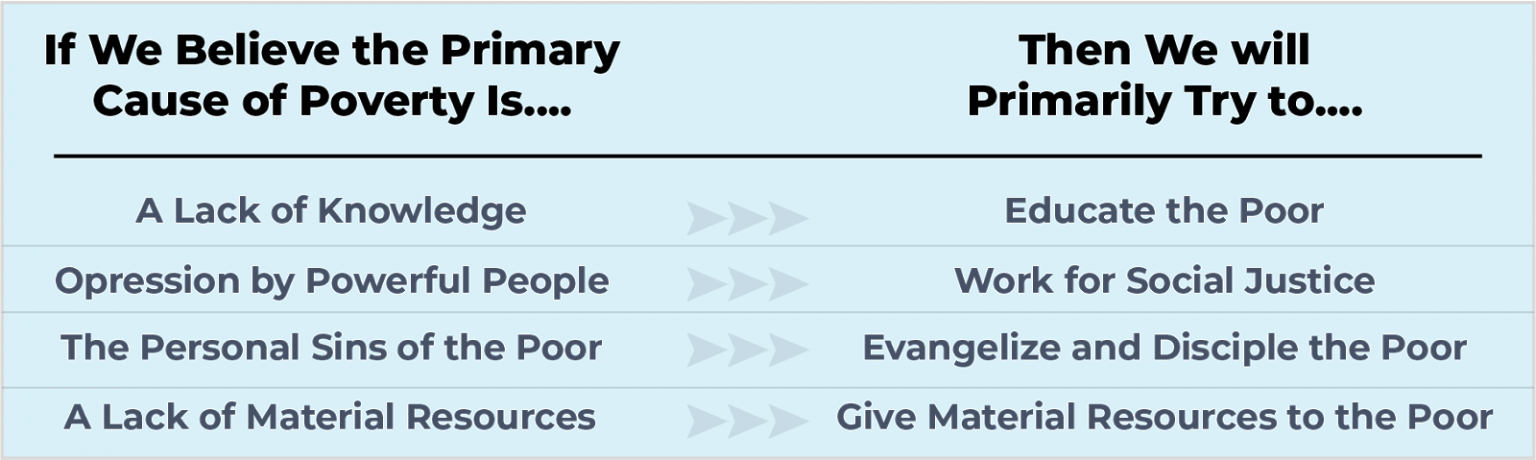
What we believe about the causes of poverty determines the solutions we will use to alleviate poverty.

A sound diagnosis is absolutely critical for helping poor people without hurting them. But how can we diagnose such a complex disease? Divine wisdom is necessary. The Chalmers Center roots our understanding of poverty and its alleviation in God’s big story of creation, fall, redemption, and consummation. Although the Bible is not a textbook on poverty alleviation, it does give us valuable insights into the nature of human beings, of history, of culture, and of God to point us in the right direction.

Helping without Hurting

Consider the example of a person who comes to your church asking for help with paying an electric bill. On the surface, it appears that this person’s problem is the last row of the table above, a lack of material resources, and many churches respond by giving this person enough money to pay the electric bill. But what if this person’s fundamental problem is a mental health issue or the effects of trauma that prevent him from keeping a stable job? What if he’s been kept out of the workforce by a lack of self-discipline or the soft skills necessary to work with others? Simply giving this person money is treating the symptoms rather than the underlying disease and will enable him to continue struggling along without long-term transformation.

In this case, the gift of the money does more harm than good, and it might be better not to do anything at all than to give this handout. Really! Instead, a better—and far more costly—solution would be for your church to develop a relationship with this person, a relationship that says, “We are here to walk with you and to help you use your gifts and abilities to avoid finding yourself in this situation in the future. Let us into your life and let us work with you to determine the reason you are in this predicament.”

While the symptoms of poor people largely look the same around the world: they do not have sufficient material things (according to the varying standards we hold of what is “sufficient”), the underlying diseases behind those symptoms are not always very apparent and can differ from person to person. A trial-and-error process may be necessary before a proper diagnosis can be reached. Like all of us, poor people are not fully aware of all that is affecting their lives, and like all of us, poor people are not always completely honest with themselves or with others. And even after a sound diagnosis is made, it may take years to help people to overcome their problems.

There will likely be lots of ups and downs in the relationship. It all sounds very time-consuming, and it is. “Spending yourself in behalf of the poor” often involves much more than giving a handout to a poor person, a handout that may very well do more harm than good.

Our efforts to help the poor can hurt both them and ourselves. Often churches and nonprofits in middle-to-upper class contexts find themselves locked into the following equation:

The Fundamental Equation for Helping that Hurts

Taking the Next Steps

What can be done to break out of this equation?

Changing the first term in this equation requires a revised understanding of the nature of poverty. Many Christians need to overcome the materialism of Western culture and learn to see poverty in more relational terms.

Changing the second term in this equation requires ongoing repentance. It requires North American Christians to understand our brokenness and to embrace the message of the cross in deep and profound ways, saying to ourselves every day: “I am not okay; and you are not okay; but Jesus can fix us both.”

And as we do this, God can use us to change the third term in this equation. By showing low-income people through our words, our actions, and most importantly our ears that they are people with unique gifts and abilities, we can be part of helping them to recover their sense of dignity, even as we recover from our sense of pride.

But do not let these truths paralyze you. Study. Learn. Pray. Repent. Try to do something. Evaluate, and then repent again. And then trust that a sovereign God is more than able to take our feeble acts and turn them into something that He can use for His glory. We would love for every Christian to quadruple their efforts to help the poor and do so immediately. But maybe we should also consider doing things differently than we have in the past. This is exactly what the Chalmers Center’s resources and training are designed for. We’re here for you. Let’s go!