6 Things to Know About Faith-Driven Investing by U.S. News

6 Things to Know About Faith-Driven Investing by U.S. News

 Photo by  Ben White

Photo by Ben White

Socially responsible investing has become a popular way for investors to put their money where their values are. Experts say faith-based investing is now following suit in popularity.

“The faith-based investment approach is predicted to grow, especially as companies see the socially responsible investing agenda as good business,” says Alexander Lowry, professor of finance at Gordon College in Massachusetts.

RELATED CONTENT

Socially Responsible Investing Delivers

There are more than 250 socially responsible funds in the United States, of which approximately 40 would fall into the biblically or religiously responsible investing space, says Dwayne Safer, assistant professor of finance at Messiah College in Pennsylvania.

The funds help like-minded investors avoid putting their money into items and practices that don’t match their spiritual values – such as alcohol, tobacco, pornography, gambling and guns – by screening them out, he says.

Faith-based investing is based on the idea that how a business makes money is just as important as how much it makes, says Ben Malick, chief investment officer at Bright Portfolios, which offers biblical investments to clients in Lee’s Summit, Missouri.

Faith-based investments exist across all asset classes and industries – and they control billions of dollars. Eager to get started? Here are a few things you should know before pairing dollars with dogma…

Read full article here.

Building a Matthew 25 Company. Should We Try? Is It Possible?

  Image by   Henry & Co .

Image by Henry & Co .

This article was originally presented at The Christian Economic Forum 2019.
Check out
CEF for other quality content!

The Christian Economic Forum hosts a world-class Global Event each year to connect the top industry leaders and experts from around the world with other individuals who are compelled to act upon the principles of God’s economy. The following paper was presented at CEF 2019.

by Robert Dickie

My time of service at Crown Financial Ministries was a life-changing experience. Through this I felt the Lord had given me Matthew 25 as my “life chapter” to live out in all areas of my life. As I was about to pivot to my next entrepreneurial venture I felt called to live out the commands in Matthew 25 in business. Was it possible to build a real “Matthew 25 Company” that had foundational principles of lordship, stewardship, and generosity hardwired into the DNA of the organization? How would God call me to live this out? I knew from experience that many “Christian” business leaders I had looked up to early in my career lived segregated lives where business and faith did not intersect; their business practices did not meet what I saw Jesus commanding us to do in Scriptures.

In Matthew 25 Jesus told three compelling stories that highlight the importance of lordship, stewardship, and generosity in a Christ-follower’s life. What struck me is His closing words to His disciples starting in verse 34:

“Then the King will say to those on His right, “Come, you who are blessed by my father, inherit the Kingdom prepared for you from the foundation of the world. For I was hungry and you gave Me something to eat; I was thirsty and you gave Me something to drink; I was a stranger and you took Me in; I was naked and you clothed Me; I was sick and you took care of Me, I was in prison and you visited Me . . . And the King answered them, “I assure you, whatever you did for one of the least of these brothers of Mine, you did for Me.”

I had an intellectual understanding of this chapter in Matthew. I lived a comfortable and segregated Christian life living out these principles with ease but holding on to what I eventually came to understand was an element of pride, arrogance, and blindness to the world around me that prevented me from seeing what Jesus was really saying. In the context of business, my blindness was not only of my own accord but also from the structural societal norms that hinder “brothers and sisters” in our midst from experiencing what Jesus offers all of us: connection, meaning, relevance, acceptance, redemption, understanding, and compassion. I had blindly followed society’s standards until Jesus opened my eyes.  

In business I had been taught that the ultimate job of the CEO is to “increase shareholder value” and profits for the company. In our society this has been the accepted and celebrated role for business at almost any cost. In my journey, I have mentored with successful, highly educated, incredibly gifted, and hardworking captains of industry who through sheer willpower, work ethic, and drive have become titans in their respective fields. Their stories are incredible. Their gifting is unmatched. In casual conversation many will opine their libertarian views, preaching limited government and how anyone in society can achieve success if they work hard enough. The mythological American self-made man with a Puritan work ethic who leans in to achieve success against all odds by hard work and a never quit attitude is the benchmark for all to achieve if they just try hard enough. Our conversations included the virtues of maximizing profits so we could support the church, charity, and those in need, but it was clear that business’ role is not to help in that fashion. “Let government, the church, and charity take care of the needy. I support all three with my tax dollars and donations,” was a statement I heard more than once from some businessmen. I wondered how those statements would be taken by Jesus. We know that Old Testament law required farmers to leave the edges of the fields to be gleaned by the poor. We see a powerful example in the story of Ruth and how this action impacted society. Farming was the most common business of the day and law required it NOT to be 100% efficient or focused on maximizing profits. It was law that business was to help the needy in society. Was this a good law? Have Christian leaders thought about this today as we lead our companies? God started to speak to me about this in a very meaningful way.

Let me state clearly, I do not consider myself as “gifted” like the great leaders I mention above, but do believe I have been given abilities by God. I came to discover that I had developed a pride around the gifts God had given me. I attributed those gifts to personal skills I had developed by my drive, work ethic, and ability to work long hours. As my eyes were opened I understood He had given me these abilities and my job was to steward them for others. Moreover, I came to realize that not everyone was made like me. In fact, my arrogance led me to believe everyone should be able to do what I did and if they didn’t something was wrong with them. I thought a person’s lack of success was due to them not trying hard enough, or perhaps came from their laziness or lack of focus and drive.

The thought to give accommodations, understanding, and compassion to people not wired like me was not on my agenda. I was running after a goal and people needed to get the job done. If they didn’t we would find someone who would. I understood that a business’s greatest asset is its people, so I looked for, hired, and kept only people who fit the mold I was looking for. My job was to grow the business, maximize value, and increase profits. I gave no thought to how Jesus’ commands in Matthew 25 should impact the way I steward a business. Certainly a company needs to strive to be the best and hire the best but should we also create an element similar to businesses of the Old Testament to help those on the fringes? That thought never crossed my mind. My life was segregated, like the lives of many of my mentors. My Christian walk, generosity, and help to others would come from my “Christian life” by donations, missions, and service in the community with my spare time and the profits I had made in my business ventures. I was effectively ignoring God’s commands in one area of my life to maximize business efficiency, effectiveness, and profits; I was then using those benefits in another area of life to live out God’s commands. Does this work? Is this what Jesus would want me to do? I finally came to a painful awakening as I saw the world around me that I had been blinded to seeing. This happened when I saw through the eyes of my son, Lachlan.

Lachlan has always had a special place in my heart as my firstborn of six children. I placed high expectations on him as a little boy and was excited to watch him grow into a man. He has a kind heart, loves the Lord, and was a naturally gifted runner from the time he was little. A remarkable student who strove to excel in the classroom, he received great report cards all through school. He became one of the best runners in the state of Tennessee, placing third in the state cross country championships, which earned him a full-ride athletic scholarship to Carson Newman University. His work ethic was unrivaled; he would routinely get up at 5:00 in the morning to go with me to the gym to get a workout in before school. I marveled at his commitment and drive. However, during his junior year of high school, my wife Brandi and I began to notice things that did not seem right. Lachlan started to struggle in both the classroom and on the track. His attention and focus waned. He started dealing with depression for no obvious reasons. His behavior was erratic and at times strange with no correlation to triggering events. It started to feel as if he was out of control. Things progressively got worse and after finishing his second year of college, he walked away from his scholarship and returned home. We were dumbfounded and confused. Our son had become a person we almost could not recognize or understand; we had no idea what to do. Through prayer, research, and the help of medical professionals, Lachlan was finally diagnosed with bipolar disorder. In simple terms, we all know what it is like to have our computer or phone crash or lock-up. Imagine the CPU of your life—your mind—doing that to you with no warning. That is the life I began to see unfold with my son. 

Unable to thrive in a college environment, Lachlan decided to stay home, work, take classes at a community college, and work on healing and building a foundation in life that would allow him to have success. He was learning how to deal with this new disorder that could derail him on a moment’s notice. Sadly, my attitude at first was one of, “Snap out of it. Be strong! Just focus, work hard, and don’t let your mind go into negative areas. You can do this. This is a choice. Choose to live your life differently. Come on Lachlan!” This was not helpful and I realized that God was working on me maybe more than on Lachlan through this experience. I understood clearly for the first time how I was blessed by God and that He wanted me to see how many people in life see and experience the world differently from me. I have shed many tears through this entire journey with my son. I have grown in patience, empathy, and compassion. I have been overwhelmed to see how a segment of our society lives and must endure with very few people understanding them. Most people do not know how to respond, help, and support those struggling with mental illness. Lachlan does not want charity. He wants a life of meaning and significance but it will require him to be in a place where people have compassion and understanding.

I have watched Lachlan on his journey these past two years as he threw himself into his work. He won efficiency awards at Honda, worked 50+ hour weeks in hot warehouses to the point of exhaustion, which ultimately led to a breakdown. I have watched him go from job to job, each leading to the same conclusion with a physical and mental breakdown. I realized that as a Christian leader I was being called to address this issue. If a Christian will not provide an environment for “brothers and sisters” in need, who will? I came to understand that living a segregated Christian life is not what Jesus called me to do. I have been blessed with attributes that allow me to work in the area of business and employ others while building and growing companies. It is my job to steward them in a different way to help the marginalized in society.

 I am committed to living out Matthew 25 in my life. I am now committed to trying to discover what it means to build a Matthew 25 company that lives out these values. I am early in my journey. I have more questions than answers and many people who have told me this won’t work. I hold on to the belief that if Jesus commanded it of us it is possible and He will help and provide the answers I need. I ask you: is it possible that Jesus’ commands are not just good but can be profitable as well? Can you build a successful Matthew 25 company? I believe you can.


A New Cure for Anemic Investment in Emerging Economies

A New Cure for Anemic Investment in Emerging Economies

  Image by   Tyler Lastovich

Image by Tyler Lastovich

This article was originally presented at The Christian Economic Forum 2019.
Check out
CEF for other quality content!

The Christian Economic Forum hosts a world-class Global Event each year to connect the top industry leaders and experts from around the world with other individuals who are compelled to act upon the principles of God’s economy. The following paper was presented at CEF 2019.

by David Simms


Christians know God cares deeply about His children who are trapped in poverty. The Bible has more than 300 verses on the topic of poverty and social justice. Jesus quoted these words from Isaiah 61:1-2 at the start of His earthly ministry:  

“The Spirit of the LORD is upon Me, because He appointed Me to preach the gospel to the poor. He has sent Me to proclaim release to the captives, and recovery of sight to the blind, to set free those who are downtrodden, to proclaim the favorable year of the LORD . . . Today this Scripture has been fulfilled in your hearing.” Luke 4:16-21

As Christ’s disciples, we are called to emulate Him. If His heart is with the poor than our mandate to love and serve them is crystal clear. But while the call is clear, how we are to respond is less clear and is varied.  

What does “poverty” mean? Where is poverty the greatest? Recent studies show almost two billion people live on less than $3 per day—that’s over a fourth of the world’s population. While this statistic may be accurate, it does not communicate the depth of what this means to those currently trapped at this level of subsistence. People living below $3 per day, in general, do not consistently have three meals per day, access to good housing, potable water, sanitation, and health care, the ability to enroll their children to school, and most importantly, hope that things can be better in the future. Most of the families living in poverty live in Sub Saharan Africa, India, China, Southeast Asia, and parts of Latin Ameria.

Many attributes define poor families, but one common thread runs through them all—a lack of steady jobs. Where good jobs exist, people can gain employment to feed and educate their families, provide adequate housing, water, sanitation, and gain access to medical care. Without a good job, all these elements that can lead to a flourishing life are likely to be missing.

Let’s then turn to understand the nature of anemic investing by capital providers into emerging economies and how it subjects millions of people to lives of deep poverty by denying them the steady jobs necessary to work their way out of despair and poverty.


1.    Why is investing in emerging economies anemic and why is that  important?

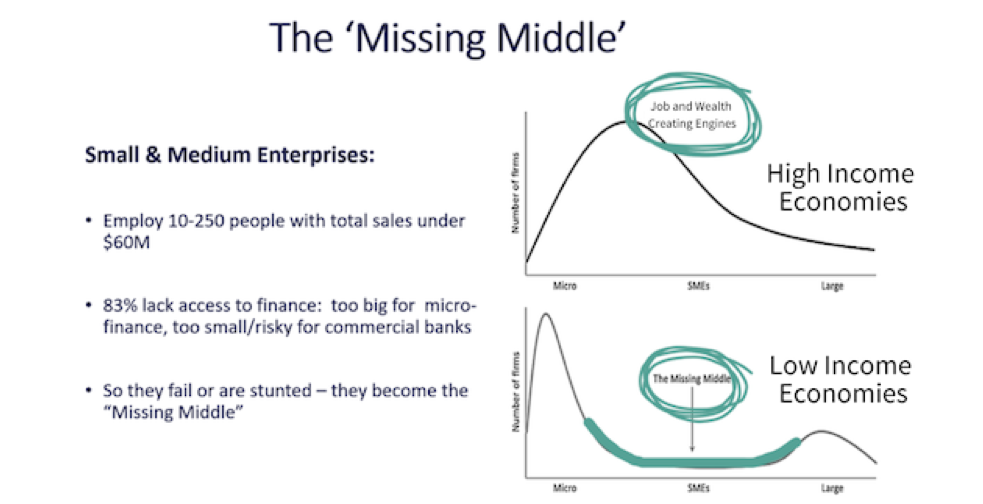
The chart below shows what is meant by the “missing middle.” In the developing world, it is a huge gap in funding for “small and medium enterprises” (SMEs). SMEs are companies that employ between 10–250 people with sales under $60M. This is the cohort that makes up the bulk of businesses in high-income counties. They are important because SMEs are the backbone of almost every economy; according to the World Bank they account for more than 50% of jobs and contribute more than 35% of Gross Domestic Product in most emerging markets. Studies show that SMEs create as many as 80% of all new jobs in a developing economy.[1]

Despite all these benefits, SMEs remain significantly under-funded and underserved by financial institutions in developing nations. SMEs are too big to be served by microfinance and too small or too risky to be served by the commercial banking sector or most private equity firms. Research indicates that the credit gap confronting formal SMEs is about one trillion dollars. If we include informal enterprises that gap more than doubles to over two trillion dollars.[2]

2.    Why does this “missing middle” exist?

At an economic level, there are several reasons for this funding gap. At the core is that capital markets allocate capital on a market-rate, risk-adjusted return basis. This is a sound approach to investing. Less risky companies have access to capital and at lower rates than do riskier companies. The capital markets perceive that investments into SMEs in developing nations are risky, and hence are attractive only if the company can pay a high return commensurate with the perceived risk level.

While there are high growth tech/other companies that might shine through to overcome these risks and access funding by providing high returns to investors (companies referred to as gazelles), the truth is that most SMEs in the developing world don’t fall into this type of high-growth gazelle category. The bulk of SMEs frequently are referred to as oxen—slower, steady growth companies that don’t readily attract commercial capital given the range of risks they must overcome.[3]

Thus, because this large segment of SMEs can’t access funding to grow and create good jobs, we end up with anemic investing in these emerging economies and the missing middle funding gap.  


3.    The consequences of anemic investing and the missing middle

A key reason why we as Christians should be concerned about anemic investing and the size of the missing middle is the inherent evils they lead to and the impact on “the least of these” from Jesus’ Parable of the Sheep and the Goats in Matthew 25. Good jobs prevent desperate actions such as prostitution, theft, civil strife, refugee flight, or terrorism. Jim Clifton, president of The Gallup organization, commented on this as a result of some significant research his organization has done: “What the whole world wants is a good job.”[4]

With increased income from steady employment, households experience security—feeding their families, educating their children, gaining access to potable water, electricity, sanitation, and medical care. As stated above, with up to 80% of formal jobs being created by SMEs in emerging economies, the way to address poverty is by helping those SMEs grow and act as the job creation engines they are designed to be.[5]

The World Bank tells us that the global economy needs to generate 600 million jobs between now and 2030, just to absorb the growing workforce and begin to tackle some of the high unemployment fallout.[6] While the job growth “solution” is clear, in over 70 percent of countries, SMEs cite access to finance as the single biggest obstacle to them doing business. Being disconnected from capital is a greater concern than tax rates, political instability, or access to electricity.[7]  


4.    How should Christians respond?

We at Talanton know that investing in redemptive businesses can play a key role. If we maximize holistic impact—economic, social, and spiritual returns—we can mobilize funding to support job-creating enterprises that are positioned to free the poor. Good investment disciplines can achieve this result, including identifying companies with strong faith-based leaders capable of scaling, supporting those enterprises with management and technical support, plus ongoing mentoring and performance monitoring.

But in addition to these field-focused disciplines, we need a movement of financial investors—true Kingdom-minded stewards—willing to look at maximizing impact beyond the uni-dimensional financial return of a traditional ROI. If we judge all investment decisions on a single bottom line of market rate, risk-adjusted return, then emerging economies will continue to suffer from anemic investing thereby entrapping hundreds of millions more people in desperate poverty.

Dallas Willard’s book, Called to Business, describes God’s way to loving people through business and the professions. Dallas Willard Ministries summarizes his teaching to say, 

Surely, we as stewards for the Master can focus some of His resources on caring for “the least of these” whom He has called us to love and serve. Maximizing our “returns” should include the impact we can have on people’s economic, social, and spiritual lives. We believe this is the road that leads to the chance to hear, “well done good and faithful servant. You have been faithful over a little; I will set you over much. Enter into the joy of your master” (Matthew 25:21).


[1] “What’s Happening in the Missing Middle? : Lessons from Financing SMEs,” World Bank Group Working Paper, Published 3-29-2017 (https://openknowledge.worldbank.org/handle/10986/26324).

[2]  Ibid.

[3] “The SME finance gap in Kenya: how are investors missing the ‘missing middle’?” (https://www.ids.ac.uk/opinions/the-sme-finance-gap-in-kenya-how-are-investors-missing-the-missing-middle/).

[4] Jim Clifton, “The Coming Jobs War”

[5] Op. cit., “What’s Happening in the Missing Middle?”

[6] Jieun Choi, “The Future of Jobs and the Fourth Industrial Revolution: Business as Usual for Unusual Business,” World Bank IBRD-IDA blog post (7-17-2017) https://blogs.worldbank.org/psd/future-jobs-and-fourth-industrial-revolution-business-usual-unusual-business

[7] Investment Climate Surveys of the World Bank (https://www.worldbank.org/en/topic/investment-climate)

Portfolio Manager Marta Norton Loves Borrowers She Never Meets

This video was originally published here.

Check out Theology of Work Project for other quality content!

Stewarding someone else’s finances is a way to love them. In some cases, real feelings of love even emerge from this impersonal relationship.

Transcript:

Money is very emotional, and the markets are very emotional. And so a client will own a portfolio and see a portfolio sell off and not know what to do. It just has been a very important lesson for me to realize that it’s not just numbers on a spreadsheet – it’s someone’s dreams and it’s someone’s livelihood. I need to be respectful of that and a good steward of that.

I feel very strongly about this mission of serving these people, many of whom I will never meet. You know, we manage billions of dollars, but the account sizes are pretty small, maybe around a hundred thousand each. So I’m very protective of them.

Watch the full Faith & Co. film series from Seattle Pacific University.

This video serves as an illustration to the TOW Key Topic article Can We Really Love Someone Through Intermediaries?

New York Times writes Editorial on Faith Driven Entrepreneurship and Investing

  Image by   Stéphan Valentin

Image by Stéphan Valentin

While the Faith and Work conversation has been growing in the Church, often times the conversation stays beneath the surface of widespread media. While our goal is certainly not landing on the front pages of a newspaper, we want to steward the story of what God is choosing to advance through Faith Driven Entrepreneurs and Investors. Our hope is that when it surfaces, it might spark encouraging discussions in the marketplace of ideas. Yesterday, Molly Worthen of the New York Times wrote an article highlighting the works of Faith Driven Entrepreneur and many other friends like @madetoflourish, @praxislabs, @SovereignsCap, Eventide, @JordanRaynor, @kleary777 and @timkellernyc.

Read her article What Would Jesus Do About Inequality? here!

Investment Principles: Leadership and Governance

Investment Principles: Leadership and Governance

This video was originally published here.
Check out
Ronald Blue Trust for other quality content!

We know intuitively that leadership and governance matter. Whether you are referring to a nation or a company, the manner in which people are led and governed greatly influences their creativity and productivity. Listen as the importance of identifying opportunities where good leadership and governance are likely to encourage the type of investment results necessary to meet clients’ objectives is discussed.

Note: This video is provided as general information, and it is not intended as specific investment advice for any individual or organization.