The High Calling of Business

  Image by   Victor Jakovlev

Image by Victor Jakovlev

This article was originally published here.

Check out Greenmoney for other quality content!

by Jason Myhre

Against all the striving of sustainable, responsible, and impact investors today, there still exists a strong, prevailing headwind: the popular belief that the purpose of business is to create wealth. To make profit. To maximize shareholder value.

This purpose of business was advanced, most famously, by Milton Friedman:

There is one and only one social responsibility of business – to use its resources and engage in activities designed to increase its profits so long as it stays within the rules of the game, which is to say, engages in open and free competition without deception or fraud. (emphasis mine)[1]

According to this quote, the overarching purpose, the highest priority, of business in the world is to maximize the wealth of shareholders.

No doubt there are many, especially among the SRI investing community, for whom this statement of business purpose rings hollow. Yet, what we say business is for matters a great deal more than most realize.

Purpose matters for two very important reasons.

First, purpose defines our assessments of good and bad. Alasdair MacIntyre, a moral philosopher, illustrates this using the example of a watch:

To call a watch good is to say that it is the kind of watch which someone would choose who wanted a watch to keep time accurately[…] The presupposition of this use of ‘good’ is that every type of item which it is appropriate to call good or bad […] has, as a matter of fact, some given specific purpose or function. (emphasis mine) [2]

What is the purpose of a watch? To keep time accurately. Thus, a watch is ‘good’ if it keeps time well; a watch is ‘bad’ if it loses track of time.

While this may seem merely academic, our judgments of good and bad are shaped by our understandings of a thing’s purpose. Purpose is the key concept in natural law philosophy, which has been the dominant line of Western ethical thought for 23 centuries. We intuitively know good and bad from what we understand something’s purpose to be.

Consider this for business. If we say that the purpose of business is profit, then a ‘good’ business is one that makes profit; a ‘bad’ business is one that does not. And if any business that makes a profit is a ‘good’ business, then it doesn’t matter what they do — let a thousand flowers bloom. Many businesses, under the banner of profit, have felt perfectly fine, for example, creating products or services that prey on human weakness. We can object, and say business ought not to do this, or that business ought to do that, but in the case of purpose, the ‘is’ defines the ‘ought.’ Without an alternative purpose for business, we have no basis to critique business’s more deleterious examples, or to orient business otherwise.

Second, purpose defines what works and what doesn’t. In the above quotation from MacIntyre, we see that purpose implies a specific design or function. As an expression of design, purpose tells us how something functions best.

The theory of managing for shareholder value maximization says that a business will prosper best when it makes all decisions for the financial benefit of its shareholders. Other parties to business, such as employees, are subordinated.

On this point, Environmental, Social, and Governance (ESG) investors contend that there are non-financial drivers of material financial performance. Yet, in doing so, we unwittingly concede that the true purpose of business is, in fact, profit. And that the Department of Labor calls all SRI investment strategies ‘economically-targeted investments’ shows this.

To quote Henry David Thoreau, “There are a thousand hacking at the branches of evil to one who is striking at the root.”[3]

Purpose is the Root

If we consent to the belief that the purpose of business is to make money, all of our efforts towards encouraging a more virtuous practice of business remain on the fringes. Unless we fundamentally re-define the purpose of business, we are left to either:

Try to change ‘the rules of the game’ (Friedman’s phrase) through regulation and political action OR

Try to send economic, market-demand signals for businesses to behave more to our liking by collectivizing our investment efforts in SRI.

If we want a more beautiful and good practice of business in the world, we need to address the truthfulness of the claim that ‘the purpose of business is profit.’ It is here that Christianity offers an answer.

For Christians, the belief that business is just about money is not just distasteful, but patently false. Christians believe work itself, and all human working, including in business, has a God-given specific design.

The story of work begins in creation.

In it, God himself is portrayed as a worker. He creates the cosmos, and everything in it. Everything he makes he appraises good; of the whole of his creation, very good.

God creates us “in his own image” (Genesis 1:27). While the full meaning of humanity’s God-likeness is thick, in this first chapter of the bible it certainly describes our capacity, like God, for creative and meaningful work — and of our ability, like God, to create things that are qualitatively good.

God gives us work. “Then the Lord God took the man and put him in the Garden of Eden to (purpose clause) cultivate it and keep it” (Genesis 2:15, emphasis mine). Theologians describe this verse as the ‘creative mandate’ or the ‘cultural mandate’ — work is a divine directive. We were made to work. Work is thus fundamental to human identity, and constitutive of human flourishing.

God tells us how to use work. James Davison Hunter, a sociologist at the University of Virginia, writes:

In the Hebrew derivations (of Genesis 2:15), the key verbs are abad and shamar. The former can be translated as work, nurture, sustain, husband; the latter means to safeguard, preserve, care for, and protect. These are active verbs that convey God’s intention that human beings both develop and cherish the world in ways that meet human needs and bring glory and honor to him.[4]

God entrusts us with the task of world-making. In the story of creation, God created the garden rich with latent potential, yet withheld task of completing it for the people he would make. God intends humanity, through work, to be his partner in developing the world. Humanity was to enlarge the locus of the beauty and provision of the garden, in all our culture making, throughout the world and for the benefit of all.

Because of the story of work, Christians believe that the purpose of business is to serve the global common good.

In a statement formed by the Christian story of work, author and philosopher, Charles Handy writes:

…To turn shareholders needs into a purpose is to be guilty of a logical confusion — to mistake a necessary condition for a sufficient one. We need to eat to live; food is a necessary condition of life. But if we lived mainly to eat — making food a sole or sufficient purpose of life — we would become gross. The purpose of a business, in other words, is not to make a profit, full stop. It is to make a profit so that the business can do something more or better.[5](emphasis mine.)

Faith convictions are often cast as personal and private, yet often it is the case that what we believe in our hearts matters for others and the world, as well.

Shelter from the Storm

This video was originally published here.

A Princeton educated, Wall Street Financial Analyst lost millions in the 2007 financial crash. Watch to see how after much praying, fasting and support from her Fellowship of Companies for Christ International group, she rebounds to live out her life’s calling to bring wealth creation and jobs to her native New Mexico.

Capital = Influence

  Image by    Steve Johnson

Image by Steve Johnson

With the help of faith friends from our gathering of Faith Driven Investors, we’ve begun drafting a set of Unifying Principles. Our hope is that we can begin to come together under these thoughts and ideas to work toward a more full vision of what it means to let our faith drive our investments.

If you have thoughts, questions, concerns, things you’d change or add, please let us know! We’re relying on you, our community, to make this resource the best it can be.

Investment capital affords the stakeholder with the opportunity to steward influence. Shareholders in both public and private companies can call investor relations with concerns, or advocate for the launch of faith-based employee resource groups (as now exist at Google, Apple, Facebook, SalesForce, Uber and other companies), or even advocate for chaplaincy in some form. This influence might also look like an Angel investor coming alongside an entrepreneur to encourage them in their discipleship.

God has put resources in our hands, and one day he will return and hold us accountable for our faithfulness in stewarding what he has given us. We work urgently with that day in mind.

Just like the servants from the Parable of the Talents in Matthew 25, God has placed gifts, resources, and talents in our open hands. These things we have are gifts from above and are to be used for God’s glory. Knowing this creates a sense of urgency around the influence we have been given.

Understanding that God will one day return and that we will be held accountable for our faithfulness with his resources, we work hard in an eager anticipation of God’s return. Because we know that the things of this earth are temporary—that life is more than what we presently see—we seek God’s wisdom on what to do with the influence He has given us in the here and now to best serve what’s to come.

The Faith-Driven Investor always leans in, always looks forward, always approaches God with an eagerness to receive first from Him before spreading and multiplying His resources in return.

Using Scripture as Our Guide

  • Romans 11:29 For God’s gifts and his call are irrevocable.

  • 1 Peter 5:2 Shepherd the flock of God that is among you, exercising oversight, not under compulsion, but willingly, as God would have you; not for shameful gain, but eagerly.

  • 1 Corinthians 12:4-7 There are different kinds of gifts, but the same Spirit distributes them. There are different kinds of service, but the same Lord. There are different kinds of working, but in all of them and in everyone it is the same God at work.Now to each one the manifestation of the Spirit is given for the common good.

  • Acts 20:28 Pay careful attention to yourselves and to all the flock, in which the Holy Spirit has made you overseers, to care for the church of God, which he obtained with his own blood.

  • Matthew 5:16 Let your light shine before others, that they may see your good deeds and glorify your Father in heaven.

  • Matthew 24:44 So you also must be ready, because the Son of Man will come at an hour when you do not expect him.

  • Romans 12:11 Never be lacking in zeal, but keep your spiritual fervor, serving the Lord.

Balancing Financial Returns and Impact in Private Equity Investments

This article was originally presented at The Christian Economic Forum 2018.
Check out
CEF for other quality content!

The Christian Economic Forum hosts a world-class Global Event each year to connect the top industry leaders and experts from around the world with other individuals who are compelled to act upon the principles of God’s economy. The following paper was presented at CEF 2018.

by Johan Du Preez

Investments reward shareholders by increasing value (increased share price) and/or generating income (dividends). In short, we can refer to these as the economic benefits of ownership/financial returns from investments. A shareholder may be primarily interested in one or the other (value or income), or may want a healthy balance.

Increasingly, however, shareholders are also interested in the impact of the investment on the environment in which it operates. This we can label as the responsibility of ownership/impact of the investments.

When we view private equity investments from a Christian and therefore eternal perspective, we are challenged to view both the financial returns and the impact of ownership from the perspective of a steward representing the owner, rather than from a perspective of being the owner.

For the purpose of this paper, I assume that the economic benefits of ownership (financial returns) will increase the funding that is available for God’s work, and that the responsibility of ownership (impact) is evaluated from a biblical perspective. As such, it focusses on capital deployment “on behalf of God,” and the paper attempts to provide a very practical framework to facilitate discussion and decision-making in this regard.

Investment Strategies

Even though the above context should be easy for Christian private equity investment managers to understand and agree upon, the strategy to achieve this is bound to give rise to different opinions. In the end, there are many good and complementary (albeit distinctly different) strategies through which to ensure the biblical deployment of capital.

Absolute clarity about the strategy is important for commercial success (to avoid chasing after a thousand different things), for spiritual peace of mind (to avoid being guided by guilt and/or fear), and for personal well-being (understanding your role/calling in the investment space).

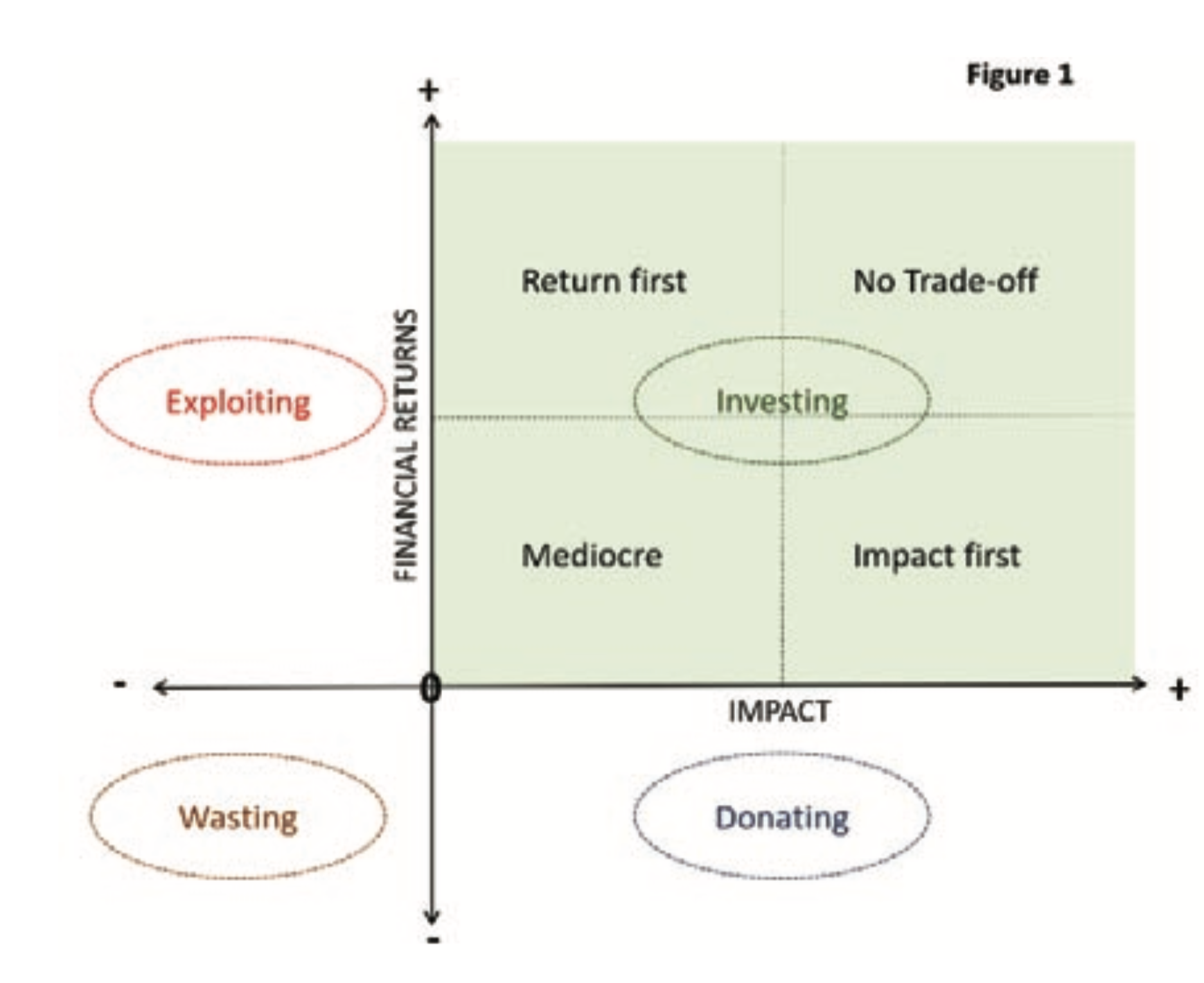
The potential trade-off between financial returns (economic benefits of ownership) and impact (responsibility of ownership) is illustrated in Figure 1.

  • Financial returns (vertical axis) and impact (horizontal axis) can be either positive or negative.

  • Negative financial returns represent donations – giving in excess of investment returns (it can also represent investments that unintentionally yield negative returns but I ignore that for purposes of this paper).

  • Negative impact equates to exploitation of people or planet.

  • The green area indicates investments that achieve the combination of positive financial returns and positive impact; this is the focus of the rest of this paper.

  • Four quadrants are identified and named:

    • Mediocre – below benchmark on both financial returns and impact

    • Returns first – favouring returns over impact (and achieving above benchmark returns)

    • Impact first – favouring impact over returns (and achieving above benchmark impact)

    • No Trade off – the ultimate achievement (high financial return and high impact)

Hurdles and Frontiers

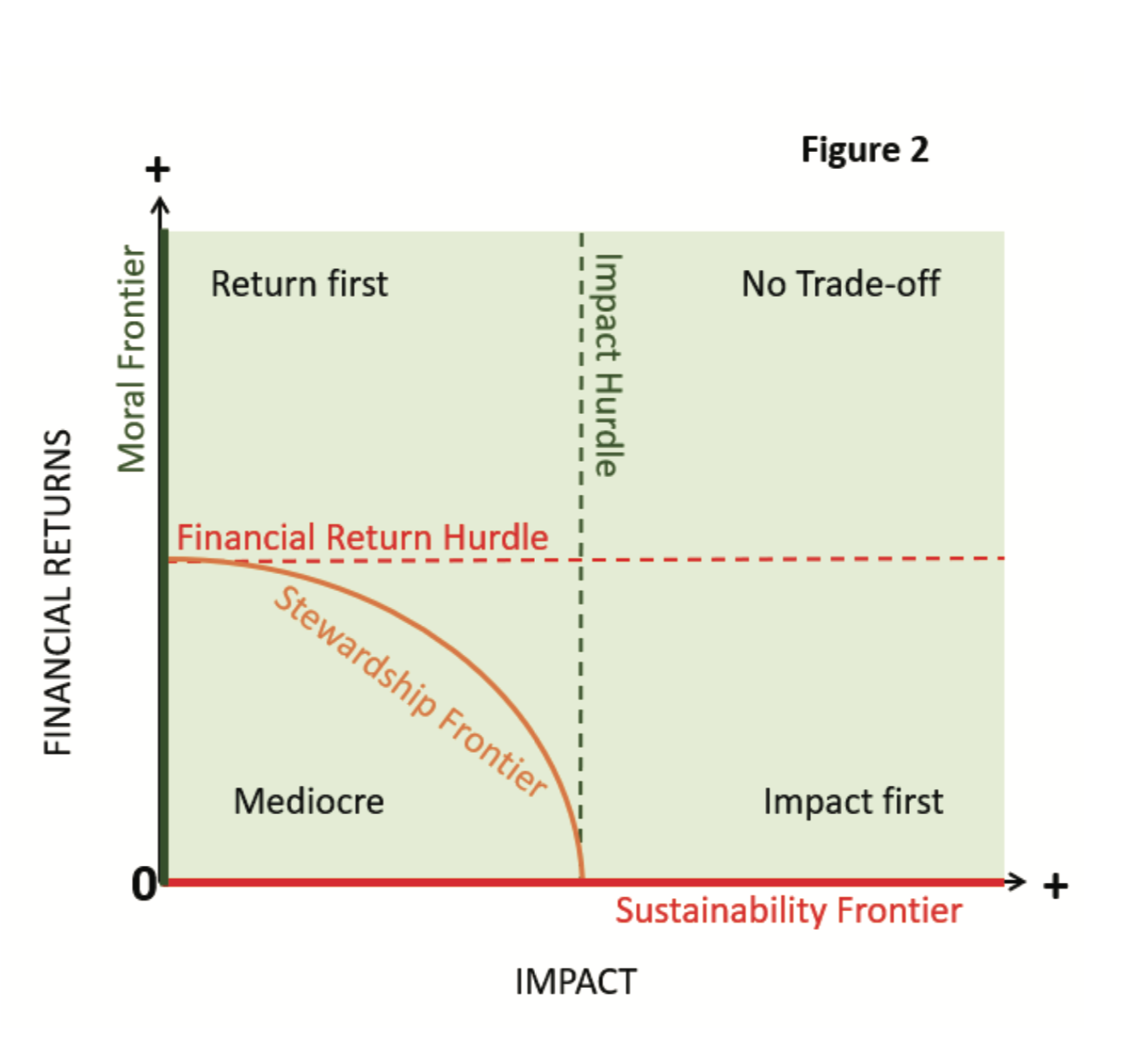
Expanding on Figure 1, we can set Hurdles and identify some Frontiers (see Figure 2). Frontiers are considered objective (and fixed), whilst Hurdles are subjective (and variable).

  • The Financial return hurdle is the minimum Financial return the investment needs to achieve, regardless of measurable positive Impact.

  • The Impact hurdle is the minimum measurable Impact the investment needs to achieve, regardless of Financial returns.

  • The vertical axis is described as the Moral Frontier, i.e. we should operate to the right of it (avoiding negative impact at all cost). In practice this typically means having a negative list of things that will automatically disqualify an investment (such as sin industries, harmful environmental impact, exploitation of people, etc.)

  • The horizontal axis is described as the Sustainability Frontier, i.e. we should operate above it (ensuring it is sustainable by achieving at least financial break-even).

  • The orange line is described as the Stewardship Frontier, i.e. does the combination of Financial returns and Impact translate to good stewardship when viewed from a biblical investment perspective? (i.e. investments should be above and to the right of the orange line).

Post-investment Strategies

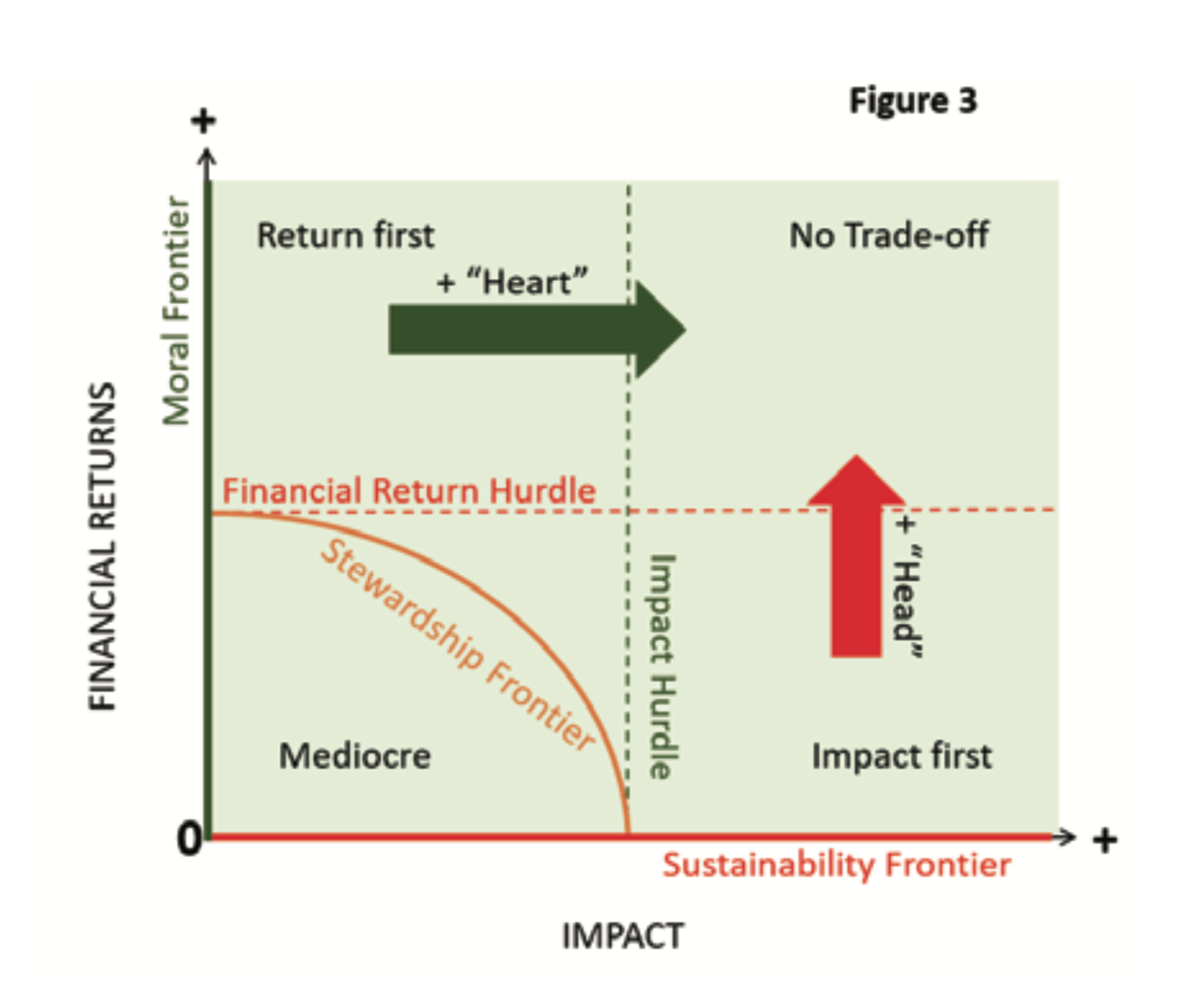
Clarity about the investment strategy (as briefly discussed above) is of utmost importance, but should also be complemented by stated objectives post investment. This is illustrated by Figure 3.

  • An investment strategy to target the “Impact first” quadrant can be complemented by a post-investment strategy to enhance the financial returns of the investment without necessarily compromising the Impact (see Red arrow). This can be done by introducing some commercial thinking into the impact-driven business model (“Head” intervention).

  • An investment strategy to target the “Return first” quadrant can be complemented by a post-investment strategy to enhance the Impact of the investment without necessarily compromising the Financial returns (see Green arrow). This can be done by introducing some impact considerations into the return-driven business model (“Heart” intervention).

The Tree of Life Foundation as a Practical Example

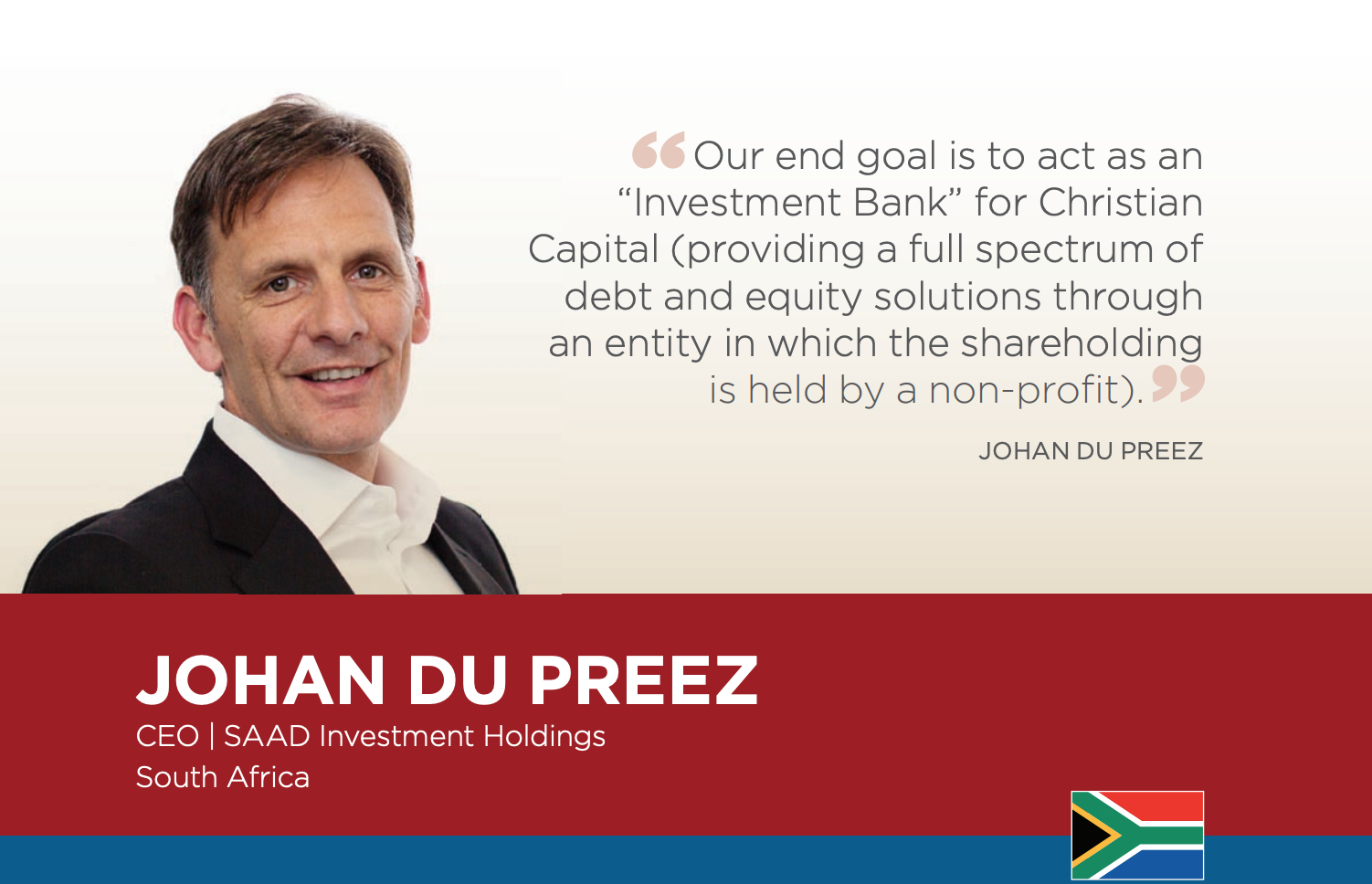
At the Tree of Life Foundation (TOL, a not-for- profit) we invest commercially to sustain ministries. Our end goal is to act as an “Investment Bank” for Christian Capital (providing a full spectrum of debt and equity solutions through an entity in which the shareholding is held by a non-profit), but as a first step we embarked on private equity investments in 2007.

Starting out we had to be clear about our initial focus, and we chose to adopt a “Return first” approach (driven by the experience of the key individuals, market opportunities, etc.). Due to our group structure (with the shareholding vesting in the Tree of Life Foundation), the profits from investment activities (and all the equity in the group) are available to fund Christian activities. Our task is therefore to decide what component of available capital should be re- invested as opposed to being distributed to Christian ministries. This is guided by our “dividend policy” that initially was set at “no dividend” and then gradually increased to the current policy, which states that 2.5% of Net Asset Value must be distributed to ministries annually (i.e., an “endowment mindset” allowing for sustainable giving with growth in real terms). The increase in dividend rate (distribution to charities) is an example of an increase in impact at group level (green arrow).

Getting back to the “Return first” strategy, it is very important for us to have a testimony in terms of biblical impact over and above the impact of giving away profits. In this regards we:

  • Defined a negative list of industries we will not invest in (sin industries) and practices we won’t tolerate (exploitation of people or planet, management with questionable ethics, etc.). The criteria is not what is legal, but what is morally acceptable from a biblical perspective (the higher hurdle).

  • Have a stated objective of introducing an impact component post investment.

The first bullet is self-explanatory, and easy enough to do. The way we handle the second bullet is to declare our intentions upfront (pre- investment) to the target investment company— we represent Christian capital and we therefore bring this worldview to the table when we join as a shareholder. This paves the way not only for robust discussions on ethical behavior, but also on remuneration, staff welfare, corporate giving, etc. We have been pleasantly surprised by the willingness of companies (in whom we invest) to embrace this, even in cases where such interventions caused a slight reduction in financial returns (i.e. where the green arrow points slightly downwards as it moves from left to right).

Summary

  • Financial returns and Impact represent two biblical parameters of investment decisions.

  • It is of paramount importance that the Christian investment manager is clear about both the focus of its investment strategy and the post-investment strategy for each investment.

  • In the context of this paper:

    • The investment strategy is the chosen quadrant in which the targeted investment should find itself (Return first, Impact first, No trade off).

    • The post-investment strategy is the targeted intervention that the investment manager seeks to facilitate and unlock post investment (Red/Green arrows).

    • The latter strategy will differ from one investment to the next, but it is highly recommended that it is defined upfront during the process of making the investment.

Read the whitepaper in its original form here.

What’s in Your Hands?

This video was originally published here.

Check out HOPE International for other quality content!

In Scripture, when God’s people approach Him with their dreams and desires, He sometimes answers with an unexpected question: “What do you have in your hands?” In this short video, HOPE International explores how God invites His people, both in Scripture and today around the world, to play an active role in restoring brokenness.

35 Players in the Impact Investing Industry

  Image by    Killian Pham

Image by Killian Pham

This article was originally published here.
Check out
Impact Foundation for other quality content!

by Impact Foundation

From officially being coined as a term in 2006 to being named as Forbes’ top trend in philanthropy for 2015 and 2016, impact investing is enjoying rapid growth.  Philanthropy is changing quickly with donors increasingly looking to invest charitable capital in companies and charities that pursue impact alongside financial profit. Even Bain Capital recently announced an impact investing fund.

With so many organizations in on the action, it can create confusion for those just venturing into the conversation. This blog attempts to explain the landscape and offer a survey of many of the organizations involved in impact investing (not an exhaustive list, but a start). 

Enterprises engaged in impact investing fall into four broad categories: 

  1. Foundation Investors – Using non-profit, tax exempt money, foundations invest in enterprises whose mission aligns with their own.

  2. Institutional Investors – “Leading pension funds, insurance companies, foundations, and asset managers across Europe and North America are pushing the responsible investment envelope” notes a recent article in the Stanford Social Innovation Review.

  3. Private equity/venture capital Investors – A 2016 Global Impact Investing Network survey found that investors plan to increase the capital committed to impact investments in 2016 to $17.7 billion, a 16% increase from commitments in 2015.

  4. Information/Advocacy Providers – As in any burgeoning industry, advocates have jumped in to provide information critical to the growth of impact investing.

Below is a long, but not necessarily comprehensive, list of organizations working in these spaces. The descriptions have been mainly taken from the websites of the organizations themselves. We welcome feedback if any of these descriptions or categorizations seems off. 

FOUNDATIONS/NONPROFITS

Impact Foundation – My personal favorite, Impact Foundation offers a donor advised fund with a streamlined solution for investing charitable capital in enterprises that do good and make money. Founded earlier this year, we’ve reached $20m in assets invested for impact and financial return. 

Acumen – is changing the way the world tackles poverty by investing in companies, leaders and ideas. We invest patient capital in businesses whose products and services are enabling the poor to transform their lives. Founded by Jacqueline Novogratz in 2001, Acumen has invested more than $97 million in 90 companies across Africa, Latin America, South Asia and the United States. We are also developing a global community of emerging leaders with the knowledge, skills and determination to create a more inclusive world.

Christian Super – is a not-for-profit pension fund based in Sydney, Australia. Operating since 1984 and with a strong non-denominational Christian focus, the pension fund serves over 25,000 members from over 2,000 ministry organizations across Australia, managing USD 750 million in retirement savings. It offers members a choice of five ethical portfolios with differing risk and return profiles across asset classes.

Impact Assets – Like Impact Foundation (without the faith emphasis), ImpactAssets provides donor advised funds that allow people to invest charitable capital for good. ImpactAssets is a nonprofit financial services firm that increases the flow of capital into investments that deliver financial, social and environmental returns.

RSF Social Finance – RSF Social Finance (RSF) is a pioneering non-profit financial services organization dedicated to transforming the way the world works with money. In partnership with a community of investors and donors, RSF provides capital to non-profit and for-profit social enterprises addressing key issues in the areas of Food & Agriculture, Education & the Arts, and Ecological Stewardship.

New Profit – Focus on helping scale organizations, shift public policy, and build communities of learning and action. Series of funds focused on specific impact areas.

Omidyar Network – (both an LLC and nonprofit) structured to support the notion that philanthropy is more than a type of funding. In its truest sense, philanthropy is about improving the lives of others, independent of the mechanism. Long time heavy weight in impact investing.

INSTITUTIONAL INVESTORS

Goldman Sachs Urban Investment Group – the group deploys the firm’s capital by making investments and loans that benefit urban communities.  Through its comprehensive community development platform, UIG is a catalyst in the revitalization of underserved neighborhoods.  UIG has committed over $4.7 billion, facilitating the creation and preservation of over 20,000 housing units – the majority of which are affordable to low, moderate and middle-income families – as well as over 1,900,000 square feet of community facility space and over 6,000,000 square feet of commercial, retail, and industrial space.  

JP Morgan –  Social Finance business launched in 2007 to serve the growing market for impact investments in direct response to client interest and the increasing recognition that innovative business models can complement limited public sector and philanthropic resources by delivering market-based solutions to achieve sustainable and scalable social and environmental impact. The group publishes research to provide thought leadership to the market, commits J.P. Morgan capital to impact investments, and provides investment services to its clients.

Citi Foundation – Citigroup is a global financial services company that does business in more than 140 countries and has approximately 200 million customer accounts. The New York-based Citi Foundation is committed to individual and family economic empowerment, and targets its strategic giving across four priority focus areas: microfinance and microenterprise, small and growing businesses, education, and financial education and asset building.

Credit Suisse – Credit Suisse engages in impact investing across three areas of operations: (1) a dedicated business line which structures, manages and offers impact investing products to retail, high-net-worth, and institutional clients; (2) in-house research which publishes reports on industry developments and impact sector trends; (3) capacity building grants through the Credit Suisse Foundation which strengthen the impact investing industry, its institutions, and their management.

Deutsche Bank Deutsche Bank’s impact investing activities are concentrated in community development and microfinance, and are carried out by the bank’s New York City-based Community Development Finance Group. Over the last 16 years, Deutsche Bank has placed over USD 2 billion of social capital, recognizing less than USD 11 million in write-offs. In the U.S., Deutsche Bank has invested more than USD 1.2 billion in community development, which includes affordable housing, green real estate, new business development, and support services.

Enclude –  Enclude, formerly doing business as ShoreBank International and Triodos Facet, is a global advisory services firm dedicated to building an inclusive and prosperous global economy through integrated capacity and capital services. Enclude’s Capacity Solutions business assists financial institutions and public and private sector organisations in improving their profitability and effectiveness to better meet the needs of the un(der)served by designing, connecting, financing, and building inclusive financial products and services. 

FMO – Founded in 1970, FMO is the Dutch development bank. FMO supports sustainable private sector growth in developing markets by investing in ambitious entrepreneurs. It believes a strong private sector leads to economic and social development, empowering people to employ their skills and improve their quality of life. FMO specializes in sectors where its contribution can have the highest long-term impact: financial institutions, energy, and agribusiness, food, and water. 

Private Equity/Venture Capital Investors

Sovereign’s Capital – Focused on heatlthcare, IT and consumer products & services, Sovereign’s invests in early-stage growth companies whose founders approach their work with strong business discipline and a faith perspective. https://sovereignscapital.com/

Schulze Global – A private investment firm focused on the world’s most dynamic frontier markets, Schulze Global approaches each investment with the goal to improve economic, social, and governance outcomes for the community where they invest. https://schulzeglobal.com/

Abraaj Group – Founded in 2002, The Abraaj Group is a leading private equity investor operating in the growth markets of Asia, the Middle East and North Africa (MENA), Turkey and Central Asia, Sub-Saharan Africa, and Latin America. The Abraaj Group currently manages USD 7.5 billion across 25 sector and country-specific private equity funds and yield-generating real estate investments. Through its stakeholder engagement program, the Group has supported best-in-class organizations focused on entrepreneurship, job creation, healthcare, education, and community engagement.
Global Environment Fund GEF’s investment programs span three asset classes: Private Equity (growth capital), Real Assets (sustainable timberlands) and Infrastructure (energy generation, environmental control, urban environment and transportation). 

Bridges Ventures – Investment focus on sustainable growth funds, property funds, and social sector funds. 

Pacific Community Ventures Pacific Community Ventures engages small businesses, impact investors, and policymakers to build an economy that works for everyone. We do this by empowering small business owners with working capital, free advice and mentorship, and access to the networks they need to grow their companies. 
Root Capital Root Capital is an agricultural impact investor that grows rural prosperity in poor, environmentally vulnerable places in Africa and Latin America by lending capital, delivering financial training, and strengthening market connections for small and growing agricultural businesses. Different Impact Dashboard Metrics – https://www.rootcapital.org/our-impact/dashboard

LGT Venture Philanthropy – Established in 2007, LGT Venture Philanthropy (LGT VP) is a global impact investor supporting organizations with outstanding social and environmental impact. Headquartered in Zurich with local teams in Latin America, Africa, Europe, India, Southeast Asia, and China, LGT VP is committed to improving the quality of life of less advantaged people in developing and emerging countries, specifically in the areas of education, health and sanitation, agriculture and forestry, renewable energy, and information and communications technologies (ICT). 

Bain Capital – Yep, that Bain Capital. They announced an impact investing fund earlier this year. Read more –>

Apollo Global Management – Working with the Private Equity Growth Capital Counsel (PEGCC) in 2009, Blackstone helped craft a set of Guidelines for Responsible Investment that incorporate environmental, health, safety, labor, governance and social issues into investment decision-making and ownership activities. The firm performs an analysis of the relevant environmental, public health, safety and social issues and continues to monitor those issues during its period of engagement.

Gray Ghost Ventures – Gray Ghost Ventures (GGV) is an impact investment firm dedicated to providing market-based capital solutions to entrepreneurs who are addressing the needs of low-income communities in emerging markets. GGV’s focus areas include microfinance, social venture investment, and affordable private schools.

INFORMATION/ADVOCACY

GIIN – Since its inception in 2009, the GIIN has supported the development of and raised awareness for the emerging field of impact investing by building a strong network of investors and leaders.        

IRIS – Metrics tool for GIIN and overall metrics leader.     

Case Foundation – The Case Foundation supports the impact investing ecosystem and provides opportunities to educate and activate investors. In partnership with CASE at Duke, PCV Insight and Impact Assets, they’ve supported the launch of a new study, Impact Investing 2.0: Insight from 12 Outstanding Funds and have created a number of helpful resources on impact investing.

Rockefeller Foundation – The Rockefeller Foundation has a long history in supporting innovations that seek to catalyze private sector investment for social and environmental good. In 2007, the term “impact investing” was coined at The Rockefeller Foundation’s Bellagio Center, putting a name to investments made with the intention of generating both financial return and social and/or environmental impact. Since then, the Foundation has worked to build the infrastructure for the impact investing field to take hold. Among our work, we have supported the Global Impact Investing Network (GIIN), B Lab, and GIIRS.

Net Impact – Net Impact mobilizes the next generations to use their skills and careers to make a positive impact on the world. Mainly undergraduate and young professional groups learning about Impact in for-profit and non-profit settings. 

World Economic Forum – https://www.weforum.org/projects/mainstreaming-sustainable-and-impact-investing/ 

Duke’s Center for the Advancement of Social Entrepreneurship – Like many universities with degree programs or focuses on social innovation or impact investing.       

Stanford Social Innovation Review – University program to create awareness and spread of ideas on social innovation.          

Global Social Impact Investment Steering Group (successor to G* Social Impact Investment Taskforce) – Taskforce that takes top thought leaders from many nations and brings them together. https://www.socialimpactinvestment.org/

Social Finance US – Social Finance partners with governments, nonprofits, foundations, impact investors, and financial institutions to create innovative financing solutions to improve social outcomes. In the Pay for Success and Social Impact Bond market, our Advisory Services, Social Investment, and Active Performance Management teams support all phases of work, tailored to the needs of our partners.        

Social Impact Bond Assistance Lab – Social impact bonds are a promising new approach to government financing of social service programs. By combining performance-based payments and market discipline, pay-for-success contracts using social impact bonds have the potential to improve results, overcome barriers to social innovation, and encourage investments in cost-saving preventive services. Established with support from the Rockefeller Foundation, the Harvard Kennedy School Social Impact Bond Technical Assistance Lab (SIB Lab) conducts research on how governments can foster social innovation and improve the results they obtain with their social spending.  An important part of our research model involves providing pro bono technical assistance to state and local governments implementing pay-for-success contracts using social impact bonds.    

Council of Foundations – The Council is participating in the conversation about unlocking new capital for social good. For decades, some foundations have made impact investments that intend to generate financial and social returns to complement grants, partnerships, advocacy, and other tools in the philanthropic toolbox. COF brings together Foundation leaders to have these conversations and also advocate for one another.         

Impact Alpha – ImpactAlpha is redefining business media around social and environmental value, just as impact investing is redefining finance. Robust journalism and compelling media have been instrumental in the growth of other new financial markets, from venture capital to hedge funds to emerging markets investment. The growing impact marketplace needs dedicated journalists working the impact beat, telling the stories, framing the narratives, identifying the leaders and calling the trends.