Podcast Episode 18 – Worry Is Not Our Friend with Todd Wagner

subscribe to the podcast here

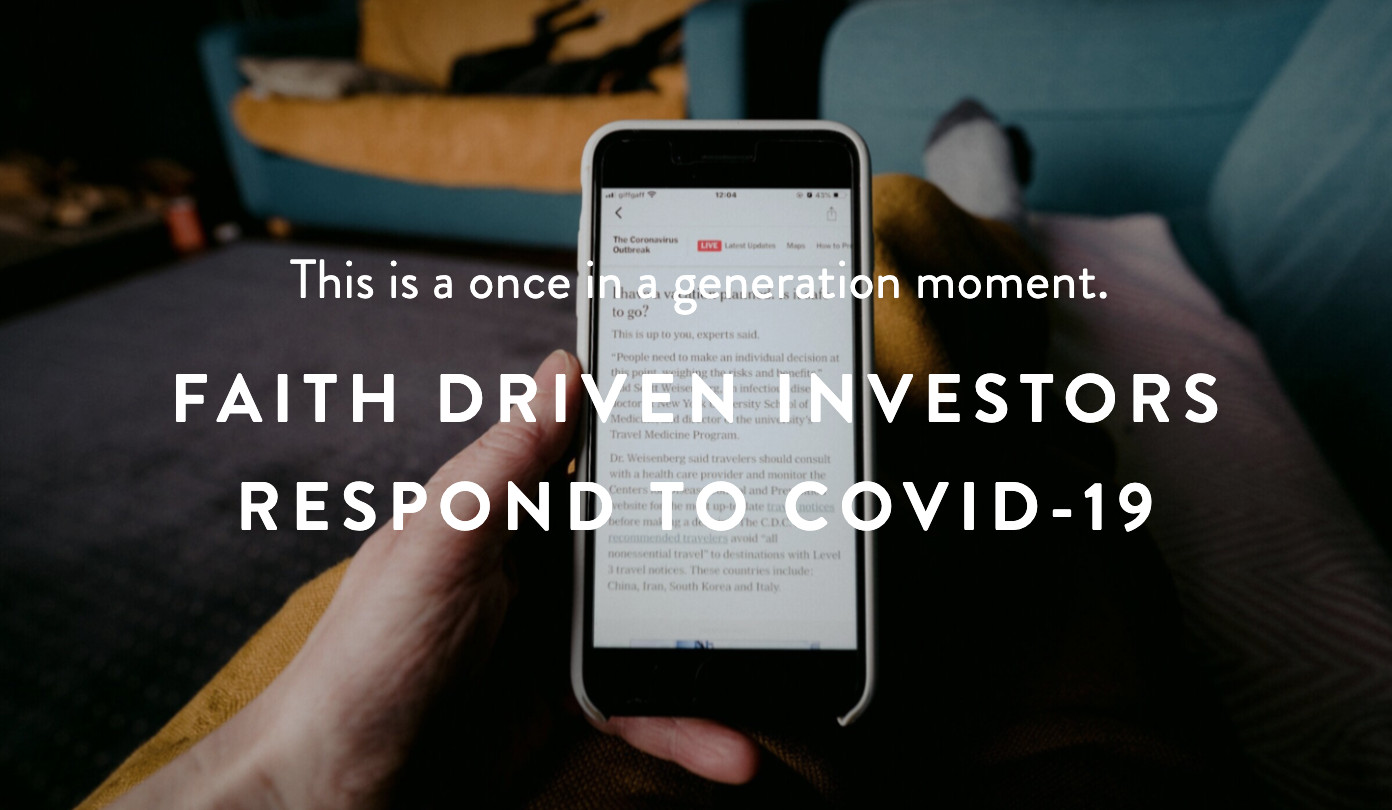
We’re combining the Faith Driven Entrepreneur and Faith Driven Investor audiences today to continue to address the current events we face. Todd Wagner joined us to speak into how we as believers can respond to the fear and worry surrounding COVID-19. 

Todd is the lead pastor at Watermark Community Church in Dallas, Texas. If that name sounds familiar to you it’s probably because you’ve heard Henry mention it in the intro to this podcast as the location for where we will be hosting our Faith Driven Entrepreneur and Investor Conferences this fall. In addition to being our host and a speaker at the event, Todd is also a great voice in the faith-driven conversation. 

His words of wisdom—or as his Twitter handle calls them, words from wags—are encouraging, challenging, and uplifting to all who hear them. And with our current events, we could all use encouragement. Like Todd shared, “worry is not our friend and panic is not our way…”

Useful Links:

Should Christians Be Anxious About Coronavirus?

Coronavirus is redefining the words Church and Worship

Real Truth. Real Quick

@wordsfromwags

Working From Home Under Lockdown

 Image by  Daria Neprakhina

Image by Daria Neprakhina

Big thanks to Andre Mann for letting us share his thoughts and helpful tips on working from home during the Covid-19 pandemic.

— by Andre Mann

As the Bay Area wakes up to life under lockdown, and companies across the country are encouraging people to work from home encouraging “social distancing,” my thoughts flash back to lessons I learned from running a business under lockdown a decade ago.  My family and I lived in Afghanistan where I helped run a media company with a Department of Defense contract, and a travel and logistics company. We lived in a shared compound of our home and the office, so we effectively “worked from home.” Kabul, being Kabul a decade ago, was a place where lockdowns were not uncommon, and where the threat of violence kept us evaluating every trip outside against the risk of an attack.  The situation was completely different from the coronavirus, yet there is so much that makes me flash back to those days. The threat was invisible, just like a virus, and every measure taken seemed like an overreaction. And yet it was all necessary. Here are some lessons we learned in running a business (and family), and staying healthy under lockdown.

  1. Don’t let fear overpower you.  The only way to truly overcome fear is to turn to God, and commit our will to trust in Him.  God is sovereign. The only reason we can take our very next breath is because God sustains us—he is in control of everything.  And we can trust Him. He is a good God. He loves us. He will never abandon us. He does not want us to live in fear.

  2. Seek to serve the more vulnerable.  How can I love my neighbors well?  Is there an elderly person who needs groceries ordered online and doesn’t know how to?  Keep your 6-foot distance, but help them out with that. How else can you help? Just reaching out and asking can be a significant gesture.

  3. How can we give generously?  From figuring out how to support small businesses with online orders, to giving to non-profits who depend on donations, to supporting your church, don’t allow fear to paralyze your giving.  If you have funds in a donor-advised fund, now may be the time to deploy those funds to make up the funding gap so many non-profits are experiencing.

  4. Practical tips for everyday living under lockdown:

    1. It’s important for everyone to have a routine.  When working from home, with young kids, spouses, and pets all in one space, before you know it, every day begins to feel like a Saturday.  That may sound like fun for the kids on Day 1. But by Day 7 everyone will be bored out of their wits and the working parent is about to blow their top at the chaos at home.  

    2. Get up early, like you did when you went away to work.  Get the kids up early like they were going to school, and have them keep a schedule of learning.  This will require some planning.

    3. Get dressed.  This will signal to yourself, and everyone else in your household that you are ready to work.  Don’t work in your pajamas.

    4. Define spaces and time schedules.  Especially with young children, it can be difficult to understand why mom or dad are not available to play.  However, you can help signal to them what is work time and what is play time by working from a specific spot, and keeping work to specific parts of the day.  And then protect your family time by not allowing work to bleed into the evening. Set limits for yourself. Keep your family time your family time, and work time your work time.

    5. Taking a Sabbath is important even when you are working from home.  Let the weekend be different than the work week.  On the weekend, break up the routine. Sleep in. Fix a meal together, take a nap.  

    6. Get some exercise.  Becoming sedentary will become the easiest thing to do when you are living in lockdown.  You will need to be creative if you don’t have a lot of gym equipment at home. Lots of gyms are taking their classes online to help people stay fit.  In some cases, you can still go for a run as long as you stay away from others. Don’t let this slide.

    7. Double down on time with the Lord.  You will need to nurture your soul, even more during uncertain times.  Be protective of your prayer life. Rather than having just one “quiet time”, why not also add a family devotional at a different point in the day?

    8. Social distancing does not equal relational distancing.  Pick up the phone and reach out to friends and relatives.  Stay connected. Use Skype or FaceTime so you can see each other.

    9. Remember that this will pass.  Trust in the Lord.  We don’t know what things will look like on the other end of this, but no matter what happens, the Lord will not abandon us.    

If you’d like more advice on dealing with isolation and/or a lockdown from a mother’s perspective, Andre’s wife wrote a helpful article on their personal blog here.

FOR MORE INFORMATION ON COVID-19, PLEASE SEE OUR PAGE HIGHLIGHTING SOME OF THE BEST RESOURCES OUT THERE FOR FAITH DRIVEN INVESTORS & ENTREPRENEURS IN THIS SEASON.
Podcast Episode 16 – How Investing Shapes the World with Finny Kuruvilla of Eventide

subscribe to the podcast here

On today’s episode, we’re talking to an expert on capital, influence, and how investments can serve the common good. Finny Kuruvilla is the Chief Investment Officer for Eventide Funds, and if you haven’t heard of them, you’re going to be glad you did. 

They’re on a mission to pursue investments that make the world rejoice—and today, Finny is going to tell us just how they do that. With a unique background in healthcare, statistics, and investing—not to mention two postgraduate degrees from Harvard and one from MIT—Finny is the type of guest you just can’t get enough of.

As always, thanks for listening.

Useful Links:

Eventide

Priorities and Investing

Do You Know What You Own?

To Change the World by James Davidson Hunter

Financial Performance and Social Impact – Being of One Mind

 Image by  Eventide

Image by Eventide

This article and video were originally published here.

Check out Eventide Investments for other quality content!

by Jason Myhre

When it comes to investing, many people today believe you have to choose between financial performance and social impact. Many tend to see these two goals in a kind of a see-saw relationship, where if you want to ‘shoot the lights out’ on performance it will likely come with ethical compromise, and if you want to maximize social benefit it will likely mean accepting a lower rate of return.

Where does this mindset come from?

At least one significant source for the modern split in thinking between ethics and economics comes from Adam Smith, in what is called Das Adam Smith Problem (use your browser to translate the page) or the Adam Smith Problem. Adam Smith wrote two famous books: The Theory of Moral Sentiments (1759), about ethics, and Wealth of Nations (1776), about political economy, which would go on to found the discipline of modern economics. The problem is that, though written by the same person, the two books are very difficult to harmonize. The two books have different and contradictory presuppositions about human nature: whereas human sympathy is the basis for Smith’s book on ethics, self-interest is the basis for Smith’s book on economics. There is little intertextual evidence of the same author between the two, save a thin thread of the virtue of prudence that can be traced in both. Because of the different and contradictory starting understandings about the nature of human beings, if you didn’t know the same person wrote the two books, you might conclude they were written by different people. Importantly, it was the first time in history where ethics was broken out from economics. If you can believe it, prior to this point in history political economy was a branch of moral philosophy!

What was Smith thinking? Did he have a shift in thinking about philosophical anthropology between 1759 and 1776, where he came to believe that human beings are most basically self-interested creatures instead of sympathetic? Unlikely. Rather, it’s helpful to understand the historical context of his writings.

Smith was writing at a time when scientific thought was really getting off the ground. Many of our modern ‘disciplines’ – the things we study in college today as separate fields of study – were founded during the time of his writings. At that time, there was a big push to really talk about the science of things – how things really worked – and to isolate subjects for examination in order to hone in on their inner workings. To separate ethics and economics, it’s likely Smith availed upon a popular approach at the time of making what’s called a fact/value distinction, or a positive/normative distinction. It goes like this:

  • Let’s talk about the ‘facts’ and not make ‘value’ (or ethical) judgments;

  • Let’s talk about what’s ‘positive’ (or true) and not ‘normative’ (shoulds and oughts about human behavior).

It was believed that you could bracket ethical considerations and talk about the pure, supposedly value-neutral ‘science’ of things – in this case making money. Right or wrong aside, this is how you make money – it’s science. Ethics is a separate discussion.

Play this forward to today and you get the modern mindset. This works upon us in a very strange way. I’ll describe it using three different metaphors:

  1. The easiest way to picture the effect is to think about a child who grows up in a home where two languages are spoken. The child will learn both languages fluently and often switch between those languages seamlessly, sometimes even in the same sentence. “Mama, can I have more juice? Por favor?” This is called ‘code switching’ – to switch between two different languages. Like this child, we today are able to easily switch between two different ‘languages’ we’ve learned to speak about ethics versus economics.

  2. This effect can also be thought about as different ‘social characters.’ Have you ever found yourself being a very different person in two different groups of friends? We sometimes call this being a chameleon. You may be more of a thinker with one group, and more carefree and humorous in another group. Similarly, we can tend to be different people whether we’re with our ethics friends or our economics friends. If I ask you, how does one make money, you take on the social character of economics; if I ask you how you think about ethics, you change social characters and start telling me about love for others.

  3. We suffer from a kind of epistemological schizophrenia. Epistemology is the study of how we know things. It’s our method of exploration in life. So, with epistemological schizophrenia, we suffer from a radical change in person in how we go about approaching life. One moment we’re the kind of person who cares deeply about others and we seek to do good to those we can, and then all of sudden we change into a totally different person caring only about looking out for ourselves.

In each of these three descriptions of the effect on us today, we’ve learned to deal with the discontinuities of our views on ethics and economics rather easily and invisibly.

Philosopher Charles Taylor, in the hugely influential book A Secular Age, says “as we function within various spheres of activity – economic, political, cultural, educational, professional, recreational – the norms and principles we follow, the deliberations we engage in, […] the considerations we act on are internal to the ‘rationality’ of each sphere – maximum gain within the economy, the greatest benefit to the greatest number in the political area, and so on.”1 We have these different ‘spheres’ of life and we tend to execute the script we’ve learned for each when we enter these spheres. You’ve heard people talk about compartmentalizing our thinking – having these different, separate, and uncommunicating compartments to our lives.

Fortunately, where modernism broke us up, postmodernism (or late modernism) has started to call this into question. Postmodernism said, “You know what, this inherited understanding has problems. Let’s go back and look at the presuppositions or assumptions that underlie this thinking.” On a personal level, people have felt the discomfort of having life all broken up and want to put themselves back together. Many people today are dissatisfied with and exhausted in remaking themselves over and over many times throughout the day. They want to be people whose lives have a genuine integrity – a ‘wholeness’ – where they’re the same person in every area of life. They want one sphere of engagement, life.

At Eventide, we count ourselves in their number. We reject the idea that we need to think about ethics differently from how we think about economics, or as we started, investing. We see investing this way: you are investing your money with companies, the companies inside of mutual funds, for example. Companies are made up of people and human relationships, therefore investing in our view is always, already, ethical. We believe that caring about investment return requires first caring about the kinds of companies that benefit people – customers, employees, suppliers, communities, the environment, and society broadly. We’re of one mind about ethics and investing, and it feels great. Want to join us?


This blog expresses the views of Eventide Asset Management, LLC, and such views may not be accurate. There is no guarantee that any investment strategy will achieve its objectives, generate profits, or avoid losses. Readers should be aware that Eventide’s approach may not produce the desired results, and Eventide’s ethical values screening criteria could cause it to underperform other firms that do not have such screening criteria.

4691-NLD-6/15/2018

Why Impact Investing is a Natural Fit for Faith-Based Investors

 Image by  Mariana Proenca

Image by Mariana Proenca

This article was originally published here by Financial Advisor.

by Amit Bouri

In 1758, at their yearly meeting in London, all Quakers were called to “to avoid being in any way concerned, in reaping the unrighteous Profits” from what they called the “iniquitous practice” of slavery. Members of the same faith would later be among the loudest to call for divestment from the apartheid regime in South Africa.

In 1891, Pope Leo XIII issued the Rerum Novarum encyclical that called all members of society to contribute to its betterment and outlined the relationship between labor and capital in a Christian society. Today it lends its name to a fund supporting Catholic businesses and philanthropy.

And as of 2016, 126 faith-based organizations of “diverse religions and creeds,” such as Islam, Buddhism, Judaism and Christianity, and with a collective $24 billion in assets, had committed to divesting from fossil fuels, with many feeling a moral imperative to provide clean energy to the world’s poor.

There are similar examples from all faiths—from Judaism to Sikhism to Buddhism—around the world. Faith-based investors have long recognized the importance of ensuring their money is not out of step with their convictions.

So, while the increased attention that values-based investing has received may be new, many faith-based investors have been doing this type of investing for generations.

Read the rest of this article here!

Faith Driven Entrepreneur Event Immediately Following Investor Conference

by Justin Forman

Last week we announced the Faith Driven Investor event coming to Dallas on Sept 23-24th.

Many of you are familiar with our other ministry initiative, the Faith Driven Entrepreneur, a close cousin to the Faith Driven Investor. For those of you who might not have heard, we’re excited to announce that we will also be hosting the Faith Driven Entrepreneur Conference in Dallas on Sept 24-25th, immediately following the investor event!

This is a gathering specifically designed to encourage the entrepreneurs, innovators, and creators of culture. It will bring together thought leaders across different organizations and will be packed with real-life stories of those on the front lines.

We believe that God uses entrepreneurs to bring about His Kingdom here on earth. Our mission is to help those who are hard at work on the trail, who are often tired, exhausted, under-resourced, and confused. They need rest, support, guidance, and provisions, as they get ready to head back out on the trail to fight dragons. 

We’re very early on in the planning stages for this event. So, stay tuned for many more speaker announcements. The Faith Driven Entrepreneur is a ministry initiative subsidized by the generosity of a few foundations that make this possible. Seating is limited to 700 attendees and there are discounts for the first 100, so register today to secure your spot!

We’re excited to see you there!