Is It Time for BIGGER Returns?

data-animation-override>
The time is always right to do the right thing.
— Dr. Martin Luther King

Don’t get too excited by the title—this is not a Faith-Driven post urging you to prioritize even LARGER financial returns from your investments—instead, think BIGGER.  

Faith-driven investors wanting to invest in alignment with Biblical beliefs, values and priorities need to think BIGGER in a new way.  Oxford Languages gives us two key definitions of “BIG”:

  • Of considerable size, extent or intensity. [what I am calling LARGER]

  • Of considerable importance or seriousness. [what I am calling BIGGER]

We like things that lend themselves to LARGER because they are measurable.  Investors and businesspeople are drawn to financial elements because we can measure them.

Understandably, when investors hear “returns”, they naturally think of “financial returns”.  In fact, Investopedia starts the definition of “Return” with “A return, also known as a financial return”!  Similarly, when businesses think of “capital”, they naturally think of “financial capital”, and when they measure “success”, it is usually in terms of “financial profit”.  Measuring allows us to see if we are doing better than last year (and better than the person next door).  There is a truism attributed to John Hayes, former Chief Marketing Officer of American Express:

We tend to overvalue the things we can measure, and undervalue the things we cannot.” 

BIGGER is more nebulous and unmeasurable, which makes it less attractive as a goal.  But I believe it is exactly the BIGGER definition of “return” that faith-driven investors need to embrace.  If they don’t, they are at risk of undermining not only the faithfulness of their own investing but also the ability of faith-driven entrepreneurs and business leaders to run their businesses in alignment with God’s design.

BIGGER Requires Choosing a New Master

It would be convenient if thinking about and pursuing returns in a BIGGER way just meant coming up with other priorities in addition to financial return.  For example, “we prioritize financial return and environmental sustainability”, or “we prioritize financial return while not investing in sinful businesses”. Unfortunately, that sounds good (and is certainly better than just focusing on financial return) but is not in line with Biblical principles or reality.

While some organizations say that they invest toward “social” ends as well as financial return or profit, it is a Biblical principle that we can have only one “priority”–only one “end” is the real “end”  (“No one can serve two masters“, Matthew 6:24).  The goals and priorities described as other “ends” are likely just means to the real “end” (or “nice to haves” as long as they don’t negatively impact the real “end”), which means they will be sacrificed if they no longer serve the real “end” or if they jeopardize the real “end”. 

 Faith-driven investors must get honest about the real WHY of their investing.  Faithful investing needs a BIGGER concept of return than financial return.  It needs a BIGGER that aligns with what God cares most about. 

BIGGER Requires a “Return” Aligned with God’s Purposes

Some things in God’s word are complicated and others are straightforward.  Perhaps one of the most straightforward is our ultimate BIGGER:

So, whether you eat or drink, or whatever you do, do all to the glory of God. (1 Corinthians 10:31)

In fact, Isaiah 43:7 makes clear that glorifying God is WHY we were created (“everyone who is called by my name, whom I created for my glory, whom I formed and made“).  Faith-driven investors are called to steward the financial capital God has entrusted to them in a way that glorifies God.  Of course, that is an extremely nebulous and unmeasurable BIGGER!  But one thing I can say with confidence based on Scripture is that comfortably measurable profit and financial returns are not #1 on God’s list.

I believe one of the five critical “mind-shifts” (and the most difficult one) for a faith-driven leader truly committed to pursuing business in alignment with Biblical beliefs, values and priorities is to recognize that God cares most about his creation, particularly humans created in God’s image.  Because an investor (like a business) can serve only one master, this “mind-shift” requires the counter-cultural reversal of people and financial returns in their “business as usual” roles of a means and the end–putting financial returns in its proper place as a means rather than the PURPOSE of the business.  This requires transforming the heart of the organization.  It is far more than leaders behaving better, cosmetic changes that look “Christian”, or generosity with profits.  It is changing the WHY of the business to something BIGGER.

Deriving purpose from its people, I believe a business glorifies God principally through lovingly and generously serving people and stewarding all creation: (1) providing opportunities for individuals to be more fully human by expressing aspects of their God-given identities in creative and meaningful work, (2) providing opportunities, goods and services, on a sustainable basis, that enable families, communities and the world to flourish, and (3) creating a culture of Shalom built on Biblical principles of relationships, community and human dignity that is conducive to the flourishing of all people it touches.

You might be asking, “What about financial return?”  Financial return is not bad.  In fact, it is absolutely necessary (just as adequate profit is necessary for any business). Investors need to ensure the flourishing of those on whose behalf they are investing.  In addition, as stewards of capital and a business that belongs to God (He owns everything), one of an investor’s responsibilities is to keep the organization viable so that it can pursue its God-given purpose.  Financial return just needs to take its proper place as a necessary means not the faith-driven end.

As a bonus, an investor gets a unique “two-fer” opportunity at a BIGGER that could be described as “Kingdom Return”.  Most directly, an investor can pursue a BIGGER of flourishing for those on whose behalf they invest and for the people touched directly by its operations (its employees, vendors, communities, etc.).  In addition, an investor can indirectly pursue a BIGGER of flourishing by investing in a way that encourages and assists the businesses it invests in to pursue business in alignment with Biblical beliefs, values and priorities.  In fact, I think BIGGER for an investor requires both legs of this “two-fer” opportunity.

BIGGER Requires a “Return” that Encourages Faithful Businesses

Scripture makes clear that we are to be encouragers and not cause others to stumble in their own faithful obedience:

Therefore encourage one another and build one another up. (1 Thessalonian 5:11)

And let us consider how to stir up one another to love and good works. (Hebrews 10:24)

It is good not to . . .  do anything that causes your brother to stumble. (Romans 14:21)

The “return” that is the “master” of a faith-driven investor can have a profound impact on the ability and willingness of faith-driven entrepreneurs and other faith-driven business leaders to pursue business in alignment with Biblical beliefs, values and priorities.  

A faith-driven investor encourages faith-driven entrepreneurs and business leaders in their pursuit of business in accordance with Biblical beliefs, values and priorities to the extent the investor’s BIGGER concept of return takes into account the Kingdom impact—the BIGGER “Kingdom Return”–of a business pursuing God’s purpose for work and business.  A faith-driven investor can cause those same entrepreneurs and leaders to stumble to the extent its concept of return pressures the business to prioritize financial returns over its broader Kingdom-focused purpose.

Marketing guru and cultural commentator Seth Godin rightly proclaimed 

Profits are fine, they enable the investment we need to produce value. But almost nothing benefits from being the only thing we seek, and the pursuit of profit at the expense of our humanity is too high a price to pay.

Investors are in a unique position to prioritize humanity and to encourage those they invest in to prioritize humanity. In the words of Dr. Martin Luther King, “The time is always right to do the right thing.” I encourage you to start pursuing BIGGER (and leave the measuring to God).


Is it time for new economic solutions?

by Brett Johnson

The economic systems of our world are in disarray. While we can hope that governments, central banks or crypto crazes can solve the problems, it is highly probable that we will continue to encounter problems until we fix the underlying issues. Now, smart people know there are challenges and we see an array of “solutions” including CSR, ESG, climate accords, SDGs and more.

We see the riotous effects of “new” philosophies hoping to replace what is with something different. There is hope. “In the last days…” says the prophet Isaiah. I will not delve into it much but, to quote what the late Benjamin Rogge said in 1965, “the typical American who calls himself a Christian and who makes pronouncements… on economic policies or institutions, does so out of an almost complete ignorance of the simplest and most widely accepted tools of economic analysis. If something arouses his Christian concern, he asks not whether it is water or gasoline he is tossing on the economic fire—he asks only whether it is well intended.”[1] Are we not in an era where Christians applaud burning in the main streets of society in the name of being a social cause? We need to do better.

We may be closer to answers than we think

In the world of 2021+ the challenges are formidable, but if we look back for the fingerprints of God in recent decades we might see we are closer than we think to solutions. The people who said God’s economy will become the main thing… perhaps they are righter than right. I believe we are closer to solutions than ever before, AND I believe it will take a concerted effort of a devoted few to press through until Kingdom Economics comes to life in our generation.

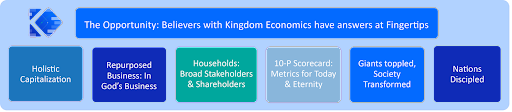
Today we are viewing capital more holistically. Movements in the marketplace are seeing thousands of businesses wanting to get into God’s business. Shareholders are giving way to stakeholders, and the best metaphor, arguably, for stakeholder analysis is to recapture a biblical understanding of “households.” Triple bottom line… it simply is not enough. We are going way beyond “people, planet, profits” to a richer set of metrics that are not only good for today, but good for eternity. Giants are being tweeted, hash-tagged and aimed at. Beyond the rants, images of transformed societies are emerging from the mists of troubled global times. We have a shot at truly discipling nations in our generation.

It will not happen automatically. We don’t get transformation by proclamation or wishful thinking. We have to return to biblically-rooted Kingdom Economics and seek out principles of sustainable transformation. Beyond the knowing of principles, we must learn the ways of God, recognize good and bad practices, and learn to write culture-changing policies that fuel the movement.

Enter Kingdom Economics

The vast majority of people of followers of Jesus Christ are still trapped in the wrong financial system. Thankfully there are pioneers (like Faith Driver Investor), who are creating funds (like Inspire Investing), platforms (FDI) and metrics (like impact funds, universities and EOM.org) that help us shift into Kingdom Economics. Which system we live in is first a matter of the heart—where do we place our trust—and then a matter of priorities, obedience, praxis. Collectively we have many of the pieces, but we don’t yet have all the answers. Will a new movement of kingdom capitalists fund adventures into the unknown, or will the scorecards of yesterday tether our capital to the sinking systems of this world?

I trust you will enjoy exploring these questions and concepts in my new book, Kingdom Economics.


[1] Benjamin Rogge, “Christian Economics: Myth or Reality?” The Freeman, December 1965

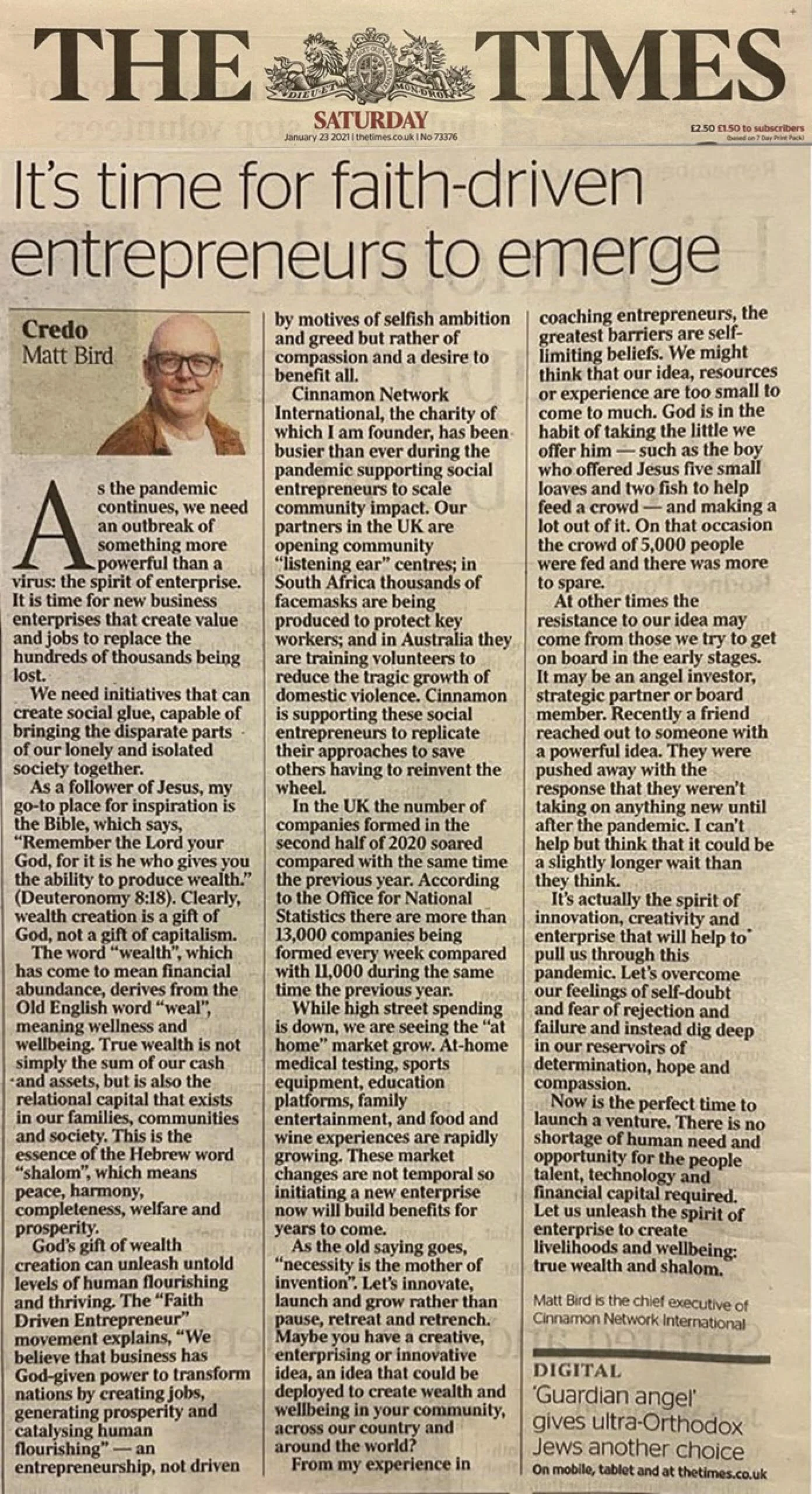
It’s time for faith-driven entrepreneurs to emerge

 Photo by  Nick Morrison  on  Unsplash

Photo by Nick Morrison on Unsplash

This article first appeared in The Times newspaper on Saturday, January 23, 2021.

by Matt Bird

As the pandemic continues, we need an outbreak of something more powerful than a virus: the spirit of enterprise. It is if time for new business enterprises that create value and jobs to replace the hundreds of thousands being lost. We need initiatives that can create social glue, capable of bringing the disparate parts of our lonely and isolated society together.

As a follower of Jesus, my go-to place for inspiration is the Bible, which says, “Remember the Lord your God, for it is he who gives you the ability to produce wealth.” (Deuteronomy 8:18). Clearly, wealth creation is a gift of God, not a gift of capitalism.

The word ‘wealth’, which has come to mean financial abundance, derives from the old English word ‘weal’, meaning wellness and wellbeing. True wealth is not simply the sum of our cash and assets, but is also the relational capital that exists in our families, communities and society. This is the essence of the Hebrew word Shalom, which means peace, harmony, completeness, welfare and prosperity.

God’s gift of wealth creation can unleash untold levels of human flourishing and thriving. The “Faith Driven Entrepreneur” movement explains, “We believe that business has God-given power to transform nations by creating jobs, generating prosperity and catalysing human flourishing” – an entrepreneurship, not driven by motives of selfish ambition and greed but rather of compassion and a desire to benefit all.

Cinnamon Network International, the charity of which I am founder, has been busier than ever during the pandemic supporting social entrepreneurs to scale community impact. Our partners in the UK are opening community ‘listening ear’ centres; in South Africa thousands of face masks are being produced to protect key workers; and in Australia, they are training volunteers to reduce the tragic growth of domestic violence. Cinnamon is supporting these social entrepreneurs to replicate their approaches to save others having to reinvent the wheel.

In the UK the number of companies formed in the second half of 2020 soared compared to the same time the previous year. According to the Office for National Statistics there are more than 13,000 companies being formed every week compared to 11,000 during the same time the previous year.

Whilst high street spending is down, we are seeing the “at home” market grow. At home medical testing, sports equipment, education platforms, family entertainment, and food and wine experiences are rapidly growing. These market changes are not temporal so initiating a new enterprise now will build benefits for years to come.

As the old saying goes, “necessity is the mother of invention”. Let’s innovate, launch and grow rather than pause, retreat and retrench. Maybe you have a creative, enterprising or innovative idea, an idea that could be deployed to create wealth and wellbeing in your community, across our country and around the world?

From my experience in coaching entrepreneurs, the greatest barriers are self-limiting beliefs. We might think that our idea, resources or experience are too small to come to much. God is in the habit of taking the little we offer him — such as the boy who offered Jesus five small loaves and two fish to help feed a crowd — and making a lot out of it. On that occasion the crowd of 5,000 people were fed and there was more to spare.

At other times the resistance to our idea may come from those we try and get on board in the early stages. It may be an angel investor, strategic partner or board member. Recently, a friend reached out to someone with a powerful idea. They were pushed away with the response that they weren’t taking on anything new until after the pandemic. I can’t help but think that it could be a slightly longer wait than they think.

It’s actually the spirit of innovation, creativity and enterprise that will help pull us through this pandemic. Let’s overcome our feelings of self-doubt and fear of rejection and failure and instead dig deep in our reservoirs of determination, hope and compassion.

Jesus And Zacchaeus’ Ill-Gotten Gains

Article originally posted here by Townhall Finance

by Jerry Bowyer

In our ongoing series about Jesus’ model for economic engagement during His earthly ministry, we look next at the encounter with Zacchaeus, the chief tax collector. Here’s Luke’s description:

And there was a man called by the name of Zaccheus; and he was a chief tax collector, and he was rich…

…when Jesus came to the place, He looked up and said to him, “Zaccheus, hurry and come down, for today must stay at your house.” And he hurried and came down, and received Him gladly. And when they saw it, they all began to grumble, saying, “He has gone to be the guest of a man who is a sinner.” And Zaccheus stopped and said to the Lord, “Behold, Lord, half of my possessions I will give to the poor, and if I have defrauded anyone of anything, I will give back four times as much.” And Jesus said to him, “Today salvation has come to this house, because he, too, is a son of Abraham. “For the Son of Man has come to seek and to save that which was lost.”

Luke  19:2, 5-10 NAS

We see the (by now) very familiar pattern: Jesus hangs out with recognized sinners. These sinner really are sinners. Jesus accepts material support, gifts and/or patronage. Critics grumble. The sinner is restored.

Note, by the way, that it is Jesus alone who is described as seeking this invitation. ‘I must stay at your house’ is not ‘we must stay at your house’.  Zaccheus ‘received Him’, not ‘received them’. In other words, the text suggests that Jesus’ disciples were not compelled to go so far out of their comfort zone as to dine with this arch-sinner. The grumblers accused Jesus and His disciples ‘Why do you (pl.) eat and drink with sinners…’.  (Lk. 5:30) Apparently, eating with ordinary tax collectors when they are part of a broad banquet is something the disciples can handle, but eating at the home of a chief of the system is too much.

Let’s get a bit deeper on the matter of patronage. The word used to describe Jesus being ‘received’ is explained here:

The verb for welcome (v. 2) is prosdechomai, which may denote more than simply entertaining guests. Elsewhere it is used in context of financial provision and social honour (cf. Rom. 16:2 and Phil. 2:29; so Marshall 1978: 599).

Blomberg, Craig L.. Contagious Holiness (New Studies in Biblical Theology) (p. 150). InterVarsity Press. Kindle Edition. 

Often those received would get all their meals, a roof over their heads, perhaps some financial provision while there, and traveling money afterwards. It’s more than a quick lunch together.

This explains the crowd’s objection to some degree. They are likely following the pharisaical teachings that benefiting from the wealth of a publican makes one also guilty.

The crowd, however, interprets the scene in diametrically opposite fashion (v. 7), for, from their perspective, ‘to stay in such a person’s home was tantamount to sharing in his sin’ (Marshall 1978: 697).

Blomberg, Craig L.. Contagious Holiness (New Studies in Biblical Theology) (p. 153). InterVarsity Press. Kindle Edition. 

Why does the sin transfer from the ill-getter of the gain to the secondary recipient? Because the wealth itself is seen as tainted, not just the deed by which it is gotten.

Whereas the crowds see Jesus accepting the hospitality of a man whose wealth is ill-gotten as becoming a partner with him in his crimes (Derrett 1970: 281–282), Jesus believes that godly character and righteous living can be modelled and have a positive impact by rubbing off on others as they commit to change their ways.

Blomberg, Craig L.. Contagious Holiness (New Studies in Biblical Theology) (p. 157). InterVarsity Press. Kindle Edition. 

Once again we see that with the coming of God in the flesh, it is righteousness which is ‘catching’, not sin. Jesus is infectious to those whom He touches, not the other way around.

Jesus’s Call to Meaningful Risk

by William Norvell

“When God removed all risk above, He loosed a thousand risks of love.” – John Piper 

Exhausted of Playing It Safe 

During the pandemic, I was faced with an unnatural amount of time alone—time to ponder, time to wander. During my pondering and wandering, I heard a consistent voice that I simply could not shake…Risk it all…For what? Why? For what purpose? For what goal? Risk it all…to uncover the person I knit together. I do not believe this is a call to do something crazy, to put my life in danger, or to risk the well-being of my family, but I do think it is a call to meaningful risk—to put something at stake that truly matters so that I can find out who Jesus made me to be. 

It was during my counseling sessions this year that I came up with a term that has defined this season of my life—and the majority of my life if I’m being honest. I am “exhausted of playing it safe.” Basically, I’m Fred, and I’m tired of being Fred. I mean, I love popcorn, but I want to get in the game. I am exhausted of watching others, copying them, and trying to pursue their dreams. I am exhausted of seeing opportunities in front of me and saying to myself, I can do that, I feel gifted in that area, I have a unique chance to impact that part of God’s kingdom…but never trying, never even starting, and of course, never finishing. During the pandemic, I became convinced that I want to enter my life and find out who God made me to be—the genius inside me and the flaws that do not define me. I’m ready to be William Key Norvell Jr., born April 14 , 1983—one of a kind, never before and never to be again. 

But how… 

Jesus’s Framework for Meaningful Risk 

After some deep searching, I determined that I needed to fully understand three things in order to take meaningful risk alongside the Savior—Grace, Humility, and Passion. 

Grace. I heard somewhere that grace can take you places that hustling can’t. It’s simple, but profound. My grace journey was sparked months before CEF in 2019 but lit on fire when a member of my group prophesied 2 Corinthians 12:9 over me…“My grace is sufficient for you, for my power is made perfect in weakness. Therefore I will boast all the more gladly of my weaknesses, so that the power of Christ may rest upon me.” This was a watershed moment that sent me to tears…and to my knees. Am I truly loved because of who I am, not in spite of who I am? Is that love enough? Grace opens the door to our true selves. As Steph Curry said recently…“I have a lot to accomplish. I have nothing to prove.” That is grace-filled motivation. 

Humility. Intertwined with the power of grace is the power of humility. God says in I Peter 5:5 that “God opposes the proud but gives grace to the humble.” Awe-inspiring, soul-settling grace cannot be found without the keys of humility. Look in Deuteronomy 8:2 to see how much God cares about our humble hearts: “And you shall remember the whole way that the Lord your God has led you these forty years in the wilderness, that he might humble you, testing you to know what was in your heart, whether you would keep his commandments or not.” 40 years!!! Just to teach them humility. Was He worried they weren’t innovating, building new towers, creating new technology? No! He wanted their hearts for Him, full stop. I must pursue opportunities to serve others not for worldly rewards but rather to uncover my true motivations and find true humility. 

Passion. If you spend enough time with me, you will one day hear the only Latin root I know. The word passion comes from the Latin root “pati,” meaning suffering, or enduring. This is most obviously seen in the Passion of the Christ. In that moment, we see our Savior so passionate about us, each and every one of us, that He refuses to stop climbing that hill, He refuses to put down His cross, and He puts one foot in front of the other so He will die…and we will live. Even though today’s culture tries to tell us different, passion is not something that makes us happy. True passion reveals something that we are willing to suffer for…and people we are willing to suffer with. Meaningful risk is rooted in passion. It’s rooted in the idea that you are willing to suffer for what God has placed on your heart. 

Jesus shows us that, once we understand how much He loves us through His grace, once we submit our hearts to Him in humility, and once we fix our eyes on the things He has called us to suffer for, we become the person He made us to be. We are then following in the mold of Jesus—fully loving, fully servant-hearted, fully passionate Jesus. 

What Do We Risk? 

I have heard the Parable of the Talents used to justify financial risk over and over and over again. As I studied this parable, I felt a prompting from the Holy Spirit saying over and over…“It’s not just about money…It’s about everything!” We must risk it all—all the gifts we have been given—and try to earn interest on—or 5x or 10x—everything we have been called to steward—prayer, encouragement, innovation, inspiration, laughter, generosity, courage, and financial resources. 

It is through meaningful risk that we grow closer to Jesus, we learn more of His character, and we see more and more of who He made us to be. This is not an invitation to success but an invitation to life with Jesus. I can’t promise you riches with this path, but I can promise that you will feel alive—and that you will also experience all that He did…joy, pain, sorrow, being known, friendship, betrayal…and no regrets. Jesus has no regrets that I can find in Scripture, and He invites us into that life. 

Provisions for the Journey 

Once I understood grace, humility, and passion (I think—Can we ever fully understand God’s Word?—I think not), I felt ready to take meaningful risk. However, as I started out on this journey, roadblocks popped up all over the place—doubt, insecurity, overthinking, naysayers, and more. So, I looked for ways to provision myself for this new journey and found four key components. 

God’s Truth. Speak God’s truth to yourself each morning and each night. As ridiculous as I feel doing it, I had someone challenge me to write down 15 things I know to be true and to look in the mirror each day and say them to myself. They are rooted in God’s view of me and His call on my life, and it’s a life-changing exercise. I am happy to share with anyone my list to help you get started. 

God’s Word. It is never changing but always illuminating. If you need a place to start, read Romans 8. Feel God’s grace, experience God’s passion, and see His call to humility. Lastly, see His encouragement to meaningful risk covered by His everlasting love. 

God’s Community. A few months back, I reached my limit. I didn’t want to end my life, but I wanted to disappear. I felt that I had inflicted too much pain on those I love most dearly, and I was convinced that my wife, my children, and many others would be better off if they lived the rest of their lives without me. I relayed this to my community bluntly—the Jesus Bros as we call ourselves—and they organized a gathering within three hours where they surrounded me, cooked for me, laughed with me, laid hands on me, and reminded me that their lives were better with me in it and so was my family’s. They reminded me that, even though the darkness was strong, I had to run towards the faint light, and I needed to ask for help any time I couldn’t see it. I now carry a picture of that night with me as a reminder of God’s love in community. Don’t do this alone or with a fake community. It needs to be real, authentic, and rooted in truth. Your version of the Jesus Bros just might save you from making life-changing mistakes. 

God Himself. Focus on Jesus. I’m reminded of Peter trusting so much, seeing so much love and confidence in Jesus’s eyes, that he stepped out on the water. Then, he got scared, he faltered, he looked at the horizon, and he fell. Jesus was, of course, there to pick him up. It’s a paradox of love, but if we can focus on Him, we won’t fall—we will remain steady. 

How Have I Been Changed? 

So, where has this newfound knowledge of meaningful risk taken me. In the last few months, I have launched my first solo podcast (a dream for 10 years), gone deep into crypto investing (a decision that typically would have taken 9-12 months took 2 weeks), had a significant conversation with my father 20 years in the making, studied and taken strides into prophecy (a gift I’ve felt for 7-8 years), dreamt more seriously about entrepreneurship than ever, and won 50 million points on my favorite golf game where the previous high was 4 million—I risked it all…and won ;). 

I have felt it all—joy, pain, sorrow, grief, excitement, confusion, anxiety, passion. I’m still finding my way…I still don’t know who I am…but I’m closer today than I was six months ago. Stay tuned for my next adventure. 

I have also reflected deeply on the most meaningful risk of my life—my marriage and the beginning of my family. I realized that the abundant grace of God introduced me to my wife and allowed me to meet my children, Liam and Eloise. I remembered how, in a rare instance, I truly humbled myself before God and physically cried out for His wisdom—and He graciously delivered. Lastly, I mediated on the passion God gave me for my family that has sustained me through pure joy and pure heartbreak from day one to year six (another essay sometime). Through it all, God’s grace, humility, and passion have allowed me to singularly pursue my family’s goals with zero regrets. It’s an odd thing about meaningful risk, even when it doesn’t work out like we hoped or imagined, we crave more because it brings us closer to the Father and to the Son and to the Holy Spirit—Who risked it all for us. 

Am I still scared of things every day, and do I still overthink way too much? Yes, of course. I’m human. However, I’m getting better every day, and if there is anything the pandemic has taught me, it is that nothing is predictable, and I can’t risk not taking meaningful risk. 

I do not miss my old life of comfort and security. I am ecstatic about this new life of meaningful risk and the opportunity to see myself through the eyes of Jesus. 

Parting Encouragement…15% 

I want to end by saying that I am not advocating for reckless risk. It’s my opinion that, while Jesus certainly can, He rarely calls us to crazy risk that puts people we love in danger. Remember, just don’t be Fred. I encourage folks to imagine their comfort zones and aim for 15% outside of them. Over time, your comfort zone will shift dramatically, and you will be seeing things with Jesus you could not imagine. But for most of us, it’s a process of taking that next step out in faith, then the next one, then the next one, then the next one, and then the next one. Before long, we cannot even see our old comfort zone from where we currently stand. We can only see Jesus staring back at us…at the true version of ourselves.

Job Creators: Why Small and Growing Businesses Are Essential to Recovering From a Pandemic

 Photo by  Jeremy C  on  Unsplash

Photo by Jeremy C on Unsplash

by Matthew Rohrs

“If things get worse and I can’t work, we will starve.”

These stark words from a Kenyan housecleaner named Esther highlight the critical importance of employment to sustain families. Before the COVID-19 outbreak, the World Bank estimated 600 million jobs needed to be created by 2030 just to keep pace with population growth. Now it projects that COVID-19 will push 49 million people into extreme poverty this year alone. The UN’s World Food Programme believes that COVID-19 could force an additional 130 million people to the brink of starvation by the end of this year. They are calling it a ‘hunger pandemic’.

One of the best and most sustainable ways to respond to this crisis is to invest in local entrepreneurs who drive economic growth and job creation. 


The Critical Role of Job Creators

It is estimated that more than 2 million households in Kenya employ domestic staff like housekeepers, cooks, nannies, guards, and gardeners. These jobs are desperately needed – especially now as more and more businesses are forced to let staff go. 

Joseph Gichunge and his wife, Leah are growing a company that meets a huge market demand while also caring for single mothers. 

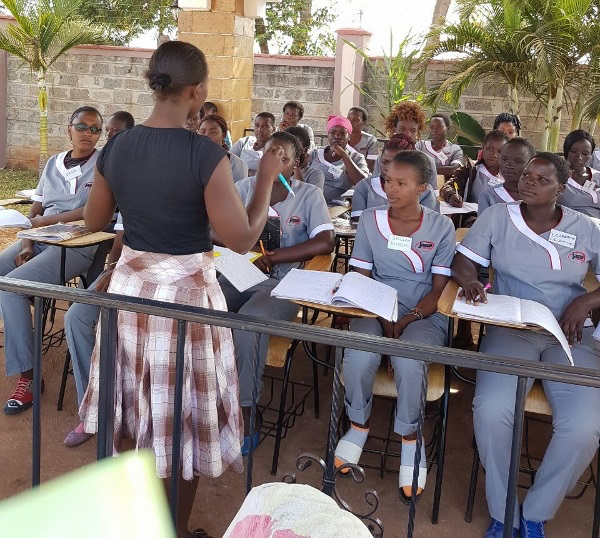
Joseph Gichunge co-founded Jazza Centre with his wife, Leah to meet the need for more qualified domestic help. Much of their business success is credited to how they train their workers to tailor the approach to the needs of each client.

However, their impact on the community isn’t just “how” they train but “who”. The majority of workers at Jazza Centre are underprivileged women with challenging backgrounds. Early pregnancies. Broken marriages. Many are left with the sole responsibility to care for their children.

Over the past three years, Jazza Centre has given over 1,200 workers a new outlook on life by providing biblically-integrated training, good working conditions, and dependable income. And Sinapis has provided Joseph and Leah with a new outlook on how running a profitable business can be a way of being God’s hands and feet in a community. 


There Has Never Been a Greater Need for Kingdom Entrepreneurs

Small and Growing Businesses (SGBs) like Jazza Centre account for up to 80% of new job growth worldwide. They are the primary job creators in the hardest places.  Yet a recent study by the Aspen Network of Development Entrepreneurs (ANDE) projects that 42% of emerging market SGBs face potential failure in the next 6 months due to COVID-19. These countries have limited funding for safety nets to help businesses and families weather this storm. 

Sinapis was one of the first organizations in Africa to focus on accelerating businesses. From our earliest days, we have invested in the whole person — the intellectual, the spiritual, the relational. When we train an entrepreneur, we focus on nurturing the person first and then growing the company second. And we stick with them. Long after they have graduated from our programs, we continue to offer opportunities to partner with Sinapis and network with other alumni.

Not only does this approach equip entrepreneurs to innovate and lead resilient companies, it makes them transformative leaders who spark change in their communities. Investing in people creates ripples of impact beyond one company. 

Right now the world needs prepared entrepreneurs more than ever. Companies that can sustain jobs. To see this happen, these entrepreneurs need training and mentorship to help them pivot their business models, preserve cash, and survive the crisis. While these needs have never been more acute, their ability to afford these services is under intense pressure.

FOR MORE INFORMATION ON COVID-19, PLEASE SEE OUR PAGE HIGHLIGHTING SOME OF THE BEST RESOURCES OUT THERE FOR FAITH DRIVEN INVESTORS & ENTREPRENEURS IN THIS SEASON.