Podcast Episode 35 – 10 Ways to Integrate Your Faith as a Financial Advisor

subscribe to the podcast here

What does it mean to be a Christian financial advisor? There are lots of possible answers to this question, but today we look at two experts in the field, Eric Chetwood and Rachel McDonough, to hear what they think. 

When it comes to integrating your faith as a financial advisor, these two are living it out in the real world. Their insights will be helpful for anyone who is a financial advisor, or for anyone who is looking for one.

Useful Links:

10 Tangible Ways to Integrate Your Faith as an Advisor

Investing as Ambassadors

People’s Faith in Business

 Photo by  Bram Naus  on  Unsplash

Photo by Bram Naus on Unsplash

by FDI Team

To say we’re living in tumultuous times is an understatement. It often feels as though the ground on which society is built is constantly shifting beneath our feet. And despite low levels of trust in institutions, The Wall Street Journal recently shared that people have more faith in business than government or media, and almost 3/4 of people said their employer was a “mainstay of trust”. This presents a significant opportunity for faith-driven business leaders to continue (or start) consciously using their influence among their employees for God’s glory.

This matters for you, the Faith Driven Entrepreneur. There’s never been a more crucial time to stand in your shoes. People are looking to you to lead. Your employees are putting their hope in you. Society is asking you to step up. But before we get too far ahead of ourselves, let’s remember that there’s only one person who we can truly put all our hope in. The opportunity you have right now is to point people to Him.

Uncertainty abounds around the economy and the seismic political shift we’re watching occur. We’re all desperate for something certain, for something concrete to hold onto. And right now, it appears God has allowed business to retain more credibility than other institutions. But before we celebrate the spotlight this shines on the many incredible men and women doing God’s work in and through their business, we have to remember that the answer we have isn’t ourselves or our businesses. The answer people need—not just in America, but around the world—is that Jesus Christ is the answer they’re looking for.

His death, resurrection, and imminent return are the reason we can have hope. Yes, businesses are great, but even that is temporary. Faith Driven Entrepreneur, seize this moment. Recognize the fact that people are looking to you, now more than ever. Continue to run your business with excellence, loving God and neighbor through your company. Then pray that you would be able to point them to the King of a kingdom that cannot be shaken (Hebrews 12:28).

“Permanent Capital” as a Strategy for Values-Aligned Investing

This article was originally presented at The Christian Economic Forum 2018.
Check out
CEF for other quality content!

The Christian Economic Forum hosts a world-class Global Event each year to connect the top industry leaders and experts from around the world with other individuals who are compelled to act upon the principles of God’s economy. The following paper was presented at CEF 2018.

by Tom Blaisdell

Much of the capital available to Small and Medium Enterprises (SMEs) around the world, especially in the U.S., is in the form of private equity. The majority of this capital is allocated via Private Equity (PE) firms that are generally structured with 10-year terms, and the investment target is 3x to 5x return in 3 to 5 years on each investment they make. This model has worked well for both investors and companies based on the growth of the amount of capital that is deployed in this manner and the impressive returns these PE firms have delivered as a class.

There is, however, a class of founders/ entrepreneurs/CEOs for whom this model is not a great fit. These “legacy entrepreneurs” are not building companies solely for the purpose of “maximizing shareholder value.” Instead, they have a sense of purpose or mission to serve a customer or address a problem or need. They understand that providing an acceptable return on capital is imperative to grow a for- profit business, but this is a requirement of the business, not the objective. Moreover, because of this “mission” orientation, they are more likely to think in terms of building a lasting or “legacy” business, usually over decades or even generations, and do not think in terms of “exits” or “liquidity events,” which are requirements of the prevailing PE paradigm.

An alternative PE strategy to the “3x to 5x in 3 to 5 years” strategy can be labeled a “permanent capital” strategy. This approach is certainly not new. One could argue it is one of the oldest strategies around, since for centuries many families’ assets have often been concentrated in “permanent” vehicles such as family businesses, land holdings, etc. While the label “permanent” is convenient, it is really short hand for “capital that will not reasonably need to be spent in any currently anticipated timeframe.” Organizations such as endowments, foundations, family offices, insurance companies, pension plans, and Sovereign Wealth Funds (SWFs) all will typically have significant holdings of permanent capital.

Any organization that has “permanent capital” has several reasons to consider an allocation to a permanent capital investment strategy within the Private Equity asset class. A permanent capital strategy has the potential to provide superior returns based on:

  • Better entry prices

  • Fewer transaction costs

  • Tax advantages

  • Better exit prices

Perhaps more importantly for the context of this paper, permanent capital also has the potential to provide better values alignment between investors and entrepreneurs.

Potential Advantages of a Permanent Capital Strategy

Better Entry Price

In many cases when a company is being sold (or is selling significant equity in the business), the sellers are simply looking for the best economic deal. For legacy entrepreneurs, however, non- economic considerations play a major role as well. These considerations may include the ability for the sellers to continue to participate in the business going forward, job protection for management as well as rank and file employees, and in many cases a commitment to ongoing preservation of the “values” of the company being sold.

As suggested above, many company founders who are committed to building “legacy businesses” have no interest in taking the company public or continually “flipping” the company from one financial sponsor to the next. They founded their businesses to serve a customer, not just to make a profit. Their vision is to serve more customers, and to do so better every year. In addition, over time they seek to build a valuable asset for their families and employees. Ideally these founders/owners would find like-minded “permanent capital” providers who are interested in growing value in and through the business rather than by trading the business from one investor to the next. In many cases, they are willing to take a lower price for their business (or shares in their business) to guarantee they can continue to operate their business in this manner.

Fewer Transaction Costs

Every time a company is sold and bought there are substantial transaction costs that are dilutive to the company’s owners. These expenses include legal fees, banker fees, accounting fees, consulting fees, and the immeasurable distraction costs of the transaction. These fees can easily run up to 5% or higher of the value of the company at each transaction point. Considering a 30-year time horizon for a company (long, but not forever) and the usual time horizon of a typical private equity owner of five to seven years (generously, as their target is usually three to five years), this would imply four to five transactions over the 30-year horizon times the associated drag of transaction costs on each transaction. Compare this to having continuous ownership by one entity through the 30-year period and the potential for saving and reinvesting these transaction costs is self-evident. There are also substantial savings in the sourcing, diligencing, closing, fixing, and selling of portfolio companies with a permanent capital strategy.

Using simple assumptions, a traditional firm would need to buy and sell 60 companies over a 30-year period, while a permanent capital strategy investor could invest and hold 10 companies over the same 30-year period. Clearly the traditional approach creates a lot more work sourcing, diligencing, selecting, fixing, and selling companies than the permanent capital approach, and would also require far more (and expensive) investment managers to implement it. The traditional approach—with its 120 transactions (60 companies bought and sold) versus 20 transactions (10 companies bought and sold) for the permanent capital strategy—would also make a lot of bankers, lawyers, consultants, and accountants very happy!

Tax Advantages

The potential tax advantages of a permanent capital strategy follow along the same vein as transaction costs, since with each transaction, taxes would need to be paid on the increase in value. Moreover, if the company is sold multiple times over a 30-year period, sometimes for a gain, sometimes for a loss, the gains and losses would accrue to different parties who would not be able to net them out against each other. The concept that taxes represent a real drag on investment performance is elementary: if you take your gains each year and reinvest them anew you not only lose the dollars paid in tax each year, but also lose compounding of those dollars over future years. While difficult to capture in hard numbers, it seems plausible that deferral of taxes is one of the biggest transaction cost savings of a permanent capital strategy versus a “3 to 5” trade-out strategy.

Better Exit Price

Nothing lasts forever. While we refer to the strategies in this paper as “permanent,” this is actually shorthand for “having a very long-time horizon with no pressure to sell.” A truism in the private equity business is that “it’s always better to be bought than sold.” But as a fund approaches (and often overshoots) its fund life, many firms are in the position of having to sell rather than waiting to be bought, and anyone who has been in this situation knows exactly how uncomfortable a position it is. On the other hand, if a company is profitable and growing and has no intention of selling itself in the foreseeable future, it is likely over time that it may be approached by interested buyers. If the company decides to sell in this situation, it will be on its own terms and timing, which may be very advantageous indeed.

Values Alignment

Admittedly more qualitative, a significant potential advantage of a permanent capital strategy is the ability to create values alignment within a concentrated portfolio. Building a concentrated portfolio of companies with zero to very low company turnover means that an investing platform can wait until target companies match their values as well as their investment objectives. As in our previous example, finding 10 great companies that are consistent with an investor’s values is easier than finding 60. Importantly, investors don’t need to sacrifice returns to pursue this values alignment, but can actually anticipate higher returns based on the analysis above.

Conclusion

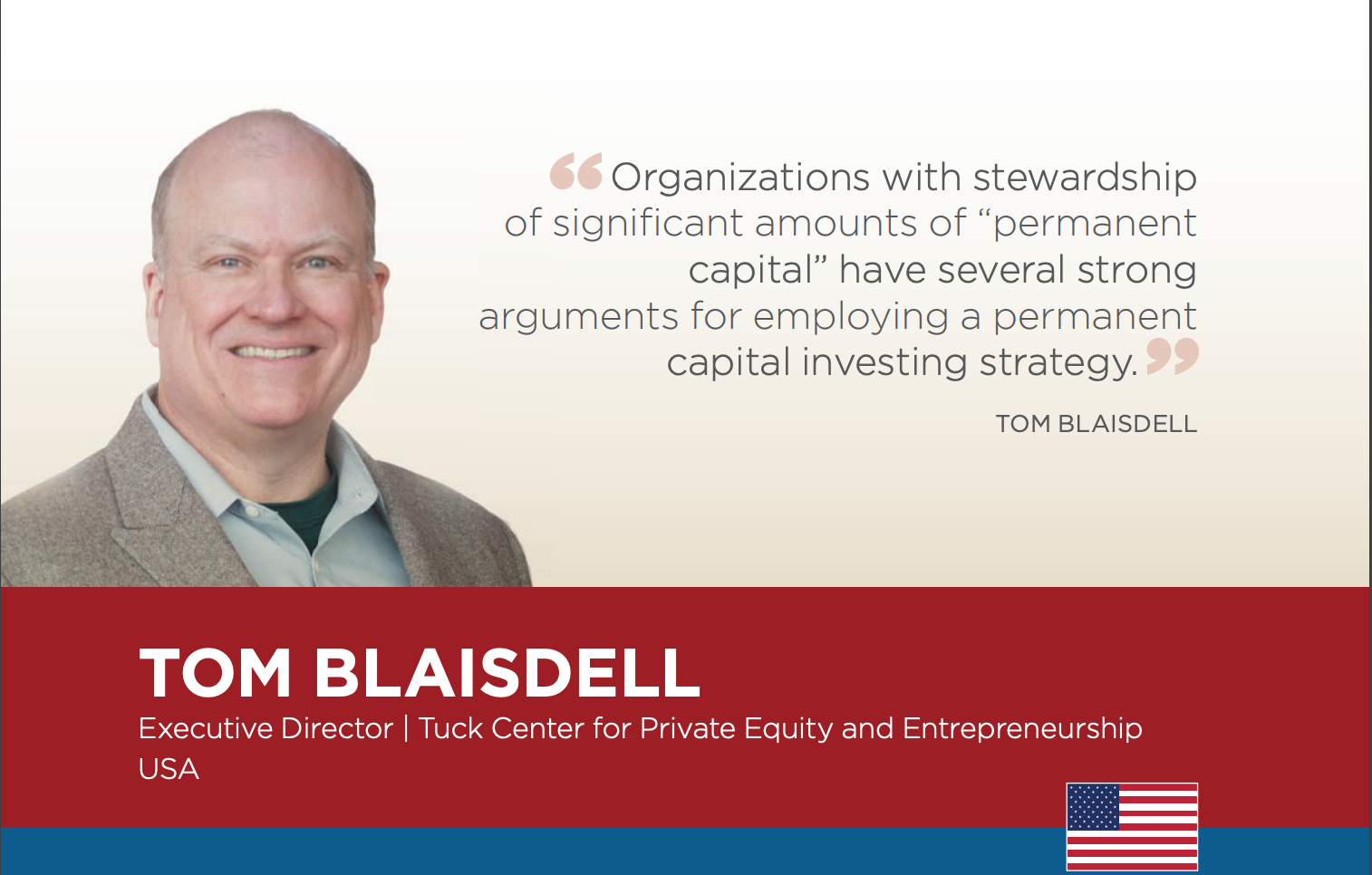
Organizations with stewardship of significant amounts of “permanent capital” have several strong arguments for employing a permanent capital investing strategy. Better entry prices, fewer transaction costs, tax avoidance and deferral, higher exit prices, and clearer values alignment are all potential advantages that could equate to measurably higher returns from employing such a strategy versus a typical “3x to 5x in 3 to 5 years” private equity strategy. Perhaps more importantly, allocating capital to this strategy will also provide access to more “values- aligned” capital for legacy entrepreneurs looking to build and grow mission-focused companies.

Read the whitepaper in its original form here.

Personal Values And Account Values

 Photo by  Karim MANJRA  on  Unsplash

Photo by Karim MANJRA on Unsplash

Article originally posted here by FA Magazine

by Mitch Anthony

I recently was invited to a think tank hosted by Eventide Asset Management, a company in the values investing space. CIO Finny Kuruvilla gave a talk and I was confronted with the question, “Do you want to own companies that you are proud of?” Well, of course I do. But truth be told, I haven’t been paying that much attention. Kuruvilla defined good corporations as those that treated their workers well, which in turn engendered happy clients, demonstrated community-mindedness, environmental responsibility, etc. In short, it meant owning companies that produce goods and services for the good of people. Sounds easy, but it’s not. The degree of due diligence required is onerous and ongoing, and the indicators are not always obvious.

We see a broad range of values-driven investment choices today, including, but not limited to:
• SRI (Socially responsible investing);
• ESG (Environmental, social, governance investing); and
• BRI (Biblically responsible investing)

There is a whole subset of questions beyond the one asking whether I would be proud to own a company:
• Would I want to work for it?
• Would I recommend its products?
• Would I want my kid to work there?
• Would Grandma approve of the company’s working conditions and atmosphere?

What value does it bring? (There’s a broad range of value out there, from new flavors of bubble gum to potential cancer cures.)

Some companies strive to deliver value, while others exist only to extract it. Extractors are the companies that the ESG movement is trying to weed out. Why would any of us want to support firms that don’t care about anything or anyone? Fred Reichheld of Bain Consulting said the following thing about such companies:

“Instead of focusing on innovations to improve value for customers, they channel their creativity into finding new ways of extracting value from customers.” Such companies, he says, “regard the people who buy from them as their adversaries, to be coerced, milked or manipulated as the situation permits. The Golden Rule—treat others as you would like to be treated—is dismissed as irrelevant in a competitive world of hardball tactics. Customers are simply a means to an end—fuel for the furnace that forges superior profits.

“This view is utter nonsense. Companies that let themselves be brainwashed by such a philosophy are headed into the sinkhole of bad profits, where true growth is impossible.”

Scrambled Signals
In our modern age of values-screened investing, one could be forgiven for incredulity when it comes to getting truth from corporations and knowing their actual behaviors. Don’t all corporations try to say the right things, give the proper appearance and elevate their standing in the global community? Don’t values range wildly from one individual to another, and from one credo, culture and affiliation to the next?

Consider that one ESG data vendor gave Philip Morris a higher score than Loxo Oncology (bought out by Eli Lilly and Company in 2019) because the ESG screens heavily weighted clean water and board diversity. Rather ironic that it’s for a tobacco company producing products that science has proved cause cancer, while Loxo has gone to market with a potential cure. Yet the party causing the problem is rated higher in ethics, sustainability and governance than the party with the cure. Excuse me while I scratch my head for a moment and wonder how “values” have become so perplexingly scrambled. According to an executive at this gathering, one of the big weaknesses with ESG historically is that it does not consider the products or services of the companies, but focuses instead on their sustainability “practices.”

I suspect that we will soon see progress in the filtering process as well.

Locate Your Values
Everyone has to choose what matters most to them personally. Eventide sets its searchlights on companies making strides in health care, cybersecurity and clean water (among other things) around the planet. One of its investments is a company that came up with a new treatment for schizophrenia that impacts 3 million people in the U.S. This disease is a leading contributor to homelessness (and the subject resonates with me, as my older sister struggled her whole life with it).

I learned that 1.6 million people a year die from diarrhea, and over 80% of them are under the age of 5. This is due to unclean water, a problem that could be corrected in a few short years via proper infrastructure.

I learned that cybersecurity breaches cost over $2 trillion a year, and the leading victims are the elderly and retired. It’s hard for any of us not to care about these issues. Is it possible that we can care with our investment dollars and turn a profit as well? Is there a sweet spot between humans flourishing and profitability that is begging for our vigilance and participation?

What matters to you? What matters to your clients? How much longer can we ignore these questions or patronize the issue with superficial discovery questions like, “Are there any stocks or companies you’d like to avoid?” I don’t say this to denigrate the value of such a question, but to illustrate the idea that being against certain products (against “sin” stocks, for example) is valid, but the conversation will need, at some point, to move from “What are you against?” to “What are you for?”

The Time is Upon Us
I suspect that your clients are hungering for such a conversation right now. I suspect that today’s clients are keen on the idea of alignment between their personal values and account values. Are you ready to bring it?

One advisor who is ahead of the curve on this issue is Jeffrey Gitterman, who serves clients in the NYC and New Jersey area. Gitterman has emerged as a thought leader and a leading advocate in the ESG space. His clients are largely college professors, and they are amenable to aligning assets with their views. He has been bold and intentional, and in 18 months moved every dollar under management into the ESG arena. Not a single one of his clients said no to the idea.

“Eighty-eight percent of clients surveyed want to have this conversation, and only 6% of advisors are engaged in the conversation,” he told me. “What pool do you want to be swimming in? Where all of the advisors are and no clients are, or where all of the clients are and no advisors are present?”

I’ve tracked his career for many years and know he’s been very successful and that his key driver has always been the well-being of his clients. Maybe we could all learn something from his example. After all, when is the last time you presented an idea to clients that got a 100% positive and active response?

Righteous Profits, Happy World
It just makes sense to reward the companies that reward their employees, their communities and the world at large. Obviously, ESG screens cannot be agnostic to profits. But it stands to reason that if a company treats its workers, clients, communities and environment well, then profits would result. King Solomon, one of the wealthiest individuals to ever live, said in Proverbs 11:10, “When the righteous prosper, the city rejoices.” When business is done the right way for all involved, then all are somehow beneficiaries of the product or service well done. I heard a phrase at this gathering on values-based investing that I had never heard before: “investing that makes the world rejoice.” We’re all happy to turn a profit—we’d be all the happier to know that we turned a profit properly and on principle.

I had to do some soul searching myself. It boggles my mind that as a society we seek to align our values in almost every aspect of life, but we are largely impartial to this alignment with our hard-earned savings. We seek an alignment of values in how we raise our children, how we vote, who we work for, where we give our money, etc. Why wouldn’t we be just as adamant to seek our values through our investments as well? Imagine walking your child, at 18 years, to the front door and saying, “I don’t care how you do it, just go out there and bring back as much money as you can.” We would never act that way, but this is largely how we deal with our investments. In the past this mode of operation has been unwitting. That is no longer the case. From this point forward we will be either witting participants or willfully negligent.

This is a conversation that is just beginning. Awareness is growing. We would all do well to take the time to get educated enough to be able to translate the possibilities to clients and to give them investment choices that will do their souls some good … as well as their account balances.           

Mitch Anthony is the creator of Life-Centered Planning, the author of 12 books for advisors, and the co-founder of ROLadvisor.com and LifeCenteredPlanners.com.
Planning for Biblical Generosity and Missional Investing

 Photo by  Helena Lopes  on  Unsplash

Photo by Helena Lopes on Unsplash

The Faith Driven Investor movement stands on the shoulders of those who have come before us. John Siverling and the Christian Investment Forum are just one of the groups who have led this conversation, and we’re grateful to feature their contribution to the movement here.

by Steve French

Plenary Session at 2019 CIF Leadership Summit featuring Steve French, President of The Signatry, speaking on Generosity.

Playing the Long Game in Africa: Why a relational model of investing builds and sustains hope for global entrepreneurship

 Photo by  Ninno JackJr  on  Unsplash

Photo by Ninno JackJr on Unsplash

by Amanda Lawson

It’s not networking for the sake of networking.

Discipleship and training in the faith-driven business world is much more than expanding followers and organizational reach. It’s recognizing the context, knowledge, skills, and similar mission that brings people together to advance the kingdom.

Touchpoints between investor and entrepreneur and customer and vendor are everything. And Faith Driven Entrepreneurs and Investors operating out of their love for God have opportunities to love others every day. In addition to common metrics on returns and sustainability, FDIs invest for kingdom outcomes like spiritual maturity and personal growth. 

But relational metrics are anything but linear.

Hustle matters. Working hard and building a strong, diverse network is important. But relational, faith-driven networking leads to discipleship and training that impacts generations and transcends geographies. 

Few people understand this better than Matthew Rohrs, CEO of Sinapis. He is stewarding global network for entrepreneurs in frontier markets dedicated to developing indigenous entrepreneurs through biblical training and community. He explained that hope for sustainable global entrepreneurship hinges on relational practices and a “long-game” mentality. 

In the context of emerging economies in Africa, hope lies in a relational, global community of entrepreneurs and investors. If you are trying to play the long-game—to develop sustainable and significant models for the kingdom—then Rohrs will be the first to tell you: you have to invest in people. 

Rohrs shared, “everything that’s really made a difference in my life is relational.” Relational training for entrepreneurs is transforming Africa. Roughly 4,500 local entrepreneurs have participated in Sinapis programs, which operate on a tri-focused, deeply relational model of training/coaching, discipleship/accountability, and access to resources for entrepreneurs via a global community.

Sinapis’ training and coaching programs work with local entrepreneurs who understand the context, problems, and feasibility of solutions in a given area. Rather than coming in like a savior and imposing practices on indigenous entrepreneurs, Sinapis works with them to partner in work already being done. Rohrs recognized that there is “always a story of God has been doing before we got there.” Sinapis pushes participants to ask how they can be change agents in their communities, countries, and continent by committing to a relational model that invests in communities, not simply ideas. 

Discipleship and accountability are not terms you typically hear in investing and entrepreneurship—at least not much beyond accountability to shareholders. But Rohrs explained that the key question at the heart of the Sinapis model encourages participants to ask: what does the gospel mean for who we are and how we work? 

Sinapis seeks long-game, inside-out change for individuals. This leads to a confident hope that such change will manifest in the businesses and organizations they run. Understanding that “everybody’s journey will exceed the length of any program,” Sinapis seeks to set participants up for lasting success and an ever-maturing journey, rooted in biblical principles and measurement.

Sinapis provides a framework and program—based on the Acton School of Business MBA curriculum—to assist and support, rather than command, work on the ground. It encourages measurement of important tangible and intangible metrics: growth in discipleship, job creation and sustainability, and growth in generosity. Participants have access to a global network of like-minded entrepreneurs and investors, many of whom are driven by their faith. Sinapis partners with entrepreneurs in several countries in frontier markets, including Kenya, Uganda, Rwanda, Ghana, Liberia, Brazil, and most recently Egypt.

 “Doing business God’s way is challenging.” Relational models like Sinapis provide support and resources to ease the burden for those in emerging economies. Their efforts to unite entrepreneurs and investors in a biblical model of relational business will continue the growth of local entrepreneurs and ventures worldwide.