Check out Christian Investment Forum for other quality content!
— by Christian Investment Forum
There are two commonly asked questions when the Christian Investment Forum introduces our mission of “Advancing the Awareness and Use of Biblically Responsible Investing“. They are “What is BRI?” and “Why should BRI be used?”. This article presents information from the Christian Investment Forum to educate advisors on the topic, and provide knowledge that can increase the confidence of advisors in the opportunity to embrace BRI.
What is BRI? Defining Faith Based Investing
The definition of Biblically Responsible Investing (BRI) used and promoted by the Christian Investment Forum (CIF) remains purposefully broad. While there are some examples of the term BRI being narrowly used for only a specific set of criteria for investing, the use of the term BRI by the Christian Investment Forum is broad and is interchangeable with other similar terms used by investors who incorporate Christian faith into the investing process. Those include Faith Integrated Investing, Morally Responsible Investing, Stewardship Investing, Values Based Investing, and others.
In this broader scope, Biblically Responsible Investing is a term used to describe an approach to investing assets in a way that is in alignment with the investor’s faith and Biblical beliefs. The definition that CIF uses is as follows:
“Biblically Responsible Investing, or BRI, applies Christian values to investment decision making by incorporating moral and social principles into traditional financial analysis. BRI provides a platform for the faithful stewardship of God’s gifts on the basis of our shared Christian faith. BRI seeks to invest in and own companies that best represent those Christian values.”
By defining BRI as an approach that seeks to align investments with the investor’s faith and Biblical beliefs, BRI is by definition a personal process. While Christians share core foundational beliefs, it is also true that on many topics personal faith will lead Christians to differing opinions and more importantly differing priorities. This makes it difficult to place a simple label or definition on what BRI is and what it is not, or how it is applied into the investment decision making process. In this sense, BRI is an approach to investing, one that is explicit in incorporating Christian values on social, environmental, and governance issues into the investment decision-making, management, and engagement activities. In our view, BRI is not a certification process or method to quantify performance.
As the Christian Investment Forum defines it, BRI is not a legalistic concept or practice, it is a motivation. Simply said, the heart of BRI is the heart. No one can act as judge to certify one portfolio as BRI and another as not BRI certified.
But what does that really mean? It means BRI is about “doing all we can do to give God our best”. BRI is about loving what God loves, and seeking to own and profit from companies that align with that love. Conversely, it is about avoiding companies that conflict with that love, or are more aligned with our sinful nature. In practice, that often means not investing in companies that profit significantly from things such as addictive behavior, abortion and pornography, and abusive practices toward God’s physical or human creations. And it is also about finding and investing in companies that positively impact their communities, the environment and our society.
In practice, BRI becomes a more complex process of setting values, priorities, and appropriate thresholds to develop a clear approach to investing. It also requires detailed levels of information and transparency so that the values, priorities and thresholds can be objectively measured and managed.
Why Should BRI Be Used?
After the question “What is BRI?”, the next question is often “Why is it important?”.
At CIF, we hope all Christians will begin to embrace BRI….to see it as a necessary part of putting God above ourselves and the possessions that we steward for him. We believe there are persuasive reasons to use BRI, and they include both moral and economic reasons.
BRI is the Right Decision as a Christian
Following the definition used for Biblically responsible investing earlier, BRI is a process and not a standard. It is about integrating Christian faith into investing. As such, it seems difficult to believe there is any other approach to investing that meets our Christian values. The alternative would be to actively avoid incorporating our Christian values into this part of our lives, to compartmentalize investing from other activities, to leave our faith for Sunday only. To leave investing out implies it is not important to God, or that investing is more important to us than God is.
Using BRI is not an either/or question. BRI does not replace the need to be Christian in other parts of our lives, or in other ways in which we use money (earning through work, spending wisely, and giving it generously). If the goal is to seek to fully integrate Christian faith into our lives, then each area of our lives needs attention to successfully integrate. Being generous with your time and treasures is wonderful, but it doesn’t give permission to lie, cheat or steal in other parts of your life. So while the goal is full integration and interconnectedness, that obliges us to strive to be better in each unique area, to do all we can do to give God our best.
With that perspective, investing must be considered separately from earning, spending and giving. Investing in a way that puts God above ourselves, that aligns with Christian faith, and meets our
responsibility to be good stewards of what God has provided, are the critical components. Being a Christian investor is not about meeting some arbitrary test, or favorably comparing to others in a holier than thou way. It is about keeping perspective on priorities, and continuing to strive to steward what God has given us in a way that honors him and our Christianity.
BRI is Good Stewardship
A commonly held belief today is that investing, particularly through the many layers of mutual funds, ETFs and other financial products, is not direct ownership in a business. It is easy to see why that thinking exists.
-
Investing has long been artificially divorced from its basic purpose, which is supplying capital to support businesses
-
Most investors are trying to profit from the market itself, rather than from any productive and intrinsic value of the underlying companies
-
A widely accepted view is that low cost, low fee products like ETFs or passively managed index funds are preferred investments, once the concept of investing is divorced from its primary purpose
-
Investing has become commoditized and depersonalized
-
Most people, and even some of their financial advisors, don’t know what companies they
actually own
Despite this, by investing in equities you do become the legal owner of the stock of the company issuing the equity, even if that stock was purchased in the market and not directly from the company. Legal ownership is not affected by the flow of the money used to buy the stock, whether it goes to the company directly, or to the owner of the stock who sells it.
Ownership confers responsibility whether that ownership is direct ownership of a small business, or being a small owner in a large corporation. By becoming an owner, an investor sanctions and benefits from the activities and practices of the company.
Thus, as a steward of God’s assets it is appropriate to do everything we can to do our best, understanding we can never be perfect, to manage those assets in a way that honors God, is not contrary to his commands, and is not against our Christian faith and values.
BRI is Credible and Meets Fiduciary Standards
One concern often raised about BRI is that it violates Fiduciary Duty. Fiduciary Duty is simply the legal duty to act solely in another party’s (presumably the investor client) interests. Whether a client investor is Christian or not, the approach of incorporating values into investing is now accepted as meeting reasonable fiscal and fiduciary responsibility. Those held to the highest standard on fiduciary responsibility through ERISA laws are allowed to incorporate social or value screens into their investment decision making, as long as it is part of proper financial analysis, due diligence, and an established investment plan. Incorporating Christian values into equity selection is not a replacement to the professional financial analysis that is required, and only adds to the investment decision making process.
15 years ago there were no more than 5 mutual funds that described themselves as BRI focused. Today there are many different mutual fund options from those that incorporate Christian values into their investing. Funds are now available in most of the core investing categories, with over 70 funds in 28 categories available from members of the Christian Investment Forum. The performance of these funds, based on ratings from firms such as Morningstar and Lipper, closely align with the performance of industry averages and the full universe of investment options.
Separately managed accounts are also available, as are portfolios designed by Chartered Financial Analysts. Model portfolios are available that only use BRI funds, while other portfolios may include BRI funds along with non-BRI funds. The greater number of fund options and fund managers available today decreases the risk of manager bias or poor diversification.
BRI is a Good Business Decision
Research has shown that the vast majority of investors want their investments to align with their faith and values. With about 78% of the U.S. population identifying as Christian, the majority of the total population then would like to align their investments with Christian values. This viewpoint is growing with the next generation of Millennials reaching their core investing years. Millennials are even more committed to an integrated view of their work, money, and beliefs. What most investors don’t know is the wide availability of investment products that can meet this desire, and the performance of those products. Most investors still rely on wise financial counsel in how their money is managed, and don’t know how to ask for their money to be managed in this way. By engaging on this topic, an advisor can form even stronger relationship bonds with clients.
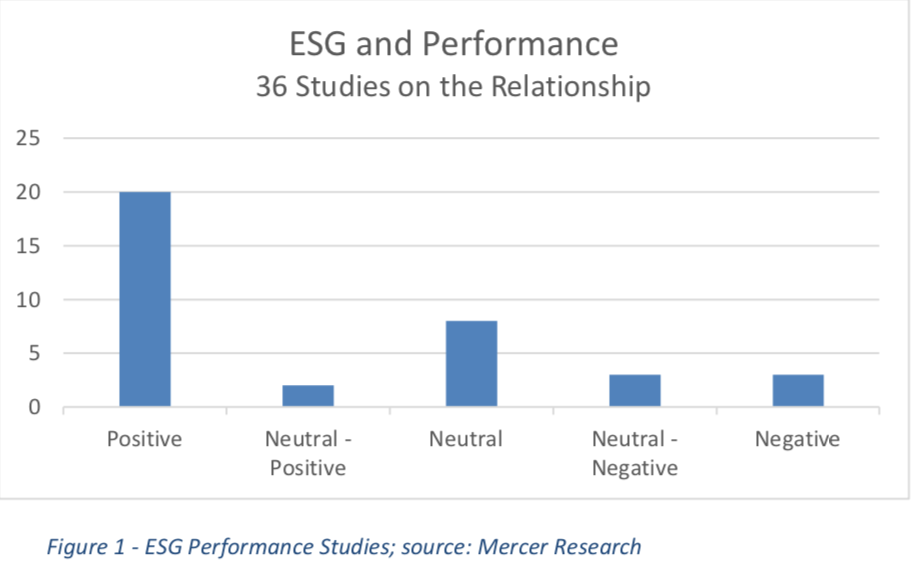
Research is now also consistently showing that using BRI criteria in investing does not have a negative effect on performance. Instead, research is suggesting that the relationship tilts more heavily towards out-performance. A recent report by Mercer Research reviewed 36 academic studies on the relationship between using BRI like criteria in the investment process (they use the term ESG – environment, social, governance). They found, as Figure 1 highlights, that 83% of the studies concluded that the relationship was neutral or positive.
The point of these findings is that market opportunity exists for those advisors confident enough to present the data to investors, and to open the conversation in the same way the advisor opens conversations about inheritance, giving, debt, and other topics that are critical to providing wise counsel.
SUMMARY
The moral reasons for using BRI – aligning with faith and being a good steward – are the primary reasons to incorporate BRI into a practice. The economic reasons provide comfort that investing in BRI funds is as justifiable as investing in non-screened funds from a purely professional financial management perspective. Whether investing in BRI funds or non-BRI funds, we all know that past performance does not predict future returns. However, research is suggesting that using BRI has had a neutral or positive effect on performance. Investors are increasingly saying the alignment of their investments is important to them, even if they are not sure how to ask how.
Given all of these factors, the question about using BRI should not be WHY? It should be WHY NOT!?!