
What We Are For

With the help of faith friends from our gathering of Faith Driven Investors, we’ve begun drafting a set of Unifying Principles. Our hope is that we can begin to come together under these thoughts and ideas to work toward a more full vision of what it means to let our faith drive our investments.

If you have thoughts, questions, concerns, things you’d change or add, please let us know! We’re relying on you, our community, to make this resource the best it can be.

Christ followers have become known for what we are against—no alcohol, tobacco, adult entertainment, gambling, etc. While acknowledging the good negative screen funds that exist, we desire for our movement to be more known for what we are FOR in how we place our investment capital—things like human flourishing, job creation, redemptive businesses that restore the world to God’s original design in the garden, etc.

The focus is less on which negative investments to avoid and more on where resources can be positively stewarded to do the most good. Of course, this is not a movement that is about delineating what Christ followers should or should not invest in. Some investments may be clear to avoid (those that produce and distribute pornography as a material part of their business model might be an example), and others may be less clear (those that make some food products that our doctors would tell us to avoid).

Regardless, we look to what Jesus said about His disciples—that they would be known by their love. Jesus didn’t send His disciples into the world to be known by the things they avoided. Yes, some things are worth staying away from, but that is not the focus of this movement. Instead, we search for the places and investments that we can lean toward.

Jesus sent believers out to live and love intentionally. Financial resources act as vehicles for this type of lifestyle. Instead of being known by what we don’t do, our investments focus on the mission given by God for humans to do good, serve others, and love well. While God has given many “Thou shall not” commands, this movement focuses on what God says “Thou shall do” to make God’s name known and to reveal His glory.

When we are engaged in a problem, we are committed to understanding the ins and outs of the community affected and always strive to come up with a solution that serves everyone involved. Instead of avoiding the problems and sins that plague this world—real as they are—the Faith-Driven Investor movement hopes to take an active and engaged role with what God has put in front of us.

Using Scripture as Our Guide

  • Ephesians 5:11 Take no part in the unfruitful works of darkness, but instead expose them.

  • Galatians 5:22-23 But the fruit of the Spirit is love, joy, peace, forbearance, kindness, goodness, faithfulness, gentleness and self-control. Against such things there is no law.

  • Proverbs 16:8 Better is a little with righteousness than great revenues with injustice.

  • Matthew 22:37-39 Love the Lord your God with all your heart and with all your soul and with all your mind.’This is t he first and greatest commandment. And the second is like it: ‘Love your neighbor as yourself.’

  • Proverbs 13:11 Wealth gained hastily will dwindle, but whoever gathers little by little will increase it.

  • Colossians 3:2 Set your minds on things above, not on earthly things.

  • Matthew 28:19 Therefore go and make disciples of all nations.

  • Hebrews 13:16 And do not forget to do good and to share with others, for with such sacrifices God is pleased.


Podcast Episode 4 – How Faith Conversations Strengthen the Culture and Value of Companies with Christeen Rico

subscribe to the podcast here

Faith-Based Employee Resource Groups. This term may be new to you, or it may be something you’re already participating in. Either way, this episode is for you. Christeen Rico is leading the conversation around ERGs, and what she shared in our conversation was both informative and insightful.

If you don’t know, ERGs are groups within companies that foster community and conversation among like-minded people. Companies like Apple, Google, Facebook, Toyota, and many more are creating these types of groups, so we’re grateful that Christeen dropped by to give us the inside scoop. 

If you’re an entrepreneur looking for ways to foster faith-based conversations within your business, Christeen will tell you exactly what it takes to form these groups. Or, if you’re an investor looking to get involved with companies that already have ERGs, Christeen will help you understand why these groups are important and how they add value.

Apart from that, Christeen was also a fun person to spend time with, and we think you’ll find this episode one worth listening to. Enjoy!

What is Gleaning?

We’re so excited to have Aimee Minnich on the podcast this week, and in preparation for her interview, we thought we’d share something she wrote about gleaning. In addition to being on our first podcast episode, Aimee was one of the presenters at our recent event for Faith Driven Investors, and she was gracious enough to share a copy of her talk with us. Below is a transcript of her presentation about the concept of gleaning. If you like this, look for her episode being released tomorrow!

by Aimee Minnich

Brittany Underwood built Akola from nothing — each item of jewelry handmade in Uganda and distributed through their warehouse in the States where most jobs are held by women recently released from prison. It’s an unlikely story for a company whose jewelry is sold for $300+ in Neiman Marcus and has been featured in Vogue and People StyleWatch.  With 70% margins and contracts with other major retailers she’s poised for growth and needs both a line of credit and an equity partner. A top VC firm in her industry was offering favorable terms and promising to help make the company even more profitable. Earlier this year, she sat across the table from them and turned them down. Why? Why would someone do that?

The difference between 70% and 80% profit margins the VC firm wanted would mean eliminating jobs that our young entrepreneur worked hard to create for women coming out of prison. The impact of those jobs for the women and their families was worth more than an easy equity raise and more revenue.

Brittany’s company Akola is modern example of gleaning — when an investor or business owner leaves some monetary gain on the table to provide access for a group that society has largely left behind.

Brittany’s decision may appear counter-intuitive, even to those of us pursuing faith-driven investing. We want to move up and to the right — that’s success, right? More profit, more impact. And often that’s the line that secular impact investing keeps feeding us. A major study by the Global Impact Investing Network suggests there’s no trade-off between profit and impact.

Does that need to be our definition of success too? Or does our faith compel us to a different standard? In Scripture we see at least 4 uses of capital commended. We are familiar with the first three — charity, tithing and traditional investing for return. To be clear, all of these are worthy of our effort and money. I love investing for market-rate financial return and many of you could do a much better job than me discussing those issues. But I also believe it deserves more attention.

I’ll focus on gleaning since it is one of the most unaddressed and important uses of capital.

Remember how Ruth gathered at the edges of Boaz’s field? Boaz was following the command from Leviticus to allow for gleaning.

 The Theology of Work Project explains:

“Gleaning is a process in which landowners have an obligation to provide poor and marginalized people access to the means of production (in Leviticus, the land) and to work it themselves. Unlike charity, it does not depend on the generosity of landowners. In this sense, it was much more like a tax than a charitable contribution. Also, unlike charity, it was not given to the poor as a transfer payment. Through gleaning, the poor earned their living the same way as the landowners did, by working the fields with their own labors. It was simply a command that everyone had a right to access the means of provision created by God.”

Our economies may not be as ag-centric anymore, but gleaning nevertheless is instructive for all of us because gleaning has to do with “provision” rather than harvesting crops.

 In fact, there are plenty of you in this room practicing modern-day gleaning within your own businesses. One of you has a business inside a prison, providing jobs and dignity and reducing recidivism. One of you operates a cattle feed lot, slaughterhouse, and distribution business in Ethiopia to provide jobs and access to the global economy for local families.

I’ve observed that it’s sometimes easier to practice gleaning within our own companies than it is to understand how to do it as investors. For over a decade I’ve worked with generous families of wealth helping them steward their philanthropic capital for maximum positive effect. What about these families, for whom the “field” that they’ve been given to work is managing philanthropic capital? How are we to think about the concept of “gleaning”?

I think we many are afraid to consider “investment gleaning” because it seems that accepting less than full market rate return is the purview of the unsophisticated. If I lend money at 8% when everyone else is getting 15%, doesn’t that make me the fool in the room? Others fear that it provides an excuse for lack of excellence from the entrepreneur.

Those things certainly could be causes of poor returns, but that’s not what gleaning entails. True gleaning involves excellence, access, work and sacrifice.

In ancient times, a farmer leaving some of his fields unharvested meant he had to be even more efficient, more effective with the portions he was working. In order to make enough to feed their family and follow the command to leave room for the poor to glean at the edges, God’s people had to be the very best farmers around. Excellence is always a hallmark of gleaning.

The next two items go together. Gleaning means access for the poor and marginalized. Access isn’t the same as a handout. Access to the means of production means wages for work. I would never advocate for eliminating charity, but I do fear that if we aren’t creating pathways to employment through our philanthropic capital then we may be doing more harm than good. If you’ve been to Haiti, you’ve seen this first-hand. There are instances where aid given to the poor and marginalized can create access – scholarships for education or career training are a great example. So is aid in the context of a disaster or mass displacement. But at some point we need to begin asking when “access” looks more like a job than a gift.

Sacrifice is the last hallmark of gleaning. It’s also the scariest. What looks like sacrifice to others often feels like simple obedience to the person making the sacrifice. Maybe its time to rethink our risk/return paradigm. If God is omnipotent, His return horizon is eternal, and we’re just His money-managers, then really the only meaningful risk we encounter is disobedience. When we get to the pearly gates, I don’t think He’s going to ask us whether we got a 15% IRR or beat our benchmarks. I am confident, though, that the ways in which we provide for His children who are poor and marginalized will be remembered.

Where Are The Christian Investors?

This article was originally presented at The Christian Economic Forum 2018.
Check out
CEF for other quality content!

The Christian Economic Forum hosts a world-class Global Event each year to connect the top industry leaders and experts from around the world with other individuals who are compelled to act upon the principles of God’s economy. The following paper was presented at CEF 2018.

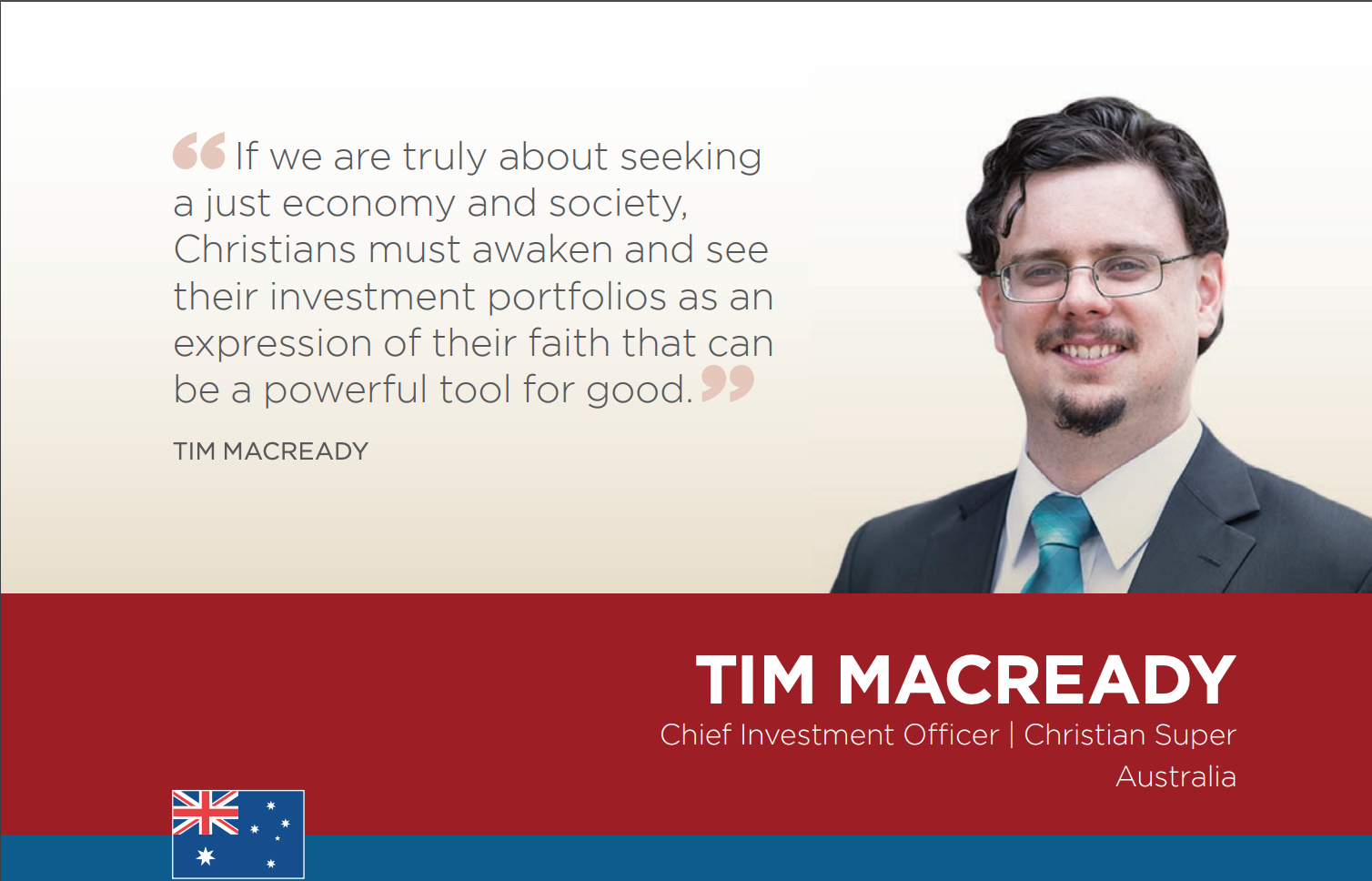
by Tim Macready

The Bible teaches that we are stewards of all we have. Everything, including “our” money, has been entrusted to us by God so we may faithfully steward it for His glory and our joy. This is true of each dollar (or pound, euro, shilling, or peso!) we have, whether we spend it today, save it for later, or give it away. Our financial choices should reflect our faith.

Christians have been leaders in giving for centuries. One of the distinguishing characteristics of the early church was the way she provided not only for her own poor, but also for the poor from the societies around her. Christians are more likely to give—and give more—than their secular counterparts (although sadly not necessarily more than followers of other religions).

Christians have also been leaders in responsible spending. The modern fair-trade movement traces its roots back to Mennonites, Quakers, and the Salvation Army. Its origins, however, lie even farther back in the efforts to stamp out the slave trade through a boycott of West Indian sugar—efforts fired by an understanding of the slave as “a man and a brother” made in God’s image. Dr. Martin Luther King, in his final sermon, reminded his listeners that withdrawing economic support sends a powerful message to companies and industries.

Likewise, when it comes to investing, Christians were early adopters of the idea that moral considerations matter. As far back as 1758, the Quakers prohibited their members from “investing” in slaves. John Wesley’s sermon, “The Use of Money,” articulates a well-developed understanding of the way we as Christians are to engage in trade—avoiding industries that harm people or that are involved in fraudulent activity.

Sadly, many Christian investors lag behind their secular peers in using capital responsibly and for good. We have often settled just for screening out a few companies from our portfolio on moral grounds. Or even worse, we have divorced our investment and our faith entirely, creating a secular-sacred divide that doesn’t care about how our portfolio grows, so long as the proceeds are used faithfully.

In the meantime, secular investors push ahead. Responsible Investment today is a US$20 trillion industry. Over half of Australia’s $2 trillion pension assets have divested from tobacco stocks. Mainstream investors the world over have bought into the idea that environmental, social, and governance factors are relevant not only to the investment performance of our portfolios, but also to how the finance industry as a whole plays its part as a positive and responsible contributor to society.

If we are truly about seeking a just economy and society, Christians must awaken and see their investment portfolios as an expression of their faith that can be a powerful tool for good. We should be early adopters and leaders in this transformative effort to shape our economies and investment markets, pursuing human flourishing and creation care.

What does it look like for Christians to wrestle with investing not just for profit, but also for impact? There are many questions to ask and much discernment is needed.

As we seek to avoid harm, at what point do we hold a company accountable for its contribution to harm, when other parties (subsidiaries, consumers, governments) rightly share responsibility? How do we maintain integrity and faithfulness in the way we invest since every company has flaws and faults? We must find an appropriate balance between avoiding investments that create harm and recognising that most companies do much good, especially by creating jobs and providing valuable products and services.

What does it look like to invest for flourishing? What is the view of the good life we are seeking for those impacted by our investments? How can we invest in such things?

We must also wrestle with questions about performance trade-offs. As followers of Christ, we value justice over profit maximisation. But we cannot forget we are stewards entrusted with assets and an expectation of return. Those of us who invest in a fiduciary context often feel constrained in our ability to adopt responsible investment strategies, fearing we might experience lower performance or higher risk in the pursuit of responsible or impact investment goals.

There is, however, a growing pool of evidence that these strategies can improve long-term investment performance. At the same time, the idea that a fiduciary exists solely for the financial benefit of its beneficiaries is increasingly being challenged. As Christians, we affirm that stewards are to act faithfully. Even so, beneficiaries of pension schemes, managed funds, and other pooled investments are demanding their values be taken into account in the way that portfolios are managed, regardless of the financial implications. As Christians, we should be engaged in this debate—at its core is a question about the fundamental purpose of investment markets and the very structures of our economies. We have an opportunity to

remind the world that money and markets are a tool for human flourishing and creation care, not a mindless exercise in profit maximisation while destroying lives and pillaging God’s creation.

Knowing Christ transforms our lives; how can it also transform our investment portfolios? As Christian investors, we expect to answer to the Master about how we have been faithful with the portfolios He entrusted to us. We will give an account not only for our financial returns, but also our non-financial outcomes.

Wrestling through these questions takes time and persistence. Perhaps we need new categories of investment and new intermediaries who will help us as Christians to invest faithfully. These might include:

  • Venture capital firms investing in businesses that integrate Christian faith.

  • Property funds that adopt Christian approaches to every facet of real estate.

  • Equities managers who integrate Christian principles across their investment strategy.

  • Advisors who will help us align our portfolios with our faith.

In God’s providence, many such organisations are emerging, giving us more opportunities to be faithful with what has been entrusted to us, so that it not only grows financially, but also leaves a good and faith-filled legacy.

Podcast Episode 5 – The Investor as a Servant Leader with Frank Chen of Andreessen Horowitz

subscribe to the podcast here

Our friend Frank Chen stopped by the Faith Driven Investor podcast to talk about how he’s helping entrepreneurs change the World at the Silicon Valley Venture powerhouse of Andreessen Horowitz. As Frank describes it they are “helping entrepreneurs build software companies that are eating the world.” (he’ll give you a little more info about what that means in our interview). 

Frank Chen is a self proclaimed former product and user experience design junkie with specialties in venture capital, artificial intelligence/machine learning, fund raising, product planning, product launches, product development process, enterprise software, UX design, Web hosting, and managed services. With a breadth of expertise like that, you can see why we were excited to have him on the show.

In addition to all of that, Frank also shared a vision for what it could look like when investors view themselves as servant leaders. So often, we think of the relationship between entrepreneur and investor as a constant power struggle, but Frank upended that idea and offered a much more redemptive approach that we thought was so helpful.

It was a fun, enlightening and engaging conversation, which we hope you enjoy. As always, thanks for listening.

Useful Links:

Marc Andressen on Why Software is Eating the World

GDP/Capita over the last 2000 Years

Frank Chen LinkedIn