CIF Releases Results from 2019 Survey of Financial Advisors on Faith Driven Investing
The full report of the survey is published here by the Christian Investment Forum.

by John Siverling

Advisors are increasingly comfortable with Faith Driven Investing, are interested in recommending it, but have been slow to engage in conversations with investor clients.

Charlotte, NC / January 31, 2020 — The Christian Investment Forum released the results of the 2019 Survey of Financial Advisors on Faith Driven Investing Awareness and Use. It shows continued, albeit slowing, improvements in all three areas of focus – awareness, knowledge, and use. This slowing growth is relative to the last survey completed in 2016, which had shown more substantial improvements compared to 2013. The results also show some interesting and seemingly inconsistent responses, such as:

  • Ninety-six percent (96%) were somewhat to very familiar with Faith Driven Investing concepts; BUT

  • Only thirteen percent (13%) were able to accurately identify that there are more than 50 Faith Driven Investing funds and ETF’s available in the market (there are over 90).

  • Ninety percent (90%) are interested in recommending investments that align with their clients’ faith and values; BUT

  • Twenty-four percent (24%) said no clients had asked about Faith Driven Investing in the last year, and another fifty-one percent (51%) said only 10% of clients had asked, yet industry research suggests just the opposite – the majority of investors are interested in values based investing.

To a large degree, the issues limiting the use of Faith Driven Investing remain the same since the initial study in 2013. There continue to be gaps in perception compared to reality on product availability and performance. Yet some further structural changes are needed – additional investment products that can more closely align with the different faith values of investors, increased acceptance of funds onto proprietary platforms, and additional research to support the already existing data on ESG (Environmental, Social, Governance) investing, FDI (Faith Driven Investing), performance, and expenses.

The greatest opportunities to build momentum towards increasing the use of Faith Driven Investing are in helping encourage further education, and more importantly encourage conversations between advisors and investors. Both advisors and investors show high levels of interest in Faith Driven Investing, but neither advisors or investors are initiating a conversation or asking questions about FDI. More education on the topic of Faith Driven Investing can help to increase confidence for advisors to have the conversation. Similarly, more investor oriented information can help Christians recognize their role in asking questions of their financial advisor.

For those interested in supporting and growing Faith Driven Investing, there are strong reasons to be optimistic about the future growth in the use of FDI overall, and as a share of total assets under management. Data from this survey confirms previous research that a majority of investors and advisors alike have an interest in better aligning investments with the client’s personal faith and priorities. Macro trends in the market are showing strong investor interest in a more meaningful and integrated approach to investing in alignment with values. There are more organizations engaging in the conversation about Faith Driven Investing, and collaboration between them is improving. All of this helps to encourage others to understand they are not alone in desiring a more integrated approach to investing with their faith.

Check out the full report of the survey here!

About the Christian Investment Forum:

Founded in 2012, the Christian Investment Forum (CIF) is a Kingdom-focused 501c6 investment association committed to educating advisors and investors by providing opportunities to bring about change – in the hearts, homes, cities, and world that we serve. CIF strives to be an organization that enables others to advance and promote Faith Driven Investing (sometimes referred to as Biblically responsible investing or BRI), and cause greater Kingdom impact. CIF Foundation is a 501c3 non-profit organization that is a wholly owned non-profit entity of the Christian Investment Forum. The objective and purpose of the Foundation is to support the activities and purpose of the Christian Investment Forum (CIF), its sole member, in order to more effectively achieve the mission and goals of CIF. It is the intent of the CIF Foundation to provide research and education services to individual investors, advisors, and financial professionals related to Faith Driven Investing. Learn more at www.christianinvest.org

National Faith Driven Investor Gathering in Dallas – Sept 23-24th

by Justin Forman

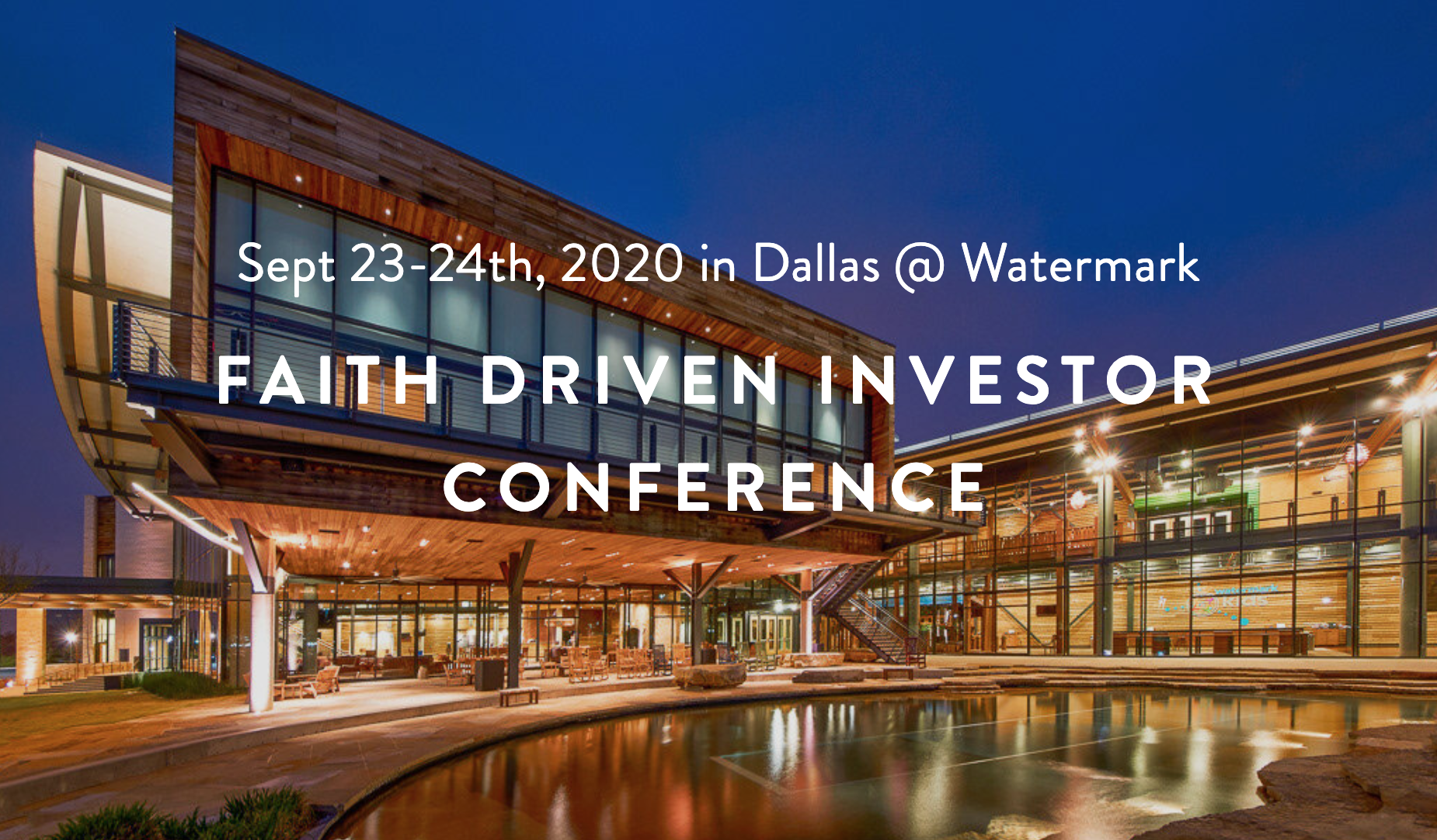
One year ago, a small group of us gathered in Deer Valley to dream about how the Gospel might advance through Faith Driven Investing. This movement of investors, fund managers, and leaders believes that God owns it all and that He cares deeply about how we steward His investments. Watermark Community Church in Dallas is graciously working with us to host what will be this year’s defining gathering for Faith Driven Investors on September 23-24th!

We confirmed the dates less than a week ago, so more details will be coming out soon. We have already confirmed that Andy Crouch from Praxis, Finny Kuruvilla from Eventide, Ron Blue from Kingdom Advisors, and Todd Wagner from Watermark Community Church will be speaking. There will be tracks specifically designed for Real Estate, Private Equity, Direct Investments, Family Office, and Institutional Investing. We’ll feature actual faith-driven investment opportunities in new startups, real estate, and video properties including Phil Vischer, Creator of Veggietales. You can also stick around an extra day to network with entrepreneurs by joining us for the Faith Driven Entrepreneur Conference immediately following.

Seating will be limited to 700 attendees and registration is open! The Faith Driven Investor is a ministry subsidized by the generosity of a few individuals and foundations. There are some added discounts available for the first 100 registered.

We’re excited to see you there!

Strategy in the Age of Superabundant Capital

 Image taken from Harvard Business Review

This article was originally published here by Harvard Business Review.

by Michael Mankins, Karen Harris, and David Harding

For most of the past 50 years, business leaders viewed financial capital as their most precious resource. They worked hard to ensure that every penny went to funding only the most promising projects. A generation of executives was taught to apply hurdle rates that reflected the high capital costs prevalent for most of the 1980s and 1990s. And companies like General Electric and Berkshire Hathaway were lauded for the discipline with which they invested.

Today financial capital is no longer a scarce resource—it is abundant and cheap. Bain’s Macro Trends Group estimates that global financial capital has more than tripled over the past three decades and now stands at roughly 10 times global GDP. As capital has grown more plentiful, its price has plummeted. For many large companies, the after-tax cost of borrowing is close to the rate of inflation, meaning that real borrowing costs hover near zero. Any reasonably profitable large enterprise can readily obtain the capital it needs to buy new equipment, fund new product development, enter new markets, and even acquire new businesses. To be sure, leadership teams still need to manage their money carefully—after all, waste is waste. But the skillful allocation of financial capital is no longer a source of sustained competitive advantage.

Read the rest of this article here!

Podcast Episode 15 – Multiple Bottom Line Investing with Pete Ochs

subscribe to the podcast here

Today’s episode takes us to jail. Well…not exactly. But we are interviewing a man who owns and operates a business that is run out of a high-security prison. 

His name is Pete Ochs, and in addition to working as founder and chairman of an impact investing company, he’s also working to make Hutchinson Correctional Facility in Kansas the best prison in America. How? Well, we’ll let him tell you…

Pete is an expert when it comes to multiple bottom line investing—something many Faith Driven Investors are familiar with—and in this episode, he walked us through what that means, what it can look like, and how others can apply this approach to their own lives.

As always, thanks for listening.

Useful Links:

Jailhouse Business of Generosity

Inmate Confesses God’s Love at Seat King

Work as Flourishing in Prison

Enterprise Stewardship

Blessed are the Risk Takers

  Image by   Loic Leray

This article was originally published here.

Check out Inspire Investing for other quality content!

by Dr. Erik Davidson

“He who watches the wind will fail to sow, and he who observes the clouds will fail to reap.”

Ecclesiastes 11:4

As human beings, our capacity to worry is quite exceptional. In a worldly sense, this predilection towards fear is very understandable as bad things do happen in our lives and in the world around us. In fact, at times our worry has likely kept us from danger or harm. Personally, I know that even as the years have gone by, I have found it very difficult to break the grip of fear in my own life. If anything, I can take some small comfort in the fact that the nature of my worries has changed as time has gone by. These days, I find myself still worrying, but about different things than I did in my earlier years. That probably does not count as progress though!

Given our very human predisposition to worry, it should be no surprise that fears are especially heightened when it comes to investing. In fact, the foundational theory in the area of behavioral economics, Prospect Theory, by Noble laureate Daniel Kahneman (author of Thinking Fast and Slow) and Amos Tversky showed that humans are so overcome by fear that we instinctively weigh loss and gain prospects unevenly thereby causing suboptimal decision-making. Especially in the wake of the trauma of the Financial Crisis of 2007 – 2009, investors are predisposed to see danger lurking around every corner. These days, the list of fears that investors face is quite long: trade disputes with China, Brexit, domestic political divisiveness, Hong Kong protests, inverted yield curves, recessionary concerns, etc.

Nevertheless, despite the enticing self-preservation benefits of fear, the Bible is filled with admonitions against it (Isaiah 41:10, Luke 12:22, etc.) because of the obstructive effect it can have on our God-given destinies. Many times in the Bible, the challenge is put forward to “fear not”. Both the Old and the New Testaments have numerous stories of ordinary people overcoming their fears and taking significant risks with extraordinary, even miraculous results (think Moses, Esther, the Disciples, et al.).

In the Parable of the Talents (Matthew 25), it is illuminating to read of the master’s praise, “well done, good and faithful servant”, for the two employees who took risks with the funds that had been entrusted to them. Yet, maybe even more instructive is the scorn directed at the servant who was afraid and went and hid the entrusted funds in the ground . . . “You wicked and slothful servant” and “cast the worthless servant into the outer darkness”. If this isn’t a call to guard our hearts against acting out of fear, I don’t know what is!

Carrying over this Biblical call of risk-taking to investing, it is important for investors to be on guard against getting wrapped around the wheel of whatever the “worry of the day” may be. Rather, investors should undertake prudent risks aligned with the timeframe of their financial objective. Certainly, for short-term (less than five years) financial objectives such as planned major purchases or expenditures, risk-taking should be minimized. Actually, these sort of short-term financial goals are better viewed as “savings” rather than “investment” strategies. However, for those financial goals that are long-term (more than five years) such as young children’s college funds, retirement, a vacation home, estate plans, charitable bequests, etc. a spirit of prudent risk-taking is necessary in order to grow the funds while outpacing inflation and taxes.

The history of the stock market shows the wisdom of the Bible’s guidance on fear and risk-taking. Going back to its inception in 1927, the S&P 500, the benchmark U.S. stock market index, despite dramatic corrections and crashes, has had a total return of approximately 10% annualized. During this very long time period, despite prior generations’ “worry list” including wars, rise/fall of Communism, recessions, famines, assassinations, political discord, etc. there has never been a 14-year holding period in which the total return of the S&P 500 has been negative. Prudent risk-taking pays off over the long-term (source: Standard & Poor’s).

Obviously, “blessed are the risk-takers” is not actually one of the Beatitudes (Matthew 5). Nevertheless, investors who believe that the Bible has wisdom applicable to contemporary life are well advised to consider its guidance as it relates to fear and risk-taking as they make investment decisions.

Learn more at inspireinvesting.com