Two Sides of the Same Coin

WHERE WILL THE NEXT GENERATION OF CHRISTIAN LEADERS COME FROM – IN MINISTRY AND IN THE MARKETPLACE

by Greg Barnes

We are in an increasingly challenging culture, where great leaders are hard to find. McKinsey & Company coined the phrase “war for talent” in 1997. Now, more than 20 years later we know that talent chooses you as much as you choose talent. And if you’re searching for great leaders of Christian faith who have executive-level talent, your pool gets even smaller. As Baby Boomers retire and a new wave of leadership is needed, where will we find the next generation of leadership for our ministries, churches, and faith-aligned businesses? 

Christian leaders are urgently needed for faith-motivated leadership in the marketplace and in nonprofit ministry positions. There are nonprofits and Christian-led organizations seeking executive talent every day. But there is a disconnect. 

The other side of the coin is this: Executive leaders often speak a different language while trying to find roles that align with both their talents and passions, while Kingdom-impact companies struggle to find people of faith to serve in their top leadership roles.

Barriers to Permeability

During my career in executive search, and now focusing on faith-based ministries and faith-motivated companies, I have gotten to know countless individuals in a deeply personal way as they approached mid-life and/or career re-assessment. There is a pervading desire for more meaningful and eternally significant work. Many feel the calling to transition from a significant season in the marketplace to a new season in the nonprofit world, but they often don’t know how. The permeability of marketplace and ministry is still very complicated. It is difficult to move from one to the other and back again.

As if looking through a window to what’s outside, executives have dimly lit insight into what’s outside the corporate world. However, there are barriers that keep them from easily passing beyond. The most obvious barrier is typically having to compromise on income, which can be a hit to their family life. Beyond that, there can also be a fear that their talents and skills will not be adequately utilized outside of the marketplace. Also underlying a move from marketplace to ministry is the question, “Would I be able to move back into the for-profit world afterward?” 

On the other hand, ministry organizations are struggling to find high-quality talent willing to move into the nonprofit realm. They are searching for executives who can lead and run businesses, but they do not know where to reach for that kind of talent. For faith-based organizations, an added barrier is finding leaders who are aligned spiritually with their mission.

Yet, as many of us know well, ministry is not only found in the nonprofit sector. 

Another Side of the Same Coin

What about for-profit companies that have been founded or are run by Christian leaders? Many of these companies have built a culture and a mission that goes beyond the products and services they bring to the marketplace. The ethos of the organization has been heavily influenced by the faith and faith-in-action mindset of the leadership. What happens when these leaders retire or want to scale back and the organization needs a new wave of leadership? 

These leaders struggle tremendously to find executive-level talent (whether that is replacing founding leaders or adding to executive staff) that share the same alignment of values and beliefs. When you’ve built a successful for-profit company, infused with an ethos that is centered around servant-hearted leadership, Christian values, and kingdom impact, you want to preserve and enhance that culture. But how do you scrutinize for marketplace talent that shares those values without being accused of discrimination?

At the same time, there are seasoned leaders currently working in traditional marketplace roles who would love to join Business As Mission (BAM) leadership teams or lead a business founded by a faith-filled leader. Many believers employed in a corporate job would consider it an upgrade to do the same kind of work in a company that has a missional focus. How do they find such companies? In the marketplace, it is not as apparent from the outside which companies have such a focus – another barrier to permeability.

Creating a Pathway

When we founded FaithSearch Partners, our goal was to create a pathway between experienced business leaders and faith-based nonprofits that desperately need their talent but don’t know how to access it. We’ve built a network across both marketplace and ministry segments that makes more permeability possible.

Yet during our many years of working with nonprofits, we discovered something else: the same network that produces great marketplace leaders for the nonprofit ministry sector is also a reliable network that can produce faith-filled leaders for Business As Mission (BAM) companies in the for-profit sector. We recognized, however, that there may be a hesitancy – even in a company run by a Christian leader – to bring on a firm with such a faith-forward name as “FaithSearch”. Their boards might discourage the connection. Yet we knew we could solve a big need for these businesses with our network.

So, we decided to go out on a limb and try something new. We began a separate entity, FSP Leaders, a distinct brand run by our same team and network. At FSP Leaders, we serve for-profit businesses run by faith-aligned leaders. We help these businesses find executives that share their same faith-in-action values and leadership culture. 

FaithSearch Partners and FSP Leaders are serving two sides of the same coin. In both brands, we are helping faith-filled executives move through mid-career transitions in a way that is aligned with who they are and what brings them joy and purpose, and simultaneously helping organizations find top-tier talent aligned with their mission and culture.

Executive leaders are no longer sitting inside their context, unclear of how to reach a world beyond their barriers. We are acting as that screen that allows the breeze in. Our hope is that the permeability in marketplace and ministry for candidates (and organizations) will begin to increase and we’ll be able to make an impact in getting talented Christian leaders into positions that leverage their gifts and align with their callings.

Setting Up the Next Generation for Success

So, what has this looked like, practically speaking? One such organization that is working to continue Christian leadership in their next stage is Office Pride, a commercial maintenance services company with 135 franchises nationwide. FSP Leaders assisted in finding a faith-aligned CFO for this franchise company. Office Pride wants to ensure their core values and cultural DNA remain the same as they bring in new leadership. FSP Leaders was tasked with finding a marketplace leader of faith who can continue the legacy and vision the organization was founded upon. 

Morning Star Transformational Tours has found itself in a similar situation. Founded by two very strong leaders of faith, MSTT is a for-profit company that organizes tours and events for global nonprofit ministries, seminaries and churches. Having leadership grounded in a Christian perspective is vital as Morning Star’s founders transition. FSP Leaders is searching for new leadership for MSTT that matches the vision and faith of their founding principles and core Christian clientele. 

Both companies are looking toward their future. They have developed and thrived from their Christian-centered roots, and their leaders are taking proactive steps to prepare for their next phase of growth. Selecting executives who share their ethos equips the companies to continue on their legacy and sustain their ministries in the marketplace.

Ministry in the Workplace

Are you a marketplace leader looking to transition into a new role that uses your talents and passions to glorify God through your work but scared to take the plunge? 

Are you a Business As Mission (BAM) company struggling in your search for an executive who will continue the same faith-based DNA and culture of your organization? 

Or perhaps you’re a part of a Christian ministry or church desiring more marketplace expertise in your next leadership hire but feeling discouraged? 

Take heart. Know that the barriers between marketplace and ministry are being permeated, and God is using executives in both the nonprofit and for-profit sectors to advance His kingdom. 

No matter your path, “Let the favor of the Lord our God be upon us, and establish the work of our hands upon us; Yes, establish the work of our hands!” (Psalm 90:17). 

At FaithSearch Partners and FSP Leaders, we pray this over all who put their faith in the Lord— that He may guide us all to use our hands to do His great work.

This is one of the 2020 CEF Whitepapers. For more information on the Christian Economic Forum, please visit their website here.

[ Photo by Mateusz Dach from Pexels ]

U-Turn retail stores as an example of an impact-focused social enterprise

by Johan du Preez

Written with the support of Gavin van den Berg and Sam Vos.


Background

At the Tree of Life Foundation, regarding the allocation of capital with a Kingdom agenda, we feel strongly that:

  • Collective effort enables bigger strategic projects / higher level of economic influence in the target geographical area

  • Local participation and investment management is crucial to avoid pitfalls due to cultural differences, lack of oversight, etc.

With this in mind, we have done the following in South Africa:

  • Set up actively managed unitized private equity and other investment portfolios on the Donor-advised Fund (DAF) platform we offer (tol.org.za/donor-advised-fund/).

  • Set up private equity vehicles for those wishing to invest with private money rather than DAF money (not further discussed in this White Paper).

  • Facilitated local investment participation (currently the bulk of capital we manage is from South African investors) and active investment oversight via a South African registered Financial Services Provider (FSP).

Whereas we have covered our views on Collective Christian Capital and the continuum of investment approaches in previous CEF White Papers,1 this paper focuses on Impact Investment (i.e., an “Impact First” as opposed to a “Return First” investment in the referenced paper) and a specific example of investment in a social enterprise where a lack of capital was the bottleneck to growth for an otherwise extremely scalable and impactful business model.


Overview of Impact Investing and Social Enterprises

A commercial enterprise has the sole purpose of maximizing profit and shareholder return. Transcending this traditional purpose of business, a social enterprise is (broadly) defined as an entity with specific social objectives, aiming to maximize both social and economic returns. Social returns include benefits to societal welfare, environmental sustainability, and—as Kingdom-oriented investors—the advancement of the Gospel.

Social enterprises have an important role to play in bringing healing and restoration to a broken world. Having a mandate to focus on social and environmental upliftment allows social enterprises to bring about change, where normal businesses are constrained.

A growing trend of identifying the need to improve social and environmental issues is being driven globally by secular institutions. In line with the United Nation’s Sustainable Development Goals, this trend has been driven from the top-down by means of an increased awareness of ESG factors taken into consideration when allocating capital.

Impact investing is the art of allocating capital with specific social and environmental objectives in mind. It is worth noting that not all impact investments require investment into social enterprises, but these concepts are deeply intertwined.


Current Limitations of Impact Investing

Noting the benefits of social enterprises, why are there not more? As is the case in traditional business, capital is at the heart of developing a sustainable economic entity. Unfortunately, social enterprises face barriers to attracting much needed capital.2 These barriers to capital include:

  • The difficulty of social impact measurement. Converting subjective matter into a quantitative, nominal figure is further complicated by contrasting views on what constitutes impact.

  • The balancing of financial and social returns. While these two types of returns are not mutually exclusive, investors’ propensity to concede financial return for social return is further complicated by the difficulty to quantitatively measure social returns.

  • An underdeveloped impact-investment market. A shortage of scale, quality impact-investment opportunities backed up by an established track record, limits investment opportunities. As a result, limited intermediaries (brokers, consultants, fund managers, etc.) exist. This in turn creates liquidity concerns, high transaction costs, and a skew toward higher-risk investment opportunities.

As a result, attracting sufficient funding for social enterprises with the potential to bring forward substantial change is often challenging.

Our observation in the Christian investment ecosystem is that there is a high presence of social impact opportunities in Third World countries but, at the same time, a lack of capital. Furthermore, the mere addition of capital to many of these opportunities does not guarantee success—more often than not, the management needs advice in refining and focusing on the core strategy, how to successfully scale (systems & people), corporate governance, measuring and reporting capability, etc.

In the First World on the other hand, there is often significant capital available that is earmarked for impact by the owners thereof, but they often face obstacles in sourcing suitable investment opportunities, thoroughly investigating them (due diligence), as well as implementing post-investment oversight. Sadly, this often gives rise to indiscriminate impact investing with the best of intentions but disappointing results (similar to how foreign aid in the form of grants/donations often do not affect the change initially hoped for).


Impact Investment Case Study: U-Turn Retail

U-turn (www.homeless.org.za ), today a registered Public Benefit Organization / charity in South Africa, was founded in 1997 by Colleen Lewis to focus on the care of homeless people in her area of Cape Town. Colleen initially operated from her home (providing food and Bible studies), but due to the growing need and concerns from neighbors, operations moved to the St Stephens church hall in Cape Town.

In 2006, Colleen stepped aside and handed the management over to a management team led by Sam Vos. Programs included feeding programs, Bible studies, an accommodation centre where homeless people were housed, and ad hoc service delivery to address whatever the needs were of a homeless person showing up for help.

Sam, being a qualified Industrial Engineer, saw the need for a more structured process through which U-turn could help people moving off the street. Due to lack of resources, this could not be done overnight (the 2006 turnover was a mere ZAR 500k, or $35k USD at current exchange rates), but they kept gradually chipping away at it until the process of “occupational therapy combined with work opportunities” settled in 2009.

I first learned about U-turn when Sam and Jonathan Hopkins attended Triga Ventures (a cutting-edge South African Organization similar to Praxis in the U.S.) in 2019, where I have the privilege to serve (www.trigaventures.org).

U-turn follows a holistic approach to homelessness as can be seen from Figure 1 below and is acknowledged as a thought leader with regards to this social dilemma in the local community. They recently published a well-researched paper on The Cost of Homelessness due to the combination of Humanitarian, Developmental, Reactive, and Punitive measures associated with it.3
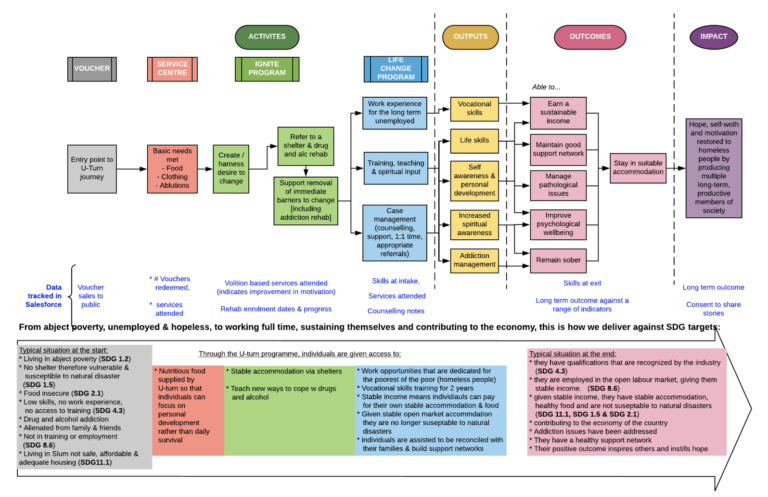
  Figure 1: U-Turn Theory of Change: Equip the homeless with skills to overcome homelessness.

Figure 1: U-Turn Theory of Change: Equip the homeless with skills to overcome homelessness.

From the above, it is evident that the provision of work and associated skills training form an important part of the overarching process that U-Turn follows. During the initial years, the government provided funding and work opportunities (e.g., cleaning up graffiti), but due to the unpredictability of these government programs, U-Turn established its first charity store in 2012. The benefit of the charity store as the employment and training component of U-turn’s program was that U-turn could be in control of their own funding as well as the length of period someone needed to be employed before moving on.

Today, they have 7 physical stores, one e-commerce store, and one laundry sorting facility—9 significant operations. Having developed and refined the IP to run these stores over a number of years, there is ample room to scale this. As part of the bigger employment ecosystem, they see the current retail operations as “but one stream of work,” and (besides significantly scaling retail operations), they have ambition to set up other things like a textile recycling plant, a recycling plant for household goods, etc.

U-Turn Retail’s shops operate like thrift shops (with the normal impact benefits of recycling secondhand goods rather than for it to end up in landfills) but with a further social and spiritual impact twist. The shops play an essential role in equipping participants, as they gain real-world work experience while earning a stipend. Ultimately, it is envisioned that participants secure an independent job in the open labor market, become active members of society, and stay off the streets. Currently, 83% of the individuals who graduate from the program remain productive members of society. (See https://youtu.be/SNW6F2061QQ and https://youtu.be/H31xUAJsmek as examples of individual testimonies).

The retail business sources second-hand goods (mainly clothes) via donations. It then sorts, cleans, and transports the goods to the retail outlets. Each of the 7 retail stores has a store manager, which oversees between 3 and 4 participants. The retail business has recently made business improvements to reinforce sustainability while employing a sub-optimal number of employees, as job-creation is their core purpose.

Currently, U-Turn Retail has the capacity for 40 rehabilitants to gain work experience. Operating in a city estimated to have 14,300 people living on the streets,3 the supply and demand relationship is sorely one-sided. To expand the rehabilitation intake, more jobs are needed. To create more jobs, growing the store network is key. While the retail business has the proven ability to sustain itself economically, its cash-flow generation is not sufficient to finance the accelerated retail expansion required to satisfy the current employment need. It is for this reason that TOL, as capital provider via our Impact First Portfolio, decided to partner with U-Turn to provide a capital solution where ordinary “Return First “capital may struggle.

To set-up a new store requires a capital expenditure of ZAR 260,000 (roughly $17k USD), with each new store creating employment for an additional store manager and 4 rehabilitants. The average monthly new store EBITDA is estimated to be roughly ZAR 8,700. To fund this expansion with external capital, a 5-year loan carrying 10% interest will require an approximate ZAR 5,700 repayment per month. The low level of cover underscores the risk associated with this investment. Investors not willing to forego the financial return adequate to compensate for the high level of risk would struggle to commit capital to U-Turn.

A ball-park interest rate figure for a justifiable risk-reward payoff in South Africa would likely be closer to 20%. For the committed impact investor, the 10% financial return differential can be justified by the creation of additional job opportunities with every store that is opened.

Since TOL provides more than capital, however, and gets actively involved in the investments we make, our expectation will be that the financial outcome at the stores may improve further. In recognition of that, we have agreed that U-Turn will pay a turnover linked fee of 7.5% to TOL but only on the turnover in the new stores and then only on the component of the turnover in excess of U-Turn’s current projections (it was furthermore agreed to cap the turnover linked fee at a 30% outperformance of turnover targets).

U-Turn Retail falls into an “Impact-First” investment bucket, with the added benefit of having a high missional rating. The business is owned by a Christian charity, run by Christian businessmen, and embedded with Christian values throughout their rehabilitation process. While subjective, TOL deems the sustainable impact opportunity a worthwhile trade-off and is willing to curtail the high return that would be required to justify the investment’s risk profile.

Our total initial investment amounts to a ZAR 1,600,000 ($107,000 USD) investment in the form of a loan to fund the setup of 6 additional retail outlets over the coming months. Our intention is that this forms the initial step in a partnership that will ultimately lead to an equity investment enabling an even more aggressive expansion of the retail platform as well as the addition of other types of businesses that can fulfill the same role.


Benefits

Investing DAF money via the Tree of Life Foundation’s (TOL) Impact Portfolio places us in the wonderful position to support sustainable businesses with explicit impact but without the level of pure financial returns that will be required for a typical private equity investment.

As mentioned, TOL offers various investment portfolios on our DAF platform. We typically seed fund these portfolios with our own balance sheet TOL funds when they are launched. Likewise, the Impact Portfolio is currently significantly funded by TOL that will dilute over time as DAF clients buy units in the Impact Portfolio, thereby also creating capacity for future transactions. Running a unitized portfolio under a DAF platform has various advantages:

  • Since there are specific portfolios with specific focus areas and benchmarks, DAF clients are clear what they are investing into and will also receive quarterly statements showing the latest value of their holding (the unit cost in each portfolio is reported quarterly).

  • It facilitates the raising of like-minded capital and the availability of capital when opportunities arise (rather than to raise funds on a transaction-by-transaction basis).

  • It facilitates transactions that are bigger than individual investors may have appetite for.

  • Each of the underlying investments is actively managed by TOL.

  • Clients spread risk across various investments in the portfolio.

  • Liquidity is possible as new DAF clients buy units in the portfolio (allowing DAF clients wishing to exit the opportunity to sell their units).

  • US investors can enjoy significant tax benefits from investing via a DAF (cross border equivalency to ensure tax benefits, although the money sits in a DAF in South Africa, facilitated by Trustbridge – trustbridgeglobal.com).

The Impact Portfolio is a relatively new addition to our value proposition (the first investment was made two years ago) but has massive potential given the abundance of such opportunities in South Africa and the growing awareness of impact investing as an alternative to grantmaking. It also complements our existing “Return First” private equity portfolio that has established a solid track record since it was launched on the DAF platform in 2016.


 ——

[1] Du Preez, J: Balancing Financial Returns and Impact in Private Equity Investments, CEF 2018; https://drive.google.com/file/d/1RGtgeiKdoXbGZX9PHTlqsKkBH_6tHAy6/view?usp=sharing

[2] McCallum, S.R: Private sector impact investment in water purification infrastructure in South Africa, 2018

[3] Hopkins, J, Reaper, J, Vos, S, & Brough, G: Cost of Homelessness, Cape Town, 2020.

Article originally hosted and shared with permission by The Christian Economic Forum, a global network of leaders who join together to collaborate and introduce strategic ideas for the spread of God’s economic principles and the goodness of Jesus Christ. This article was from a collection of White Papers compiled for attendees of the CEF’s Global Event.

Understanding and Unleashing Transformational Biblical Generosity for Christians, Churches, Communities, & Countries

Article originally hosted and shared with permission by The Christian Economic Forum, a global network of leaders who join together to collaborate and introduce strategic ideas for the spread of God’s economic principles and the goodness of Jesus Christ. This article was from a collection of White Papers compiled for attendees of the CEF’s 2019 Global Event.

by Brian Kluth

Everyone on the planet is on a generosity journey. Each person needs to be encouraged, equipped, and empowered in their faith journey to live and give generously. In today’s complex world this white paper seeks to provide practical and proven models, methods, and materials that can help leaders understand and unleash transformational biblical generosity in the hearts and lives of people everywhere.

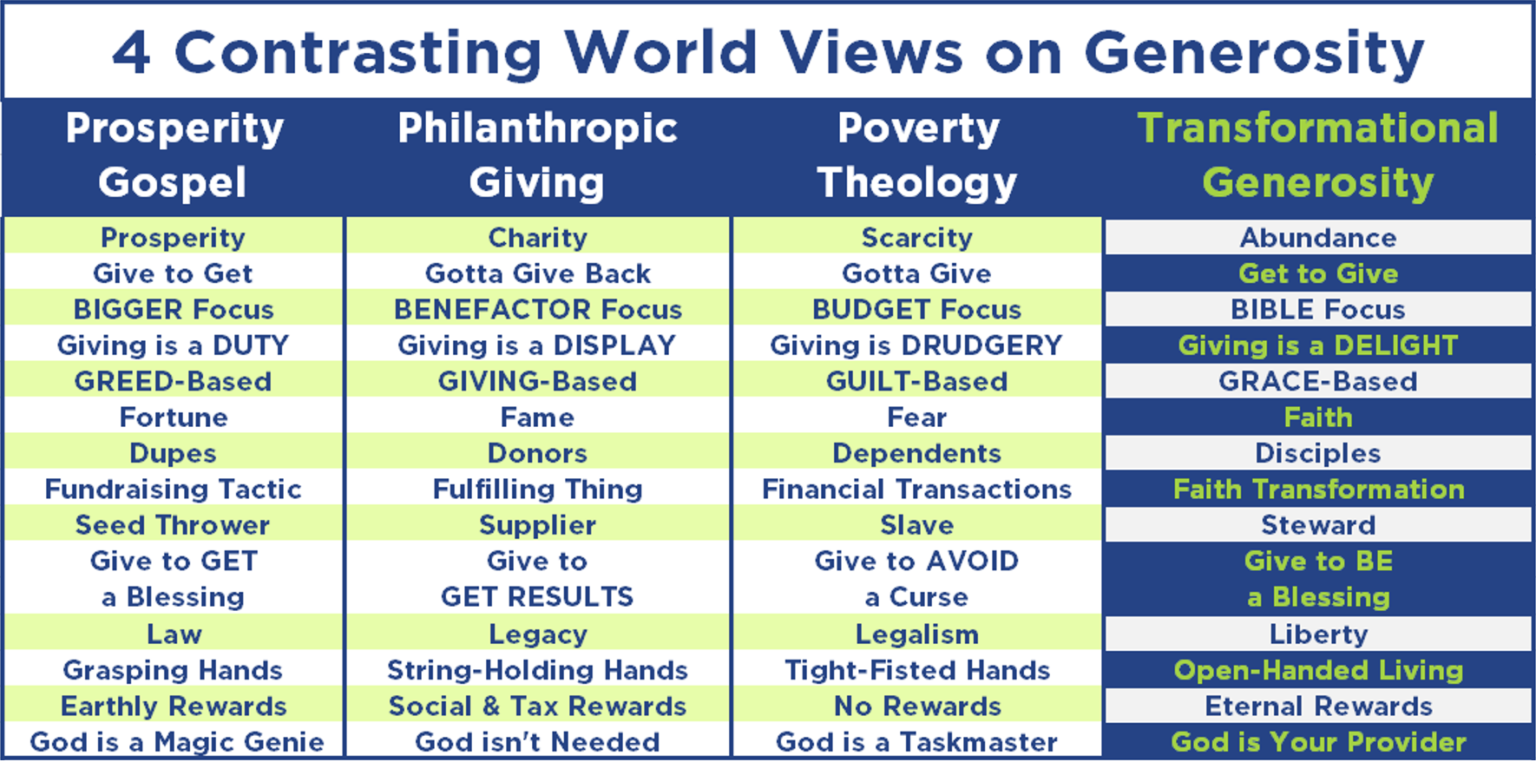
For the sake of the readers of this white paper, I have identified and contrasted four generosity world views in the chart below. Please carefully read through these contrasting views to see which views you notice operating among people you know, in the Christian world around you, and in our larger society. I would then like to share with you 10 Ways Christians Learn to Be Generous with transferable and proven models, methods, and materials to better understand and unleash Transformational Biblical Generosity for Christians, churches, communities, and countries

Hopefully, you found the above graph insightful and helpful in recognizing the four generosity views that operate in our world and among people and leaders that you know.

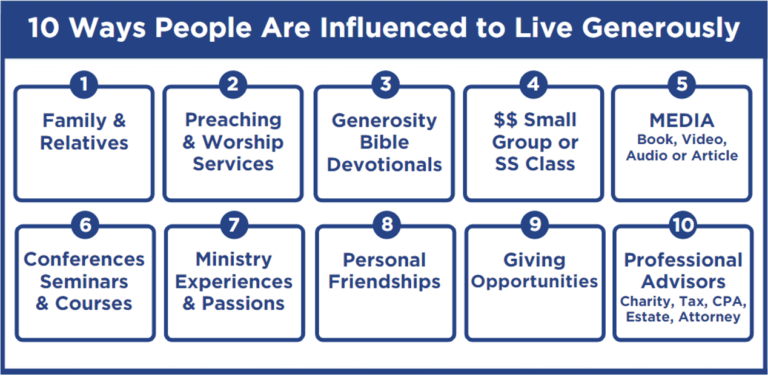
10 Ways People Are Influenced to Live Generously

Now, let’s move on to how people learn to become generous. The fact is that no one is born generous when it comes to giving to God’s work. Joyful and faithful biblical giving and living is something that has to be taught and caught as part of people’s faith journeys to be all that God created them to be. Based on my experiences teaching, writing, and researching on generosity for many years, here is the link to the 5-minute training/discussion video to help you and others understand the top 10 ways people learn to become generous.

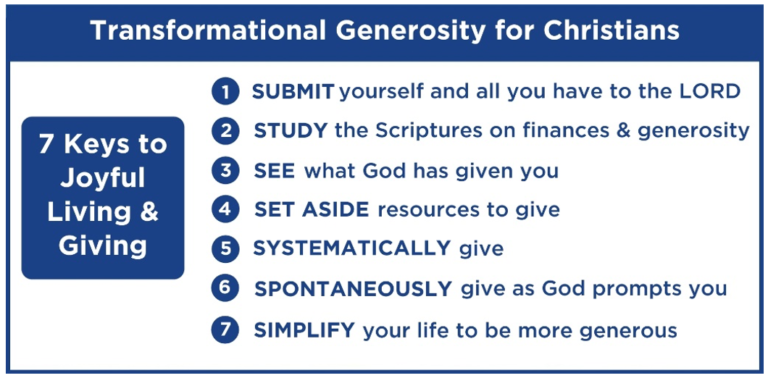
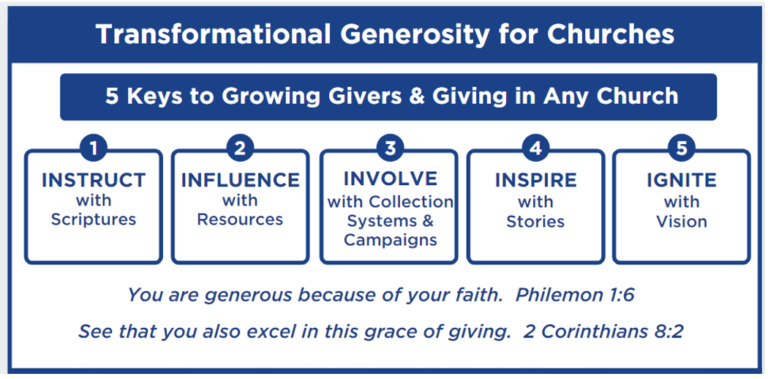
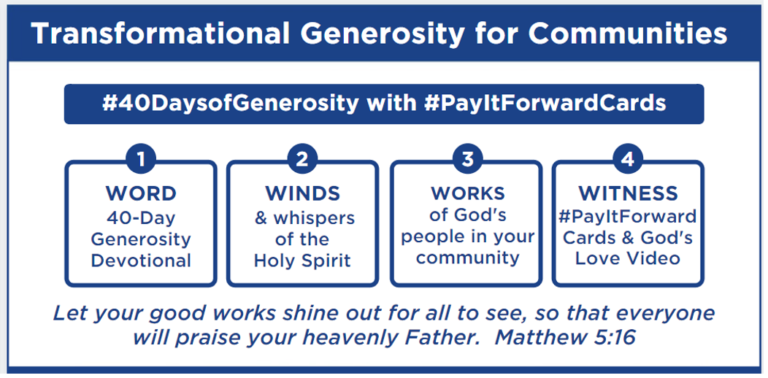
Now, let me share with you three slides to help you understand how Transformational Biblical Generositycan work among Christians of all income levels, churches of all sizes, and communities and countries anywhere in the world.

Transformational Generosity for Christians

A number of years ago, I was privileged to participate in several Lausanne Committee for World Evangelization (LCWE) meetings in Atlanta with other global leaders. During these meetings, we were trying to address the need for a generosity movement that would grow and spread across the world. The group grappled with what would need to happen to unleash biblical generosity among those they led and served. Because of my ministry travels to over 50 countries and my writing of biblical generosity materials for leaders in over 100 countries, I was especially seeking the LORD for, “What are the attributes of a generous person anywhere on planet earth?” What would be 100% true about a generous person living on $1/day in the slums of Asia, living in a small rural village in Africa, living in the suburbs of America, or living in a world class city and making millions of dollars a year? Through much prayer and group discussions, I eventually created the 7 Keys to Joyful Living & Giving teaching slide and a 7-Keys to Open-Handed Living in a Tight Fisted World 30-Day Bible devotional and free app (go to your app store and search for “joyfulgiving”). Hopefully, in this list of these seven key milestones, you will see what God did in your own faith journey to ignite in you the desire to live and give generously. Here is a link to the 8-minute training/discussion video on this topic for a grant-funded 6-session Church Generosity online course I helped develop for church leaders.

Transformational Generosity for Churches

For the past four decades, God has allowed me to help train and equip thousands of pastors and leaders in North America, Latin America, Europe, Russia, Asia, and Africa.  Through these experiences and many leadership conversations, I have discovered the five practices that will allow any church of any size anywhere in the world to grow givers and giving. By building on these practices, churches will be able to INSTRUCT people in God’s Word, IGNITE people’s faith, INSPIRE generosity, and INCREASE giving. Here is a link to the 5-minute training/discussion video that goes along with the Transformation Generosity for Churches teaching slide. As you watch the video and read each of the five practices, I trust God will inspire you on ways your church can unleash biblical transformational generosity that will bless families, your congregation, your community, and even the ends of the earth. Many churches have reported experiencing double and even triple-digit giving increases by following these practices that have proven to work in any church, country, or culture.

Transformational Generosity for Communities, Cities, and even Countries!

A number of years ago, I received a personal phone call from Hugh Macellan of the Macellan Foundation.  He asked if I could put together a list of Bible verses that encouraged people to live and give generously that he could share with others. So, I studied and identified 400 generosity Scriptures that I organized into a 40-Day Generosity Bible devotional. Over the years, God has used this simple 40-Day Journey to a More Generous Life Bible devotional around the world to changes people’s heads, hearts, hands, and habits when it comes to their generous giving and living. In America, thousands of churches have distributed this devotional to inspire generosity and increase giving. Around the world, the devotional has been translated into over 30 languages and been freely given out by churches on every continent.

Then, in Guatemala and in Florida, groups of churches decided to do #40DaysofGenerosity at the same time. In Guatemala, over 100 churches participated and greatly impacted communities across their country with God’s love through acts of generosity and charity. In Florida, I had the privilege of working with over 30 churches and many community groups to do #40DaysofGenerosity in the Titusville/North Brevard area. Through these initiatives, a free “givewithjoy” app was developed for Apple and Android phones along with #LoveInAction materials with #PayItForward cards and a GodsLoveforYou.com website. There are now discussions happening with leaders with MovementDay/GrandRapids and other cities, states, and countries about using the free open-source #40DaysofGenerosity customizable model, methods, and materials for their churches and communities. Here is a link to the 4-minute training/discussion video that helps provide more insights into the Transformational Generosity for Communities teaching slide. In addition, these links give insights on how God used #40DaysofGenerosity to transform lives in Guatemala and Florida.

It is my hope and prayer that these teaching models, methods, and materials instruct and inspire you personally. I also hope that the ideas presented here will help you spread biblical transformational generosity in your family, church, community, city, company, country, or culture!

Brian Kluth – Denver, Colororado

Understanding Calling and Being Obedient Leads to Shalom – Even as an Entrepreneur

by Michael Norman

Normal Beginnings

My parents’ best friends are loud, joke-telling, game-playing people; my parents are the opposite. We were the “normal Normans” growing up. If you have seen the movie My Big Fat Greek Wedding, my parents were the non-Greek parents. My dad worked hard in our family’s small business – my mom took care of three kids in a relatively small, sleepy central Texas town where not much happened. Very normal. I confessed Jesus as savior at a young age, went to church, and all in all had a nice upbringing. I excelled in school and athletics and was able to attend university at a small liberal arts college in Texas. It was great.  

Abnormal Beginnings

I can reflect now that God took me specifically to that school to launch my “abnormal” journey. My family came from humble origins and had no experience internationally, yet I was drawn to studying international relations and business. I met my wife early in my college experience and we dated and married before we finished our education. We were young. Her family was like the Greek family in the movie. They were fun and she was beautiful, had lived abroad and could speak French! Wow! Encouraged by my relationship with her, I studied abroad and my passion for God’s world and his people was ignited. But I didn’t have a view for how this growing passion could flow forth in my life, so I took a “safe” path and went to law school.

We moved cities and I started school. My wife was working in an industry she loved (study abroad) when the opportunity to start a company presented itself in the same industry. We were young and we jumped at the chance. We lived on student loans and small paychecks and life was good. I started practicing law as both my wife’s business and our passion for the nations grew as we got to interact with wonderful people around the world through her business.

Abnormal at Full Speed Ahead and Calling Whispered

I began practicing law in a corporate practice with some great lawyers. I learned how business works, how decisions are made in the corporate setting and participated in some exciting ventures. My wife’s company grew. We started having kids – we ultimately had five – and life felt full. It was “up and to the right” for us. My wife’s situation allowed us to do really gratifying things like travel with our kids for extended stretches. I left my corporate legal job and began being more entrepreneurial myself. I was working mostly on my own and we had flexibility. Our lives seemed charmed to the onlooker.

As you may have noted, until now I have not said much about my faith. “Up and to the right” can make it hard to see your need for dependence on Christ. I had a real faith, but it was confined to a traditional way of thinking about faith, family and work. Thankfully during this time, one of my good friends became involved in the “business as mission” movement. This was early in the 2000s when the BAM movement was originating. He asked me questions like, “how does your faith intersect with your work?” and “how does your faith show itself beyond Sunday activities?” God used these thoughts to grab my heart. I felt alignment in my spirit for the first time; a real calling to align my faith and my daily life in Kingdom of God expanding activities. By early 2008, I convinced my wife that I should leave my legal practice and start a company with a friend. We had some money saved and an idea that we believed could have global ramifications that we could use for God’s Kingdom and Glory. It was exciting. How could we fail?

Crash and Burn but Calling Obeyed

The financial crisis hit and our fledgling business never got off the ground. Then my wife left her day-to-day job in her company, and our income changed dramatically. Then we experienced deep tragedy in our family. Up and to the right was over. We then knew at a deeply visceral level how badly things could go. It was a painful and difficult time. Deep inside though, my business partner and I knew that we weren’t supposed to go back to “normal.” We knew we had a defined calling, so in mid-January 2009, he and I got on our knees in our little office and prayed for God to do something with our business for his Glory – we knew we were called, but didn’t have a clue which way to go.

Shalom

Doors began opening and people pulled us in some very unexpected directions. A new company was borne from that moment. It was a huge dream: we were going to develop a diagnostic test to solve one of the biggest unmet needs in global health. We saw firsthand what God’s favor meant as real miracles happened – my faith “box” was being enlarged almost daily. New colleagues encouraged us with how God had called them into a faith/business journey as well.

But it was also hard. We lived without salaries for several years and used up our savings. We learned and grew, but it was difficult for our spouses. (As an aside, my view is that my wife has a far more difficult calling than I do, as she gets to feel the pain, but often is not a part of the cool moments that happen along the way. She is a praying saint who is a rock for me.) We worked diligently and were successful at slowly raising the money needed to develop the product from a globally prominent group of investors and global health stakeholders. We were at the forefront of the global Christian impact movement and making good progress on our product. We were living out real answers to questions that my friend had asked me ten years before. It was so “abnormal” that my kids struggled (and still do) to say what their dad did for a job, but we felt that we were being obedient.

Then our clinical trial failed. Our stakeholders and investors said they wouldn’t fund any more work on our technology. We had to lay off our staff. Seven years in, it was over. I had lost our investors’ money – some of whom are reading this (and are still my friends) – and we didn’t solve the big health problem.

But shalom was not lost in this process. We had pain and sadness, but over the previous ten years, God taught me how to live shalom. It is not rooted in my performance or the financial success of my business, but in the obedience to God’s call on my life. That is the source of shalom. I sought to manage the business in a way that lived out God’s grip on my life. Though my investors did not like losing their money, they did not come to me with the question of “how did this happen?” or “what went wrong?” We had communicated well and been transparent. Life science innovation is risky. We were doing something that could fail, and it did; but we worked in a way that was still glorifying to God and we continued to press on from there.  

Some who backed us in our former company introduced us to our current company. I believe we are living out our calling through this new endeavor. I also believe we will succeed financially and that the learning we gained in the previous company has increased that chance. No matter what happens, I will strive to continue living shalom, because it is not dependent upon my financial success or how well I manage a company or whatever else may happen in my life, but rather on my daily obedience to God’s calling.

This is one of the 2020 CEF Whitepapers. For more information on the Christian Economic Forum, please visit their website here.

Unleashing $20 Trillion in Capital $1B at a Time

Article originally hosted and shared with permission by The Christian Economic Forum, a global network of leaders who join together to collaborate and introduce strategic ideas for the spread of God’s economic principles and the goodness of Jesus Christ. This article was from a collection of White Papers compiled for attendees of the CEF’s Global Event.
by Anonymous

We don’t have a resource issue in the Body of Christ—we have a heart issue. Although there are estimates that Christians hold $20–100 Trillion in wealth, starting with $20 Trillion seems to be an excellent place to start.  

What would happen if $20 Trillion held by Christians was unleashed in our cities as an expression of God’s grace? What would happen if marketplace leaders saw their businesses as their ministry and came together to pool their capital to invest in for-profit “impact investments” and scalable end-use ministries in their cities?  

Since reading The Treasure Principle by Randy Alcorn in 2000, I have been asking these questions of myself and others, not as an intellectual exercise or for debate but to explore and practice living out biblical investing, generosity, and wealth creation as an entrepreneur. One of my early mentors, Walt Henrichsen, would often express it by saying, “We all take risks in the direction of our hope. When you take risks in a particular direction, you identify where you have placed your hope.” Perhaps this is obvious to others, but eternal accountability and rewards were a powerful insight that radically changed how I thought of risk along with income and wealth creation. 

Having spent half my life living and working in China/Asia and half in the US, I have seen brothers and sisters in Christ taking bold risks in the direction of their hope in Christ in for-profit businesses and non-profits. However, I also noticed that these were almost always operating in isolation with practically no connectivity to others in their city, diminishing potential impact. Where I have seen collaboration, it has often been through those linked with CEF. Many of you reading this have already made significant progress in many of the most pressing challenges of our lifetime.  

In 2017, after my family and I returned to the US, I sensed from the Lord some questions: “What if we could unlock $1 Billion in capital in the city of Columbus (and 10, 20, or 100 other cities) that would be invested in for-profit impact investments and strategic scalable ministries dealing with the biggest problems in our city? Would we be willing to take the risk and see if God could provide a 10-20-50 or 100x return in this life and the next?”

Over the last five years, we discovered 6 phases for initial steps to unlocking this capital in our city. These phases are not exhaustive or prescriptive and will undoubtedly change by this time next year. However, we are attempting to establish principles that can be easily communicated and given away to other cities. Many within the CEF community have already been practicing similar types of approaches and hope there can be a common language and encouragement to do this at scale.   

Phase 1:  Dealing with the Knowledge Issue of God’s Kingdom Economy

Over the last ten years, we have been blessed to see incredible works to bring together resources, stories, and research that provide more than enough content to give a clear biblical picture of God’s economic system. The content makes it clear that we are stewards, not owners. Here are some excellent resources to reframe how Christians should be thinking and living as it relates to stewardship and God’s economy: Faith Driven Investor and FDE, Crown Ministries, CEF, Tim Keller’s sermons and books, Kingdom Economics (Brett Johnson), Practicing the King’s Economy (Fikkert, Holt, and Rhodes), and Money, Possessions & Eternity (Randy Alcorn).

To compliment this, we need more of the incredible practical stories of Christians who have discovered these principles and put them to work in their businesses and personal lives. These stories can encourage and give models that others can use to live out their stewardship.  

Phase 2:  Necessity of Opportunities to Communicate Kingdom Economic Principles to Broad Audiences

Marketplace leaders need to create opportunities for broad-based discussions/meetings/talks on generosity and impact investing and leverage our capital as Christians for the good of our cities. These can be larger audiences in the hundreds to smaller 40–50 person events. However, the focus should be broader to identify those who resonate with the message and are ready to go deeper in both the knowledge and practice of the principles.  

We have found that marketplace leaders are drawn by the idea of using their talents and accumulated resources to impact their community for Christ. They are attracted by the ideas of impact investing and working with others to leverage resources to impact their city for Christ.  

In Columbus, we have used a combination of approaches for broader gatherings. In some cases, we utilize those in our city to give testimony on their journey and the practice of these principles. We also bring in national thought leaders to expand our thinking and application. 

This broader sowing approach leads to marketplace leaders selecting a more intentional phase of learning and practicing.  

Phase 3:  Initiating “Investing in the Eternal Kingdom Cells” of 10–25 people 

We all realize most marketplace leaders do not need another meeting or Bible study to attend. However, to have an impact, we must create a compelling opportunity for leaders to come together to share Christ in the context of these Kingdom economic principles. We must move beyond concepts to the heart issues that prevent practical applications in our businesses and companies. Here are some basic principles we established:

  • There needs to be trust built and absolute secrecy on what is discussed, so we are free to share. 

  • Only marketplace leaders are to be a part of a group, and we are not to use the group to solicit from one another.  

  • There is no lecture/sermon. Instead, content and principles are facilitated each week, and the expectation is that the Spirit is leading us and everyone contributes as the Lord leads them. Sharing our lives with one another is foundational to the trust created.  

  • Although the meetings are 1 hour, most members are organically integrated into each other’s lives weekly. In addition, many are on Boards and part of strategic end-use ministries in the city.  

  • The content always returns to God’s economy vs. the world’s system. We deep dive to understand and see how our decisions are influenced and encourage one another to remain operating by the Spirit in God’s system.    

After 2+ years of being together, we felt compelled to take things to the next level of intentionality.  

Phase 4:  Holding “City Reaching Generosity Evenings” 2–3 Times per Year

Although many of us were doing impact investing projects together and supported various end-use ministries in our city, we sensed another level of intentionality we could pursue. In February of 2021, we did our first “Generosity Evening.” We committed to the following:

  • Each person would pray in advance of the evening “how much” they sensed the Lord wanted them to give. The amount was to be over and above already committed giving.  

  • Each person was to pray in advance about one end-use ministry in the city that the Lord would want to be considered as part of the evening. The intent was that the ministry was dealing with one of the significant issues facing our city and was doing it well.  

  • Upon arrival, after a time of prayer, everyone confidentially wrote down the number the Lord had led them to give. Those were put in a bowl and tallied anonymously.  

  • Each person then gave a concise summary of the ministry the Lord had laid on their heart. No persuasion. 

  • After a few minutes, we returned to a time of prayer, asking the Lord to give us a unanimous leading of the Spirit on which ministry/ministries were to be selected. Again, no discussion, just prayer until the Lord confirmed three ministries to be funded.

  • We then repeated the process of prayer and discernment until we also confirmed the amounts to be given to each. Spirit-led, not an extended open discussion. We joyfully concluded this process in about 90–120 minutes.

  • We then enjoyed an incredible meal, sharing what the Lord revealed to us during this time and asking, “When can we do this again?”  

  • All monies were distributed to the various ministries through a confidential vehicle set up through NCF. Therefore, this group can practice Matthew 6 principles of giving with confidentiality. Also, we do not know the amount others have given to protect against comparison.  

On the first evening, $300,000 was raised and distributed by seven people. The 2nd session, approximately a year later, had 14 participants with more than $1,200,000 raised for six ministries. The 2nd session saw such an incredible movement of the Holy Spirit, and the evening was filled with tears, laughter, and joy at how the Lord moved us together. It was a beautiful evening of worship and fellowship in the Spirit.  We all recognized the $ amount was not important, but the responding to the movement of the Holy Spirit that evening was an act of obedience we experienced together.   

We are now beginning to see the pathway to unlocking and unleashing $1B in capital for our city. We are seeing that by giving not only from income but also from wealth the Lord has entrusted to us via companies, real estate, and other vehicles, we can scale quickly to $1B. For example, if each Kingdom Cell has the capacity to unlock $10–50M in capital, then we would only need 50–100 Cells in a city to reach this first target.   

Phase 5:  Establishing “Stewardship Accountability Teams” of 3 People

Most Christians have never thought of putting themselves into an accountability relationship related to the stewardship of the resources entrusted to them. It is generally off-limits. As a subset of our Kingdom Cell weekly gatherings, we have established stewardship accountability teams where we mutually submit to one another on our stewardship of time, talent, treasure, and relationships. This cooperation involves an open-book approach to our resources and requests for feedback on where we are in the process. These teams intend to encourage going to the next level of living out the principles of the Kingdom economy.  

This 5th phase can begin at any point, but I have listed it in this order as it was how it organically happened for us.  

Phase 6: Launching a “5 Talents Collective” (or whatever you want to call it) in Your City

We desire to see deep spiritual integration and impact in our businesses and our communities. Such integration will require a group of leaders and their families willing to mutually and humbly submit to one another and set aside personal agendas, fears, and limits on God’s ability to produce the results He wants. It has to be about the process, not the $ amount deployed. It will require tremendous mutual trust and commitment up front never to break relationships over money. We all have seen too many situations of professing Christians cheating, suing each other, and breaking relationships over money, power, and who gets the credit. It is heartbreaking to us, and I can only imagine how heartbreaking it is to the Lord.  

The following are some examples of what this might look like in a city:

  1. Kingdom Cells commit to “Generosity Evenings” 1–3 times per year to keep the practice of giving together consistently.  

  2. Existing Kingdom Cells commit to disciple others to launch their Cells within their sphere of influence. Repeat this process with the hopes of 100 groups across a city. 

  3. Commit to giving from wealth, not just income. This commitment can be the equity in your business, your own real estate, equities, and other assets you manage. How each person expresses this cannot be mandated, but it should be encouraged to think differently about leveraging what has been entrusted to us as 5 Talent people. NCF, Commonwealth, and the Impact Foundation are excellent resources to do this effectively.  

  4. From the wealth and income you have committed to give, determine how much you would give as part of a city-wide collective that seeks to solve one or more of the big problems in your city. Collective giving can be far more powerful and scalable than individual giving. Unfortunately, what prevents such giving is usually fear, pride, and control.  

  5. Commit to taking a portion of your portfolio for impact investing with others. There are a tremendous number of companies seeking investment from impact investors. Our capital has influence, and we must be shrewd in leveraging capital for Kingdom-focused investing. Suppose we can invest 1 dollar that returns 5 dollars, and the business is spiritually integrated. In that case, this is an incredibly clever way to increase our influence in our cities and generate more sustainable capital for end-use ministries and more impact investment opportunities.  

  6. Practice principles of “gleaning” and “jubilee” in your business, should you have one. Adapting these principles includes how you pay, the type of healthcare, and even the willingness to give ownership of your business to those contributing to the company’s value creation. Modeling principles of abundance to those in your company is an expression of the Gospel. I have had the privilege of practicing this with my business in China/Asia and our COhatch business in the US.  

  7. As your 5 Talent Collective takes shape by the Lord’s leadership, you can identify the worst zip code in the city. You can discern the most acutely felt spiritual need in the city and decide to allocate the collective resources (time, talent, treasure, and relationships) to take on this need in your city. Principles of collaboration and mutual submission bathed in prayer will be foundations for light to be brought to the darkest places of our cities.   

We can now see a Spirit led path to $1B being activated in our city and $20 Trillion globally.

  1. 50+ Kingdom Cell groups on average unlocking $20M each in aggregated capital to be deployed 

  2. The $20M is a result of families giving from their wealth creation, not just income. If 20 families are in each Kingdom Cell, then it is $1M average per family that is unlocked.  

  3. 1000 families unlocking on average $1 million each to reach $1B in the city  

  4. 20,000,000 families unlocking on average $1 million each to reach $20 Trillion globally

Conclusion

We have been blessed in Columbus to be a part of the initial stages of what appears to be a global movement of the Holy Spirit to inspire like-minded marketplace leaders that want to take responsibility for their role in the Body of Christ. The Body of Christ has the resources to meet the needs of our cities. Jesus waits for His Body to love our neighbors and become the fullest expression of the Church that God has intended since eternity past.  

Are we prepared to count the cost and take the risk?  

Are we willing to risk temporal resources for eternal rewards?  

Are we willing to put relationships before money?  

Are we willing to leverage our resources together, trusting God for the results?

Imagine millions of Christians globally leveraging their resources to love their neighbor.  

Imagine billions of dollars in every city deployed to serve one another as an expression of God’s grace that has been extended to us.  

Imagine $20 Trillion globally unleashed to serve our cities, as the Body of Christ demonstrates in whom we really trust!  

My hope and prayers are to see this in our lifetime!